Thursday, 23 November 2017

15 Things You Should Know About Location-Based Advertising

forbes.com
As the name implies, location-based advertising means creating highly customized and targeted marketing efforts tailored to consumers in a specific place. While it's not a new concept (neighborhood-based direct mail campaigns came about long before the internet age), geo-targeting and GPS-enabled mobile devices have made it easier than ever for brands to learn where their customers are and when to reach out to them for maximum effectiveness.
Modern location-based marketing tactics like text messages and app push notifications triggered by certain actions (entering a store, making a purchase, etc.) can help tremendously in engaging and retaining customers. But you can't just start sending texts to everyone who interacts with your brand: You need to do your homework and implement a carefully-crafted strategy to get the most out of local ad campaigns.
Fifteen members of the Forbes Agency Council offered one key fact all brands should know about location-based advertising before you get started.
Images courtesy of FAC members.
Members of the Forbes Agency Council offer their tips on location-based advertising.

1. Local Businesses Can Use It To Compete With Big Brands
Many local businesses often fear that the hurdle is too great when it comes to competing with nationally known brands. What business owners need to understand is that Google has given the advantage to local business owners by engaging in the most immediate of all audiences, which, many times, aren’t reached at a personal level by huge brands.   - Charles KimExecutive Digital 
2. It's Highly Personalized And Measurable
Mobile advertising can be dynamic and personalized, based on a consumer's previous shopping behavior, apps downloaded, specific location and even external factors such as weather, sales inventory or sports scores. Further, brands can track exposure to a mobile ad or even a billboard to see whether ads had any impact on store foot-traffic based on a control and exposed group.   - Jeff TanDentsu Aegis Network 
3. You Need To Know Your Target Audience
Knowing and understanding your ideal customer will be a big help with location-based advertising. You don't want to just throw everything on the wall and see what sticks. Strategize and hone in on who you serve.   - Aisha MartinA. Martin Group 
4. It Can Deepen Your Connection With Customers
Think of location-based advertising as an opportunity to deepen your connection with your target audiences. Providing content that is specific to their circumstances shows that you are knowledgeable about where they live and their needs, which can foster trust and help them feel more connected to your business.   - Megan ShroyApproach Marketing 
5. It Should Complement Your Other Marketing Strategies
Location-based targeting should be complementary, not a focus. The moment a consumer leaves that location, the message will get lost. It is important to capture audiences, followers and emails from the location-based consumers, and then use that data to push retargeting ads, newsletters and general brand awareness campaigns to increase the ROI on your location-based ad spend.   - Omar JenblatBusySeed 

6. Timing Is Everything
Since location-based advertising is so personalized and tethered to specific audience member locations and behavior, brands can reach people when purchases are accessible and convenient. This greatly increases your brand visibility and you can target audience members who will be more likely to purchase from your business.   - Kristopher JonesLSEO.com 
7. It Can Help You Measure Offline Results
Most advertisers focus on how they can use different location tools to target ads, but the real value comes from using beacons, Wi-Fi and store visits in Google to measure and understand the offline effect of digital advertising. Being able to attribute offline results with digital efforts allows brands to build on successes and adjust when the results simply aren’t there.   - Dan GoldenBe Found Online
8. You Need A Good Strategy For Tracking Results
The tricky part of any location-based advertising is the ability to align promotion with success measurement. How do you associate a local ad with in-store traffic and, even further, in-store purchases? Coupons help and specific redemption codes are ideal, but depending on your business model, this approach may have a lot of holes (i.e., are you solely dependent on your store clerk's discipline to track a campaign?).   - Jon ClarkFuze SEO, LLC 
9. A Call To Action Will Bring Customers In
If you are doing location-based advertising, you need a really solid call to action to drive the user to your store or make the purchase. Don't just advertise something generic, but rather a key difference that will finalize the sale.   - Peter BoydPaperStreet Web Design 

10. You Can Use Multiple Platforms
When it comes to location-based advertising, there's no exclusive platform out there that you have to use. Google AdWords, Facebook, Bing, Instagram, display ads, programmatic online radio, LinkedIn ads and more can all be location-targeted within a one-mile radius or less of your desired location. Use multiple ad platforms to have maximum impact.   - Jordon MeyerGranular 
11. Getting Too Personal Will Scare Consumers Away
Location-based advertising is powerful, but also intimidating to many consumers. When using location-based advertising, you should make an effort to draw in prospects without getting too personal or giving them a “Big Brother” feeling. Opt-out options and low-risk offers are a must.   - Jon SimpsonCriterion.B 
12. It's Reliant On Targeted Consumer Insights
When it comes to location-based advertising, we must acknowledge that the days of generic out-of-home ads and commercials are gone. We've shifted toward a hyperlocal and intimate approach to actually reach consumers in a cluttered landscape. Ultimately, you have to be spot-on with your insights, because your creative and copy for ads are directly generated by the insights of the location's consumers.   - Coltrane CurtisTeam Epiphany 
13. You Must Consider Context And Intent
Marketers should consider context and intent when thinking through their location-based advertising strategy. While CPG and retail advertising near a shopping mall would generally align with a consumer's mindset, healthcare messaging near a hospital should be approached more carefully.   - Nina HaleNina Hale, Inc 

14. It Should Provide Value Above All Else
Good marketing is useful, contextual and relevant for the audience. Location-based advertising is a great tool that should be wielded thoughtfully with the end result of passing value back to the consumer. It's not enough to just stalk someone online; location-based marketing should still be relevant and ultimately useful.   - Shannon WuMr. Progress
15. You Need To Stay Relevant For It To Work
If you can't be relevant locally, then you can't advertise to your target audience. It's also about being there at the right time, being extremely relevant to consumer's needs and to the right group of consumers. Gather some analysis to effectively understand your consumers' behavior.   - Solomon ThimothyOneIMS 

Tuesday, 21 November 2017

The state of interactive advertising: New formats are infusing digital ads with creativity that gets results

marketingland.com

With the rise of mobile usage, brands have been challenged to figure out how to do more with less screen real estate and shorter attention spans.
Thanks to a combination of new technologies, more powerful mobile devices and a drive to blast through banner blindness, a new level of creativity is coming to mobile advertising as interactive ads are finally coming into their own.
A number of companies are on the forefront of interactive ads — also called engagement or immersive ads. These companies are rethinking the standard banner, using 360-degree video, augmented reality (AR) and virtual reality (VR) in advertising experiences that aim to get users engaging with ads beyond just clicking through to go to a website or download an app.
It’s not just for the sake of creativity. These companies and the brands they work with will tell you the results they’re seeing from re-imagining what digital ads prove that interactivity will only continue to gain traction.
“Interactive ads are a way to spend more valuable time with consumers,” says Kara Manatt, SVP, audience intelligence and strategy at IPG Mediabrands’ MAGNA agency. Manatt leads a research team that tests new ad formats and strategies. This year, the team conducted a large-scale test of interactive ads with four major brands in different industries.
“In general, brands are receptive to interactive ads. Most of us know that given most screens are touchable … interactive ads are the future,” says Manatt. “People expect to be able to interact with their screens, so why shouldn’t ads do that.”
Here’s a look at some of the real-world use cases and campaigns using interactive ad formats, beyond what the major platforms offer (e.g., Snapchat 3-D world lenses, Facebook canvas ads and its new effort in web-based VR, 360 experiences, Google lightbox and trial run ads).

Next-level display ads

Mobile and the use of rich interactive media has opened up new creative opportunities for display ads.
Working with New York-based PadSquad, Timberland ran a “coloring book” ad featuring a Nas video and cartoon (see the demo on mobile here). The ad features a Nas video that plays with the sound off and invites users to color and bring the cartoon to life (mobile demo).
In fewer than 40 days, the ad had accrued 59 days of video play time, with over 50 percent of video starts getting completed and more than 200,000 engagements, including coloring and click-throughs, says Padsquad.
“Units just really haven’t changed much over the years from rectangle and squares. There’s a low bar. We try to challenge brands to do things differently,” says Meehan. The mobile-only company works with clients on ideation, design and development for free and charges for media, says PadSquad CEO Daniel Meehan.

Timberland’s interactive ad from Padsquad features an image users can color and a video featuring Nas.
London-based mobile video platform LoopMe also added a coloring dimension to an ad for Yorkshire Tea featuring the storybook character the Gruffalo to promote the brand’s pledge to plant 1 million trees over five years. Users could select colors from a palate and share their finished product on social media.
The company says brand awareness was 97 percent higher among those exposed to the ad versus an unexposed control group. Perception of Yorkshire Tea as an environmentally friendly brand increased 39 percent among those exposed to the ad.

Yorkshire Tea’s ad campaign let users color in and share a picture of storybook character the Gruffalo.
Other PadSquad interactive mobile display formats, including the title lookbook unit that flips through “pages” of an ad with a slight tilt of the user’s phone — no swiping or scrolling required. DSW used the format (mobile demo) for a spring promotion.

360-degree video is filling in for VR

“TV is moving to video, and mobile is where consumer activity is happening,” says Stephen Upstone, CEO and co-founder of LoopMe. Upstone says LoopMe, which recently expanded to the US, reaches some 2 billion devices globally. The firm focuses primarily on mobile video and putting video in rich media ads.
LoopMe’s Purchase Loop platform uses artificial intelligence to optimize campaigns for brand lift based on the outcome a brand wants to achieve.
“For example, a quick-serve restaurant wants to be viewed as a coffee destination,” suggests Upstone. “We can determine which video formats actually caused the consumer to change their mind about the brand or come to the desired outcome. It gives us an interesting view into what’s working.” Upstone says that in addition to brand metrics, “you can also trace the effectiveness of these ads to store visits, new car sales, etc.”
Some examples of 360 video campaigns powered by LoopMe:
  • The North Face ran a 360-degree gyroscope ad that tied in with weather data.
  • A Honda ad got users’ phones to vibrate when a car engine starts up. The company also used 360 video to let users experience the inside of the car.
  • A Norwegian Air campaign allowed users to click on locations they’re interested in and then to experience those locations.
Mountain Dew and its agency, OMD, used Immersv’s mobile 360 and VR marketing platform for an ad campaign promoting the VR experience, “The Professor Presents: #GotHandles.” The campaign delivered 63 percent video completion rates and 22 percent post-video click-through rates. The 360-degree trailer (shown below) promoted the VR experience on Immersv’s network of mobile 360 and VR app publishers and directed them to download the VR experience.
OmniVirt powers 360 VR ads on publisher sites, starting with an ad for GE that appeared on the The New York Times’s mobile site in July 2016. The platform can distribute 360 VR ads in standard units on publisher sites and apps, as well as in social networks like Snapchat and Twitter.
Last year, Outlyer Technologies launched its Advrtas platform and interactive 360 VR ads that employ its patent-pending Panamorphic technology. The company also creates VR and AR ads, but saw Panamorphic units as a way “to get people excited today and then learn from that and extend to platforms as more users come online,” Robert Bruza, CEO of Outlyer, told me last spring.

The units have a VR mode for viewing in headsets but also work on the web. Users have 360-degree navigation throughout a visual environment that can also include 3D or 2D computer-generated elements, photos or graphics and transactional calls to action in the ads. Users can click interactive hotspots to explore different aspects of the environment.


In this example of a 360 VR ad from Advrtas, calls to action surface as the user tours the areas of a resort.
“Video is the linchpin behind interactivity,” says PadSquad’s Meehan. The company launched an interscroller ad format called Vvital that can incorporate 360, shoppable icons, a swipeable product gallery, store locator, interactive cue cards and other interactive features.
“Many clients had been doing pre-roll and some had tested Snapchat,” said Meehan, “but for many, it was the first time to run vertical video that wasn’t placed ahead of other video content.”
ABC used the Vvital format to promote its TGIT (Thank God It’s Thursday) suite of shows (mobile demo). Meehan says in the short flight of just 11 days, the ad vertical drove more than 775,000 engagements and 239 days of total video play time.

Augmented Reality has come to the web

Upstone says their research has shown advertisers get more impact when they combine video and rich media formats. These formats will soon be more mainstream, says Upstone. “It’s going to become more commonplace. Consumers are very happy to adapt photos and videos with AR on social. Snapchat, Samsung and Facebook are helping push that.”
While VR advertising is still in its infancy, AR is rapidly gaining traction, in part because the format doesn’t depend on delivery via a headset. Also because of Snapchat. Snapchat is now running AR campaigns regularly on its platform. But AR is poised to extend well beyond Snapchat to the mobile web and other apps. Google and Apple, with ARCore and ARkit respectively, are offering developers tools to create AR experiences more easily.
For Santa Monica, California-based Vertebrae, Apple’s iOS 11 created the opportunity to open the camera onto the ad itself and use facial recognition to provide an AR experience from an ad, and at scale.
Vertebrae launched a suite of AR ad formats last month that can run on Android 5.0 and up, “but having iPhone in the game is really impactful,” says CEO Vince Cacace of the company’s AR efforts. “iOS users are more likely to engage, and we see higher camera open/allow rates than on Android.”
Vertebrae’s AR ad units work on the mobile web in Chrome and Safari. “The problem historically has been, if you’re Golden Grahams, for example, and want to have AR-triggered promotion on the box of cereal, you probably don’t have an app and don’t want to make consumers download one. Now we can build AR ad experiences over the web.”
The company offers five web AR ad templates: Virtual Try On (see how accessories look on you), Dynamic Experience Mask (facial recognition), Interior World View (inside 360 image/video), Interactive 3D Object, a Portal, and swipeable static branded filters — with plans for several more.


“Brands are going to be doing ads on Facebook and Snapchat, and we should be able to offer this on the mobile web,” said Cacace of the company’s AR efforts. “We create the assets — advertisers can also use them on Facebook and Snapchat — and we serve them through our own platform on the mobile web.”
Cacace says they are just beginning to figure out the best use cases and measurement. “On the AR side, you have all this standard data, but also all this new information from the AR experience. For instance, camera events data — in the ad for trying on Ray-Ban sunglasses, you can see which models got tried on most, for the longest and how users engaged.”
San Francisco-based VR ad network OmniVirt also offers AR and 360 video ad experiences on the web.

In September, Tel Aviv-based in-app advertising platform IronSource launched what it says is the first AR ad format to promote high-end mobile games that often use 3D (known in the industry as AAA games for their high development quality). The AR ad format was developed by IronSource’s Playworks Studio when Apple’s ARKit was still in beta. The ads use 3D assets from the original game and can run in iOS and Android apps.
IronSource AR ads superimpose in-game characters and scenarios from the advertised game onto the user’s real-world environment. “Users will be able to vanquish monsters, earn points or step into the virtual world of the game, before being prompted to install the app to continue playing,” the company said in a statement.

Virtual Reality is still in its infancy

It’s still very early days for VR content, let alone VR advertising. Most of the advertising that does exist still promotes other VR apps
USA Today’s in-house studio, GET Creative, has developed true VR and 360 VR branded stories for several advertisers, including a 360 VR campaign for True Michigan and a VR campaign for Honda.
The group is also working on creating a native VR ad format it’s calling a cubemercial that puts viewers inside a room in which brands can show products and videos on each of the walls. Google is also working on a cube-like VR ad format.

Engagement through personalization

“Advertising has always been about awareness. The only thing that’s changed is new channels,” said Eric Frankel, CEO and co-founder of personalization platform AdGreetz. “The future is ‘activation’ — hyper-relevant, data-driven personalized videos. The best way to activate people is to treat people in a personalized, hyper-relevant manner.”
AdGreetz is taking a bit of a different approach to driving engagement. The company develops and distributes hyper-personalized ads at scale across online and offline channels, including web, in-app, social networks, email outdoor and more.
Users can log in to Facebook or type their name to see a personalized video from West Elm.

Interactive in-app & App install ads

Mobile advertising platform Leadbolt launched its version of a playable app install ad format last month that lets users test out an app before downloading it. The company says the playable ads averaged double the click-through rates and 4x improvement in conversion rate when compared to static interstitials.
Tapjoy, which specializes in in-game rewarded ads, recently launched an interactive end card for its inter-play ads. In its debut application, 20th Century Fox used the ad format to promote the film, “War for the Planet of the Apes.”
After the movie trailer, an interactive slider appears, allowing users to swipe up or down to see images and descriptions of the film’s characters, followed by the option to click out to Fandango to purchase tickets to the movie.
IronSource is launching what it calls 4D Interactive Ads this month. The ads layer interactivity on top of video content and feature interactive “choose your own adventure” journeys, taking users through various scenarios within the ad. The ads change as users make their choices and answer specific questions. Audience preference and behavior data gets funneled back to the advertisers to help them better understand their customers and prospects.

The barrier to entry in interactive is getting lower

MAGNA’s Manatt says that while some brands worried about the investment needed to create interactive ads, the agency found that they could make effective interactive ads with existing assets. “You can take existing video and make it more effective with interactivity. It’s probably going to be even more effective with new assets, but we proved it’s possible with existing assets.”
“One key angle for us was time and attention — how can we get consumers’ time?” said Manatt of the agency’s recent study. “Could interactivity turn a 15-second video into a longer user experience and drive brand KPIs? We found the average interactive ad meant 47 percent more time with consumers.”

How should you start the process of mobile app development?

searchmobilecomputing.techtarget.com
IT teams must go into the mobile app development process with a strong plan for implementation. Know which tools and types of apps work best for the organization ahead of time

Organizations that plan to implement a custom application face a number of decisions about how to build the app.
Before diving into the process of mobile app development, IT teams and developers must first decide what type of app to develop and deploy based on user needs. IT must also decide whether the app should run on Apple iOS devices, Google Android devices or both; they might also want to support Microsoft Windows devices or even BlackBerry devices.
Many IT teams deploying mobile apps are now turning to mobile backend as a service (MBaaS) for their infrastructure needs. MBaaS decouples front-end development from the back-end systems. Effective MBaaS provides the services necessary to support apps throughout their lifecycles, as well as for integrating with other systems and managing security and synchronization. As with other services, however, IT must ensure that MBaaS can integrate with its existing systems and support operational workflows, without interfering with desktop and application management.
Another consideration in the process of mobile app development is whether to build native, web or hybrid apps. Native, built-from-scratch apps generally perform better than other app types and can take full advantage of the device's built-in features. Native apps are more difficult and costly to build, however, because developers must create a version of the app for each supported platform, often having to learn new languages and systems in the process.
Web apps are much simpler to build. They're based on open standard technologies, such as HTML5, CSS and JavaScript. As a result, they can run on any device with an HTML5-enabled browser, making them much cheaper and quicker to implement and maintain than native apps.
An IT team should take into account their users and the app's purpose.
The hybrid app falls somewhere between the two. It uses open standard technologies like web apps, but can take greater advantage of a device's native features. The hybrid app uses the same core code for all platforms, but for each platform, the code is wrapped in a platform-specific shell. This makes it possible to access many of the device's native capabilities.
As part of the overall process of mobile app development, an IT team should take into account their users and the app's purpose. For example, they might want to invest more in customer-facing apps than those used only internally. If a web or hybrid app can provide the functionality necessary to support the workflow, there is no need to invest in a native app.
Lastly, IT teams and developers might also consider tools such as mobile application development platforms (MADPs) or rapid mobile application development (RMAD) services to accelerate the process of mobile app development. MADPs and RMAD tools offer end-to-end software for building, deploying and managing apps. For an organization to use these tools effectively, however, it must provide the ability to easily integrate the apps into existing systems.

Monday, 20 November 2017

Here's How Mobile App Publishers Are Defending Against Ad Fraud

emarketer.com

Blueprint includes a mix of rule-based and statistical methods

The digital ad industry has had something of a rough year, with concerns emerging—and re-emerging—about brand safety, ad transparency, viewability and fraud.
A new report by Singular examines some of the top methods used by fraudsters to manipulate the mobile ad ecosystem, as well as some effective defenses against such efforts.
The report broke down fraud into two main categories. One is fake users, in which dishonest players rely on a mix of bots, malware and install farms to generate activity by means other than real people. Some techniques in this category include install farms that rely on humans to install and interact with apps to generate the appearance of a large audience and mobile device emulators that mimic the effect a large number of real mobile devices might have.
According to Singular’s breakdown, the second category of mobile ad fraud is attribution manipulation, in which fraudulent clicks are sent to an attribution record system, thereby falsely taking credit for an engagement—and gaming last-click attribution models in the process.
This can include click injection—when fraudulent apps are downloaded by users and generate fake clicks to take credit for the installation of other apps. It also includes click spamming, when a fraudster uses real, but appropriated, mobile IDs to send out a host of fake click reports. When a real user with that ID organically installs an app, the fake click will get the credit.
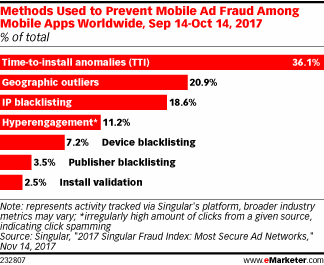
Methods Used to Prevent Mobile Ad Fraud Among Mobile Apps Worldwide, Sep 14-Oct 14, 2017 (% of total)
But those running mobile campaigns can rely on a few different types of fraud prevention using both rule-based and statistical methods. Singular’s analysis of its mobile app network worldwide from September 14 to October 14, 2017, found that time-to-install (TTI) anomalies were used to prevent 36.1% of mobile ad fraud, followed by geographic outliers (20.9%) and IP blacklisting (18.6%).
TTI anomalies are fraudulent traffic identified using a statistical analysis to reveal abnormal behavior that correlates to click spamming, while geographic outliers identify a large distance between the location of a click and the corresponding app download. Meanwhile, IP blacklisting identifies IP addresses that don’t belong to actual users, or that had other signs of fraud.
While there are solutions to mobile ad fraud, Singular also cautioned that fraudsters and those combating fraud are stuck in a never-ending game of cat and mouse. As soon as new methods to combat ad fraud are developed, it’s almost a certainty that less ethically inclined people will attempt to find workarounds.

Friday, 17 November 2017

Digital Content Apps Show Sharp Revenue Gains

emarketer.com

Apps generating the most revenue tend to be some type of content subscription service, like Netflix

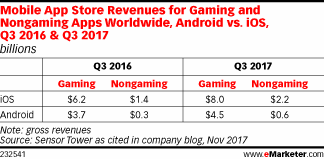
Recent research from Sensor Tower shows that revenues generated by nongaming apps are seeing a huge leap worldwide. The company reported that nongame app revenues totaled $2.8 billion globally in Q3 2017—a 67% increase year over year.
Despite the fact that smartphones running Google’s Android operating system are more widely adopted than the iPhone on a worldwide level, the vast majority of nongaming app revenues are being generated on Apple’s App Store, Sensor Tower found.
In fact, the store made $2.2 billion in revenues from such apps during the third quarter, compared with $605 million for the Google Play store.
Mobile App Store Revenues for Gaming and Nongaming Apps Worldwide, Android vs. iOs, Q3 2016 & Q3 2017 (billions)
Even though that number was comparatively small in Q3 2017, it was still an 84% increase from last year’s figure, indicating that Android users are spending significantly more on or within their apps.
Sensor Tower also found that the apps atop the revenue-generating leaderboard tended to lean heavily toward those delivering some type of digital content. Netflix was in the No. 1 spot worldwide, but music-streaming service Pandora, HBO Now, Tencent Video and fellow China-based video-streaming platform iQiyi all made it into the top 10 list.
When Sensor Tower narrowed its scope to just the US, it found that Pandora had ridden its Pandora Premium offering to first place in app revenues; Pandora grabbed more than $80 million during the quarter on the App Store and Google Play combined, according to Sensor Tower. Netflix, HBO Now and YouTube were also in the top five list, with Tinder holding the No. 4 slot. Premium TV channel Starz and music streaming site Tidal also cracked the top 10 list.
It seems that subscription-based business models are doing quite well for app publishers, perhaps far better than apps that have embraced an advertising revenue approach.
Overall, the uptick in mobile app revenues makes sense given how much time consumers are increasingly spending with their apps. eMarketer projects that in the US alone, smartphone and tablet users will spend an average of a little more than 3 hours per day with mobile apps, compared to about 30 minutes on the mobile web.

Unlocking your phone to kill time? You're not alone

appdevelopermagazine.com
People unlock their phones just to kill time – in fact 47 percent of the time people unlock their phones with no specific app or activity in mind. 
Unlocking your phone to kill time? Youre not alone
A study of 900 mobile phone users - conducted by Phoenix Marketing International and Mobile Posse - analyzed consumer phone usage, attitudes, why and when people unlock their devices to determine their interest in “Proactive Content Discovery.” Proactive Content Discovery can be described as the automatically opening of relevant content when a phone is unlocked, making it the first screen a user sees.

50.4% of all mobile users expressed strong interest in Proactive Content Discovery - this group is called “News Feeders.” This group is as big as the 50.3% of all mobile users that say they use Facebook primarily for social communication with friends and family.

Strong Predictors of interest in Proactive Content Discovery:

  • Mobile users that frequently use their phones to consume local/national/world news, entertainment news and gossip are 56% more likely to be interested in Proactive Content Discovery. Mobile users that don’t use their phones to consume local/national/world news, entertainment news and gossip are 73% less likely to be interested in Proactive Content Discovery.

  • Mobile users that use Facebook primarily for access to interesting/entertaining stories are 68% more likely to be interested in Proactive Content Discovery. Mobile users that don’t use Facebook primarily for access to interesting/entertaining stories are 67% less likely to be interested in Proactive Content Discovery.

Medium Predictors of interest in Proactive Content Discovery:

  • Mobile users that use their phones to “kill time” (For instance, when waiting in line, during TV commercials, etc.) are 27% more likely to be interested in Proactive Content Discovery. Mobile users that don’t use their phones to “kill time” are 66% less likely to be interested in Proactive Content Discovery.

Weak Predictors of interest in Proactive Content Discovery


  • Mobile users over 55 are 20% less likely to be highly interested in Proactive Content Discovery, but age is generally a weak predictor of interest in Proactive Content Discovery.

  • Mobile users who make over $100,000 are 33% more likely to be highly interested in Proactive Content Discovery, but income is generally a weak indicator of whether or not a mobile user will be interested in Proactive Content Discovery.

  • Mobile users who did not vote in last year’s presidential election are 45% less likely to be strongly interested in Proactive Content Discovery, but political party is generally not a predictor of whether or not a mobile user will be interested in Proactive Content Discovery.

  • A subscriber’s wireless carrier, how often they unlock their phone, and the region they live are all weak predictors of whether or not a mobile user will be interested in Proactive Content Discovery.

Tuesday, 14 November 2017

Thanks to AR, discoverability has become even harder in the Apple App Store

digiday.com

Ikea ‘dreams’ of its AR mobile app fuelling online shopping.
Brands have long bemoaned the lack of discoverability in the Apple App Store. When Apple redesigned its app store in September as part of its iOS 11 update, the tech giant claimed the update would make discovering apps easier than ever. However, the app store’s new layout and Apple’s recent push into augmented reality have only made it more difficult for brands to get their apps in front of consumers.
Apple’s push into AR has affected optimization and discoverability in the redesigned store. Since September, it has become 14 percent more difficult for an app to rise in search results when the search keyword “augmented reality” is used in an app description, according to Amir Ghodrati, director of market insights at app insights company App Annie.
This is a result of more developers creating AR-enabled apps. When Apple introduced iOS 11, it launched ARKit, which gave developers the tools and technology to create their own AR experiences.
Brands, especially furniture brands like Wayfair, Ikea and Overstock, quickly jumped at the opportunity, either updating their existing apps or introducing new ones with AR. In the company’s fourth-quarter earnings call at the beginning of November, Apple CEO Tim Cook said 1,000 AR apps have been created so far. User searches for “augmented reality” have also risen by 50 percent since the iOS update, according to App Annie.
This data is significant because the majority of app downloads come from people actively searching for apps with specific names or keywords like “augmented reality,” with searches accounting for 65 percent of app downloads, said Ghodrati. And with 2.2 million apps in the Apple App Store, according to Statista, brands need every opportunity they can to rise in search results.
“App description updates can help impact where an app might rank for relevant keywords,” said Ghodrati.
Walmart is one brand that has updated its iOS app ahead of the holiday season. The brand’s version notes were changed on Nov. 19 to read, “Our elves have been hard at work so you’ll save time during the holidays and everyday,” according to App Annie. The brand has also updated its app icon to a holiday present and added screenshots with snowy backgrounds, all tactics that could help with conversions, said Ghodrati. Using the term “holidays” could help the app rise in search as well, he added.
One agency executive, who wished to remain anonymous, said Apple is not concerned with improving search discovery because it wants brands to purchase its Search Ads, a feature it rolled out in October 2016 that places ads at the top of search results. Marketers buy Apple’s Search Ads by bidding on keywords. They average 50 cents per tap for larger brands and drop to 25 cents per tap for smaller brands, according to Apple.
Apple’s pitch has been working. Even high-ranking apps use search ads to move to the top of search results. Search ads have led brands to advertise on keywords their apps are not ranking highly for and to advertise against competing brands. For example, Walmart is advertising on search results for the keyword “Target,” and Amazon is advertising on search results for the keyword “Walmart.” Nike, however, has placed a Search Ad for “Nike,” likely because the brand wants to ward off competitors from advertising directly above its app.
But some marketers believe consumers don’t spend time searching for apps, and the only real way to get discovered in the Apple App Store is by getting featured. “Everybody wants to get featured,” said Matt Britton, CEO of Crowdtap. “There’s a front page, and then there’s a zillion back pages.”
As part of the redesign, Apple took its sprawling lists of apps and divided them into separate tabs, which is also affecting discoverability. The Today tab features App of the Day and Game of the Day sections, the Games tab lists featured games under groups such as New Games We Love, and the Apps tab does the same for other app categories. Featured apps receive larger visuals and take up more of the screen than they did previously, meaning that a user only sees the top three apps in each curated category, and only after scrolling down past two sections. Before, a user could scroll as deep as they wanted through the Top Charts tab.
“You can still click into the Top Charts,” said Adam Blacker, communications lead at app data firm Apptopia, “but it takes more time and effort to get there, with more distractions along the way.”
The new layout is increasing downloads for featured apps. Apptopia found that non-gaming apps given featured status saw their downloads increase by an average of 1,747 percent, while featured gaming apps saw their downloads spike by 792 percent.
However, Apple might be getting pickier with the apps it chooses to feature. Apple curates its Top Charts lists without paid support. On the one hand, said Blacker, Apple is featuring more apps, switching them out more frequently than before App Store’s redesign. On the other hand, the apps that tend to get featured now are ones that are already popular in the store. Apple did not respond to a request for comment.
Apptopia analyzed the first 30 days of Apple’s redesigned app store (Sept. 19 to Oct. 19) and found that the apps Apple featured were already receiving an average of 5,062 downloads a day before the redesign, and at least half of the featured apps were making at least $10,000 a day.
“Apple wants to make money,” wrote Jonathan Kay, founder and COO at Apptopia, in a Medium post on Oct. 24. “They make 30 percent of every dollar you spend on or in a mobile app, and they are hoping you will spend more. They know which apps create the biggest spenders, and they’re typically made by large companies with big budgets.”
In the post, Kay calls out some of these apps, including Starbucks, the NBC App and Minecraft. McDonald’s is another. At time of writing, McDonald’s is listed under New Apps We Love, not because the app is new, but because it has updated new payment options, including Apple Pay.

“Apple is doing the choosing,” said Blacker, “and any app that won’t get featured is now harder to find.”