Friday, 27 January 2017

Most Snapchat Discover Ads Are Either Interactive or Direct Response

adweek.com
Three-week study has surprising results

Apps, retailers and food brands have all run recent campaigns
As Snapchat plugs away at proving that its vertical video ads work with data and machine-learning targeting, marketers are increasingly testing longer video and direct-response campaigns on the platform.
For the past three weeks, Adweek has tracked 53 campaigns within Discover, the section of the app where marketers run short video ads alongside content from publishers, and we found that 36 of them (or 68 percent) prompted users to take an action by swiping up on the screen. The other 32 percent were Snapchat's standard 10-second video ads. Fifteen (42 percent) of the campaigns Adweek observed that encouraged consumers to swipe up led users to longer videos when swiped. Another 14 campaigns directed users to websites, and eight campaigns pitched app-install ads.
Moreover, a third of all of Snapchat's advertisers in Adweek's test were entertainment companies including Lionsgate and MTV. Food brands were another big category, with 13 advertisers including General Mills, Nabisco and Starbucks.
It's worth noting that the test was only with one reporter's account, and a Snapchat rep said each user is served different ads based on targeting that gauges which ads people are most likely to swipe due to the content they look at. The rep stated each user also gets served a different number of ads based on how often they view Discover content. 
Snapchat has been pitching its twist on direct-response ads that link to app installs, longer videos and websites since last year as a way to compete for mobile advertising dollars with Facebook and others as it gears up for a rumored IPO this year. As part of its API program, Snapchat also has 15 partnerships with measurement companies—including Moat, Oracle Data Cloud and Nielsen—to help advertisers quantify their campaigns.
Christina Miller, supervisor of social strategy at VML, said she has used Snap Ads with attachments to push consumers further down the purchase funnel. "We use the Snap Ads that link out if we have a deeper goal, further content, acquisition of some sort," she said. "The plain videos are more just for the goal of views [or] awareness—quick consumable content."
And to avoid bombarding consumers with too many ads, "[Snapchat] was so careful in how they rolled out—they give a lot of guidance on that," she added.
But Jill Sherman, DigitasLBi's svp of social strategy, warned that brands shouldn't go all in on swipe-up ads quite yet since users' own messages are capped at 10 seconds.
"Snapchat is first and foremost still a messaging app, and Discover content created by publishers is still relatively short form," she said. "That said, I think brands should experiment with it, and learn where the drop-off is. There are best practices, but no hard and fast rules and some brands will likely find that the 10-second spot makes the most sense."

4 Ways Mobile Apps Will Change in 2017 (Or How Ad-Tech Firms are Changing the Space)

portada-online.com
pantene1
Apps are at their peak and we will be seeing many ad-tech companies developing specific apps for each market under one same platform. As a result, mobile app producers will have to increase the benefits and offerings that are provided by existing apps. Here are the top 4 mobile app predictions for 2017, by Portada's digital media correspondent Pedro Labarta.
  1. Smart prices will take over.

Apps focused on the sale of products will have to become smart bots, since buying  sensitivities vary depending on region/country. Producers of mobile applications will have to use individual user data, along with location at the time of sale in order to achieve better profits down the road. For example, people in Mexico may not be willing to pay the same amount for a particular product as do people in Spain. Companies will be able to classify purchases according to the algorithm needed to quickly adapt to each market, thereby unifying inventories and databases.
  1. In-app advertising

This will be the year in which businesses such as agencies will be able to safely, quickly, and effectively monetize applications. For example, a clothing brand will be able to pay for an in-app ad when the user is searching for a specific application or even within the app itself, as is already the case today, but will also be able to do it a crucial moment of the game or video where the advertiser wants its ad to appear. This will help advertising networks improve their performance and especially their revenues once this feature kicks in by mid-2017. This will lead to higher satisfaction rates and more business opportunities for all.
  1. "Yes" to TV on smartphones and "No" to TV on smartwatches

descarga-3Apple, Samsung, and Google specialize in mass consumer products. The smartwatch is not a great product because it does not replace the phone, just as Apple Pay has not replaced the credit card. Also, not everyone wears a watch, while most everyone uses a smartphone. This is another problem faced by large companies that have failed to build an adequate ecosystem and a monetization model for smartwatch developers. With development not being financially viable, developers will stop creating for it and instead focus on creating for apps for TV, etc. This will open a new source of revenue for publishers, leading to better content and a better advertising platform that makes it a win-win for everyone.
  1. Apps and messaging

Messaging has tapped out, so entering this market is too complicated these days. The focus now should be on developing message extensions, where we can take advantage of the billions of people already connected on them.
We are already seeing specific developments for iMessage from Apple and Facebook Messenger. Instead of opening an application such as Skype separately, users will use a face-to-face extension within the messaging application with which they are already familiar.
This will be the year in which businesses such as agencies will be able to safely, quickly, and effectively monetize applications.
Extensions will not stop there, however. They will be used for everything, including some tools we are already used to seeing in our email, such as calendar invitations, unread text markings, current status, and functions that will be carried out within our specific message groups. Bots and AI were launched in 2016, but they still do not work very well. In 2017, we will see strong breakthroughs in bot intelligence and more implementations in our everyday technology. Many of today's most promising video messaging and walkie-talkie apps will soon find themselves competing against and potentially missing out on a well-implemented app extension.
However, bot technology will see its strongest boom in late 2017.

Can Social Media Stay Free Forever?

forbes.com
Can Social Media Stay Free Forever?
Since social media first emerged, it’s been, for the most part, completely free to use. New users can create accounts for free and engage however they’d like with no charge, and even businesses and organizations can get in on the action. Nobody in 2004 would have guessed that “The Facebook” would have exploded to have more than a billion users worldwide.
Now that it does, it seems crazy to think that all user accounts—including business and organization accounts—are completely free to hold and manage as you see fit.
Of course, there are other ways for social media platforms to make money, and Facebook is only one example, but the general trend is permanent freeness. Could social media stay free to use… forever?
Why Social Media Was Ever Free
First, let’s remember why social media was free in the first place. The power of a social media platform, regardless of what it’s selling or how it’s selling it, depends entirely on the strength of its user base. Without a significant volume of users to support the platform, it’s going to inevitably die; people want to join networks with the most people, or there’s less opportunity for interaction. If it cost even a dollar to sign up, it would be nearly impossible to generate any momentum.
Once hooked, introducing some kind of fee would potentially cause a significant drop in use. Imagine if one day, Facebook decided to start charging businesses $25 a month to make organic posts and continue to exist; you can bet thousands of small businesses would suddenly exit, and Facebook’s user base would shrink.
Keeping Up
The threat of competition also keeps social media platforms collectively maintaining a free model. If Facebook started to charge money, users would flock to Twitter, Snapchat, Instagram, LinkedIn, or one of dozens of other platforms to fulfill their needs. As long as one company provides free socialization, all other social media platforms pretty much have to follow suit.
Profitability in a Free Model
How can social media apps and platforms remain profitable if everyone is using their technology for free?
You likely know the answer to this already. Most social media profit comes from advertising. Even though most features are free, extra boosts and advertising space are sold for a fee that varies based on the quality and frequency of the ad. Because of this, every new user that an app collects adds to the total potential value of the app, even if they aren’t paying; businesses pay extra to reach extra people, and they only care about the platforms with the biggest user bases. In this way, users aren’t taking advantage of the app for free, apps are taking advantage of users for free—more on that momentarily.
Pushes for Advertising
It’s no coincidence that Facebook’s Chief Operating Officer is an advertising guru—not a software engineer. Social media platforms know that the real money is in advertising, and businesses need to keep paying for advertising if the app is going to continue growing. This presents a dilemma of balance; apps need to keep businesses happy with enough free features to appeal to any business owner, but also push for businesses to advertise more.
This is why many platforms have begun throttling what’s known as “organic reach.” The number of people a basic, free post can reach has been steadily declining for a number of years, with advertising increasingly becoming the only way for businesses to effectively scale while using the app.
It’s likely that Facebook and similar platforms will continue escalating this push, but never so much that it results in companies dropping off the platform entirely. Instead, at that point, advertising costs will likely rise—especially as their platforms become more sophisticated and their user bases become even larger.
Hidden Costs for Users
It’s worth noting that while users aren’t paying any tangible, monetary costs to use the platform, they are paying in other ways. When you use a social media platform, you’re essentially forking over all your personal information—and on a silver platter. Facebook hypothetically knows more about the world population than Google or any governmental organization; it knows your age, location, birthday, likes, dislikes, networks of friends, and major life events. It even knows when you’re happy or sad.
Your personal data is valuable, just like currency, and using a social app is a contract that passes that currency forward. Plus, every time you use a social app, you’re confronted with ads—whether you notice them or not. Even glimpsing these ads is a distraction, and could be considered a form of payment. After all, every time you see an ad on Facebook, Facebook is making money.
Social Media Dependence
Facebook needs businesses and users to stay happy. Otherwise, its ads would have no value, or there would be nobody left to pay for ads. In this way, social apps are almost required to keep things free, and at the same time, users get “hooked” enough on the platform that small non-payments—like user data submission and ad watching—become almost unnoticeable.
The Bottom Line
Social media will never stop changing, but it’s likely that it will remain free pretty much forever—at least for the most part. The better way to look at it is this: we’re already paying for social media, each and every time we log on our platform of choice, and social apps are reaping the benefits.

Wednesday, 25 January 2017

7 Mobile Marketing Techniques for the Travel Industry

customerthink.com
Travel brands understand better than anyone that it’s more fun to live on the move. By adopting mobile marketing techniques, these companies are recognizing consumer demand for a truly multichannel customer experience. 
This post will examine the seven most effective examples of travel brands reaching customers with relevant mobile marketing. We’ll look into specific mobile techniques like in-app messaging, push notifications, mobile email and responsive landing pages.
#1 Airbnb – In-App Referral Landing Page
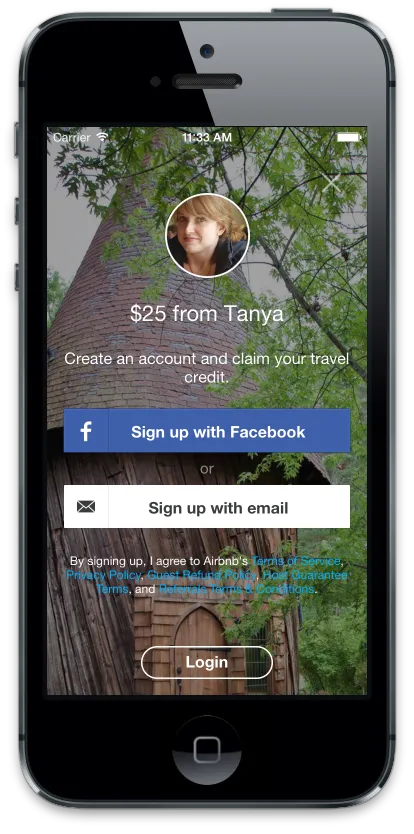
Airbnb makes it easy on users to bridge the activation gap and start using their app with this responsive mobile landing page. With a strong hero image to communicate the value within the app, the brand greets potential users with a friendly face and a pared-down design to make enrolling a breeze. In the ever-more mobile world, having web pages adapted to each device is critical.
The copy here is value-forward and direct, concise to the point of being visually appealing – it’s cut to fit the screen. The calls to action (CTA) are a must-see and there are only two real options: signup or login.
The design hierarchy has large, actionable CTA boxes to make the choice easy for first-time users.
Already having optimized for mobile app conversions, Airbnb uses referrals to great effect to maximize engagement. Aiding in this is the simplified set of sign-up options. A quick email or an even quicker Facebook sign in glosses over the only technical aspect of signup and prepares the user to book immediately.
#2 TripAdvisor – Triggered  Push Notification
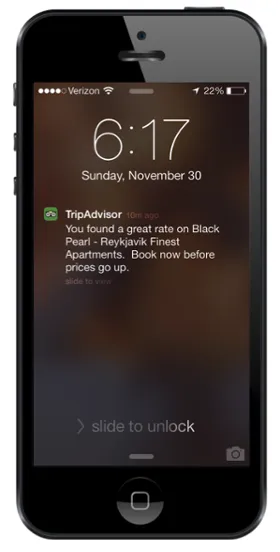
TripAdvisor uses push notifications in a fashion similar to Airbnb’s onboarding process. Even for the self proclaimed “World’s Largest Travel Site,” remaining top of mind (and within the top three) with users, is the apps biggest challenge.
The travel industry giant makes short work of providing benefits to users on their home screen. Extra points for their use of the bright green, familiar logo icon to instantly relate feelings of brand loyalty and enthusiasm.
Push notification strategy is a touchy subject and requires a degree of finesse, as these notifications are seen by permission only; once viewers disable messaging, the app is on the way out the door. Drawing users in with personalized language (e.g., “You found”) gives the copy immediate relevance and punch while following up with information users have requested.
With push notifications, space is at a premium and attention spans are short – and easily upset. TripAdvisor uses only two sentences in the message, finishing with a sense of urgency and action-specific language to drive results. Scarcity leads to demand, so brief copy is essential to relating the necessary data and drawing users into another round of engagement.
#3 Busbud – Mobile Refer a Friend Email
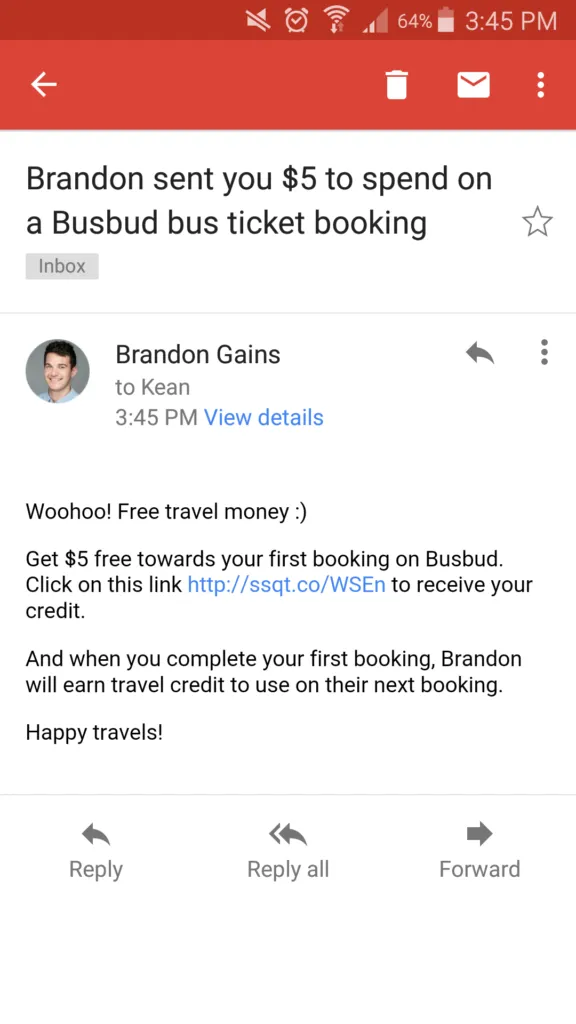
Travel marketplace Busbud uses ore-filled share messaging to encourage mobile referral engagement. First, the personalized subject line references both the reader directly and their buddy’s awesome gift, creating an immediate incentive to open.
Secondly, the brand uses exciting, yet aptly, informal branded tone to give readers immediate value: “Woohoo! Free travel money!” Capitalizing on early stage good energy, the best brands are willing to give to their audience before receiving usership, a major psychological cornerstone ofmobile optimization.
One clear, action-driven CTA initiates the click-sequence and converts new users. The message also highlights the reciprocal benefits of the campaign appealing to a consumer in a different way than single-sided offers. This is the self-affirmation theory of psychology at work, effective at creating the desired conversion action.
Mobile marketing doesn’t rely on words alone, so the bright color red plays a big part in communicating the excitement and energy Busbud would like to inspire in the user’s action. Color theory is a huge part of mobile marketing, playing along as the perfect complement to the essential use of succinct, powerful copy.
#4 Uber – In-App Mobile Messaging
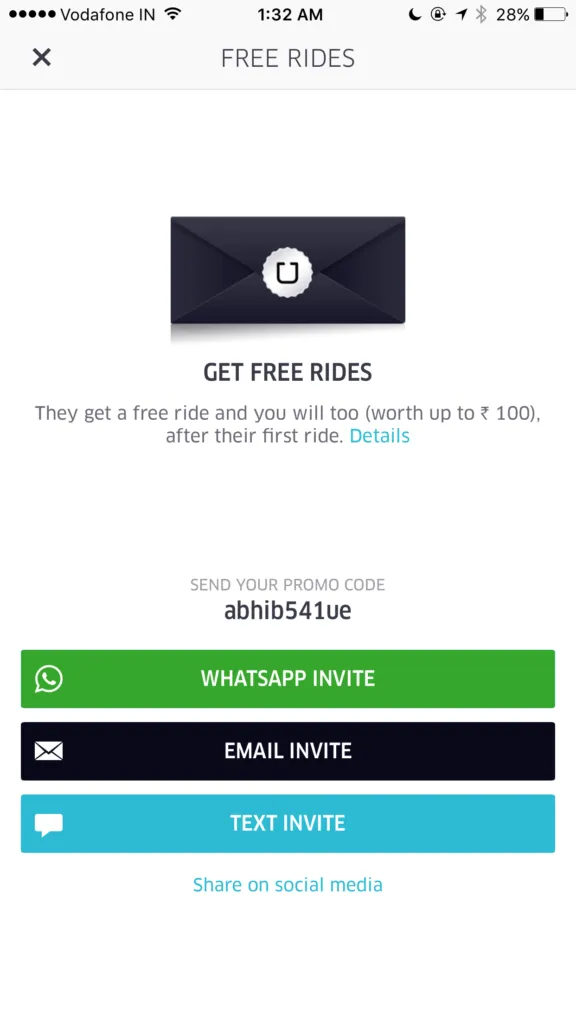
Uber is a great example of how to employ in-app messaging for increased engagement and conversions. The white background is crisp, minimal and allows the bright CTA buttons to shine in the user interface. The vivid and simplistic aesthetic shows in no uncertain terms that it pays to share the love of Uber with friends.
The secretive black envelope implies exclusivity and confidence, while contrasting with blues indicating upbeat loyalty and greens for security and trust. The effect is an overall alluring combination from which users get to choose.
“Free” and “Invite” are the most prevalent ideas here. These power words allude to the exact benefit waiting for both the giver and the receiver. Uber’s balance of reciprocal rewards is not only explicit in concise copy, but reinforced by bright and direct social share CTAs.
A prime example of referral programs optimization done right, Uber illustrates a perfect blend of actionable language, personalized copy and powerful design elements used with restraint within the physical constraints of a mobile interface.
#5 United Airlines – Contextual Push Notification
Research shows that push notifications get a 50% higher open rate than emails, while 68% of user have them activated across their apps. Personalized messaging is the way to avoid being ignored or uninstalled.
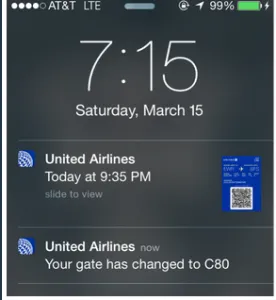
United Airlines provides a great example of how to optimize by individual user: Create hyper-relevant, time sensitive material to improve lives. Through improving an overall customer experience, the air carrier is guaranteeing more engagement while retaining loyal customers. Next time, these notifications might contain a special offer and the user at the other end will be more likely to buy.
Urgency is the theme, but the calming blue logo icons and scan-ready ticket provide great structure and balance to the message. Providing the ticket for use is the key element, making this correspondence well worth the while of any traveller concerned with saving time and getting the most current itinerary information.
United uses direct copy like “Today” and “Your” to take the lead and guide users to a simple understanding with no wasted effort. Without extra content, these are obviously meant to add ease and value. In turn, this reduces decision fatigue and increases engagement with their service.
#6 Airbnb – In-App Messaging Consistency
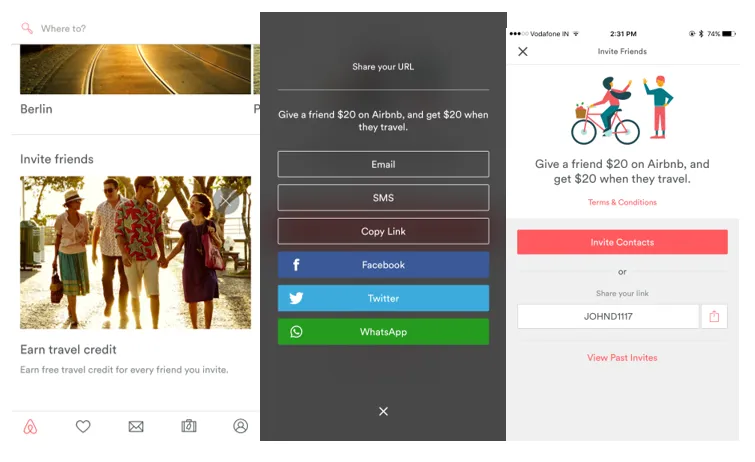
Here’s the holistic view for Airbnb’s in-app referral process. The aesthetic consistency is worth replicating – users move from a clean and minimal in-app referral screen to a secondary page of almost identical CTA size and style – only the colors are different. We can see here how crucial design hierarchies are to effective UX on small screens.
The first page makes good use of three alternating bold and muted colors, matching the referral selection interface at right. The center share page switches color palettes while keeping the copy as a clear reminder for selecting the proper social share CTA. Every element is friendly, consistent with their brand and one click away from completion.
One-click actions are particularly important for facilitating shares and conversions. Like using auto-fill forms, reducing friction in the app and guiding users through an almost effortless funnel is what optimizes conversions.   
#7 Uber – Responsive Mobile Web Page
uber mobile website example
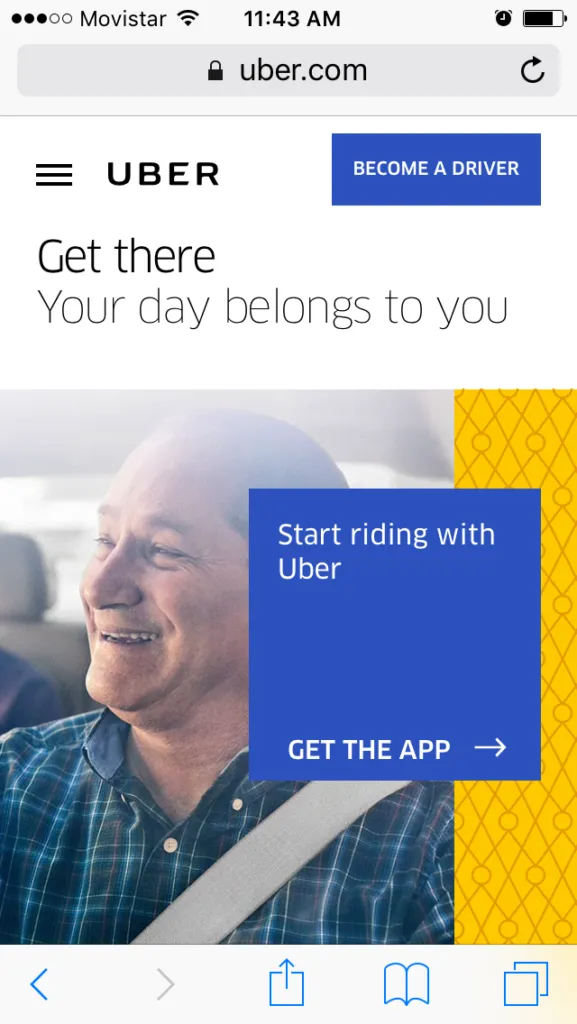
People love to see people smiling – and this cheery hero image features a happy rider and his patron. Uber’s mobile landing page smartly plays into our social dispositions while simultaneously communicating the brand values that connect users with good folks and a better ride experience.
As a person-to-person rideshare service, the company runs on the reciprocal drive to serve others and receive benefits in return. Referral programs thrive upon this very element: users connecting with others, engaging in mutually beneficial exchanges.
Their page design is grounded within a simple four-color palette, most prominent of which is blue for loyalty and yellow for energy and optimism. Also, basic geometric lines emphasize the imagery and help the messaging pop.
The word choice is targeted for action, focusing on the benefits of arriving at your destination and enabling the app do this for you … all while sharing smiles and saving time. Secondarily, visitors are prompted to become drivers themselves, the other aspect of Uber’s service that the company isn’t going to let slip from view.
In Closing
These have been seven examples of mobile marketing techniques for the travel industry. In examining brands from Airbnb to United Airlines, we’ve seen how to use tactics such as mobile email, responsive webpages, push notifications and in-app messaging to deliver a strong customer experience.
Offer your customers a consistent brand experience that is personalized to their unique customer journey. Ultimately, step into the shoes of your on-the-go audience and ask yourself: Does it help me go places? Would I use it on my next trip?

7 Predictions About App Marketing

adotas.com

App marketing is one of the most competitive and rapidly changing fields that marketers can get into in this day and age. It requires a skillset that includes both creative strategy and data-driven methodology, as well as the curiosity to ask questions that others might not even think of. But more than anything, it requires a marketer to anticipate shifts in the ecosystem and be ready to leverage new trends before their competitors do.
What trends will have the most profound impact on the app marketing landscape in 2017? It’s a difficult question to answer, but an important one for those in the trenches of app marketing. Here are seven predictions for trends that I expect to take shape in the next year.
1. More ad formats will appear on the scene
Native. Video. Rich media. Social. There are already a ton of different ad formats that app marketers must juggle successfully to find the right mix. This diversity is both a blessing and a curse; it requires a lot of time and energy to design all the creative, but ultimately delivers campaigns optimized for each channel. In 2017, even more ad formats will appear on the scene, providing more opportunity for developers to connect and engage with their targeted audiences. Playable ads are one format that we’re particularly excited about, as we believe that the better job an ad can do in letting the user get a true sense of what the app is all about, the more effective the campaign will be for both publishers and marketers alike.
2. Video will reign supreme (once again)
Despite the arrival of new ad formats, video ads will continue their run as the industry’s most important format. In AdColony’s latest App Install Marketing Survey report, over 98% of app marketers include mobile video in their channel mix. They also name full-screen video, social video and in-feed video, respectively, as the three most effective ad formats for app installs. In an internal Tenjin study of Facebook Lookalike campaigns by creative, video has become the most popular creative for all Lookalikes campaigns for monetisation, displacing creatives such as carousels. The bottom line is that trailer videos are the best way to show a viewer what the app experience is like, and their cost effectiveness makes them a go-to format for marketers throughout the industry. That will only accelerate in 2017.
3. Data will become more accessible, especially for smaller developers
Data is the lifeblood of any app marketer. It’s required to tell us who’s engaging with our ads, who’s installing our apps, who’s making in-app purchases, and so much more. But historically, many app marketers have had difficulty connecting the dots between their marketing campaigns and their users’ in-app behaviors. Even if they could connect those dots, they often struggled to access the data in a way that made it actionable for future campaigns and re-engagement efforts. Traditionally, only the largest developers had the budgets and engineering resources to build the robust data infrastructures these campaigns require. In 2017, new tools on the market will give smaller and mid-sized developers access to this same data, leveling the playing field for all app marketers.
4. Predictive analytics will get more accurate and more ubiquitous
“Predictive analytics” has been a buzzword for years. For app marketers, the promise of predictive analytics is to show which users are projected to convert soon, purchase soon, churn soon, influence their friends soon, and so on. In theory, this information is invaluable for helping app marketers target their next campaign, whether for acquisition, engagement, retention, revenue, or what have you. But in reality, predictive analytics have thus far remained inconsistent and unreliable at best. In some cases they’ve proven downright erroneous, leading to wasted ad spend. Next year, however, should see a quantum leap in the accuracy of predictive analytics as the algorithms they depend on become smarter and more advanced. That means that more app marketers will be able to use predictive analytics as an important part of their arsenal.
5. Marketers will start sharing more data analysis (if not actual data)
I’ve found the app marketing community to be a wonderfully supportive and communicative one. And yet, most people in the industry have been reluctant to share any analysis of their data that might give them a leg up on the competition. We often meet at industry gatherings like the Mobile Growth Summit, Mobile Apps Unlocked and others events where we freely share best practices and helpful strategies. But data insights have remained secretive. This stronghold on proprietary data was loosened a little throughout 2016 with posts such as this one by Oliver Kern of Lockwood Publishing on methods of establishing LTV, and I think we’ll continue to see more of this type of sharing throughout 2017. A rising tide floats all boats, after all, and the more open and transparent we can be with our data analysis, the better off we’ll all be as an industry.
6. Data reports will become more collaborative
There was a time, not that long ago, when it required advanced knowledge of databases and SQL in order to run the types of reports that most app marketers have come to rely on. But with advances in data warehousing and visualization tools, it is becoming easier for people with little or no SQL skills to extract the reports they need. It is also becoming more commonplace for people within an organization to share their reports with one another and allow others to tweak those existing reports to suit their own requirements. In this manner, teams as diverse as marketers and product managers to the executive teams and investors can all run reports based off of a single SQL query. We expect to see more of this type of intra-team collaboration in 2017.
7. SDKs will become more multi-faceted
Developers hate integrating SDKs. Although necessary to their business, the process of adding, updating and removing SDKs can lay a heavy burden on the engineering team. In 2017, thanks in part to industry consolidation and in part to SDK providers expanding their repertoires, we will see SDKs become more multi-faceted, meaning that developers might not have to integrate as many SDKs as they have in the past. Instead of separate SDKs for analytics, marketing automation, ad serving, attribution, push notifications and more, many of these functions may be combined so that developers don’t have to experience quite as many headaches as they have in the past.
The app marketing industry is changing fast, and in many ways there’s no telling what the future may bring. One thing we can be sure of, however, is that there will be unexpected developments that change the way the industry operates. But by anticipating some of the trends that we expect to take shape in 2017, we can at least be prepared for success.

Four Best Practices For Successfully Onboarding Mobile App Users

mobilemarketingwatch.com

The following is a guest contributed post from Amy Abascal, Head of Marketing, Americas, FollowAnalytics. In the old days of software design, onboarding campaigns were considered a crutch …

home-page-background

opinion
In the old days of software design, onboarding campaigns were considered a crutch to compensate for bad UX.  In some cases, the on-boarding workflow even interfered with your ability to use the application.  Anyone remember that talking paperclip in MS Office that always seemed to get in the way?  But mobile apps are a different beast.  Well thought out onboarding flows can be an essential tool to ensure user retention.
It’s fairly well established that most apps are deleted after their first use – over 80% to be clear.  And comscore reports that users spend more than 75% of their time in their three favorite apps. So unless you want your app to be deleted or forgotten about, it’s critical to ensure that users find immediate value.  Coaching screens and in-app messages that introduce key features can make a huge difference
In addition, many mobile apps are useless or crippled without permission to use external features provided by the smartphone.  Think of Instagram without camera permissions or Waze without GPS.  Unfortunately, smartphones don’t allow apps to access these by default.  The user must agree and onboarding campaigns can get them to do so.
Here are five tips to creating successful onboarding that will ensure your users love your app and keep using it.
I. Take the Pain Out of Logging In
Typing passwords on a desktop computer can be tough, but typing them on a mobile device can be downright maddening.  If your user opens your device, is immediately prompted to create an account and cannot get through the login process, it’s pretty much guaranteed you’ll lose them.
Instead, don’t require users to create an account until it’s really necessary.  How much can they explore before a login is required?  Once they see the value of your app, they’re more likely to go to the trouble.
Next, provide as many options to login as possible.  Social media sign-ins through Facebook and LinkedIn are great, but if users store their passwords keychain tools and don’t remember them, you’ve added more complexity to the process than they may be willing to put up with.  Furthermore, ask your team if it’s really necessary to have strict password requirements?  Can you let them log in with a numeric pin?  My bank lets me login with my fingerprint.  I love them for it!
II.  Think About Context When Asking Permission
If you are going to request permission to send push notifications, use the camera or GPS, or access other external functions, then explain what the user is getting out of it.  When they sees the app is more useful by clicking “allow”, they’re much more likely to do so.
Likewise, the timing of your requests is just as important as explaining why you’re asking.  I’ve used apps that asked for everything from my social media profile to my location before I was even certain what the app did.  Let your user get addicted to your app first.  You might not need to ask for permission to use the camera until someone is ready to scan a barcode or take a picture.  If they understand that denying access will create an obstacle to whatever they are trying to do right at that moment, they are far more likely to agree.
III.  Segment and Personalize the Journey
Different users users are likely follow different paths through your app.  When you consider context as part of your on-boarding journey, you find out that there are now many journeys and not just one.
Not all users will respond to the same things the same way?  By leveraging a  best in class mobile analytics tool, you can understand your segments (down to segments of one!) and know quantitatively what messages and content appeals to each.  This allows you to tailor your onboarding campaigns, sending the right message to the right person at the right time.
Not only should you use your segments for demographics, but you can also use them to see where people are in the onboarding process.  If you have a group of users that have all opted out of push notifications at a certain point, then by experimenting with the process, you may be able to change their minds on down the road.  Or perhaps you learn that it’s appropriate to show coaching screens to certain subsets of users and not others – or at different points.
IV.  Analyze, Test and Optimize
Onboarding paths are no different than any other engagement campaign.  Be sure you test and optimize your messages.  First, use funnels and event flow analytics to understand where certain segments are dropping off.  Then split test your mobile messaging to improve results.  Perhaps calls to action can be written differently to appeal to different segments.  What can you test and optimize to boost successful adoption of your app?
The Takeaway
Well designed onboarding flows can be powerful tools that improve retention and help users get value from your app.  Put yourself in the shoes of your user.  Think of times that a login process was so cumbersome that you gave up.  When considering when and how to ask permission for external resources, be sure your timing makes sense and that the user perceives value in allowing the request.  Understand that not all users will follow the same hard coded path and use segments and personalization to be sure each person gets the best experience for them.  And finally, test your messages and calls to action.  By observing these practices, you can improve retention and be sure users get the most out of your app.