Wednesday, 2 December 2020

The Company Challenging Businesses to Get Out of the Digital Stone Age

Blockchain technology is getting accepted by companies from various industries — financial, healthcare, legal, education, and even governments — that have recognized its future and want to actively participate in order to share its benefits. 

In that sense, organizations of all kinds have started addressing the burning technological challenges of their time and adopting blockchain to modernize their infrastructure and pull out of the digital stone age. 

For instance, blockchain technology is providing the solution to modern issues of securing people’s sensitive information and rights to identity. Companies like AIKON are providing a safety platform that adheres to various legal frameworks like GDPR and CCPA — ORE ID — as well as protocols for safely accessing, controlling and managing proprietary digital assets — ORE Protocol

Moreover, it’s expected that corporations will spend $20 billion a year by 2024 on blockchain technical services, while governments from all around the world are already actively seeking ways to integrate blockchain security into their infrastructure — electrical grids, government apparatus, financial system, etc. 

Indeed, for a technology still in its infancy, the results are overwhelming, albeit differing from one industry to the next. However, the benefits of blockchain technology are universal, and the potential can only increase from hereon. 

Here is how to get out of the digital stone age by implementing blockchain solutions. 

1. Accountability and Privacy

A growing business challenge for some industries is the lack of accountability in data and information systems. Blockchain is appealing here as a way to manage data that is transparent, thereby increasing accountability, while still protecting rights to privacy and control over users’ own data.

This can be particularly useful for legal and financial transactions, but also in government systems that manage electoral rolls, national insurance and health information of citizens. Through sophisticated encryption and control mechanisms, blockchain is able to direct provably immutable data such that individuals are transparently verified identifies, yet without revealing more than is necessary, or only what is consented by the data owner.

2. Traceability Enhancement for Data

For industries subject to fraudulent behavior — by both internal or external actors– prevention is the key to solving this problem. Blockchain offers a unique advantage in fraud prevention, utilizing easy traceability of data back to its origin. 

For instance, a complex supply chain can make it very difficult for companies to trace proper paths of goods and services, which may negatively affect the efficiency of their internal processes in addition to user acquisition and retention. 

Therefore, business solutions directly dealing with end-users are the most at risk of losing customers by creating convoluted and ineffective processes that obscure the origins of goods and their paths. 

Blockchain provides transparency via an immutable ledger, or record of transactions that allows for quick and efficient fact assertion via clear audit trails that are recorded into the network itself and are therefore unchangeable. That means you can never get into a situation where you don’t know where your supplies are, when customers are served, and how to resolve a user complaint quickly and satisfactory.

3. Enhanced Business Security

In terms of maintaining constant and reliable business security, there is no better solution than blockchain. Record-keeping has never been easier since the technology arrived on the scene — no matter the size of your business. 

That is made possible by spreading access points across the blockchain network, thus removing any possibility of compromising data — as every change to the data must be verified and accepted by all the points. Simultaneously, end-to-end encryption and a hierarchical permission structure have brought user authentication security to the next level. 

For organizations dealing with large quantities of user-sensitive information, securing that data — and relying on the high level of security over time — can make or break a company, its reputation, and customer base, be it a small business or a large corporation. 

4. Higher Process Efficiency and Execution Speed

Since record-keeping in the blockchain is achieved through a single digital ledger, human error is minimized, and third-party mediation is completely eliminated in regard to data management. 

This also means that all transactions going through blockchain are inherently faster and safer. Tying into the trustless principle of blockchain, the data transparency also ensures that it remains intact and usable at all times and by all authorized participants.

Cross-border financial transactions rely on this aspect of the blockchain to achieve unprecedented speed and quality of B2C security when moving assets from one part of the world to another, for example. This is an incredible competitive advantage companies need to make use of in order to stay ahead of other market participants and provide the best service possible.

5. Risk and Cost Reduction

By integrating third-party solutions into their services, companies must be wary of the level of risk they are bringing with them as well as continually being vigilant of the entailing costs. 

Blockchain mass adoption empowers companies to base their processes and services on a reliable architecture that reduces their costs significantly and streamlines operations in the long run. 

For instance, a supply chain can optimize its processes by having constant access and transparency to relevant information and be confident in the knowledge of an asset’s origin and authenticity.

How to Get There

As an industry that is still a big unknown to numerous companies and their executive staff, blockchain technology has not shown its full potential — business model challenges in blockchain adoption are yet to be fully explored and overcome. 

However, some companies successfully help others to get on the blockchain wagon and realize their business goals in a completely different manner, but with a set of newly opened horizons and a wide variety of possibilities. 

Each company has their own ideas and needs, but every one of such companies is on a mission to find the appropriate method of applying the basic principles of blockchain in a unique manner suitable for specific company’s needs. 

And therein lies the beauty of blockchain challenges and opportunities. Get all the puzzle pieces and come up with new and inventive ways to incorporate them in existing infrastructural landscapes by making databases and processes decentralized, impenetrable, and agile. 

Ultimately, by dragging them out of the digital stone age, companies gain the opportunity to revolutionize their business models and even entire industries, thus securing their long-term existence on the market.


This article originally appeared on aikon.com

Tuesday, 1 December 2020

5 UI/UX Mistakes That Will Hold Your Mobile App Back


Developing a mobile app is becoming essential for many businesses. In many cases, the mobile app is the business.

With so much time and money going into things like iPhone app development, you don’t want to expend all of those resources only to find that it doesn’t catch on or that it doesn’t drive the results your business needs.

For many apps that don’t live up to their potential, mistakes in UI/UX design are the key problem. This is one area where a seemingly minor oversight or poor design choice can have a huge impact on success. Fortunately, years of UI/UX design experience have revealed some of the more common issues that can make for an underperforming app.

The following are some of the common UI/UX mistakes that will hold a mobile app back.

Complicated UI

If users need to spend a lot of time and effort learning how to use an app, your UI is a failure. You want the features and functions of the app to be intuitive. In essence, you want people to be able to just look at the screen and know how to use the features without having to think about it. 

Try to put yourself in the shoes of a first-time user. Is it easy to figure out the basic functions of the app? Do you have to look around to find key elements that make the app work? If so, you might need to consider a redesign of the UI.

Depending on Long Tutorials 

Intuitive design is ideal, but there may be some need for tutorials. While a tutorial can be helpful, you do not want it to be too long. If users have to spend several minutes going through a tutorial before they can even use the app, you need to find a way to improve the onboarding experience.

One way to do this would be to use simple overlays that highlight features and control elements for first-time users. It is an easy way to provide new users with some of the basic controls and features without taking up a lot of their time.

Overdoing it With Features

A lot of businesses that are new to app development go a little too heavy on the features. While many features can improve an app, having too many can affect performance. It might make the app slow or glitchy. In some cases, an unnecessary feature might distract from the core purpose of the app.

Start by figuring out the features your app needs. These are the features that are essential to delivering on the promise of your app. Develop the app to meet these demands and then start looking at optional features that would be nice to have. Make sure your app works well for its core purposes, and then you can add new features and see how they work.

Ignoring Easy Sign-in Options

The process of signing up and signing in can be a barrier that will get many new users to quit before they even use the app. As a way to get around this, you should let people use the app without signing in if that is possible. 

As another way to make it easier for new users, you should take advantage of some of the easy sign-in options. Instead of forcing customers to set up an independent account with your company, offer options like signing in with Google, Apple and Facebook. 

Going Too Broad With the Audience

There are very few apps out there that are really for everybody. Most apps have a target audience. Maybe an app will have a few target audiences. If your app does not connect with that audience or meet their needs, it is not going to be a success. 

Defining your target audience should be one of the first things you do when you design an app. You need to know the age of your ideal user, their interests, spending habits and more. Once you know your target audience, you can refine your app to meet their needs.


Tuesday, 24 November 2020

Construction Apps — 10 Ways to Build Your Contracting Business From Your Phone


Want to grow your construction business? There’s an app for that. Thanks to modern technology, it’s possible to update blueprints, create and sign contracts, and care for your construction workers from your smartphone. To help take your company to the next level, check out these top construction apps.  

Whether you’re building your business from the ground up or fine-tuning your workflow, one thing’s for sure: You’re just a few taps and swipes away from making your mark in the construction industry. 


SMARTBID

Ready to build your company's portfolio and work on some impressive projects? Well, a lot needs to happen before your team steps foot on a construction site. As one of the top bidding apps for general contractors, SmartBid helps streamline the entire preconstruction process. This app offers a secure platform to track your bid status with subcontractors and other companies. Not only does SmartBid help you get the job, but it also keeps your project organized from the very start.

Download SmartBid on the App Store and Google Play.


PLANGRID

As the old adage goes, Rome wasn't built in a day—and neither was your latest construction project. PlanGrid uses Autodesk BIM (or building information modeling) to monitor your project as it changes. From punch lists, to blueprints, to progress photos,  this app is designed to keep your team in sync throughout the entire construction process. 

Download PlanGrid on the App Store and Google Play.


HOURLY

There’s more to running a successful construction company than updating floor plans and calculating roof pitches; it’s important to track and compensate your employees for the time they spend working. Fortunately, Hourly is here to help make time tracking and administering payroll easy. The app uses GPS and geofencing to ensure your employees are at the correct construction site—and only lets them clock in once they’ve arrived. Keep your contractors on schedule by creating custom rules such as enforcing an eight-hour workday, granting a 30-minute lunch break, and setting a mandatory start time. Have a few team members who are burning the midnight oil? Hourly will automatically calculate overtime pay based on your company’s local labor laws, and add it to your employees' timesheets. 

Download Hourly on the App Store and Google Play.


GASBUDDY

From driving to the job site each day to schlepping around construction materials, general contractors are always on the go. Since they're often on the road, construction businesses wind up spending a lot of money on gas. That's exactly why every contracting company should download GasBuddy. This platform uses a smartphone's location services to find the closest and most affordable gas station. According to the app, GasBuddy can help you save up to 25 cents per gallon.

Download GasBuddy on the App Store and Google Play.


DEWALT MOBILE PRO

How many slate shingles do you need to build a gable and valley roof? Or how many studs for a 3,200 square-foot home? That's where DEWALT Mobile Pro comes in. The tool company has created a construction calculator to determine the materials your general contractors will need for their next project. Simply enter your dimensions and DEWALT Mobile Pro will do the math for you.  

Download DEWALT Mobile Pro on the App Store and Google Play.


GOCANVAS

With so little time and so many construction projects, the very last thing you need to do is to spend a superfluous amount of time sifting through old paperwork. If you want to be as efficient as possible, download GoCanvas. Instead of turning your filing cabinet upside down, GoCanvas will let you store, organize, and share important data and documents from its mobile app.  

Download GoCanvas on the App Store and Google Play.


PROCORE

Consider Procore your one-stop construction management app. From sharing accurate BIM data with your team, to receiving real-time productivity updates, to staying in the loop about potential safety hazards, Procore empowers project managers to stay connected with their mobile devices. You can also use this app to keep tabs on RFIs, inspections, daily reports, and more. Unlike many construction apps, which require an Internet connection, Procore lets construction managers access and save their work in offline mode. In other words, this app is a great match for managers who either travel often or work on a job site with a poor signal. 

Download Procore on the App Store and Google Play. 


RED CROSS FIRST AID

Accidents are bound to happen, regardless of your construction team's skillset. Unfortunately, falls and fatalities are more common in smaller businesses. According to the Bureau of Labor Statistics, nearly half of the deaths that occur on construction sites are from companies with ten or fewer employees. While downloading Red Cross' First Aid app won't guarantee your project will be accident-proof, it will help construction professionals know what to do if an emergency strikes. 

Download Red Cross First Aid on the App Store and Google Play. 


DRONEDEPLOY

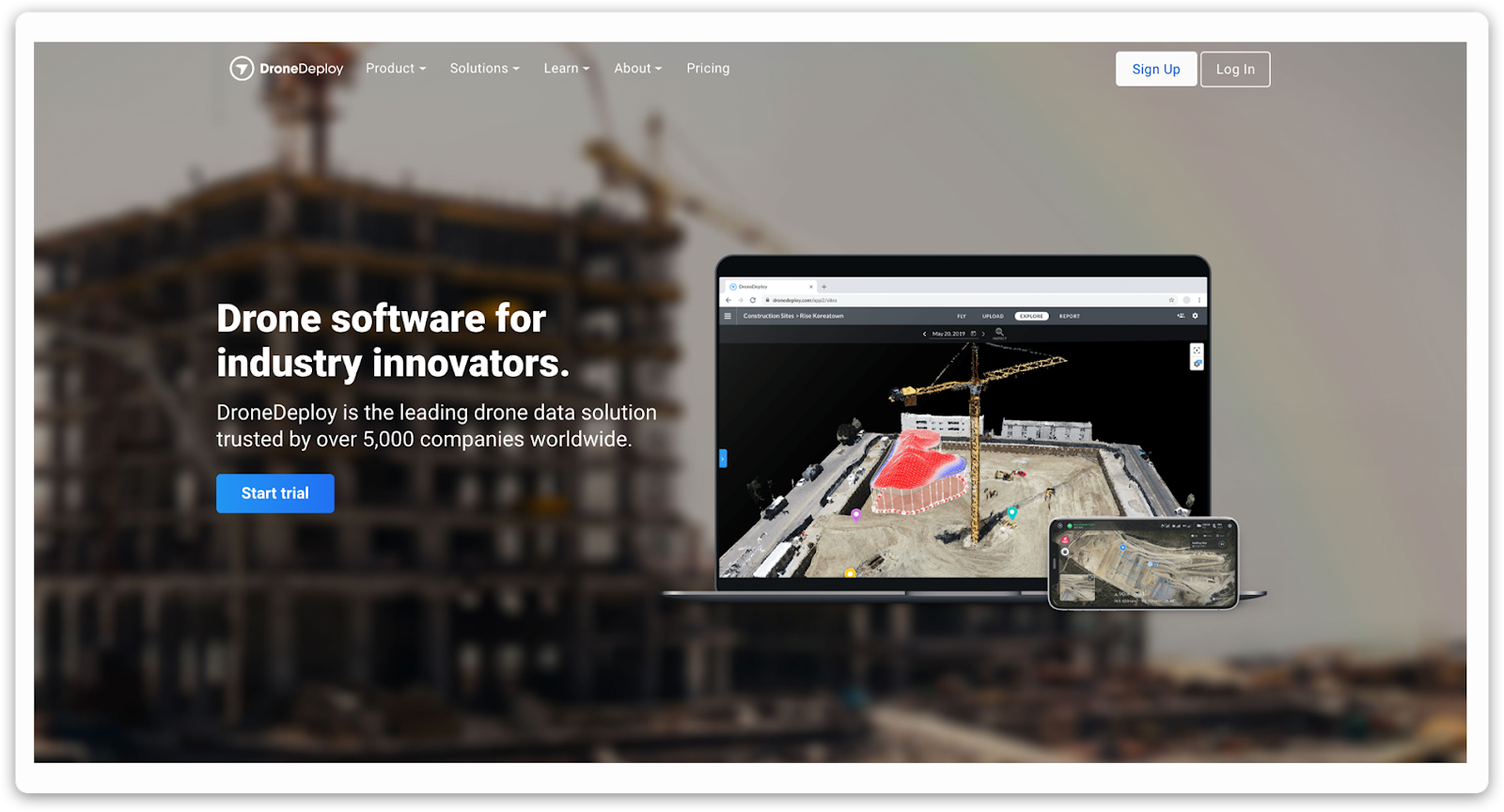
Thanks to DroneDeploy, your project team can get a lay of the land before arriving at the construction site. Compatible with both iPhones and Androids, this app uses drones to survey a job site on your behalf. Once the drone collects and interprets the data, the app sends over real-time drone maps and 3D models. Since launching in 2013, DroneDeploy has served 5,000 companies nationwide and surveyed 100 million acres of land. Not only can DroneDeploy save time and money, but it can also help you streamline your construction project. 

Download DroneDeploy on the App Store and Google Play.


FORMS BY LEGALSHIELD

Want to add a new client to your growing roster? It’s important to agree on all the fine print before you step foot on the job site. That’s where Forms by LegalShield—formerly Shake—comes in. Once you and your client have set the terms for the project, simply enter a few basic facts into one of the app’s legal templates. From there, Forms by LegalShield will whip up a contract (complete with legal jargon, of course) for both parties to sign. While the app does offer legal counsel for an additional fee, you can skip the trip to a fancy law office and make a deal from your iPad. 

Download Forms by LegalShield on the App Store and Google Play. 

 This article was contributed by Kelsey Mulvey and originally posted on Hourly.io

Adopting Blockchain Shouldn’t Be Painful for Your Users


According to Deloitte, over 50% of worldwide organizations see blockchain adoption as their strategic priority, with 86% of executives expecting it to go mainstream, and 77% recognize that not adopting blockchain could cause them  to lose their competitive edge. 

However, blockchain integration into an existing infrastructure is not the same as building your product or service using blockchain architecture from the ground up. 

To ensure a successful migration process, a great deal of attention must be paid to the existing customer base, and finding the proper way to facilitate the experience for them as well. 

For instance, companies that are looking to secure their users’ identities are increasingly looking towards adopting blockchain. However, as the technology is still a big unknown for an average consumer, product makers and service providers are seeking out the services of companies that can make the process seamless for their users.

While the average cryptocurrency user may very well be familiar with private key access and signing from their wallets, using these same access points to authorize applications, for example, can be a confusing and uncomfortable experience for non-cryptocurrency users. 

Companies like AIKON have found a way to formulate a smooth migration process onto another platform and provide the ultimate identity security solution, as well as a powerful protocol for easy digital asset access, control and management

Therefore, careful consideration of their needs, user habits, familiarity with the architecture (and assessing how much they need to know about the impending adoption of blockchain) needs to recognize ways to facilitate the transition process for them and eventually ease of use down the line. 

Here is how to make it painless for your customers. 

  1. Raise Awareness

While company executives and government officials are getting rapidly familiar with the benefits of moving their backend infrastructure to the blockchain, their end-users might not. 

And why should they? It’s not important to consumers to tell their brand how to do things faster and cheaper. They’re not necessarily concerned with transparency, security, and data immutability without knowing how it affects or benefits them.

So the question to answer for the end user is: “What’s in it for me?”. Identify how your customers benefit significantly from blockchain transition and communicate it to them.

For example, a customer might feel safer if they knew that the solution protects their personal data from being unknowingly accessed by unauthorized entities. They might also appreciate knowing that blockchain keeps them in complete and sole control of their assets.

Bear in mind that the technology is still mostly unfamiliar to the broad masses, or it may be reduced to Bitcoin and other cryptocurrencies in their minds, so stick to the simplest of explanations concerning the why and the how.

For more interested customers with advanced knowledge of the concept, it would be wise to concentrate on addressing specific concerns they might have raised in a clear and transparent way. 

For example, to demonstrate how blockchain-enabled authorization works, you could use illustrative or visual “How-to” guides outlining the flow of the process, rather than the precise technical details.

This will help you prepare your customer base for any changes they will experience first-hand and might contribute to its expansion as well. 

  1. Make It User-Friendly

When switching to a new platform of any kind, it must alleviate the overall user experience, especially if it affects the system they come into direct contact with. 

For instance, adopting blockchain for enterprise asset management may not be directly visible to your customers, as they don’t have access to your operations’ back office. But it will probably affect their perception of the service they have gotten from you or the quality of the product made by your company. 

But when it comes to a banking app’s user interface, for example, things change drastically. If it changes, it needs to be for the better. 

Therefore, if you are keen on integrating blockchain technology, make it easy for customers to use it, guide them through the process, and train your support to provide the necessary information in case of issues. 

Companies adopting blockchain have the responsibility to make the concept approachable to their users and remove any concerns that might arise. AIKON’s ORE Enterprise, for instance, is one such identity management solution that found a way to do this quite well — a backend business blockchain integration that happens completely behind the scenes that results in a net neutral change for the end user experience on the front end.

  1. Control the Costs

One of the advantages of blockchain is the potential for exerting more control over the way you pay for your operations and business processes. Today, businesses can switch from paying for centralized servers and services like AWS and Google Cloud, to a model that pays for public blockchain transactions.

In this way, instead of paying flat enterprise fees on a subscription model, costs scale along with business volume (and in many cases, depending on the public blockchain, can end up being far cheaper when transactions are batched or conducted off-chain via a second layer).

For businesses worried about the additional steps and possible complexities for their users switching over to blockchain, they can simply opt for solutions like AIKON’s ORE ID, which helps companies facilitate transactions on behalf of their users. At any stage, should users elect to independently control their transactions with their own private key, ORE ID also allows for that flexibility.

  1. Communicate Safety

As a relatively new and unknown concept, blockchain technology is to an average person indistinguishable from its products, such as many types of cryptocurrency. That also means that any scandal with Bitcoin, for example, will be automatically associated with blockchain. 

Companies adopting blockchain technology can guarantee the next generation of data security to their customers, but they must also be able to communicate that clearly. 

All companies operating on the blockchain must do what they can to enter the regulated framework — such as it is at this stage — to be able to officially say to their customers that their information and funds are safe with them and that they needn’t have any asset security concerns. 

Not only will that facilitate customer acclimatization to the changes, but it will also draw other stakeholders and end-users to the company. 

Final Thoughts

As the number of industries adopting blockchain rises, so does the number of people being in direct contact with the concept. It’s up to the companies leading the charge to make sure they transition their customer base safely and painlessly to the other side by being transparent about the effects it will have on user experience, data security, and overall product or service quality.


Original Post: http://blog.aikon.com/2020/11/adopting-blockchain-shouldnt-be-painful-for-your-users/