Friday, 20 October 2017

How to Launch the Best Facebook Ads of 2017

By ILAN NASS

We all know a good Facebook ad when we see one. While it might be easy to identify an effective advertisement, the elements that helped to make it successful are not always clear.

Facebook can be the perfect platform for marketing a product or promoting your brand, but most companies have a hard time when it comes to developing good ads. In this post, we are going to look at four successful Facebook ads, and cover some of the points that made them effective. Look to these examples to help you launch a better Facebook marketing campaign.

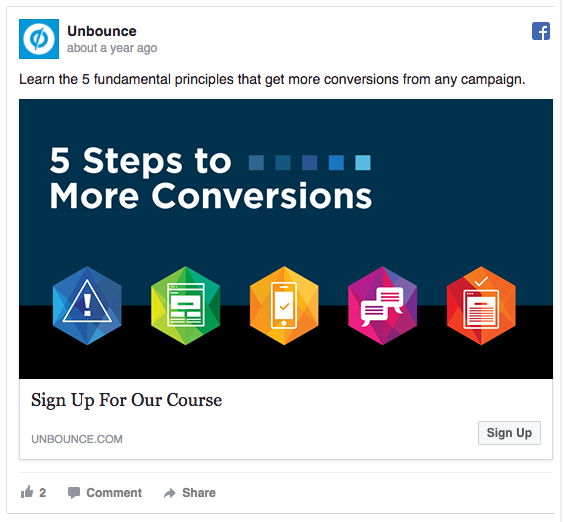
Unbounce

The reality of Facebook advertising is that most users will only read the headline of your ad. That means that you have to catch their attention with a limited number of characters. The Facebook recommendation for the headline is no more than 25 characters, and this ad from Unbounce does a good job by presenting a clear call to action in 22 characters.
Along with an effective headline, they also optimized the body of the text to maximize the clickthrough rate. This is accomplished with body copy below the 90 character maximum recommendation, and it provides enough information to get the reader interested without going into too much detail.
The image also works perfectly for this ad campaign. It is a clear and bold image that is enough to engage the user, but it does not dominate the ad. It serves the purpose of grabbing attention without distracting from the message.

A&W Canada

Facebook video ads are growing in popularity, and with good reason. A person that has watched a video is 1.8 times more likely to make a purchase than a person that did not. In addition, video has been shown to increase brand awareness and ad recall more effectively than static forms of content.
This ad from A&W Canada is a good example of Facebook video advertising done right. To start, they kept the video short, which is an important part of a successful video ad. Coming in at 22 seconds, this video is close to the perfect length for success. Most experts suggest keeping videos to 30 seconds or less, and if you look at the numbers the most popular videos are around 16-20 seconds in length.
Most Facebook videos are watched with the sound turned off. Realizing this fact, the team from A&W Canada added captions. This is a good way to ensure that the entire message comes through, and it will increase the clickthrough rate on your Facebook videos.

AdStage

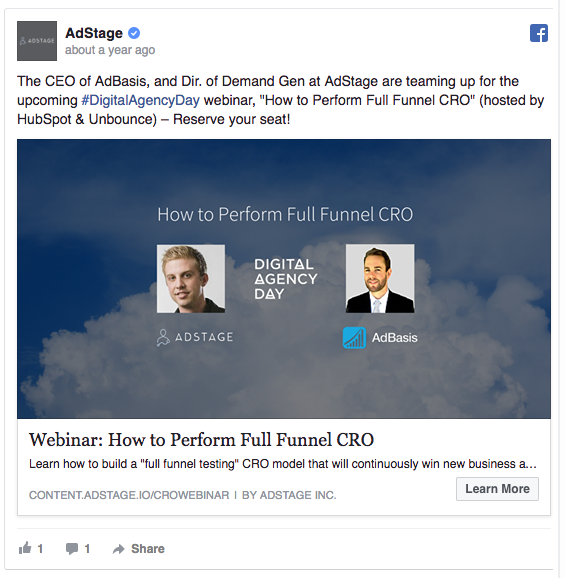
Influencer marketing can be a highly effective way to promote your brand. People trust the opinions of experts in their field, and it adds credibility to the campaign. With this ad from AdStage, you see a good example of how to get the most from an influencer campaign.
The team from AdStage made sure to mention the influencers in the text of the ad, and they added visual proof to provide a face to the name. The photos not only show the influencers involved, but also a good image of a real person is a good way to establish trust with the audience.

Survey Monkey

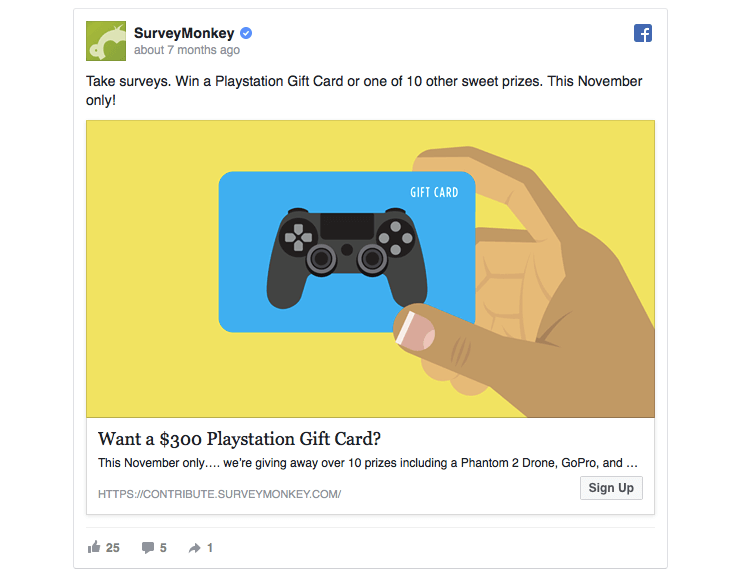
The key to a good Facebook ad is that it encourages the user to click with some type of incentive. It could be valuable information, the solution to a problem, or it could be a physical reward of some sort. Survey Monkey did a great job of incentivizing engagement with this ad.
With one of the prizes being a $300 gift card, they offered an incentive that was sure to attract many users. They also added an image of the reward to give their audience a sense of realization of the prize. Finally, they incorporated urgency by making the promotion a limited time offer. All of these elements helped to make this a highly successful Facebook ad.
When it comes to launching your best Facebook ads, there is no secret formula to getting it right every time – each campaign needs its own strategy. Depending on the intent of the campaign and your audience, you will need to use different tactics. However, the examples mentioned above do show some of the strategies you can implement to create successful Facebook ads.

Wednesday, 18 October 2017

Apple’s move to kill cookies isn’t a crisis — It’s an opportunit

marketingland.com

Columnist Mike Sands believes Apple's cookie restrictions will encourage marketers to take a new approach to building customer data sets and identity, giving them a more holistic customer view.


Once again, Apple’s got everyone in a tizzy — and no, I’m not talking about the $999 price tag on the new iPhone X. I’m referring to its latest iOS mobile operating system update, which takes cookie-blocking to a whole new level and will drastically impact a brand’s ability to maintain direct relationships with its customers.
As you may remember, early this summer Apple launched Intelligent Tracking Prevention, a feature for its Safari web browser that blocks third-party cookies by default. With the new iOS 11, first-party cookies take a hit, too. They’re now restricted to a tiny 24-hour window for retargeting, and after 30 days, they totally depreciate, disappearing into a veritable customer data black hole, never to be found again.
The update brings Apple one step closer in its decade-long quest to make cookies obsolete — a perilous development for the 91 percent of marketers that still rely primarily on cookies to identify users and build customer profiles.
But while six industry trade groups are up in arms over Apple’s move, it poses a real opportunity for brands that have a persistent identity resolution strategy in place. By eschewing fragile digital identifiers in favor of rooting customer profiles in durable, deterministic identifiers, such as email addresses or loyalty member IDs, brands can maintain continuous connections across all touch points throughout the customer life cycle, not just a campaign.

The ‘sandbox’ effect

Think about all the limitations facing first- and third-party cookies for desktop and mobile web regardless of browser, or application IDs and advertising IDs (e.g., Apple’s IDFA or Google’s Ad ID) for mobile apps and tablets. Cookies have never functioned well within most smartphone or tablet browsers, and their functionality is restricted, or “sandboxed,” within each app (where people spend nearly 85 percent of their mobile time).
With app IDs, the “sandbox” effect again comes into play: As the name implies, an app ID is specific to the app being used, meaning it will not offer a pervasive ID for all marketing communications with a user.
Of course, both Apple and Google thought of this when designing their respective advertiser IDs. Available across apps and often exposed within them, advertiser IDs (or “device IDs”) are unique to an individual and offer a single and relatively permanent ID source. However, consumers typically use only five apps on a daily basis. So unless a brand’s app is one of those lucky few, most marketers will not see an ad ID.
The cumulative effects are staggering. Given that the average US adult uses more than four connected devices to research, interact and transact (mostly within the mobile environment), it’s hard enough to keep pace with people as they move among channels, platforms and applications.
But the minute a brand commits to building any customer data sets around just one digital identifier, it creates massive identity gaps. Brands may see one person as many, or not recognize a known customer at all, leading to misattributed conversions, misinformed strategies, misappropriated ad spend and, ultimately, missed opportunities for engagement.
While it’s still essential that brands collect and connect digital IDs to fill in the holes in customer identity, it’s equally critical that marketers not use them as the foundation of their customer identity asset. Facebook doesn’t. Neither does Amazon. Nor any number of the newer, smaller yet massively disruptive brands that are able to recognize their customers on a 1:1 basis, not as a cookie file or device type, but as someone who has logged in or authenticated via some type of transaction. (You know, like buying a $999 iPhone.)
To get the same perspective on consumer behavior that Amazon or Facebook has, brands must take a new approach to data and identity, and implement a strategy that allows them to pull together their many fragmented glimpses into a holistic customer view. If they don’t, this latest move by Apple will undoubtedly lead to an identity supernova — a massive explosion that turns the brand’s customer data asset to vapor, hurtling customer relationships into a colossal black hole from which there is no escape.

Beyond the Blue Bar: The State of Location-Based Marketing for Advertisers

huffingtonpost.com

By Ian James, General Manager, International at Verve
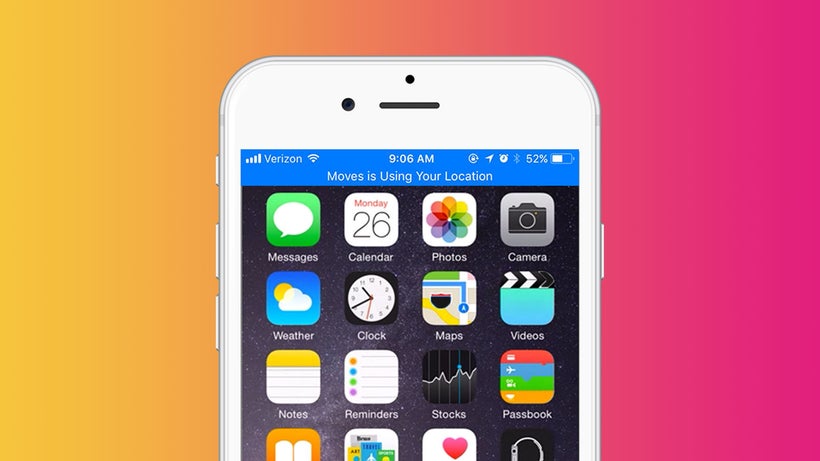
The arrival of Apple’s iOS 11 blue bar for location is a significant moment for mobile marketing — telling users when apps are drawing on location data (and raising all the concerns that change can create).
What the blue bar really represents, however, is not a blow to location-powered campaigns but instead a battery-life spotlight that will drive positive consumer experiences. The iOS blue bar is an opportunity for premium media and premium in-app advertising to shine. And it’s a moment that developers with power-draining apps — and those with unscrupulous data-collection practices built into their apps — will not soon forget. In short, the iOS blue bar for location will curb unnecessary data collection, and it will be good for our industry.
One data-driven moment at a time, this is how you win in the location-data space … you don’t need a blue bar to tell you that.
Every time a new feature like this one comes along, however, it’s also an opportunity to assess how mobile marketing is evolving in the location-powered space. With investments set to reach $32B by 2021 for location-derived advertising, it’s crucial to unpack what our technology can actually do — highlighting progress and also where we need to grow even further. Consider the following four points; each goes to the heart of where location data can take us, and what it takes to get location data and best outcomes right.

  1. Foot Traffic: At the core of what location-powered marketing promises is accurate and precise data about foot traffic. Beginning your journey with location data derived from the device — via in-app software development kits (SDKs), for example — enables marketers and advertisers to achieve a realistic measurement down to 5–10 meters. That’s the real-world case, right now, no myths about it. But it also comes with Remember, it’s not the SDK that’s driving the accuracy, it’s the ability to access increasingly precise sources of location data, like on-site beacons and Wi-Fi. The SDK must exist within a robust network of signals.
  2. Points of Interest and Other Data: Signals and data, along with multiple data sets coming together, are key to our continued growth. Beyond the device, for example, it’s true that point-of-interest (POI) data is important to every mobile-marketing campaign. It’s also true that keeping POI databases accurate and up-to-date is a challenge — stores change and buildings often contain multiple businesses on a vertical as well a horizontal plane (read our recent white paper for a deeper look at vertical location). The good news is that POI, CRM, beacon, and household data are converging, industrywide. As we promote and develop that convergence, powerful options such as the SDK will further make the case for location-powered marketing.
  3. Dwell Time: It’s not enough to know a consumer visited your location, you want to know how long they stayed — ultimately tying visits to purchases. To measure dwell-time you need the precise, consistent signals that can be collected through an SDK (again, it’s the conduit to background data, beacons, Wi-Fi, etc.). That being said, there are other solutions for finding dwell-time outside the location-data space — video-based solutions exist and there are metrics not attached to SDK or ad-serving — but SDKs are the only way to track dwell-time using mobile location data. Clearly, we’re looking at future that focuses on this approach.
  4. The Future of Beacons: There’s a lot to say about the history and future of beacons. We can start with this: the old story of pushing notifications and offers to consumers when in proximity to beacons has evolved. But advanced leaders in the location-data space approach beacons along the lines of measurement and strategy. Knowing the beacon-supplied frequency of consumer visits to a location, for example, gives advertisers the ability to measure the effectiveness of ads served and then develop thoughtful ways to engage consumers at other times.
In the end, it’s all about the audience. Location data is a piece of an audience-profile approach that enables marketers and brands to target with accuracy and precision. The best way to get location-rich data that is both reliable and powerful is to become as closely linked to each device — and each user — as possible. Going back to our list above, it’s repeatedly the case that the best way to get closely linked to users — and their devices — is to focus on the SDK.
Furthermore, thanks to the SDK and the learnings we can extract from the data it provides, we can even improve the future of open exchange data. Exchanges are full of noisy and low-quality data. But we can take benchmarks such as time-stamp and horizontal accuracy and apply them to exchange data, cleaning it up and scoring it to ensure advertisers are getting the best of both worlds — on-device and open exchange.
Blue bars and other notifications will come, and some will go, but one certainty in our industry is that the best-quality location data will always drive the most meaningful results. Meaningful results, for advertisers, publishers, and marketers, means engaging users with relevance. One data-driven moment at a time, this is how you win in the location-data space … you don’t need a blue bar to tell you that.

Tuesday, 17 October 2017

IAB LAUNCHES VIEWABILITY SDK

mobilemarketingmagazine.com
The Interactive Advertising Bureau (IAB) Tech Lab has released an Open Measurement Software Development Kit (SDK) to deliver data about ad viewability in apps. 

The in-app SDK is available now in limited beta purely for members of the Open Measurement Working Group, for testing. While the SDK has gone through extensive review and testing within the Open Measurement Working Group, which develops and maintains the SDK, the limited release will enable the IAB to collect feedback from integration partners and make any necessary adjustments before the SDK is made more widely available. 

The SDK consists of a native library for iOS and Android, as well as a JavaScript API, named OMID (Open Measurement Interface Definition), to communicate with measurement tags in a standard fashion. Initially, the SDK aims to deliver viewability metrics for in-app ads, including display, video, interstitials, and native ads. The IAB is also working on a similar solution for websites which it hopes to release early next year.
Open Measurement Working Group members Eric Picard, Pandora VP, and Brad Beal, senior product manager at Pandora, explained the reasons for the launch of the SDK in a blog post, saying: 

“Despite the complexity of supporting numerous viewability vendors on the web for any publisher, advertiser, agency, or vendor in the space – the challenge of supporting multiple vendors in mobile in-app environments has been nearly impossible to solve so far. The proliferation of vendors with their own software solutions that need to be supported in-app was causing complexity. Publishers were finding it difficult to maintain their apps and stay up to date with SDKs, and, there were discrepancies between vendors that were hard to understand and debug. Buyers were finding that inventory supply was becoming fragmented since not all publishers supported all vendors, which either restricted their options in media planning or forced them to work with different measurement partners across different publishers. And, as an industry, we frankly were not collaborating as much as we should have been to end the proliferation of fraud.”

The post goes on to explain that integrating software code from a third party into the code of the mobile app itself is fraught with all sorts of complexity and risk. “Mobile app developers must incorporate a Software Development Kit (SDK) into the code of their app to support the vendor’s tracking and analytics,” it says. “From a resourcing and time perspective, integrating with just one SDK can be costly for an organization. The process requires not only coding, but also significant testing on an ongoing basis to ensure the stability of the app. Couple this with regular SDK updates, essentially repeating the cycle, and the costs become prohibitive. And even then, SDKs can and do cause instability.”

The IAB initiative will enable publishers to deliver viewability metrics, supporting independent third-party measurement from multiple sources through the integration of one single SDK. And while there is no guarantee that the IAB’s SDK will be widely adopted, it’s worth noting that the Open Measurement Group includes some of the major players in the measurement space, including Moat, Integral Ad Science, Nielsen, Google and DoubleVerify.

'App Gap' Crisis? Big Data Visionary Urges Test Automation Rethink In IoT Age

forbes.com
Crisis? What crisis? No, I'm not talking about the 1975 Supertramp album, but research from a global leader in the test automation space demonstrating the “acute pressure” facing businesses to deliver apps in the Internet of Things (IoT) and digital era. It reveals that half of companies in the US and the UK admit to releasing apps before completing “quality testing.”
And, enterprises are being urged by the British CEO spearheading the test automation firm’s endeavours to rethink test automation to avoid the “app scrapheap.” But are matters getting to a crisis in the apps space?
In the survey commissioned by Testplant, a UK headquartered firm with a R&D presence in Boulder, Colorado, which provides what is touted as user-centric, digital automation intelligence solutions to enhance the quality and performance of the digital experience, canvassed 750 development team leaders in Britain and the United States to derive its findings.
The sample of canvassed ranged from telecoms companies, financial services groups, retailers and manufacturing firms - from listed to reasonably large companies - as well as government organizations. And the rationale for conducting the exercise was to validate what Testplant felt was the reality on ground and current thinking by companies.

The results come a month after Testplant, in which Carlyle Group’s European TMT-focussed fund invested €657 million (c.$696m) last year, launched its AI-powered Digital Automation Intelligence Suite, which brings to testing and the promise of “full automation and predictive analytics” to ensure their customers have a robust digital experiences.
Clearly, improving user experience (UX) and productivity are the keys to success in a digital world. But it would seem not all companies are up to speed given the survey’s results, which were conducted on its behalf by Kickstart.
Given that the manual testing market today is worth around $33 billion (bn) globally, if one could use Artificial Intelligence (AI) to augment humans to make them more productive the spoils on offer could be sizeable.
(Image: Shutterstock).
Roy Cornelius, Principal Architect (Digital Apps), IT Centres of Excellence, at BT Group, reflecting in the wake of the recently conducted survey said: “Test Automation is now a critical business requirement in the world of Digital and Mobile Apps. Rapid time-to-market and delighting customers are imperatives to business success.”
He added: “Expanding automation to assist with not just test automation, but also test case creation and test results analysis is a vision I share. And this must be done ensuring an optimal digital experience on any device or network.”
John Bates, CEO of Testplant, who urged enterprises to step up to the plate and commenting said: “To win in the Digital World and avoid the ‘app scrapheap’, enterprises must go beyond the current approaches to test automation. Testing must transition to become a profit center - testing not just code quality and app performance, but delivering predictive business metrics like satisfaction and retention.”
Cambridge University educated Bates, who has been recognized as a fintech and Big Data visionary and will move between TestPlant’s London HQ and their U.S. office in Boulder, added: “Only companies that adopt intelligent, end-to-end test automation approaches for software and apps will be able to keep pace with customer demands and the DevOps teams that support them.”
Productivity Gaps
Given that almost 1 in 4 people who download an app only use it once, and 51% of users do not download any apps in a month, things might well need to change and on testing front. However, at the same time, 86% of test teams say they are meeting their test objectives.
This it turns out is because organizations have “made testing more about code compliance checking rather than about delighting users” according  to Testplant. The upshot is low user adoption, engagement and revenue. And, in turn this creates a gap in user experience.
Concurrently with all this happening, DevOps, mobile and IoT, digital, and consumerization are hugely increasing the scope of testing, but shrinking time to delivery.
Teams are in consequence unable to keep up with the pace of DevOps, or deliver what the business wants - even with the budget they have requested. This creates productivity gaps in time to market and efficiency.
App Market & Economy
Last October, market intelligence firm Newzoo released its first Global Mobile Market Report, which included global app revenues and forecasts, device brand market share and smartphone penetration, which estimated that global app revenues will reach $44.8bn in 2016 and grow to $80.6bn by 2020. But the figure rather depends on which markets and segments are included.
More recently in June 2017, a report from app analytics firm App Annie projected that the global app economy would be worth $6.3 trillion (trn) by 2021 - against $1.3trn last year. And, over this time horizon the user base using apps will see an almost doubling to 6.3bn from 3.4bn people.
Mobile commerce was cited in this report as being the single largest driver of growth for the app economy, increasing from $344 per user to $946 by 2021. Asia will witness the quickest growth, reaching $3.2 trillion (trn) in 2021, followed by the Americas hitting $1.7trn and the EMEA region at $1.0trn.
Testplant’s survey titled ‘Application Crisis Research’, which was conducted amongst development team leaders on both sides of The Pond, revealed that 68% plan to build more apps during the next twelve Months. At the same time as reporting increased volumes of development, 91% of developers agree that user expectations for innovation and quality have also increased.
The ‘App Complexity Crisis’
The research, confirming that organizations are not only planning to build more apps in the next year, noted that they will be more complex. Over the next 12-18 months, 50% of the sample said their companies will develop more apps with IoT components, more than half (58%) indicated that their companies will develop more apps with Artificial Intelligence (AI) components, and 62% of  enterprises will increase the amount of apps deploying machine learning/deep learning components.
In addition, 42% believed that they are expected to design, develop and test apps in an “unrealistic amount of time”, with over a third (36%) admitting they are not given enough time to ensure apps are properly tested before deployment.
Just over four fifths (81%) expressed the view that with more time, apps deployed by their team would have a greater impact on the business.
Over half of the respondents (56%) agreed that use of outdated techniques and tools is “holding them back” from meeting the demands of the digital world. And, 75% agreed that with better tools, apps deployed by their team would also have a greater impact on the business.
Pressure Cooker & Crunch Point
Of the survey respondents, 60% said the majority of pressure comes from within the company, whereas nearly half (49%) indicated pressure comes from competitors.
Two-thirds  (66%) of the companies canvassed felt pressure from their company to innovate quickly and worryingly according to the Testplant’s survey, this resulted in 49% putting out apps “before they go through ideal testing.” Just under half (45%) knowingly put out apps that “will perform below initial requirements”, it was found.
And when it comes to specific app testing, automation beyond execution was ranked as the “most critical challenge” by 67% of the sample, though 70% claimed they are now more focused on automated testing than they were in the past.
Bates, who was previously CEO of PLAT.One, a company with an enterprise-grade IoT platform acquired by SAP back in September 2016, asserted: “It is reaching a crunch point for businesses, under pressure to provide the most amazing services and apps to consumers, and development teams facing internal and competitive pressures, as organizations rush towards digital transformation.”
He added: “Companies are struggling to keep up with the pace of digitalization and there will be a quality toll unless businesses see the imperative to completely re-think their traditional development processes and move towards more automated, intelligent solutions and tools.”
Digital Automation & Testing
Speaking on the sidelines of a Digital Automation Intelligence Roadshow at Absolute on the 29th floor of the Millbank Tower in London hosted this week, Dr Bates said: “It has moved from testing being about checking that the code [for an application] works, to now that in order for an application to be successful, does it delight the customer, does it get 5 stars in the App store and does it have a high net promoter score?”
He added: “An app success is not just about does it work, but does it win, does it delight the customer and does it get 5 stars? And. that is all about the user experience.”
As such Testplant’s goal is to use AI and analytics to automate it all, and according to Bates “figure out the system, to automatically create the test cases and coverage, then to analyse the results and to learn using AI.”
Making an analogy in his presentation in London, Bates said that in terms of where we currently are and mapping historically for where testing is: “We are not exactly in the dark ages, but probably in 1815 in terms of the use of real-time data. We are not learning from testing, not feeding it back and not using AI. Although we are automating tests, they are manually created just like algorithms. So, we are not considering what to test but automating the test process.”
The “real opportunity” for disruption in the testing space according to Bates is to “move to an AI-powered” learning approach to testing the system. Effectively, this involves analysing the system, automatically building the script and running them.
A tester’s job will never be easy given that the systems they work with vary in scale, complexity and cost, and systems development projects differ in timescales and the pressures facing participants in the space.
As Paul Gerrard, Principal of Gerrard Consulting and a member of the Working Party that produced the Component Test Standard (BS 7925), who attended the event in London, stated in ‘The Tester’s Pocketbook’: “Process-heavy technologies, technically dazzling tools and agile approaches work well in the right context but all have their shortcomings: high ceremony, cost, maintenance and ineffectiveness; poor productivity, reliability, accountability and return on investment.” But with AI and enhanced analytics we might just get there.
Testplant convenes its next digital automation intelligence roadshow in Los Angeles on Tuesday, 17 October, 2017, which will hear speakers including Anthony Edwards, Testplant's CTO, Michael Silverman of FIS and Samir Shah from UCLA Health. Thereafter it moves to Dallas on October 19 and Philadelphia in early November.

Friday, 13 October 2017

What is Link Retargeting?

blog.retargetlinks.com
Link retargeting
To put it simply, link retargeting is just like traditional ad retargeting. The key difference is that instead of having to send customers to your site, you can display retargeted ads based on the link they click. And it can be any link – not just to your website.
Link retargeting really allows you to take your content, social, email, or even AdWords marketing farther! We’ve put together five key tips you need to know to get started.

Can I shorten a link to any content?

The short answer (pun intended!) is yes! You can shorten any link on any platform to any site. To make the most of your efforts, we recommend making sure the content is relevant to your brand. This way, you’ll improve the odds that your target customer will click.
As an example, Pampers is using link retargeting to target ‘first-time moms’. They chose to direct their audience to a relevant article in Parents Magazine: “How to prepare for your first baby?”
Link retargeting in Pampers social media campaign with short link
Step 1: The advertiser posts “retarget” short links through social media, email, press or influencer platforms.
Link retargeting launches Pampers banner ads from social media campaign
Step 2: The service will retarget only those that click on the link. In this case, it will show 150,000 banner ads to 10,000 people.

Can I use link retargeting on a standard “long” link?

Link retargeting is not possible with a standard link. This is because it requires specialized technology that allows the link to place a retargeting cookie on the computer of the person who clicks.
We’ve developed this software to make it really easy for you to turn your standard links into retargeting short links. All it takes is the click of a button in your RetargetLinks dashboard.

Can I customize my short links?

Absolutely. Our short links are quite flexible, to allow you to have them appear exactly how you’d like.
You can customize the default re.tc links (this is a link to our patent for example: re.tc/patent). You can also request a short vanity URL (su.tt or jmpr.rocks are examples from some of our clients).
Note: In the vanity URL example, you’ll need to buy the short domain name first and then follow the instructions provided in your dashboard to start link retargeting using your own short links.
When running AdWords campaigns, you’re actually able to hide the short link within your AdWords ad link (see more here on how to set up a search retargeting campaign).

How many ads will be shown and where?

Our default volume cap (the maximum ads we show per person) is 15. This displays up to 9 ads per week, 5 ads per day, and 2 ads per hour, depending on the audience. We do this to keep your brand top of mind over a two to three week period, following the launch of your campaign.
We display banner ads just like a traditional retargeting tool. Your ads will display in Google AdX, OpenX, Rubicon, AppNexus and other real-time bidding platforms across premium online publications like Vogue, Elle, Fortune, FastCompany, Wall Street Journal and all other ad-supported sites.

How do I know if my link retargeting campaign is working?

There are three key metrics we use to determine whether a link retargeting campaign is working. They are: link clicksad clicks, and conversions. We’ve included some steps here to show you how to measure these metrics.

Step One – Measure Your Link Clicks

Make sure your link retargeting campaign is reaching your target audience. Emails, online articles, social media posts, newsletters, press releases, and even Google AdWords are all ways for you to share your short links.
If you’re just starting or are looking to reach out to more targets, we recommend using RetargetLinks as a prospecting tool. You can do this by boosting posts on social media channels, or paying for ads in Google AdWords.
Then, you can tell if your campaign is working by looking at the number of link clicks on your Links Dashboard (see below).
Link retargeting performance dashboard
Pictured above is the Links Dashboard> Here, you can monitor the efficacy of your audience building (or number of cookies dropped) for each campaign.
If you’re sharing the right content to the right audience on the right channels, you’ll have a lot of clicks. The example you’ll see next is from a campaign run by the team at Traction Conference. As a result of their RetargetLinks content campaign, they had 85,138 clicks (58,296 unique) from 873 links shared via their email newsletter (direct), Twitter and Facebook pages.

Step Two – Measure Your Ad Clicks

The second indication to help you measure your campaign is to look at the number of ad clicks on your Ads Dashboard. See below the example from our friends at Traction.
Link retargeting banner ad performance dashboard
Shown above is the RetargetLinks Ads Dashboard. Use this to monitor the efficacy of your retargeting link ad campaign.
When you display relevant and compelling banner ads, you’ll catch the attention of your targets and encourage them to click to find out more.
Helpful tip: banner ads are most effective when they have consistent branding, simple messaging, a clear call-to-action (CTA), and even some element of animation. 
In the above example, Traction Conference managed to display 161,340 retargeting ads to most of the 58,138 people that clicked on their short links. Out of those, 422 people clicked for a 0.26% click-through rate. Note that this is three times the 0.10% average for banner ad performance!

Step Three – Measure Your Conversions

The final indication of performance is to look at the number of people that land on your page and ultimately the number of those that convert by purchasing your product or subscribing to your service.
In the case of Traction Conference, 947 people landed on the marketing page and 186 actually went on to purchase a ticket for the conference. The team was able to achieve a 20% conversion rate. Note that this is 10 times greater than a typical retargeting ad conversion rate.

Summary

Hopefully if you’ve made it this far down the post, you have a better idea of how link retargeting works. Now you are ready to make the most out of your campaigns.
If you have any questions, don’t hesitate to drop us a line as we’d love to hear from you! If you’re ready to get started, click here to create your first shortened retarget link!

Tuesday, 12 September 2017

Learn From The Influencer That Gets 25-Million Impressions Per Day

inc.com
Influencer marketing creates a human connection between the brand and their audie

Influencer marketing has captured the hearts and minds of entrepreneurs all over the world. The realization that we can use other people's platforms to build our business has quickly become a go-to strategy for most small, medium, and large businesses of all kinds.
You may be wondering what can change in influencer marketing which will affect your business even more positively? That's what I love about this industry. There is always a new innovator breaking through the walls of creativity to announce new plans which can build your business even faster.
Abtin Masseratagah is one of those people. This CEO of Northrn is one of the forward thinkers on influencer marketing proving his prowess by accumulating nearly near half a million last year and providing co op jobs from local universities. Abtin aspires with future goals of opening his course within an MBA program to teach this new world of digital marketing to further the reach of education in this industry.
Sit back as this interview shares some of Abtin's ideals and how influencer marketing can change the way you do business in the future simply because the game is changing itself.

Working with influencers

The amazing thing about working with influencer marketing is that it is so new. We are only at the start of scratching the surface of influencer marketing.
Influencer marketing is where we have the chance to work with such brilliant young minds, as many of them are typically found to be the ages of 13 through 25. These are the millennials that are working in a space that targets their own age group. They know what they want, they know what works, so why not ask an 18-year-old what will work with an 18-year-old? It's almost common sense! They'll have the best insights.
Abtin has been working within this industry since he was 13, and many of the techniques and strategies that he's created for his clients are all ideal campaigns that he would have believed to spark his own interest.
The great things about this model versus the traditional channel is the work done with influencer marketing allows brands which are still young and small to truly build up quickly without needing such a large budget. It allows the brand to give itself a reputation through its influencers.
Many of these brands can't afford the millions it would cost for celebrity endorsements, so if they can spend a couple hundred to have influencers team up to assist them, it becomes a no brainer.
Working within the influencer marketing arena has helped many businesses create a more solid foundation with their audience to create trust, authority, and build respect through the influence of someone who is on their side.

Using mobile apps & influencer marketing

As Abtin mentioned in our interview, the mobile app space is currently being absolutely dominated through the influencer marketing.
Every app that his company Northrn had the opportunity to work with, when performed through the proper campaign design and pushed through Northrn channels had cracked the top 100 of the app store at the minimum.
These are larger designed campaigns that the Northrn clients requested. Many of which have gone on to crack the top 50 or top 10 at points of the apps career.
Influencer marketing is the perfect fit for the work done within mobile app development because of how instantaneously it works. "Within seconds of a post going live, using influencer marketing, we can have upwards of a million unique eyes on it to generate instant curiosity of the app leading to a huge influx of downloads.", says Abtin Masseratagah.

Think about real connection

One of the main strategies in which Abtin and Northrn firmly believe in is the realization of the human connection between the brand and the audience.
Abtin says, "I believe that if you can create something which can generate discussion within the real world between individuals, rather than a simple ad the typical consumer will view for a few seconds and forget about, then we've truly done our job as marketers and storytellers by going above and beyond to create something MORE."
Abtin's role in the work Northrn has made to impact business models includes a human touch. Using influencer marketing, you can build a bridge of connection between your audience which takes the place of an impersonal advertisement or simply asking your audience to do something for you all the time.
IvoryElla, Stargaze Jewellery, Electric Family, Protocol Recordings, and Republic Recordings are just a few successful campaigns which have benefitted from the advanced human touch of this strategy.
When you begin to think about the real human connection in your marketing strategy you force yourself to learn about their wants and needs.
You begin to understand what their struggles are and how you can move your business to help meet those goals.
The willingness to connect places you in the epicenter of the individual's life which makes it more personal for both of you and creates an investment of all kinds of opportunities in the future.

Ready to change the game?

In the end, the use of an influencer marketing strategy for your business is up to you. The benefits of influencers working for you means you can build measurable statistics to launch from later.
There are many different variables in which you can determine if influencer marketing is right for your business.
Whether you're just starting your business or launching a brand new product, both of these are a great reason to start an influencer marketing strategy with someone who has the reach, the know-how, and the clout to serve your brand you know the way it should be served.