Monday, 22 August 2016

What it takes to build a successful branded mobile app

marketingmagazine.co.uk
Starbucks: mobile app is a win-win for consumers and the brand
With app install ads having been introduced to both Google's Double-Click bid manager and Snapchat already so far this year, it's clear that the popularity of apps is on the rise, writes Shenda Loughnane, global strategy director at iProspect.
Apple announced that it passed the 100bn mark on app downloads via its App Store midway through last year. That means the App Store has seen roughly 14 times the amount of app downloads as there are people on the planet.
Developing apps is clearly top of mind for brands then, and a set trend for this rest of this year. The appetite is there, phone memory is increasing – but what actually makes for a successful branded app, and what is likely to see branded apps left downloaded, but largely unopened?
While consumers are indeed downloading more and more apps, branded apps in particular have to do three things.

Be personalised

Consumers are unlikely to download or use an app if it isn’t differentiated from the mobile browser experience. They’ll want to see curated suggestions on purchases, or location-based information that makes using the app worthwhile, for example.

Be adaptive

Consumer demands on apps are constantly changing, and new competitors enter the market constantly. Any branded app needs to move with the times, and follow the changing behaviour of a particular consumer in order to survive. Being open to integrations with new apps should be on the agenda, for example – so think about how Facebook Messenger is integrating with Uber, and how partnerships like this add value.

Be valuable

Branded apps need to add value, and do so consistently. The overall objective of developing them is to differentiate and elevate the position of the brand within the market. If the app is downloaded and used once by the majority of users because it’s got a poor value proposition or is a novelty, then it’s simply not worthwhile.
With this in mind, here’s a few branded apps that I think really work, and serve as good examples of how to ride the app zeitgeist – and avoid falling off.

Charmin – SitOrSquat

Spotting a gap in the market, Charmin helps you find public toilets when you’re on the go, and even lets users rate the bathrooms. Who would have thought that a toilet paper brand could develop an app that’s so relevant and useful?

Hilton – Hhonors

As a fairly frequent traveller, I really appreciate apps that make the whole process easier. Hilton’s Hhonors does that – you can check-in via the app, it acts as your door key, but you can also manage bookings and loyalty points. It’s an app that’s so entwined in the Hilton brand, while helping the hotel go above and beyond in terms of customer experience.

Nike – Nike+ Running

Nike was really ahead of the game in moving in on the ‘quantified self’ and understanding that its audience of fitness fanatics love tracking their progress, competing with their friends and publishing their success online. It’s created a whole culture of Nike fans that sits outside of just buying its sports gear. Although it does allow for logging trainers and prompts users to replace them frequently, so it has savvy commercial elements too.

Hotel Tonight

Hotel Tonight is a really useful app that allows hotel brands to advertise any remaining rooms for that evening at cheaper prices. Great for hotels looking to fill rooms, and for travellers looking for a deal at short notice. However, its positives also come with a side dollop of caution. Google is increasingly making app content searchable via the same process that it uses for sites – so in the case of Hotel Tonight, unless it offers something more in terms of content and utility, its app may become redundant.

Starbucks

Starbucks processes millions of mobile payments via its app every week. In fact, it saw around a fifth of its US transactions take place via its mobile app in Q4 2015, which has been downloaded by 11.1m Americans. It’s a resounding success because it speeds up orders (meaning you get your coffee quicker, and Starbucks can sell more coffee, faster) whilst offering a rewards scheme, that gives something back to the most loyal Starbucks fans. Win, win.

Driving change in times of organisational transformation

forbesindia.com
 Refine or if needed redo the change management plan to eliminate the most critical friction points and then to reduce or eliminate the remaining friction elements
Refine or if needed redo the change management plan to eliminate the most critical friction points and then to reduce or eliminate the remaining friction elements (Shutterstock.com)
We often hear that “Change is the only constant” or during a business transformation, that “The key to success of this transformation will be effective change management”.
Given the degree of leadership focus we see on this topic, it’s unfortunate that most of the times this is just lip service, with neither the thought nor the investment of people and resources being put behind these statements.
The key is in understanding that CHANGE needs ADOPTION to sustain.  So you need a framework that drives adoption and interestingly applying key PRODUCT ADOPTION principles for change ADOPTION during transformation actually works.
change
1. End users adopt “Experiences” not service, product or initiative
If you study services or products that have been adopted rapidly it emerges that end users are attracted not only to the product but to the entire user experience. For example, Apple products provide a unique and seamless experience through the user interface and App ecosystem, allowing for much more pervasive adoption than competitors.
In the context of adopting change, the same logic of focusing on the “experience”, is key.  Change is tough, but if leaders focus on breaking down the problem and understanding what stakeholders will undergo as an experience, half the battle has been won.
This is easier said than done, but keeping it simple works well as an approach:
1. Deconstruct what the change means from each stakeholder’s perspective
2. Focus on how the stakeholders will typically experience the change
3. Once you have a clear tested hypothesis on elements to drive a great experience, build your change management plan accordingly
2.  Ease of use makes adoption go “viral”:
A product or change initiative that is easy and intuitive to use is more likely to get adopted very quickly and enjoy viral propagation.  For example, the App ecosystem of Apple is so easy to use, build on and consume that it has led to viral growth of apps being developed and consumers downloading and paying for them.
Applying this to managing change, the key is how easy you make adopting the change through process, phasing, incentives and tools.
So in the change adoption context:
1. Prioritize and phase the change plan to make it super easy for stakeholders to adopt the change
2. Test that plan with stakeholders to validate what would make it easy for them to adopt the contemplated change and to get their input on the change plan
3. Refine the plan and execution on scope, and phasing. Most importantly focus on the actual execution i.e. the tools, organizational support and communication
3.“Friction” in any form kills adoption:
Unwavering focus on reducing “Friction” in any form, towards change adoption is critical. This friction could come from the organization, customer, technology or human interface, sales & distribution, or organizational processes.
Imagine a product / service that is great, fulfills a critical unmet need, is easy to use but that has other “friction” issues, such as an App crashing frequently or being too slow.  In this situation, adoption of the product / service would suffer hugely, even if the first 2 conditions are met fully. In a nutshell, friction in any form kills adoption.
When it comes to change adoption, the same principle applies. Thus, focus on identifying ALL relevant friction issues preventing adoption
1.Classify these friction issues by their criticality into “critical nonstarters”, “key to sustainability” and others
2. Refine or if needed redo the change management plan to eliminate the most critical friction points and then to reduce or eliminate the remaining friction elements
As we applied this to our breadth of experience with managing change, this construct fits perfectly both in successful and unsuccessful change management initiatives. However, we also find that in successful change initiatives, this is usually intuitive and not implemented as a structured process. The risk with not formalizing it, is that it could lead to a change event failing if for instance a “critical nonstarter” was overlooked.
Every change event is unique and complex, but a structured and powerful framework outlined above, in conjunction with a robust change management process & resources, definitely ensures a higher change implementation success rate.

Monday, 8 August 2016

Turning Mobile Banking into a Sales Machine

thefinancialbrand.com
Combining demographics with account level insight, transaction history and locational data can make your mobile banking app your most effective and efficient sales channel.
With the overwhelming acceptance of the smartphone and the increasing use of mobile banking applications, progressive financial institutions have moved beyond traditional marketing channels and are leveraging the mobile phone as an important sales channel. No longer just focusing on the mobile Web, integrating marketing messages within the mobile banking app itself offers a better opportunity to target the right audience at the right time.
For years there’s been a disparity between the amount of time people spend on their mobile device and the actual ad dollars allocated to this medium. No place is this more true than the banking industry, where there has been a hesitancy to use this powerful channel beyond basic banking tasks. It is expected that this gap will narrow as bank and credit union marketers become more adept at using mobile to reach their audience.
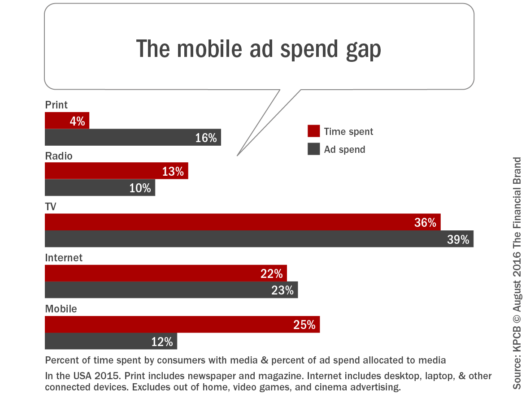
The_mobile_ad_spend_gap
The primary reason for the increased focus on in-app mobile banking offers is that this channel can provide a solution that can capture the targeted consumers’ attention and encourage them to interact without interrupting their mobile banking transaction.
“In-app mobile ad spend is really the future of the mobile advertising category. Considering that people with access to a smartphone or tablet now spend an average of three hours on them per day and 84% of all smartphone time is spent in-app, in-app engagement is increasingly critical for brands, advertisers, marketers, and agencies,” says Chad Gallagher, director of mobile at Advertising.com.
Compared to other marketing channels, it is estimated that the growth of mobile advertising will increase significantly more than any other channel, While the banking industry doesn’t anticipate this significant of a shift from traditional channels, it should be noted that the marketing world has noticed the sales potential of connect with consumers on their channel of choice.
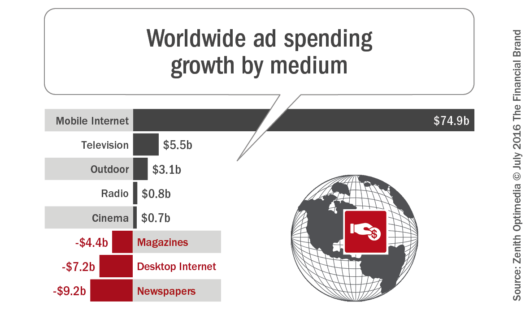
Worldwide_ad_spending_growth_by_medium
Avoka | State of Digital Sales Report 2016

Why In-App Mobile Banking Marketing Works

In-app mobile banking marketing works well because it combines the power of rich customer insights already on file with location data, which allows a bank or credit union to better understand context and increase engagement. So, while the best financial marketing can leverage both internal and external insights such as demographics, account ownership, balances and behaviors, in-app mobile banking marketing can add an additional data layer that can be delivered at the exact time of need.
Moreover, in-app mobile marketing also improves tracking, attribution and targeting, since a marketer can pinpoint exactly when and where an offer was clicked as well as what occurred before and after the engagement. This insight can be used to improve the offer selection and delivery via the mobile channel while also helping the targeting of other digital and traditional channels.
Finally, unlike most other channels, financial marketers can use in-app mobile marketing to determine if the digital sales process is overly complicated, causing abandonment of engagement and the loss of a potential sale. By understanding the stage of the sales process that causes abandonment, marketers and product managers can simplify the process and improve sales effectiveness.

Pre-Login Sales Opportunities

According to the Insight Series Report, “Sales Opportunities in Mobile Banking,” done by Mapa Research, which researched 44 banks and 8 other financial service institutions across 8 countries, there are many places within a mobile banking app where marketing can occur. Some brands use the pre-login area for promotional messages, while the activity in the post-login space appears to have more potential with more variety of engagement tools
There has been a significant increase in the number of banks using the pre-login space to promote new products and services, with 60% of financial institutions monitored by Mapa using some form of a promotional banner that appears behind or on the main login screen. Given that the log-in screen is seen most often by the customer, this is an obvious space to use for promotional banners.
Mapa warns that the generic nature of most banners can make them feel like internet pop-up ads and can detract from the aesthetics of the app and be a deterrent to those customers who are particularly sensitive to the feeling of being pushed to buy. To avoid this issue, some banks are using public-site product menus on the pre-login page, including market trends, community events, etc. In fact, 45% of organizations monitored offer more than just promotional banners on the log-in page.
Other strategies used by financial institutions as part of the pre-login process include:
  • Linking social media
  • Appointment scheduling
  • Tools and calculators
  • Rewards/Offer section
According to Mapa, banks need to be wary that significant investment in the pre-login space may go to waste as biometric authentication methods replace the need for passwords and speed up the login processes. “With instant access into the app, customers will be less inclined to browse the features of the pre-login space”, says Mapa.
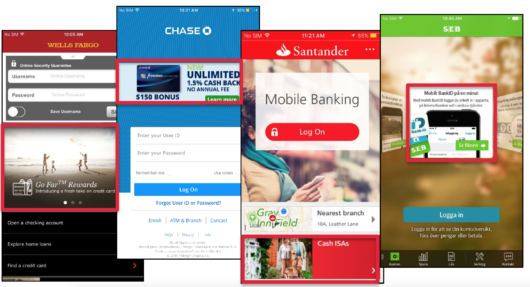
Mobile Banners - Mapa
Mapa Research

Post-Login Sales Opportunities

The main areas for post-login promotional messages are alerts and push notifications (managed in the app but received at any time). Both approaches are designed to keep the brand in the customers mind. Some providers are even using the customer spending and account activity to send timely notifications.
Beyond simply using alerts to warn a customer about a recent transaction or when an account falls below a certain threshold, organizations are also using these types of post-login messages to inform about a new product or service or to encourage the use of rewards. For instance, Bank of America uses alerts to inform customers about the status of their BankAmeriDeals rewards.
Post-login notifications are primarily used to engage with customers regarding the activity on their accounts. Not only can these notifications encourage customers to think more actively about their finances, they can also provide recommendations about services that could assist in these efforts.
In order to meet “unmet needs”, providers are making use of customer data to get to know their customers. Using this data wisely allows brands to deliver promotions tailored to each individual.
According to Mapa, “Every push creates trust between the user and the app because it delivers immediate value. Due to the trusting nature of this relationship, if the customer was to then be sent a notification alerting them to a new product that could further improve the health of their finances, the customer is likely to react positively to this, and see it as an extension of the existing relationship instead of an obvious sales push.”

Interstitial Messaging

Financial institutions are not only focusing on the pre- and post-login opportunities to market products and services. Some organizations are leveraging the space between between pre- and post-login for using interstitial messaging. These are screens that pop-up after the consumer has logged in but before they can continue their transaction.
A well done interstitial only causes a minor interruption in experience, with the customer having the option to skip the message with a simple ‘swipe’. This has the benefit of balancing experience with effective selling.
This technique can be used to inform the customer about a recent update of the app, a major product announcement, a community event, etc. Some organizations provide the opportunity to ‘see more’ before they move forward with their transaction. Although ad formats are less important than relevancy, research shows that in-app banner ads don’t generate as much revenue as personalized ads and both of these formats are much less effective than an interstitial.
Mobile _sales_channel_do’s_and_don’ts

Tailored Marketing Messages

Optimally, customers should receive marketing messages based on their spending habits and marketing preferences. The latter is an important point, since even tailored messages can become intrusive if received too frequently or in a format/channel that the customer is not comfortable with. As a result, some banks provide customers with the option to control how and when they receive marketing messages.
Banks and credit unions can also tailor product offerings to specific consumers. such as loans with predetermined values based on consumer spending data. “By using customer data that the bank already has access to, the bank can expedite the application process and significantly reduce the likelihood that a customer would go looking elsewhere when thinking of applying for a similar product,” states Mapa.
Done effectively, selling within the mobile banking app dramatically reduces the inconvenience of applying for financial products or services through other channels, meaning that the number of customers that abandon the process and ‘quit before the check-out’ is lessened considerably.
Mapa research manager Jess Morley comments: “Consumers and financial solution providers have become wary of the ‘hard sell’ when it comes to financial services. As a result, there has been a move towards selling by identifying unmet consumer needs, using data to identify products that could improve a consumer’s financial situation.”
He continues, “When products are suggested to consumers in this evidenced-based manner within a mobile app, the sale seems less forced and consumers are more willing to trust the suggestion. This is a sales technique that banks have adopted from e-commerce providers like Amazon, which provides customers with a list of suggested products based on their browsing history.”
At the end of the day, it is best to target the best way possible and experiment with all kinds of ad formats and placements. Try pre-login and post-login and use banners, lists, interstitials and maybe even a video. Then, conduct A/B testing them.
While the placement and ad format may be important, making sure that an ad is relevant to the user while simultaneously presenting it in an non-invasive manner is more important. It is the relevancy of the message that makes it compelling as opposed to the ad type.
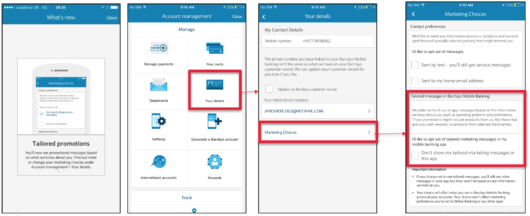
Tailored Messaging
Mapa Research

Wednesday, 9 March 2016

WHAT DOES IT COST TO DEVELOP AN APP?

fueled.com
Author: Mary Hurd
mobile app wireframe
It’s official: mobile apps are now integral parts of life (even old ladies gossip about them at country clubs). Formerly a millennial phenomenon and currently a multi-billion dollar industry that is clearly here to stay, the mobile app industry is the way of the future (and the present).
So, how can an entrepreneur achieve longstanding recognition in this crowded field? What are consumers looking for? How can you build a successful app?
We enlist the help of Rameet Chawla and Ryan Matzner, who run the show at Fueled, our mobile development shop that works with startups and more established enterprises alike, to give us some insight. With over a decade of experience in the technology industry and relationships with hundreds of startups in New York City, the duo boasts an understanding of both the technical and social aspects of app building. Who better, then, to share all of the industry’s secrets?
Ladies and gentlemen, here’s your everything guide to building your very own (and very successful) mobile app:

HOW DO I FIND A GOOD DEVELOPER?

Remember: credentials precede promises… and reputation supersedes all else. Chawla suggests reaching out to agencies that have won awards, have been mentioned on tech-related news sites, and, most importantly, have the sort of experience that your specific app requires.
“If [your] app [has] a heaving programming or coding component to it, [you] don’t necessarily want to go after an agency that only has experience with more simplistic apps,” he says.
shutterstock_119236960

CAN I START BUILDING THE APP MYSELF BEFORE REACHING OUT TO A DEVELOPER?

Yes. “We call [them] ‘rescue projects,’” says Matzner. “[These are projects that] people have started elsewhere and they end up coming to us because they realize that these promises someone else made were completely empty, or they didn’t know about us when they started and they have figured out some pitfalls with their current setup.”

HE CONTINUES, “THEY’RE LOOKING FOR SOMEONE WHO CAN ACTUALLY FINISH THE APP AND GET SOMETHING RELEASED. OR, THEY’VE RELEASED SOMETHING AND IT JUST DOESN’T WORK AND HAS ONE STAR IN THE APP STORE, AND THEY NEED HELP FIXING IT.”

ALTHOUGH STARTING TO WORK ON THE PRODUCT ON YOUR OWN IS NOT IMPOSSIBLE, MATZNER EXPLAINS THAT THE APP WILL MOST LIKELY NOT POSSESS “THE SAME POLISH AND QUALITY AS A PRODUCT BUILT BY PROFESSIONALS.” A SKILLED PRODUCT TEAM WILL UNDOUBTEDLY BRING MORE EXPERTISE TO THE ENDEAVOR.

HOW IS A MOBILE APP DEVELOPMENT TEAM SET UP?

Matzner breaks it down for us: “A development team […] is sort of like a Broadway play. You have the actors on stage, but then there’s a whole bunch of stuff happening behind the scenes. An app that gets built properly is sort of similar.”
A successful team should include:
  • designer who creates all the visual content that will be coded into the project
  • An account manager who acts like a liaison for clients and works with product managers and producers to coordinate the completion of different tasks
  • product manager who executes the functions of a director by overseeing the app

HOW MUCH DOES IT COST TO BUILD AN AVERAGE APP?

Aaron Cohen, a highly-respected top representative at Fueled, gives us some insight: “With Fueled’s experience you’re going to find that you’re going to need at least $150,000 to build the first version of your product.” This budget, he continues, would probably be the same regardless of the shop hired.
Although Fueled has built version one products for as little as $150,000, the agency has also catered to customers who had more extensive requirements for their minimum viable product (MVP)–costing them as much as $500,000 for their first version app.
shutterstock_158600417

WHAT QUALIFIES AS AN MVP?

“As we like to say, the definition of MVP is completely context dependent,” explains Cohen.  “If you are going for a social media play, you want to test assumptions about how people want to share content, then you can probably get your app out of the door for $100,000-$150,000. But if you’re an e-commerce play, you need to integrate advanced payment services, profiles, databases, perhaps an email marketing system, then you’re looking at involving back-end engineers, creating custom back-end systems, and the price tag can very quickly escalate.”
One way to estimate the amount of resources needed in the first 18 months of operation “is to look at the amount of money that successful startups raise for the first year or two of their operations,” explains the expert. “Traditionally, a startup will get going with a seed round or a friend-and-family round of $250,000 to $500,000. That will allow them to run the company for 6 months or so. Generally, they then need to raise a bridge round. Another $500,000 to a million dollars, which will really let them take whichever prototype or proof-of-concept they validated in the first phase, take that to a higher level, [and] really polish it up for widespread consumer release.” The result? About a million and a half dollars to operate a startup for the first 18 months.
A deeper analysis of an app’s cost and development time.

WHAT IF I HIRE A FREELANCER OVER A SHOP?

Hiring a freelancer results in a decrease in costs… and an increase in risks. Risks may include inefficient work ethics and habits, miscommunications, and a lack of consistent efforts and availability. Unless catching a lucky break, hiring a freelancer will most likely lead to an end product that won’t match its original footprint.
Think of building an app as you would think of filming a movie from scratch. Budget and motivations are key components, and your dedication to the task at hand will be of paramount importance. You will be putting as much effort into a one-dimensional app as you would when scraping together a casual student film. On the other hand, if you’re working on the next world-changing app, the time and power invested in the product will resemble that required to roll out the next summer blockbuster.
When employing all these resources and energy into the product… wouldn’t you want to rely on a company whose entire day is dedicated to you as opposed to a freelancer who constantly deals with other clients as well?
Agile Mobile app development

ULTIMATELY, WHAT IS THE SUCCESS OF MY APP TRULY BASED ON?


App development is a science based on trial and error. The secret to eventual success involves tempered expectations. The most common success stories are based on a solid beta test or a proof-of-concept that is splendid enough to generate another round of funding and maybe even attract some press.
Most app developers have big dreams for their grand product before even entering the scene. But, remember: to traverse a mile, you must take your first step. So come up with a grand idea, believe in yourself, and enlist the help of professional developers who can turn your vision into a reality that will change both the mobile app industry and the lives of the consumers.

Thursday, 25 February 2016

Waging Restaurant Wars: How to Create a Mobile App That Boosts Revenue and Customer Loyalty

Waging Restaurant Wars: How to Create a Mobile App That Boosts Revenue and Customer Loyalty
business.com
Restaurants thrive on loyalty.
Sure, there are always out-of-towners passing through that stop by for a quick meal then jump right back on the highway, never to return, but the real money is in winning over locals and convincing them to order off your menu again and again.
Improving customer loyalty requires more than just good food (though that is vital, of course). You need a finely-crafted marketing and customer engagement strategy to get people to keep coming back, and having a mobile app for your restaurant is an important piece of that strategy.  
Making your advertising efforts more effective, increasing brand awareness, and improving customer relations are just a few of the many benefits associated with having a mobile app.
All those benefits have a tremendous effect on your bottom line and meeting your revenue goals.
Want an app of your own, but don’t have the coding experience or budget to build something custom? Here’s what to do:
  1. Find an app builder. In your initial search, you’ll see that there are many options to choose from. There are many app builder solutions out there for small businesses that offer an excellent blend of quality and affordability and don’t require a lot of extra time to get started.
  2. Select a template, give a few directions regarding content and branding, and upload your menus and other content. The app builder will take it from there.
If you still need a little more convincing, let’s delve deeper into those aforementioned mobile app business benefits.

Direct Marketing Channel

The trouble with most marketing methods is that there’s no guarantee that what you’re paying for is going to be seen by the people who you want to see it.
Think about a TV spot: very expensive, and anyone who has a DVR will just skip right past it, and even those without a DVR will take the few minutes they get during a commercial to go to the bathroom, grab a snack, play on their phone, etc.
In others words, they’re not exactly engaged with the content you’re trying to present them with.
A mobile app provides you with a direct marketing channel to potential customers. People may not pay attention to commercials, but they do check their phone whenever they hear it make a noise.
So when you have a new menu option or some sort of sale/promotion, you can be sure that  pretty much everyone who uses your app is actually going to be aware of it.
The same cannot be said of other advertising methods (print, radio, TV, we’re looking at you).
Another aspect to consider is a concept called effective frequency, which is defined by BusinessDictionary.com as an “advertising theory that a consumer has to be exposed to an ad at least three times within a purchasing cycle (time between two consecutive purchases) to buy that product.”
We can’t knock print/radio/TV on this one. Those methods are very good at establishing effective frequency (exposure doesn’t necessarily require paying attention).
A mobile app, though, might be even better in this regard. It earns you a spot on the potential customer’s oft-used iPhone, allowing you to constantly remind them of who you are and what you do.
As much as people love their TVs, smartphones feature the screens that are seen the most nowadays.
Customer Loyalty
Another problem with traditional advertising is that everyone knows that the ads are biased. Even when you agree with an ad or find it entertaining, in the back of your head you always know the content is only there to serve the sponsor.
Your mobile app, on the other hand, allows you to engage with your best customers, to spoil and reward them so that they feel a positive connection to your brand.  
App builder solutions have built-in programs to provide your customers with coupons and giveaways using push notifications. You can also track loyalty programs directly in the app. No more need for punch cards.
One survey found that improving customer service and experience was the top driver cited by small businesses for building a mobile app. Surprise and delight your best customers with regular rewards sent directly to their pocket, and they will surely become an advocate for your brand.

Brand Definition

Your business’s brand isn’t something you can exactly quantify with a dollar amount, but little else is more essential to your restaurant’s success.
Personality is important. In the restaurant business you’re going to have to deal with a lot of competition, and if you don’t stand out from all that noise you won’t stay in business for long.
McDonalds is the place to take the kids (it’s no coincidence that they use a clown as their main mascot. Children love the simple food and the playgrounds, parents love the price), the fancy Italian joint downtown is the place to take a date.
You don’t bring a date to McDonalds or your kids to the Italian joint. Those restaurants are successful in large part because they’ve decided what kind of restaurant they want to be, and they’ve learned how to reach that demographic.
You can use your app as a statement to attract whatever demographic you’re going for.
For example, an app for some college town burger bar can use offbeat design and humor to appeal to its average customer, while a more kid-friendly establishment will opt for simple language and bright colors.
Your mobile app is an opportunity to refine your image.
More than 200 million Americans own a smartphone. That’s nearly two-thirds of the population.  
App builder tools make it easier and more affordable than ever to get started with a mobile app, and anything that better connects you to the wide, and still expanding, smartphone-using demographic is good for business.

The Futurist: Sorry … there’s no app for that


Mark Potrait 0250

On its 30th anniversary, the world celebrated Back to the Future day. Cable news channels debated whether the producers got their version of 2015 right. So if you want to know what the future of marketing may be like, I’d suggest looking at the past for some timeless truths.
Crystal balls? We don’t need crystal balls! The principles of marketing management have not fundamentally changed since Philip Kotler and Peter Drucker first translated best practice into academia in the 1960s. But what has changed is the sheer variety of tools we now have at our disposal.
However, the best tool is only as good as its user. And the vendor who’s making the fancy PowerPoint
presentation convincing you their wonder tool or predictive channel is the bee’s knees is probably the least objective person to turn to for unbiased advice. There’s no more shock in future shock.
So what’s the future going to be like? Let’s get the obvious out of the way.
• Next Gen Tech will overtake Now Gen Tech. And there will always be new bandwagons to jump on.
• Media will continue to fragment. Channels will always get costlier and reach less.
• Big data will overpromise and under deliver.
• Agency planners will needlessly overcomplicate advertising.
• Pundits will prematurely predict the death of ad agencies, newspapers, TV and radio.
• Today’s Millennials will be replaced by tomorrow’s post-Millennials.
• Focus groups will continue to reinforce the familiar and seldom uncover the undiscovered.
• Everyone will continue to confuse each other with more jargon and acronyms which we hear, use and repeat without real understanding.
Just like Max Planck’s chauffeur, the ability to qoute what one hears doesn’t make one a quantum
physicist. Success isn’t forever. Failure isn’t fatal. What will not change in this future is the
marketing world will be divided as always into winners and losers.
For every iPhone launch, there’s an Apple watch bomb. For every PayPal success, there’s a failed Bitcoin. For every online viral Volvo “Epic Split”, there’s a brand popping up on an undesirable website thanks to programmatic buys.
Regardless of which industry you are in, I humbly submit the one factor which characterises marketing winners is quite simply: courage. As Drucker pointed out – behind every business success was someone who made a courageous decision.
Warning label
Let’s be clear, courage is a double-edged sword. It’s both a career killer and a turbocharger in corporate land. Courage cannot be learnt in business schools. There’s no “on/off” switch in one’s DNA code nor an app for it. As such, courage is the one quality that’s sadly missing among many marketing professionals. At its core, marketing management is the art of making strategic decisions to achieve positive outcomes.
Therefore, it takes courage to navigate ambiguity, reject conformity, filter falsehoods, buck convention, trade control for collaboration, take ownership for mistakes and realise that silver bullet solutions do not exist.
Twelve things business schools never teach
1. It takes courage to terminate ineffective legacy strategies and practices.
2. Conversely, it also takes courage to support a tried and proven strategy when consultants call change for “change’s sake”.
3. It takes courage to “double down” on initiatives that can only bear fruit after more than one financial quarter or FY. (Patience is not a common trait among CFOs.)
4. It takes courage to take a leap with the untestable when research says stick to the tried and tested.
5. It takes courage to point out that just because some things can be measured, it doesn’t mean it’s always worth measuring.
6. It takes courage to realise that big data identifies patterns, but not always insights. (The customer isn’t an IP address, she’s your wife.)
7. It takes courage to know that just because ideas can be content it does not necessarily
mean that all content has ideas.
8. It takes courage to reject buzz dujour activities such as content creation, UX and branded entertainment if it doesn’t solve business problems.
9. It takes courage to explain their real value given that “views” and “likes” cannot be booked in the one-company ledger.
10. It takes courage to admit that brand conversations and storytelling are peripheral activities, not a primary business objective.
11. It takes courage to call BS on the latest “black box” digital solution if you can’t explain how it works in plain English.
12. It takes courage to hire small independent ad agencies with special talents over big networks agencies with hierarchies and overheads.
After all, didn’t the best SIA campaigns come from a small local shop with no global network to speak of?
No guts no glory. As a former creative director, ad agency head and now a client, I always believed marketing is, at its core, an intuitive alchemy of imagination and best practices.
In a future where the environment becomes more complex and the pressure to deliver mounts, the more we need marketing professionals with the courage to make bold and considered decisions that will move the business needle.
And that’s something that was just as relevant in 1985 (when Back To The Future was released) as it would be in any future.

Security Is a Top Barrier to Internet of Things Growth

emarketer.com
Business execs are working on IoT projects to grow their business 
Interest in the internet of things (IoT) is increasing, but challenges still arise. According to January 2016 research, business executives said security was one of the top hurdles to growth. - See more at: 
Barriers to Internet of Things (IoT) Growth According to Business Executives Worldwide, Jan 2016 (% of respondents)
James Brehm & Associates revealed that almost two-thirds (64%) of business executives worldwide said that security was a top barrier to IoT growth. Interoperability was another barrier, 51% of respondents said so. - See more at: 
Other obstacles included cost, hardware integration and the fact that business executives could not prove the ROI.
Additionally, 60% of business executives that were polled said their company was working on IoT projects to grow revenue and profits. And, nearly a quarter of respondents said they were looking to improve a business process.
Primary Use of Machine Data/Internet of Things (IoT) in Digital Marketing Campaigns According to US IT/Business Executives, July 2015 (% of respondents)
Generally, marketers are leveraging the internet of things to track and reach the cross-everywhere consumers. A July 2015 study by 2nd Watch found that nearly six in 10 US IT and business executives said they leveraged machine data/the IoT for digital marketing.
However, for most, it was still early days for doing so, as two-thirds of users said they were in the beginning stages.