The best articles, videos and links about App Ecosystem, Mobile Marketing, Mobile Commerce/Payments, Blockchain/Cryptocurrencies, Artificial Intelligence, Retail Media,..that help me in my daily work.
http://www.linkedin.com/in/agustingutierrezbazaco. Mail: agbazaco@yahoo.es
Twitter:@agbazaco
Nowadays, privacy is more important than ever. This is particularly true in the context of identity, which is at the core of what makes us human.
In a world of data, we’re torn between the convenience of all-knowing companies and the safety of complete privacy. And with recent data spillage from tech titans, the risk associated with the convenience of centrally-stored data is all the more evident.
Thankfully, blockchain technology brings a solution that is both safe and convenient. It’s putting power back in the hands of users by giving them full control over where and how their data is used. It decentralizes data storage, so sensitive information doesn’t have to be entrusted to a third party or stored in piles that can become honeypots for bad actors.
And there are a number of powerful applications.
Your identity is easily verified. With traditional login methods, all it takes is knowledge of the right information to access an account. That means anyone with your personal data can pretend to be you. Decentralized identity verification, on the other hand, requires physical access to the user’s device or some other means to prove that they’re the rightful owner of that identity information — they didn’t just find it or buy it — a much higher barrier for any bad actors to surmount.
There’s a lower risk of mishandled data. Recent data breaches of Equifax, Facebook, and other large companies have called into question the security of third-party data storage. When companies failed to secure data, they left millions (sometimes even billions) of account owners vulnerable to identity theft and cyber attacks. With a decentralized identity, however, your information and power over it are always in your hands — so there’s a much lower risk that your data will be compromised.
Transactions are set in stone. Change isn’t always good. If previously attested information is altered, it opens a system to fraud. By decentralizing information through blockchain signatures, altering verified information is nearly impossible. All transactions on the blockchain are immutable, preventing anomalies in the network and thus ensuring that verified data has not been tampered with.
It’s convenient. You know how it goes. To access an online service, you have to register online, set your password, and choose security questions that will later prove your identity. And with each new service, you start the process all over again, forgetting almost all your passwords along the way. Decentralizing identity simplifies the sign-up and sign-in process. Just prove your identity once to a trusted third party, then reuse that verified identity over and over again with your mobile device, eliminating the need for security questions like your 3rd-grade teacher’s pet’s name.
Users are in control. By decentralizing data to store it on devices rather than on centralized databases, users get the final say over where, when, and how their information is shared.
Though “power to the people” certainly isn’t a phrase commonly used in the financial and technological world, blockchain is literally doing just that. By implementing a decentralized identity, it puts you back in control of your digital self.
So, you’ve entered the exciting world of digital currency but you’re worried that you may be at risk of having your coins stolen by hackers. This concern is completely valid, and even some of the biggest players in the space have gotten hacked.
There are billions of dollars worth in cryptocurrency that have fallen into the hands of malicious third parties and hacks don’t seem to be slowing down. Coincheck, a Japanese exchange, lost $534 million in NEM coins (523 million NEM) in 2019 - one of the biggest hacks in cryptocurrency history.
As an individual, you might not be such a focal target as centralized exchanges such as Coinbase, but the possibility that someone wants to gain access to your coins is still very real. Here’s how to get and stay protected and keep doing online gambling with bitcoin safely.
WHAT’S COOLER THAN BEING COOL? COLD STORAGE
By far, the safest way to keep your coins safe is by keeping it in cold storage, a term that refers to cryptocurrency (or data) kept off the Internet. This can be done in a variety of ways included by paper wallets (literal pieces of paper) or hardware wallets such as a Ledger Nano S or Trezor.
When it comes down to it, you’re probably better off using a hardware wallet because paper wallets can be very easy to lose and often require using an online generator, which sort of defeats the purpose of having an offline hardware wallet.
However, keep in mind that cold storage only protects you from external threats - not the seemingly infinite capacity for human error. There are dozens of stories of unfortunate souls accidentally tossing their cold storage devices in the trash, or in a moving box that ended up getting mixed up and being sent to a Goodwill as a donation.
CALL IN THE BACK UP FOR YOUR BACK UP
The coast isn’t clear even once you’ve got your cold storage set up, but you’re almost there! Hardware wallets usually come with a series of back up words that will help you regain access to your cryptocurrency wallet in the event that you lose the physical hardware wallet.
But, wait - what’s the point of a hardware wallet if someone can just gain access to your cryptocurrency holdings by using your back up phrases?
Exactly - so you need to make sure those are safe as well. The point isn’t to prevent someone from gaining physical access to your cryptocurrency, which requires the same precautions as having a briefcase full of cash or high-end piece of artwork.
Many people decide to rent one or two safety deposit box at a reputable bank(s), which usually costs around $60 per year, and keep their hardware device and back up phrases there for safe keeping. However, this has some burning drawbacks
The first is that you lose the convenience of having your cryptocurrency on you and available for trading at any moment. This is why this strategy tends to be only used by people looking to sit on their holdings, you know - the HODLers, and not by people doing short-term trades or using their cryptocurrency for things such as online gambling with bitcoin on MintDice.
The second is more ideological. Many cryptocurrency enthusiasts are vehement supporters of “being your own bank.” Keeping your hardware wallets in a bank seems diametrically opposed to this, but at the end of the day, would you rather be a hacked or not hacked?
BUT, WHAT IF I DON’T WANT TO KEEP ALL MY CRYPTO LOCKED AWAY?
While cold storage is the safest way to protect your digital assets, it can be inconvenient for people who need access to their holdings on a regular basis.
If you’re in this situation, it’s recommended you keep whatever cryptocurrency you need on hand on a software wallet such as Exodus, and the rest in a cold wallet.
Of course, you also have the option to keep your cryptocurrency on an exchange such as Binance or Coinbase, but then you immediately up the ante of risk. You not only have to worry about hackers getting into your personal wallet, but also those hacking into the exchange itself, or even the exchange deciding to run off with your mula.
Modern exchanges have taken precautions to safeguard their customers, but this is an article on the best ways to store your crypto, so we need to mention the risks associated with exchanges.
If you do decide to store some cryptocurrency on an exchange or other “hot wallet”, there are some precautions you should take:
Enable 2FA - This is a MUST. Two-factor or other multi-factor, authentication sets up more safeguards to your private keys. Most people set this up with their phone number, and many exchanges have made 2FA part of their standard procedure. However, there have also been instances where hackers have gained access to someone’s SIM card remotely.
Google Authenticator - This is a free software-based authenticator that generates new codes every few seconds, making it harder for hackers to use any single code for any period of time.
FreeOTP - This is a free and open-source software token that can be used for two-factor authentication.
Keepassxc -a free and open-source password manager.
FINAL THOUGHTS
“Only you can prevent forest fires.” - Smokey the Bear.
Also, only you can prevent your cryptocurrency from getting jacked. Learn the ropes of keeping your tokens safe, and you will be able to live the crypto-libertarian dream of being your own bank - or at least not losing a bunch of tokens that potentially will be (or currently are) worth a fortune. Done correctly, you’ll be protected and gambling online with bitcoin safely.
As we dive headfirst into a new digital era, it’s becoming increasingly important that we each take extra measures to protect our online identities. Today, so much of our lives — communication, entertainment, travel — rely on digital technology, and using that tech often requires us to provide data about ourselves. While this is typically a necessary exchange for access, with more traditional technologies, people become subject to identity theft and this creates barriers for both them and the service providers to offer the most seamless experience. After all, the way we authenticate today is based on information “challenges,” and they are called challenges for a reason.
Blockchain technology is bringing about a more secure and convenient solution, and Civic is at the forefront of this revolution when it comes to digital identity. Just think of the Civic app as a digital wallet that bridges your physical and cyber credentials—it will eventually be able to hold not just your verified ID docs, but also ticket information, credit cards, passwords, and other types of personal information you use on a regular basis. But unlike a traditional wallet, information stored on the mobile device is secured with blockchain attestations, encrypted, accessible with biometrics and usable only with independently verifiable attestations, so you can rest assured that even if you lose your device, it becomes incredibly difficult for anything bad to happen to your data.
Let’s say you’re planning a vacation:
You’ll probably start by browsing a few websites, then booking your flight, hotel, and tours online. When you make these reservations through a Civic partner, they send you a request so you can provide the information they need via your Civic app on your device. If you don’t have your information already in there, no need to worry, you can get verified on the spot in less than 5 minutes.
As you head out for your much-anticipated vacation, you can use the same mobile device with the Civic app to board your plane, check in to your hotel, and explore your new destination. And instead of pulling out your credit cards and ID at every check-in station along the way, all you’ll need is the device to verify that you are who you say you are. This makes it easier and more convenient than ever to get from point A to point B (and back to point A, and if you really enjoy yourself, back to point B).
Engaging in the online world doesn’t have to be risky or complicated. With Civic, you get full control over your digital identity, so you can have a friction-free experience while keeping your data safe and sound.
One of the golden rules of investing is to understand the company, industry, and reason that you are investing. Educated investments are the ones where the investor thoroughly understands how they will make money from the investment.
However, that can be difficult when you’re dealing with new technologies like blockchain and cryptocurrency. Many people see the significant potential gains and want to invest their money before understanding what they’re getting into. But it’s important to understand the company you’re buying coins and tokens from instead of blindly investing because someone on Twitter is pushing a particular cryptocurrency in the market.
The good news is there are resources available to help you understand the blockchain technology companies you’re investing with and perform the critical due diligence necessary before buying into a cryptocurrency. There is usually chatter about particular cryptos in forums and on social media platforms, but often the best place to start is simply the company’s website.
That’s where you’ll typically find the company’s white paper, which should be one of the primary factors behind your decision to invest in a cryptocurrency. white papers are a key resource to learn about a blockchain company, and we’re going to give you some critical points to look for when you’re reading a company’s white paper.
WHAT IS A CRYPTO WHITE PAPER?
Let’s take a quick moment to define a white paper. Traditional companies that trade publicly want to attract investors, so they have business plans and resources to explain their business model, growth strategies, and future milestones.
The same is true for blockchain companies. The new crowdfund investing style has changed the landscape slightly, but cryptocurrencies usually provide all of their business-related information in a white paper.
Strong white papers primarily act as business plans that outline the blockchain company’s business model, the problem they’re solving, how they’re addressing it, the team behind the project, and any other information to build credibility behind their project.
WHAT TO LOOK FOR IN A WHITE PAPER BEFORE INVESTING?
white papers can make or break it when it comes to a cryptocurrency investment. A blockchain company that has a professionally developed website and an easily understandable white paper has a great chance to attract more investors than a company that looks like it quickly threw together a few presentation slides.
With over 1,500 different cryptocurrencies in the markets now, it’s essential to become familiar with white papers and the process of using them as a resource for your investing decisions. It's especially true when it comes to ICOsand new blockchain companies that haven’t been trading on the public crypto exchanges.
However, we know that some white papers can be long, complex and daunting. To keep you from getting overwhelmed, here are a few key things to watch for when you’re looking through a cryptocurrency white paper:
Legal Structure:
Take note of the legal structure of the project. Have they formed a company yet? Which country is it registered in? As a U.S. citizen, you might not be able to invest in offshore ICOs. Check to see if they share their address and if they’re operating from an office or other space. Having a defined legal structure helps add credibility to the company, rather than investing in an unknown entity and group.
Development Team:
You want to have information about the development team available, so you know what skills and experience are backing the company. Some blockchain companies stay anonymous or hide their team; you want to keep your distance from those companies. That’s a perfect recipe for a scam cryptocurrency.
Other times the company will try to inflate their team members. You want to check on the experience of the key members of the team and evaluate if they are capable of achieving the company’s goals.
Good blockchain companies will have strong development teams listed in their white paper and displayed on their website.
Use Cases:
Blockchain technology has the potential to solve a multitude of problems and inefficiencies in business and the world. white papers are the perfect place for blockchain companies to explain how their business and product address specific issues.
When reading a white paper, you want to be on the lookout for the key problems identified, and understand how this company is using blockchain to solve it. If you can’t get your mind around the use case and it seems impractical, then the company is probably not the right investment.
Product: white papers will often share details about the product or prototype. Depending on the company’s stage in the process, they might be actively building the prototype, or they might have a functioning product with live users.
It's an important part of the white paper for potential investors to understand. Blockchain companies that don’t have a working product are a much riskier bet than companies with an active blockchain and user base.
Good white papers also frequently share technical details behind the product and blockchain. Often they will publicly share their code on a platform called GitHub. While it may not be in your skill set to read through and understand the technical language, that’s where ancillary resources are incredibly helpful.
There are forums like Reddit and BitcoinTalk where the cryptocurrency communities are more than willing to share their thoughts and opinions on different cryptos. A lot of crypto enthusiasts are tech-savvy, and share their thoughts on the technical details of a blockchain company’s white paper. So if you don’t quite understand the technical sections of the white paper, read through some threads on the company and see if anyone else breaks down the information in plain English.
Roadmap:
The other thing you want to look for in cryptocurrency white papers is a clear roadmap for the company. It should probably include a history to date of the company’s progress and key milestones. Again, keep your distance from cryptocurrencies that have short histories that only include ICO preparation.
Then there should also be key benchmarks and milestones for the future. It's where you want to evaluate and determine if the roadmap dates are practical, and if the development team is capable of delivering on the proposed time frame. Many blockchain companies map out optimistic roadmaps, so it’s important to temper expectations and stay updated on companies you’re considering through social media channels like Telegram.
FINAL THOUGHTS
Cryptocurrency investments are just like any other investment you make. The key is understanding how the investment vehicle (company, stock, bond, real estate, crypto) is going to deliver returns on your money.
When it comes to cryptocurrencies, this can be a new feat for many people just entering the crypto markets. Many of those people are eager to get their money in and start investing in cryptocurrency. We’ve noted before that patience is important, and there are some fundamentals to get under your belt before diving into the deep end, like understanding crypto wallets and exchanges.
Now we can add understanding white papers to the list. Just as you would want to read, understand, and believe in a company’s business plan before investing in shares, you want to have a firm grasp on the blockchain company before investing in its cryptocurrency. In a marketplace where there’s a new scam popping up right and left, it’s a buyer beware market. white papers are a good compass for investors to navigate the murky waters and make smart investments in cryptocurrency.
Skill testing can give recruiters a competitive advantage in today’s ultra-competitive job market. Not only that, but candidates who are hired on merit, rather than background, tend to stay longer and perform better over the long term. Here’s how to use skills assessments to fill your open positions and to keep your pipeline full of happy, engaged candidates.
What is a Skill Test?
A skills test is an assessment used to provide an unbiased, validated evaluation of a candidate’s ability to perform the duties listed in the job description.
Typically, a skills test asks a variety of questions in different formats to see how candidates perform on-the-job tasks. A good skills test includes questions that are capable of being answered by someone already doing the job and can accurately measure key performance metrics. Questions should also be specifically tailored to relate to the responsibilities of an open position. Many skills tests include immersive experiences, like coding challenges or job simulations, to mimic how a candidate performs when faced with a real-life scenario.
Other types of job-readiness evaluations deploy validated psychometric assessments to identify those in-demand soft skills: things like motivation, conscientiousness, resilience, and emotional intelligence. A personality assessment varies from a skills test in that it predicts how a person will behave in a specific scenario, rather than their ability to complete a task.
While skills test cover task-related abilities, like coding, copywriting, or sales, some pre-employment assessments integrate the less tangible capabilities – things like teamwork and leadership. These qualities are sought after by executives at more than 900 companies, according to a Wall Street Journal survey of executives. Yet, 89% of those surveyed said they have a “very or somewhat difficult time finding people with the requisite attributes.” Where traditional hiring methods fall short, a skills test can easily clarify a candidate’s true talent.
Overall, skills tests can play a critical role in predicting on-the-job success. More so than resumes or job interviews, a skills test can assess the true potential of a new hire to go the distance with the company. Here’s how skill testing works, and why more companies than ever are starting to integrate skill testing into the recruitment and hiring process.
How Skill Testing Works
Skill testing works best when the questions being asked are specifically crafted to the role and needs of the team hiring the new candidate. In designing a skills test, combine different types of questions to get a 360-degree view of how a candidate will perform in different scenarios.
There are a variety of ways to set up a skills test – and we’ll get into the mechanics of how to actually run the assessment in the next section. But, designing a thoughtful aptitude test takes some initial foresight on behalf of the hiring manager and team. Research by Deloitte suggests this sample process for selecting and implementing skill testing questions:
Define the “human elements” needed to perform the job
Compile questions that will measure and predict these human elements
Use the data gathered by the skills assessments to empower the next round of the screening process
Post-hiring, evaluate the efficacy of the hiring assessment to ensure the questions delivered the best result.
Ultimately, the best use for an aptitude test is to help recruiters move away from the resume and allow candidates to prove they are the real deal. Crafting the right series of questions should be a collaborative process between the recruiting team and the team hiring the new employee. Here’s how these teams can set up and run a skills test.
How to Set Up and Run a Skill Test
In designing a skills test or pre-employment assessment, there are a few specific steps to take in order to thoughtfully structure your questions. Vervoe recommends following these best practices in setting up and running your skills test. These tips can help with candidate engagement and lead to high rates of completion.
Your skills test should include a minimum of six questions; somewhere in the eight to ten range is best.
At least a few questions should require text answers; start with a text-based response in the first question, rather than a video or immersive question.
At least one question should be multiple choice.
Include an “immersive” style question, in which the candidate edits a document, spreadsheet, or presentation.
To retain a candidate over the entire experience, start with easier questions and build up to more difficult ones later in the assessment.
Try to minimize use of timers to account for technical difficulties and give the candidate the best chance of success.
We also suggest that video responses not be timed; there are too many technical issues that can result from a candidate trying to film a one-way video interview. If you do wish to set a time limit, make sure it’s at a minimum of five minutes.
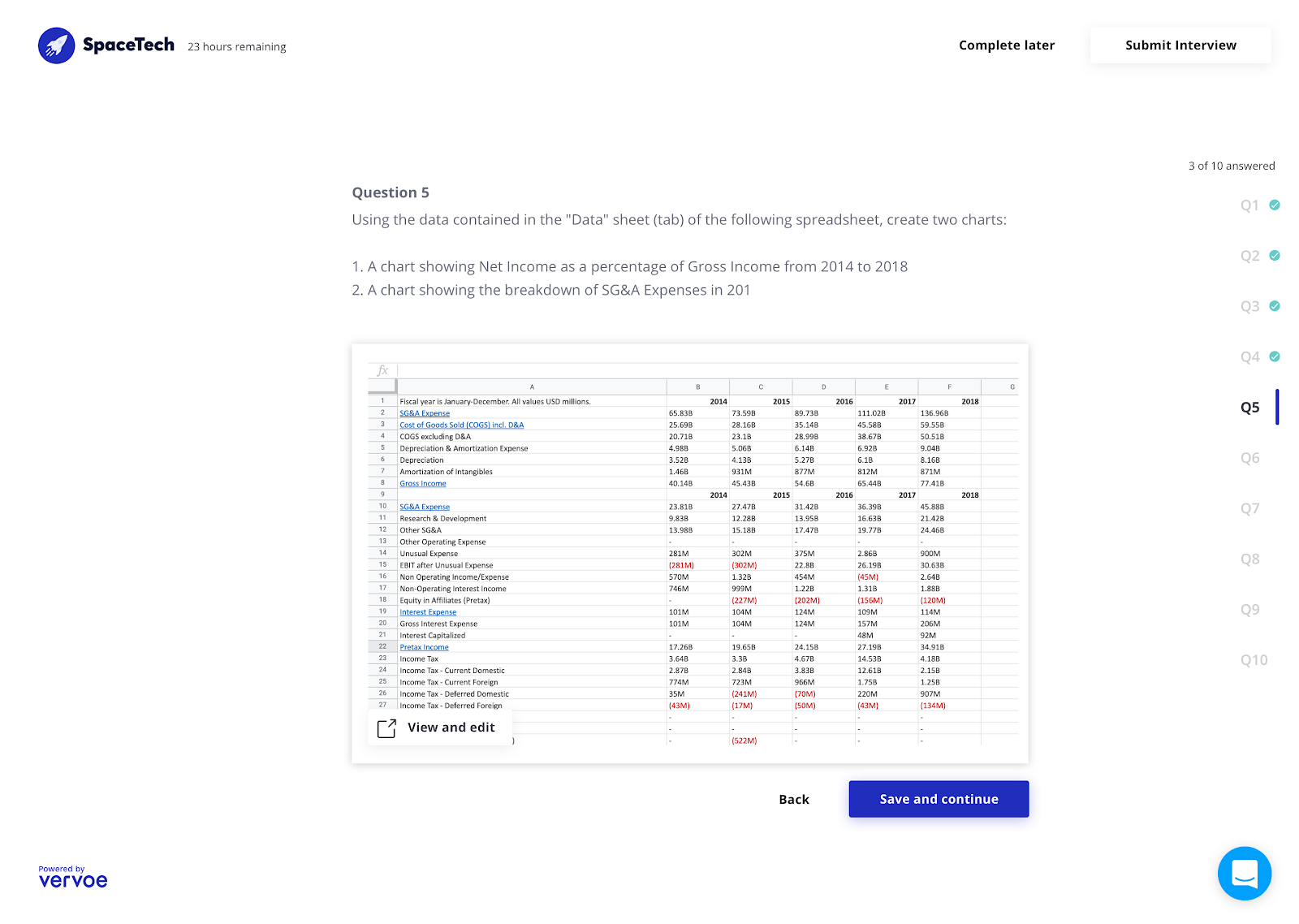
Running a skills test through Vervoe, or any other platform, is relatively straightforward. Vervoe’s Talent Trials let you select questions from a library of assessment tools, or design your own questions based on the specific needs of your company. The Talent Trial library offers questions and trials created by experts in their fields, meaning they have at least 3+ years of experience in their specific area of expertise. You can preview questions from any of the Talent Trial areas and add them seamlessly through the Vervoe platform.
Now that you know how to set up an aptitude test, when should you deploy this tool during the hiring process?
Using Skill Tests During Hiring
Timing is everything when it comes to adding a skill assessment to your hiring process. Research by Harvard Business Review revealed that skills tests should come early in the hiring process. According to their study, “Many service companies, including retailers, call centers, and security firms, can reduce costs and make better hires by using short, web-based psychometric tests as the first screening step. Such tests efficiently weed out the least-suitable applicants, leaving a smaller, better-qualified pool to undergo the more costly personalized aspects of the process.”
Skill tests should be used to screen candidates in, not out. The issue many recruiters face is that the volume of candidates makes it impossible to carefully consider each person’s ability. Smart algorithms and AI tools can turbo-charge candidate assessments by scoring results quickly and removing human biasfrom the equation. Vervoe’s algorithm scores candidates using a multi-layered approach. Candidates are ranked based on how well they performed, rather than filtered out if they didn’t achieve a certain benchmark. The top candidates easily rise to the top; but no one misses out on being considered for the next round. When used early in the hiring process, Talent Trials can select a more diverse pool of applicants to continue onto the next phase.
Skill Test Examples and Templates
There are many ways to set up a skills test, depending on the position for which you are hiring. Pre-employment skills tests can cover a range of positions: administrative assistant, finance and accounting,and call center reps are just a few roles that companies hire for using Talent Trials.
Excel skill tests, coding skill tests, typing skill tests, and other computer skill tests are the most common forms of pre-employment assessments. Some companies focus on questions that are task-related, e.g. “Create a Powerpoint Slide that has a video embedded in the presentation.” Questions can get hyper specific to test a niche skill, like a coding language, or be posed more broadly to test the general requirements for success at a certain level.
Some companies choose to focus on verifying the skills that will help a candidate succeed beyond the immediate position. This approach skews closer to a pre-employment assessment, with questions designed to reveal if a candidate can climb the corporate ladder, adapt in a challenging work environment, or respond under pressure. For example, one call center rep test included questions such as, “You have an elderly customer on the phone who is having trouble understanding your instructions. A colleague is also trying to transfer a call from a customer you served before, and you have a scheduled follow-up call happening in 5 minutes. How would you handle and prioritize in this situation?”
Multiple choice, open-ended questions, and pre-recorded video responses are all great ways to see if a candidate has what it takes to do the job well. But, do candidates enjoy answering these types of questions?
Do new hires like doing skill tests?
By most accounts, candidates appreciate the opportunity to showcase what makes them great at their job. Orica, the world’s largest provider of commercial explosives, integrated skill testing into their interview process to the delight of their job candidates. In revamping the interview process for graduate students looking to join the Orica team, recruiters consolidated their online evaluation components into one platform, Vervoe. The Talent Trial test combined questions focusing on skills, logic, and values.
An average of 86% of candidates completed the online process, and the reviews were mostly positive. Here’s what the candidates had to say about the skills test:
“The tests required total engagement and thought, and were a clear demonstration of what makes Orica different from any other company.”
“I think the questions were very diverse and it allowed me to showcase myself, my skills and abilities in different ways.”
“It gave me an opportunity to showcase who I am as well as challenge my skills”
This is just one example of how a skill test can change the entire interview process for a potential new hire. In a job market where people spend an average of 11 hours a week looking for a new job, it’s easy to get burned out, fast. Every job description starts to look the same; every interview begins to feel stale.
When given the opportunity to showcase their talent through real-world tasks, job candidates will jump at the chance to be engaged with the job description, rise above their resume, and challenge themselves. Companies that use Vervoe’s Talent Trials experience a 97% candidate completion rate, which is among the highest engagement rates in the industry. Candidates love the opportunity to stand out from the crowd. Even if they aren’t hired, skills testing offers a break from the repetition of the stale interview experience.
What are the benefits of a skill test?
The benefits of a skills test aren’t limited to the candidate experience.
Recruiters looking to hire diverse, high-performing teams with better efficiency and consistency can use pre-employment tests to their advantage. Skills tests are a better predictor of performance than resume screenings or traditional interviews alone. Resume screenings are bad for three reasons. First, studies suggest that it’s common for candidates to lie on their CV. The person you think you’re hiring may not actually possess the qualifications you think they do.
Second, resumes only provide a high-level view of a candidate’s credentials and work experience. These items don’t offer qualitative insight into actual on-the-job performance. Coupled with recruiting biases that are built into the process, the third threat is that recruiters are privileging candidates based on background and demographics, rather than talent. Perhaps this is why new hires crash out as often as they do. According to one study, 46% of new hires “fail” within the first 18 months of being hired.
Skill tests can help take some of the bias out of the interview process, give recruiters a new evaluation metric to consider, and lead to happier, long-term hires. There’s ample evidence to suggest they really do work better than many of the other traditional hiring methods recruiters have relied on in the past.
Do skill tests work?
In our experience, skill testing works better than traditional hiring methods – with some caveats.
Without a doubt, aptitude tests can be used to replace resume screening. This style of sorting through candidates increases the chance that the best candidates will be unfairly eliminated. Good people get screened out, rather than screened in. So-called “pedigree proxies” – resumes and cover letters – are not indicative of job performance, yet they are often the quickest way a recruiter or algorithm can think of to cut down on their stack of candidate resumes.
Skills tests improve time to hire while allowing the hiring manager to see how someone will do the job, before they get the offer. This reduces turnover costs, which add up quickly: the cost of making the wrong hire can be up to 2.5x salary, easily over $100,000. Working with Vervoe’s Talent Trials, on the other hand, can help a recruiter identify the best people at under $100 per hire.
The best skills tests, however, need the right formula to help the candidates succeed. Some recruiters focus narrowly on the skills that will help a new hire succeed in the immediate position for which they are hiring. Yet, many CEOs emphasize the importance of soft skills – things like leadership and teamwork. New hires may end up being disappointed and leaving because they lacked the soft skills needed to adapt to their new team, not necessarily the skills to perform the job. Recruiters must integrate questions into their skill assessment that focus on critical soft skills that predict long-term success. These validated psychometric assessments are key to assessing “culture fit” without defaulting to recruiter bias.
Skill tests vs. interviewing
In conclusion, we’ll leave you with few thoughts on skill tests compared to interviews.
First, interviews, in general, need a total overhaul. Recruiters have been asking the same, outdated interview questions for decades. Many candidates get overwhelmed by the performance anxiety inherent in the interview and may make (forgivable) mistakes. Nevertheless, many recruiters like the security of meeting someone before making an offer.
Many recruiters seek the same insight from a group interview or case study that they would get from an individual skill test. Unfortunately, using these methods can’t give you the same valuable information as a straightforward aptitude assessment. Case studies can be too conceptual; rather than seeing how a candidate will approach the work listed in the job description, case studies ask abstract questions. The goal of asking “how many tennis balls can fit on a Boeing 757” is not to see if the candidate can guess the right answer, but to see how they approach the question and reason through their response. But this knowledge doesn’t always serve a recruiter with the best predictor of on-the-job success.
Group interviews provide more insight – into a candidate’s teamwork, leadership, and communication, for example. Yet, in a group scenario, extroverts tend to dominate. It can be difficult to see how each candidate performs as an individual while trying to consider the group at once.
In summary, skill testing is all about understanding whether a candidate can do something or knows something. It’s about verifying their ability to go the distance with your company. Pre-employment assessments differ slightly in that they focus on predicting how a candidate will behave in certain scenarios, not what they can do. By combining questions from skills testing and pre-employment assessments, recruiters can get a more accurate picture of the candidate’s ability.
Take a second to consider how much someone would know about you if they had unfettered access to your phone. We store so much information on our phones that our mobile devices have become windows into our lives. Think about all the apps you sign into, photos you take, and texts that you send. Studies show that the average person spends over four hours on their mobile device per day. The average person also has over 80 apps installed on his or her cell phone.
All of that information adds up to a treasure trove of identity data for anyone who gains access to it, regardless of whether it is through legal or illegal means. Accordingly, we’ve seen the data economy take-off, as companies have discovered that identity data is very valuable in the digital economy.
Until recently, we didn’t spend too much time or energy protecting our data. Passcodes were simple to hack or altogether nonexistent, giving thieves easy access to your credit card information, photos, emails, and anything else you’d store on your phone. It didn’t take much for bad actors to get their hands on your identity, then use it for nefarious purposes. The rise of the data economy, coupled with worsening data breaches and identity theft, have exacerbated these privacy concerns, and the face of privacy is changing.
We need new and improved security measures that actually protect users: making stolen data useless without the owner of said data. We need a system that values ownership of data rather than the sharing of data. The Civic App uses biometrics so that people must prove ownership of their data. Biometric authentication uses the things that make you, you — like your fingerprint or face — to ensure that only you can access or share this encrypted data. It’s much more secure than just sharing abstract information, like a social security number. Anyone can share your social security number, not everyone can prove ownershipof your social security number.
Imagine if you had the Civic App pre-installed on your mobile phone and get your identity information verified the first time you use the device. Imagine if you could use this app as your ID at the airport or a bar, and you could use this app to log in and access every other app on your phone, from Facebook to your bank account, without the need to remember a username or password.
This is how digital identity can create a secure ecosystem, and this is the foundation that we’re building with Civic technology. The Civic App functions as the identity layer on your mobile device, and this functionality only becomes more powerful as it is connected to a growing ecosystem. The Civic App offers one, central account protected by biometrics and secured by blockchain attestations, in addition to giving you the ability to prove who you are on-demand.
Fifteen years ago when Mark Zuckerberg and Eduardo Saverin created what would become Facebook, it would have been difficult to picture just how powerful that project would eventually become.
When Facebook opened its doors to the public in 2006 and began its journey in the shadows of social networks like Hi5 and MySpace, there wasn't the slightest hint that it would exist in today’s era of digital currencies, much less create its own. But development has brought Facebook a long way, and with it, millions of users.
Facebook was originally intended as a social networking site in which users could create extensive friend lists and share activities with members of those lists. It served a different purpose for every demographic. For adults, it was a way to find old friends again after many years. For teenagers, there was no better way to throw a party and invite everyone at the same time.
As more people used the network, Facebook’s functionality increased. For brands, Facebook became a new way to reach their target audiences and as the demand for more intentional marketing tools increased, Facebook silently evolved.
Today, Facebook is a machine for the creation, storage and distribution of data through various channels, including Whatsapp, and can be used for any of the following:
Uploading photos and maintaining picture galleries with time stamps.
Networking and interacting online using Facebook's instant messenger.
Joining groups and interacting with fan pages at any point in time.
Marketing a business by distributing content to a wide audience
Streaming and creating videos easily on Facebook live.
Just like Chinese social media app WeChat, Facebook has joined the race to become the ultimate platform with every type of activity a user could need including tools for work, advertising, social activities, and payments.
While it has everything else on lockdown, the social media giant has had some difficulties perfecting its payment areas. In an effort to solve these difficulties, it plans to introduce FaceCoin, its own digital stable coin to facilitate payments using blockchain technology for its WhatsApp users.
FaceCoin is a new cryptocurrency proposed by Facebook that will allow users of Whatsapp to send money around the world. It is expected to be cheaper and faster than regular payment methods while allowing users to keep their money within the social media network.
According to a report by Bloomberg, other messaging companies like Telegram are also minting their own cryptocurrencies for the same purpose. Their extensive user bases present a unique opportunity to tackle remittance, especially in developing countries. For example, in Saudi Arabia, Malaysia, and Brazil, 73%, 68%, and 56% of the total population are active WhatsApp users. It would be easier to send money to such countries using an integrated Whatsapp payment structure than to use a separate app like Paypal.
Bitcoin has shown that it is possible to simplify the process of sending money across borders even with their restrictions. Unfortunately, there are still many problems that Bitcoin and other cryptocurrencies face, such as regulatory uncertainty.
One major regulatory hurdle faced by Bitcoin is the lack of a central authority to blame if anything happens to user funds. This situation makes it easier for criminals to take advantage of the network and creates a lack of trust on the part of users. The design of the network also makes it difficult to scale up for mainstream adoption.
FaceCoin is expected to be different from Bitcoin in its structure and design but it remains unclear how these differences will solve its problems. Will they have a more centralized structure that users can trust? Or a perhaps a more scalable design?
For now, it seems that if FaceCoin and other new digital currencies don't take a deliberate stand against these issues in the planning and design phase, they'll get stuck.
A HISTORY OF PAYMENTS
Although FaceCoin is the first fully-fledged cryptocurrency supposedly coming out of Facebook, this is not the company's first dabble into payments technology. In 2011, Facebook launched Facebook Credits, a virtual currency system intended to simplify payments. Issues with fluctuating exchange rates for international payments prevented this system from gaining widespread use.
The company also launched Facebook Gifts in 2012 as a way for its users to send digital gifts internationally, but couldn't solve localization issues to make it work either. For a while, Facebook has been expected to make another move in the virtual currency space, especially since recruiting former PayPal president David Marcus in 2014. In light of recent developments, Marcus is heading the company's blockchain initiatives, which are still strictly on a need-to-know basis. According to Linkedin, Facebook's blockchain team now has up to 40 people.
As digital currencies grow more popular, the pressure to solve the problems with cross-border payments is also increasing. Digital currencies like Bitcoin and Ripple are credited as faster payment methods compared to traditional banking and they also have reduced fees, so what on earth is the big problem?
Simple. The intended market (developing countries) still has a currency conversion problem after receiving money in the form of digital currency. For example, a person could send 500 Bitcoin, Ripple or even FaceCoin to someone else in Kenya. But now, the recipients must go through the time-consuming task of looking for local exchanges on which to convert it back to Kenyan shillings.
This is even more difficult because developing countries have nowhere near the number of exchanges or level of cryptocurrency infrastructural development as their counterparts. An alternative would be to use foreign exchanges and pay charges, but going through the stress of opening Coinbase accounts just to convert some money makes the whole purpose of using digital currencies redundant.
FaceCoin can attempt to solve these issues in different ways. They can create a better way for users to exchange their virtual currency for their national currencies without the need for Coinbase accounts. They can also aim to create a large marketplace where users can pay bills, buy goods and services, as well as invest without leaving the Facebook ecosystem (including WhatsApp).
This will reduce the need for conversion and save users the stress. As it stands, the Facebook site has a great foundation to make something like this work. Integrating bill payment, ridesharing, and other platforms with the Facebook platform should not be too difficult to achieve. There's just one hitch: Not everyone wants to use a currency simply because Facebook made it. Also, a system like this is out of the realms of remittances and is simply equivalent to a game system in which people can send game tokens to each other.
Like other companies, Facebook is showing that it understands the importance of remittances. Being in a great position to take advantage of it is one thing, but knowing the best way to approach it is another. FaceCoin could be the missing link between digital currencies and fully functional remittance systems.
Facebook is only one of several large companies making a move with blockchain technology. Lately, corporations like Amazon, Walmart, and even IBM have graced the headlines with one innovation or the other. By increasing financial accessibility and scaling one of the greatest hurdles that Bitcoin has faced, Facebook could make life easier for millions of people.