Monday, 18 February 2019

A NEW AGE FOR DIGITAL ADVERTISING WITH BLOCKCHAIN?

mintdice.com
Image result for A NEW AGE FOR DIGITAL ADVERTISING WITH BLOCKCHAIN?
Advertising has become an essential part of promoting any type of business available and even plays a role in driving the data market further. The world of advertising is worth billions of dollars and is on course to hit $120 billion by 2021 in the US.
Every company, no matter what they offer, cannot function without reaching their target audience-- this is where advertising comes into the picture. Brands like Google live off consumer data which can be used to send targeted ads to the right audience. Unfortunately, there are several issues that make the process of reaching the right audience inefficient.
Currently, almost half of all ad traffic is generated by bots. This means that even though so many brands pay a lot of money to reach their potential customers, it does not guarantee that they will actually make any sales to real, paying customers. While the reach and even engagement generated by paid ads can translate to heavy figures, the useful leads are relatively low.
This situation can be fixed by creating platforms that will allow companies to target their potential customers individually and in a direct manner. This will ensure that bots can be filtered out and sales can be maximized.Blockchain applications and  smart contracts are great technologies to base such a system on.
A blockchain platform is an immutable digital ledger that stores all the transactions carried out on the network it supports. It has already been described as an emerging technology that will disrupt the way several industries function. It is now clear that digital marketing may be one of those ledger technology industries.
In the past few years, since the emergence of bitcoin, the buzz surrounding blockchain which underpins most cryptocurrencies has increased considerably. There are already more than 2000 digital currency, all with their own unique use cases and projects. The appeal of blockchain lies in the number of useful applications it has. In advertising, a blockchain platform would be able to target the users on its network without allowing bot activity to thrive. It could also change current the world of advertising by making the process more transparent and private.

HOW CAN THE NEW BLOCKCHAIN PROCESS BE USED BY ADVERTISERS?

Mostly, blockchain can be used to improve the process of running digital ads and paying out publishers as well as distributors. When implemented, the technology can improve the following:

FRAUD PREVENTION

Advertising has a fraud problem perpetrated by human accounts as well as bots. Usually, bots are created to crawl web pages carrying out helpful tasks, but they have become a medium for carrying out cybercrime.
Popular platforms like Twitter where advertising plays a huge role have reported a bot problem that they’re actively trying to combat. In fact, Twitter has begun making plans to implement blockchain technology in solving this problem.
According to “What Happens Next: How To Reverse The Rising Tide Of Ad Fraud,” a 2017 report, up to $16.4 billion of global advertising revenue was wasted on ad fraud in 2017. Unfortunately, this figure may continue to increase if nothing is done to fix the situation. There are several factors that make blockchain well-suited for fraud prevention, including:
  • Immutability
  • High levels of security due to its decentralized mode of operation, verification mechanisms and encryption.
  • Transparency since transactions can be authenticated.
Overall, blockchain systems make it difficult to commit fraud because transactions are in the open. Also, blockchains do not have a single point of failure and as such, it is difficult to hack them. This can potentially save advertisers and publishers millions each year by protecting them against cybercrime.
Image result for A NEW AGE FOR DIGITAL ADVERTISING WITH BLOCKCHAIN?

DIRECT TO CONSUMER DIGITAL MARKETING

Platforms like Google and Facebook have come under fire recently for consumer-data distribution issues. Because such platforms make a lot of revenue off advertising, they collect consumer data to better target the right target audience. Unfortunately, this could feel like a violation of privacy for many users who would rather have more control over how their data is collected and what it is used for.
Usually, enterprises that run digital ads on larger platforms like Google and Facebook have to pay for this service. Blockchain gives them a way out. Since the information stored on blockchain networks are secured using various encryptions that can only be decrypted using the owner’s private keys, users retain control over their data. As a result, the services of middlemen will no longer be needed in the advertising data collection process. These blockchain platforms create a direct connection between consumers and enterprises.
Companies can also use blockchain to show people who their data is being sold to since the information cannot be deleted or manipulated. This will make consumers feel at ease without having to constantly worry about their data.

PROVISION OF EFFICIENT CROSS-PROMOTIONAL B2B CONTRACTS

Smart contracts are lines of written code in the form of distributed apps on a blockchain network. They are created to set up a binding agreement between parties based on their conditions. The conditions can be external events, like a price point, set of obligations or time limit with an expiration date. Since blockchain transactions can easily be verified, smart contracts cannot be forged and all involved parties can follow up the transaction.
These contracts can be used in any system from voting to app subscription and digital marketing. They help advertisers bypass lawyers and other middlemen by conducting the process of exchanging money, shares or any valuable assets. These contracts are created with conditions that are self-executed in a transparent and conflict-free way.
Influencer marketing is popular among brands but there is currently no regulatory third party to determine how terms are created and followed or even how payments are made. Using blockchain, businesses will be able to clearly state obligations that must be met for payments to be made, and a smart contract will enforce it.
This will make B2B cross-promotional marketing more efficient since several contracts change hands between marketers, writers, bloggers and even social media influencers daily. Ultimately, businesses will protect themselves and save money and time in the event of a contract breach.

TRANSPARENCY IN CONTRACTS AND WITH CONSUMERS

There are lot of cases in which advertising lacks transparency, such as platforms that show advertisers false metrics. For example, a platform could claim to gain millions of impressions on each ad they put out. Normally, there would be no good way to verify this information and find out the truth.
This presents an easy way for platforms to defraud enterprises through false advertisement. However, since a blockchain records such data in a way that cannot be tampered with, it can easily be verified.

FINAL THOUGHTS

Advertising will continue to be the backbone of commerce because most people will not buy a product if they are not given a reason to. However, like many other industries, it is due for a technological reform that will make it more efficient for all relevant stakeholders. Blockchain not only makes the advertising process easier, it makes it faster, more secure and transparent. As this emerging technology continues to develop, there will gradually be more stable versions of it that may become more valuable to advertisers.


Tuesday, 12 February 2019

Most Common Cryptocurrencies that Circle the CBD Space

MadeByHemp.com
By Alex Moskov

Cannabidiol, or CBD for short, has long been lauded for its potential significant medical benefits and pain-reducing aspects. But for all of its popularity and trendiness, CBD is still largely misunderstood by population masses and regulators alike. Although the legislature in the 2018 Farm Bill was recently passed, de-scheduling hemp and CBD, there are still several pain points which circle the CBD industry.
With the CBD industry expected to grow to $2 billion by 2020, it’s no shocker that hundreds of entrepreneurs are viewing CBD’s pain points as a call to arms to provide lucrative solutions to facilitate the growth of the space. Many of these entrepreneurs are jumping head first into blockchain and cryptocurrency, two relatively new technologies that could make a substantial dent and potentially free the CBD space from its woes.
From Bongger (BGR) to Sativacoin (STV) to DopeCoin (DOPE), there is no shortage of appropriately named cannabis-focused cryptocurrencies coming out of the woodwork. The following article explores a few of the most common and most legitimate cryptocurrencies that circle the CBD space, as well as the innovative solutions they offer.

PotCoin (POT)
No cannabis cryptocurrency list would be complete without its poster child, PotCoin.
Launched in January 2014, the Canada-based PotCoin was a pioneer for the intersection of blockchain and marijuana. The token was created to solve the banking problems for businesses and customers seeking to transact in completely legal purchases. In 2017, only 300 of the 11,000 banks in the United States allowed cannabis business owners to create accounts, and that figure was much smaller in 2014.
PotCoin remained relatively dormant but exploded with popularity alongside the overall cryptocurrency industry, hitting a peak on June 12th, 2017 when a video of the controversial perplexing NBA star Dennis Rodman rocked a potcoin.com shirt in North Korea on his way to the historic summit between the Supreme Leader of North Korea Kim Jong Un and the President of the United States Donald Trump.

PotCoin reached an all-time-high market cap of roughly $93,129,000 USD in 2017 and currently sits around $2,900,000 USD. There is a limited supply of PotCoin set at 420 million POT.

ParagonCoin (PRG)
Paragon was established in July 2017 with the intention of creating a suite of products aimed at organizing, systematizing, and creating easily verifiable and transparent cannabis industry solutions.
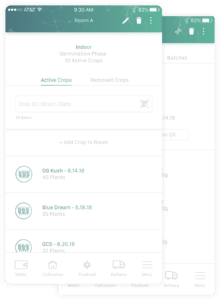
ParagonCoin (PRG) is the cryptographic token that powers the Paragon ecosystem, which allows businesses and users to easily transfer funds. An interesting solution to note in the Paragon suite is a full seed-to-sale tracking solution that integrates all of the different stages in each individual cannabis-based companies supply chain. Within the scope of CBD products, this would help verify and ensure that the end-product CBD is created from exactly what is expected

ParagonCoin user screenshot
Image via Paragon website.
Cultivators are able to enter their relevant crop data and growth cycles, with the final harvest batches becoming linked to smart contracts that track the flow to the point of sales. The immutability of the blockchain would ensure that database information can’t be tampered with at a later date or removed altogether, making it easier for businesses (and regulators) to better understand the flow of products and lax liabilities.
Paragon would later trip into a lawsuit for failure to register its Initial Coin Offering (ICO) with the SEC, which served as a landmark case for all ICOs in the industry. ParagonCoin reached an all-time-high market cap of roughly $57,000,000 USD at the start of 2018 and currently sits around $8,000,000 USD.

Bitcoin and Litecoin
Although not branded as cannabis-based cryptocurrencies, Bitcoin and Litecoin are popular choices for businesses and consumers transact for cannabis and CBD-related products.
Many cannabis and CBD businesses set up portals to accept Bitcoin and Litecoin early on to circumvent opaque regulations that prevented them from accepting credit card payments. As Bitcoin and Litecoin grew their user bases exponentially in 2017 and 2018, many more businesses jumped on board.
Although both cryptocurrencies provide the same end result, they differ in small ways. Bitcoin tends to be more popular due to its massive user base and liquidity, and Litecoin is sometimes preferred because of its lower transaction fees.

Final Thoughts
As the CBD and cannabis space continues to grow, there will likely be an increase in the number of entrepreneurs leveraging the power of blockchain and cryptocurrency to facilitate their business needs. By understanding the current economic and regulatory climate, as well as the technological applications of cryptocurrency, these business owners will be much better equipped to position themselves as leaders in their respective fields.
Original Post: https://madebyhemp.com/most-common-cryptocurrencies-circle-cbd-space/

Alex Moskov
Alex is the Editor-in-Chief of CoinCentral, a leading cryptocurrency and blockchain media publication. Alex also advises blockchain startups, enterprise organizations, and ICOs on content strategy, marketing, and business development. He also regrets not buying more Bitcoin back in 2012, just like you

Monday, 4 February 2019

Utilizing Blockchain Technology in the Cannabis Industry

madebyhemp.com
by Alex Moskov
Image result for Utilizing Blockchain Technology in the Cannabis Industry
Few industries are as misunderstood, or as complimentary, as cannabis and blockchain. Both niches are young and exist in highly speculative markets with foggy regulatory conditions, but have also received an influx of highly talented entrepreneurs and programmers looking to solve some of their respective industry’s largest problems.
In order to truly understand the synergy of cannabis and blockchain, we must look beyond the hype and speculation and understand how and why the cannabis industry needs blockchain technology, and how both industries may inevitably depend on each other.  

Cannabis and Blockchain at a Glimpse
The North American cannabis industry has seen a major spike in growth and attention from entrepreneurs seeking to create value and strike it big, investors looking for a piece of the pie, activists fighting for what they believe to be a truly beneficial product, and politicians on both sides of the heated legalization debate.
The major strides in the cannabis industry were not without their pain points. Transparency, payment solutions, quality assurance and maintenance, and general regulatory uncertainty have plagued cannabis entrepreneurs for years.
The blockchain is essentially an immutable distributed database that is at the heart of what many people are calling a cryptocurrency revolution. Everything from popular cryptocurrencies such as Bitcoin and Ethereum to publicly traded companies such as IBM have utilized blockchain to solve countless issues for thousands of businesses.  
Combined with sister technologies like cryptocurrency (digital cryptographic currency) and smart contracts (programming-based contracts), blockchain can help the cannabis industry solve its current issues and navigate the uncertain path ahead.

Setting a Standard of Transparency
In an interview with RollingStone, Jessica VerSteeg, the CEO of a cannabis startup called Paragon that utilizing its own blockchain-based cryptocurrency, noted that “Blockchain is about [transparency]. And that’s what we need in the cannabis space.”
Since the blockchain ledger is unchanging, it significantly reduces or eliminates any potential human-based obfuscation or deceptive practices. This would make it extremely easy for financial institutions and governments to audit cannabis companies and keep track of taxes owed.
This is particularly important in the cannabis space where businesses must face fragmented regulations across borders. Blockchain would empower these businesses with tangible proof of the point of origin and whether any products moved across national or state lines potentially incurring more taxes or violating federal law. This is one of the reasons VerSteeg and other entrepreneurs cite blockchain as being “one catalyst that could help legalize cannabis.”
Although Paragon would later become embroiled in a lawsuit due to its failure to register its Initial Coin Offering (ICO) with the SEC, their fundamental business plan to add transparency to the cannabis space hasn’t changed.

Quality Assurance and Maintenance
Blockchain enables businesses to manage their supply chains in real-time, eliminating paper trails and their inescapable lag. Since the cannabis space is relatively new, few companies have been able to create an effective vertical integration in their supply chain free from any lag or loss of product.
It’s likely that cannabis will touch many different businesses from when it is farmed to when it gets to an authorized dispensary, creating multiple potential costly points of failure. Cannabis businesses utilizing blockchain will be able to precisely pinpoint any inefficiencies in the process and, well, nip them in the bud.
Additionally, by utilizing blockchain in their supply-chain, cannabis businesses will be able to provide customers with the complete picture of their purchase’s journey from when it was just a seed and how many different parties it touched before ending up in their shopping cart.
Dispensaries will also be able to fully guarantee their products contain exactly the amount of THC, CBD and whether it is sativa or indica dominant as what they’re advertised. Many first-timers walking through legal dispensary doors tend to be concerned about their sensitivities to the products, and a supply chain supported by flawless math caters to a better overall customer experience.

Payment Processing and Storage
Payments are perhaps one of the largest blights for the cannabis industry.
Although the vast majority of states in the US have legalized marijuana in some capacity, whether medicinal or recreational, federal law poses cumbersome restrictions for how cannabis-based companies can accept and store payments. According to the Credit Union Times, out of the 11,000 banks in the United States, only 300of them allowed cannabis business owners to create accounts.
This has led many business owners to operate as a sole cash-only business. With hundreds of thousands and sometimes millions of dollars of revenue, business owners are faced with a near-Wild West high stakes risky scenario. Additionally, accounting at high volumes tends to become a nightmare for cash-only businesses and regulators end up having to sift through nebulous financials and end up with an unclear view of tax liabilities, contributing to hesitations for more lenient regulatory policies.
Since cryptocurrencies are decentralized and unregulated for the most part, they enable cannabis businesses to accept secure, cashless, and fast payments that can be converted into greenbacks or sent anywhere around the world at competitive speeds.
The North American cannabis industry is expected to count $20.2billion in sales by 2021. While traditional payment solutions companies are bound by federal restrictions, cryptocurrency entrepreneurs are positioning themselves to not only change how the cannabis industry accepts payments, but how global commerce operates.

Final Thoughts
From payment processing and identity confirmation to tracking the entire supply chain from seed to end-product, the cannabis industry has plenty of entry points for blockchain technology.


As the cannabis and blockchain industries evolve together, there will be an even deeper mingling and collaboration between the respective entrepreneurial talents, technological advantages, and political activism of each die-hard community.

TOP BITCOIN FAUCETS

mintdice.com
Image result for top bitcoin faucets
Bitcoin adoption is something that is continuously talked about due to the need to sustain the growing world of cryptocurrency. Developers and other users within the space are becoming increasingly creative with their crypto-centered applications, aimed at fostering adoption.
However, where those outside the industry are concerned, incentives matter the most. The crypto community has had to return to the drawing board to create simple and efficient ways to attract new users. One of these ways is through the use of Bitcoin faucets.
A Bitcoin faucet is a reward system in form of a website or app that aims to give new users the chance to earn small amounts of Bitcoin for the completion of small tasks such as:
  • Captcha puzzles
  • Completing a survey
  • Visiting an advertiser/partner website for a specified period of time
  • Playing a game with recurring tasks
  • Answering quiz and trivia questions correctly
Similar to basic game reward applications that gift players tokens and other rewards for watching ads or taking brand surveys, Bitcoin faucets allow users to have a structured starting point for building a crypto portfolio.  
This type of application also allows users to test the waters and hold tradeable cryptocurrency without spending their own money, ensuring that the risk of loss is minimized. From this early exposure, users can easily decide whether or not holding Bitcoin is something they would like to do. They also offer rewards in different digital currencies like Ethereum and Bitcoin Cash so that users are exposed to a variety of them.
Rewards within this system are usually measured in the form of ‘Satoshi’, the basic unit of Bitcoin (1 Satoshi = 1 hundredth of a millionth BTC). Faucets fill up with rewards which users can withdraw regularly as they empty them and usually, the value of these rewards fluctuate due to the volatility of Bitcoin.   
BTC rewards paid out by faucets are stored in users’ Bitcoin wallets where they can be accessed via a private key. They are kept secure via complex encryptions as long as the private key is not compromised. Since they are paid out in smaller amounts, users leave their payments to build up to substantial points before making any withdrawals.
The first-ever Bitcoin faucet was designed and created in 2010 by Gavin Andersen and awarded up to five Bitcoins to users. Now, there are many faucets which mostly function as referral systems. Unfortunately, the tense cryptocurrency climate has not been favorable to these applications. The effect of this is that their profit potential and trustworthiness have been called into question.

WHAT IS THE PURPOSE OF BITCOIN FAUCETS?

Bitcoin faucets serve three major purposes:
  • They introduce new cryptocurrency users to the idea of Bitcoin as an independent currency without the added risk of losing money through bad investments. Allowing people to earn and store their own tokens is a practical approach handling tokens in the future.
  • They are sources of relevant Bitcoin information that new users may need.
  • They generate traffic for other websites by directing users to carry out tasks on those websites which usually belong to brands that have paid to be promoted.
Image result for top bitcoin faucets

WHAT ARE THE TOP BITCOIN FAUCETS?

Although there are hundreds of faucets on the internet, some clearly stand out in terms of rewards, profitability, user interface, and efficiency. The cryptocurrency landscape changes constantly, therefore, this list cannot be all-inclusive. Regardless, this is a breakdown of the 10 best Bitcoin faucets to use:

1. MILLI

Milli reportedly has one of the most profitable payouts available. Users can also earn rewards when new visitors sign up on the platform using their referral code. Most tasks on the platform are in the form of short and long surveys that users can fill out for various brands. Basically, credit is earned for marketing their products. Milli also addresses customer complaints via its comments section and typically resolves issues within 24 hours.

2. BITCOIN ALIENS

Bitcoin Aliens also offers one of the highest paying averages out there, normally in excess of 4,300 Satoshis per hour. Unlike most other faucets, this one does not require users to complete surveys or take tests. Instead, in a rather unusual twist, users are required to play a game in which they kill several aliens and get paid for each kill.

3. BONUS BITCOIN

Bonus Bitcoin is a central website consisting of 20 different Bitcoin faucets to reduce the wait time that users face on other faucet sites. Usually, such sites make users wait for more than 10 minutes before they can complete another task. Bonus Bitcoin solves this problem by providing more faucets to choose from. Users can earn as much as 40,000 Satoshis every hour as a result.

4. BITCOIN ZEBRA

Like Bitcoin Aliens, Bitcoin Zebra does not require users to fill out surveys or complete similar tasks. Instead, they play a game in which they feed zebras every few minutes. Easily one of the oldest and most respected faucets on the web, Bitcoin Zebra also has a highly rewarding referral program.

5. BITCOINKER

Bitcoinker is often regarded as a twin faucet to Milli and pays out relatively high rewards. Users also get high seniority bonuses and a referral system that allows them to earn Satoshis when new users sign up with their code.

6. ROBOT COIN

Robot Coin rewards users with Satoshis for killing robots in its game. As users move up to different levels, it becomes increasingly difficult to do so. As a way to incentivize users, the platform offers 1 million Satoshis to anyone who defeats its final robot.

7. WONDERLAND COIN

With Wonderland Coin faucet, users can earn a maximum payout of up to 5,000 Satoshis every twenty minutes by feeding the digital critters of Wonderland. As the critters are fed, the capacity to earn more increases.

8. MOON BITCOIN

Moon Bitcoin is one of the most popular faucets which requires users to watch brand ads as a task. Users can earn up to 1000 Satoshis per hour and accumulate their rewards over time. The Moon Bitcoin faucet fills up quickly at the beginning and slowly at the end until users claim their rewards.

9. SATOSHI CITY

Satoshi City is another site with a high referral bonus which only requires visitors to use captcha as a way to claim Bitcoins. Anyone on the site can earn up to 400 Satoshis every ten minutes.

10. SATOSHI QUIZ

The “Who wants to be a Millionaire meets HQ Trivia” type Satoshi Quiz offers rewards for correctly answered questions while a timer on the platform prevents users from searching for answers on Google. However, the process is fun for people who like the thought of new and exciting quizzes.

FINAL THOUGHTS

Bitcoin faucets are an innovative approach to spreading the use of BTC and other cryptocurrencies globally. While Bitcoin is quite popular, adoption has been somewhat stagnant. This can be linked to the recent insecurity and uncertainty within the industry.
Faucets provide a gradual introduction of digital currencies to new users and keep them away from the risk and negative occurrences in the industry. It also provides a great way to earn money on the side since cryptocurrencies can be converted to fiat currency like USD.  It is unclear whether the faucet system will die out, but even if it does, hopefully, more creative ways to boost adoption will emerge before then.