Tuesday, 4 December 2018

WHAT IS THE PO.ET CRYPTOCURRENCY PROJECT?

mintdice.com
Image result for WHAT IS THE PO.ET CRYPTOCURRENCY PROJECT?
The Po.et (POE) cryptocurrency project is a venture that directly addresses issues with content ownership and piracy. Every other day, creatives are faced with the hassle of confronting those who have duplicated their work.
Often, this leads to lengthy correspondence and unplanned lawyer fees. Added to the fact that many content creators find it difficult to gain the necessary exposure on large platforms, this situation can be extremely frustrating.
Unlike most crypto projects which are primarily focused on financial transactions, Po.et is based on provenance. It is one of the few projects that are aimed at solving pressing issues in the area of content creation and distribution.  

PO.ET PROJECT EXPLAINED

Defined as a decentralized protocol for content ownership and provenance, Po.et is a project aimed at creating a foolproof digital licensing system. To achieve this, the project’s developers are leveraging the immutability of blockchain, a decentralized digital ledger technology.
According to the Po.et official website, the platform stores time-stamped information for the sake of posterity. This will help authors establish a claim to their work and as a result, it would be difficult for others to plagiarize it. The project has been ongoing for about a year, since its initial release in 2017 and has drawn a lot of attention so far.

HOW DOES IT WORK?

As most blockchain networks do, Po.et requires a way to secure its blockchain through consensus. It does this via a consensus mechanism termed “Proof of Existence”.
Each piece of content added to the Po.et marketplace is given a unique immutable fingerprint that has no single point of failure. There is also no need for a third party, not even a publisher for the distribution of content.
Po.et is compatible with web technologies like Javascript and WordPress, ensuring that it can be integrated with various websites, as necessary.

WHAT IS POE CRYPTOCURRENCY?

The Po.et ecosystem is largely underpinned by its own digital asset, known as POE cryptocurrency. It is primarily used in the Po.et marketplace and has three major uses, including:
  • Bootstrapping the network
  • Raising capital
  • Acting as an incentive
By bootstrapping the network effects of Po.et, POE cryptocurrency provides a solid foundation for its ecosystem. It acts as a common unifying factor for users, and other stakeholders, creating a community that is well-invested in the progress of the project.
Through various fundraising ventures including Initial Coin Offering (ICO), Poe will serve as the primary token and symbol of investment. By offering up their tokens to investors, the development team can raise funds to further develop and run the platform smoothly.
As with almost anything, people will be more likely to promote and adopt a platform like Po.et when there are incentives to do so. This is especially true for platforms that plan to create active communities around their products. The distribution of POE to early investors is a way to solidify their trust and loyalty in the platform for a long time.
Image result for WHAT IS THE PO.ET CRYPTOCURRENCY PROJECT?

BENEFITS OF POE

The Po.et network along with its cryptocurrency offers four main benefits to its users, namely: attribution, discovery, monetization, and reputation.

ATTRIBUTION

This refers to the ownership aspect of the network. It describes a case in which content creators no longer have to jump through hoops, just to prove the ownership of their work.  It is unrealistic to claim work that was simply created and published with no solid proof. Authors often find themselves having no real case, especially if their work has been plagiarized by a much larger competitor.
Since POE cryptocurrency creates a secure, immutable digital licensing system, it is easy to verify content ownership. This will eliminate plagiarism and save creators the time and stress put into protecting their work. Such a blockchain-based system is easier, faster and less resource-intensive than the traditional copyrighting system.

DISCOVERY

Normally, on content sharing platforms like Medium.com, Twitter and even Facebook, the more followers a user has, the greater the reach of their work. This leads to a need to build followers through organic marketing.
It can be especially difficult on a platform like Twitter where there is so much content flying around from over 100,000 active users. In fact, the entire web is so populated with content that standing out requires an enormous amount of work.
POE token currency allows users to share their work in its marketplace as well as curate content for their followers. This, in turn, drives engagement and the value of the tokens since tokens are allocated according to the quality of content.

MONETIZATION

One of the factors than continuously hinders the monetization of content is plagiarism. Why would anyone want to pay for a creator’s work if they can simply get it somewhere else at a cheaper price or even for free?
Plagiarism takes away the common person’s incentive to pay for content. However, once this hurdle is jumped, it becomes possible to reap the full benefits of content monetization. Using the Po.et marketplace and cryptocurrency, content creators are provided with a way to carry out safe verifiable transactions, a secure means of exchange and a central location where their work can be viewed.
In addition to this, they would be able to create custom marketplaces and set up micropayment channels. This makes monetization easier for the content creators as well as their audience who now have a secure way to access content.

REPUTATION

As transactions progress over time, the Po.et network continues to build reputations according to the behaviors of various entities. This further aids security by allowing the platform to form a comprehensive profile on possible threats. The reputation record can be viewed by anyone on the network and builds trust in the community.

WHAT IS THE PROGRESS OF PO.ET IN ACHIEVING ITS GOALS?

The Po.et team has created a solid roadmap which they have grouped into different eras in the platform’s development. These eras include the Ptolemaic era, Rosetta era, and the Gutenberg era, as followsThe Ptolemaic Era
This marked the beginning of the Po.et platform’s journey after the realization that blockchain could provide solutions outside the financial space.

THE ROSETTA ERA

Initially, the project was focused on running its basic version seamlessly. However, that changed in the Rosetta era. Firstly, the POE testnet was launched on the Ethereum blockchain like other decentralized applications. This allowed the platform to carry out its ICO which raised over $10 million worth of cryptocurrency. Po.et also released its Wordpress plugin which enables the addition of timestamps to blog posts.

THE GUTENBERG ERA

This describes the current phase of the Po.et project in which the development team is focusing their efforts on scaling the network. They plan to achieve this by scaling up from their earlier testnet to the Bitcoin Mainnet.
As for POE coin, the team will add support for claim batching and automated workflow which will, in turn, allow the deployment of production level scale without limitations caused by the blockchain itself.

FINAL THOUGHTS

Po.et has made considerable progress since its creation. Till date, its team continues to put a huge amount of marketing effort into sensitization sessions aimed at driving adoption. Content creators, who form its primary audience, are embracing the platform along with the benefits it offers. This gives them a visibility advantage, especially considering how difficult it is to have a notable presence on platforms like Google and Facebook. Ultimately, the platform has certainly positioned itself as one of the projects to watch within the cryptocurrency space.

How Infrastructure as a Service (IaaS) Meets Blockchain

coincentral.com
Image result for How Infrastructure as a Service (IaaS) Meets Blockchain
Cloud computing has enabled many companies to outsource much of their IT operations. Doing so eliminates the need for enterprises to run their own servers, software, and databases. Infrastructure is a fundamental need, and these days many organizations leverage cloud computing to outsource all of their IT infrastructure. This is known as infrastructure as a service or IaaS.
Currently, a few big companies dominate the sector. However, blockchain provides new ways of handling infrastructure as a service that could prove disruptive to how many of the big tech firms operate today.

What Is Infrastructure as a Service (IaaS)?

Infrastructure as a service is also called hardware as a service, which is perhaps a better way of explaining it. Enterprises need necessary hardware such as servers, storage, or components to run a network of computers.
It used to be the case that organizations would need to run internal data centers that housed this kind of hardware. However, the advent of cloud computing now means that an organization can outsource its infrastructure requirements to an external provider. The provider of infrastructure as a service hosts a datacenter and allows its clients to access the infrastructure remotely. This is usually charged on a pay-as-you-go model.
For enterprises with fluctuating workloads, using a cloud IaaS provider can work out far more cost effective and flexible than self-hosted infrastructure. Consider a company that’s developing a new piece of software. While the software is under development, the company needs additional computing resources that will be redundant once they have the software up and running. So it uses infrastructure as a service to procure the necessary resources when needed.
Some well-known tech companies provide IaaS including Amazon AWS, Microsoft Azure, and IBM. Other providers specialize only in cloud computing, such as Digital Ocean or Cloudstack.

Challenges of Infrastructure as a Service

Despite that it’s becoming a more popular model, there are some challenges for IaaS users. Bandwidth is a common issue. A provider of infrastructure as a service is only leasing out their own hardware for multiple clients to use. Therefore, if one client has a sudden spike in workload that utilizes more resources, this can adversely affect other clients. Similarly, a hardware outage at the provider may affect many or all clients.
An IaaS user doesn’t necessarily have insights into their provider’s infrastructure, so understanding what’s behind a sudden slowdown or outage is impossible. This lack of visibility also means that users cannot monitor and manage systems as they would using their own internal datacenter.
Image result for How Infrastructure as a Service (IaaS) Meets Blockchain
Billing is another issue, as IaaS providers tend to bill for everything on a very granular level, meaning users can often be surprised by their actual usage when the bill comes in.

Where Does Blockchain Come In?

Although blockchain hasn’t yet taken hold of infrastructure as a service in any significant way, it could still happen. In itself, a blockchain is a form of shared system infrastructure, as many machines work together to keep a blockchain running. Therefore, it’s possible that in future a cloud computing service could utilize the idle capacity of any number of CPU’s and GPU’s working as part of a decentralized network.
This could apply to different infrastructure elements. Cloud computing can leverage decentralized computing power itself, in the same way that a centralized datacenter leases out capacity in today’s cloud computing models. Memory and data storage could also be decentralized in a similar way.
So, imagine a decentralized network of computers. Some in the network will be working on particular tasks, taking computing power and storage from others on the network. This isn’t a parasitic relationship. The arrangement can be monetized, so those machines using power over their own capacity are paying in digital tokens to those leasing out their idle capacity.
Image result for How Infrastructure as a Service (IaaS) Meets Blockchain

Will This Mean Big IaaS Tech Firms Become Obsolete?

It’s tempting to imagine decentralized networks “sticking it to the man” and taking over from current centralized models. But big tech firms like AWS or Microsoft could actually benefit from this kind of decentralized computing ecosystem.
Consider that a centralized infrastructure as a service provider must try to hold sufficient hardware to meet the changing needs of its clients. At the same time, it must hold such an excess of capacity that sits idle too much of the time.
A prominent provider could actually participate in a decentralized infrastructure network and lease out any overcapacity to remain profitable. They can also leverage that network by paying for extra infrastructure if their client needs suddenly outweigh their available capacity. It’s a win-win situation.
There are already some blockchain projects operating in this space. Although none of them are currently marketing themselves as a full infrastructure as a service provider, both Golem and DeepBrainChaincontain elements of IaaS. This is more apparent when you consider that both these projects aim to provide computing power for AI, and AI developers are currently one of the biggest growth drivers for IaaS and cloud computing providers.
Storj provides a similar service but for decentralized hard disk memory space. MaidSAFE is perhaps one of the only blockchain projects with ambitions of providing multiple elements of IaaS, as it ultimately aims to cover both decentralized computing power and storage.

Conclusion

Infrastructure as a service is a growing market, so there’s plenty of opportunity for blockchain projects to get involved. The projects named here are still young compared to the big, established tech firms. Also, blockchain continues to battle issues of scalability and resilience. Therefore, it’s unsurprising that none of them have yet proved a significant rival for AWS or Microsoft Azure. However, it’s still possible that we could soon see a shift, where infrastructure as a service depends partially, or even totally, on decentralized networks.
This article by SARAH ROTHRIE was originally published at "CoinCentral.com": https://coincentral.com/infrastructure-as-a-service/

Monday, 26 November 2018

LUXURY CAR RETAILER OF ROLLS ROYCE WILL ACCEPT BITCOIN

mintdice.com
Image result for LUXURY CAR RETAILER OF ROLLS ROYCE WILL ACCEPT BITCOIN
Post Oak Motor Cars, the luxury automobile retailer which stocks Rolls-Royce, Bentley, and Bugatti vehicles has announced plans to accept Bitcoin and Bitcoin Cash payments at its dealership. The retailer is reportedly the first one in the U.S. to embrace the use of popular cryptocurrencies for retail payments.
The auto retailer will operate its crypto payment service via Bitpay, a popular payment service provider. According to Tilman Fertitta, renowned American businessman, and owner of Post Oak Motor Cars, the company is moving forward with this new plan to enhance the buying experience for its customers who are cryptocurrency holders or wish to use digital currencies for their own reasons. He also stated that crypto purchases will make it easier and faster for people to buy cars from the dealership.
The statement by Fertitta reads:
“Being a premier luxury car dealer, I always want to offer my customers the very best buying experience and this partnership will allow anyone around the world to purchase our vehicles faster and easier.”
In 2017, Fertitta opened up to reporters concerning his thoughts on Bitcoin, stating that people will most likely not buy it since it is not exactly insured by the Federal Deposit Insurance Corporation (FDIC). However, Bitcoin adoption has grown considerably since that statement was made and various corporations have risen to the task of catering to the ever-growing population of crypto investors. Currently, Post Oak Motor Cars is no exception.
According to the press release, Bitpay is embracing the dealership’s plan due to its reputation and the popularity of the luxury automobiles it stocks.
The statement by Sonny Singh, Chief Commercial Officer (CCO) of BitPay, reads:
“We’ve noticed people prefer to make larger purchases with bitcoin since it is a simple way to make payments. This partnership is timely with the increasing popularity of Rolls-Royce, Bentley and Bugatti vehicles. Post Oak Motors has a great reputation for selling the finest cars, and we are thrilled to be partnering with Tilman.”

THE POST OAK MOTOR CARS LUXURY EXPERIENCE

Like other Tilman Fertitta companies, Post Oak offers a luxury experience to its customers, that seeks to integrate them into its ecosystem, making them return several times. At its prestigious uptown/galleria area of Houston, the dealership welcomes customers looking to purchase Bentley, Rolls-Royce, and Bugatti vehicles.
The world of cryptocurrency is often characterized by the presence of millionaires, flashy cars and real estate. This is why it makes sense that Post Oaks sees an emerging class of cryptocurrency owners among its clients. By allowing this group of customers pay with their digital currency, the firm is retaining customers and opening its doors to even more customers within the field.
The firm aims to create the best possible automotive experience and in the past, this has meant post-delivery services, including major repairs, oil changes, brake repairs, and tire replacements. Now, however, this includes catering to its crypto crowd and ensuring that people are not restricted when paying for luxury items. This is especially convenient for investors since it is not easy to convert cryptocurrency back to fiat currency without any hassle.
Cryptocurrency acceptance is still minimal, seeing as there is still much development going on, in terms of stability, security, and regulation. This means that businesses accepting cryptocurrency are few. There are currently over 20 million active Bitcoin wallets and about 5% of Americans use cryptocurrency, so this presents a unique opportunity, just waiting for brands to snatch it up.

WHO IS TILMAN FERTITTA?

Tilman Joseph Fertitta is an American entrepreneur as well as the Chairman, Chief Executive Officer, and owner of Landry's, Inc. With over $3.5 billion in assets, the company operates more than 500 restaurants, hotels, and casinos across various international locations, generating $3.4 billion in revenue annually.
Fertitta is also a TV personality, Chief Executive Officer at The Oceanaire, Inc., and Co-Chairman as well as Chief Executive Officer of Landcadia Holdings, Inc. He currently serves as Chairman at Houston Police Foundation, Houston Children's Charity, Golden Nugget, Inc. and University of Houston System Board of Regents. He is worth an estimated $3 billion and is regarded as the richest restaurateur in the world.
Born in Galveston, Texas, in 1957, Fertitta spent part of his childhood learning the ropes at his father’s seafood restaurant. According to many reports, Tilman Fertitta began investing in stock as early as high school and successfully established his first business in his twenties. After graduating from high school he got into Texas Tech University and later transferred to the University of Houston, where he studied business administration and hospitality management.
By 23, a young Fertitta, still in college, took a loan of $6,000 to start a seaside hotel in Galveston. This was his first business. Soon, he was able to build a restaurant empire which he has continued to expand till date.
In September 2017, he signed an agreement to purchase popular NBA team, the Houston Rockets, for $2.2 billion. He is also credited as one of the original investors who helped shape the future of the Houston Texans as an NFL team although he eventually sold his franchise. He served as the director of NBA team, the Houston Rockets for a long time.
Tilman Fertitta was the star of the reality show “Billion Dollar Buyer” which aired on CNBC from 2016 and featured the businessman traveling across the country to test innovative hospitality products to be used in Landry's, Inc.’s hotels and casinos. In 2004, Tilman Fertitta became the second-youngest Texan to be inducted into the Texas Business Hall of Fame.

WHAT ARE OTHER CAR BRANDS DOING WITHIN THE CRYPTOCURRENCY INDUSTRY?

Luxury Car,  Bitcoin
As cryptocurrency users continue to increase, the auto industry is making moves to promote adoption and incorporate blockchain technology into their operations. One example is Daimler AG, the Germany based automobile giant responsible for a range of luxury cars including Mercedes-Benz.
The firm recently created MobiCoin, its own digital currency, as a way to reward drivers for maintaining eco-friendly driving practices like low-speed driving. The vehicles will transmit data directly to Daimler AG which will allocate MobiCoins based on this data, all carried out via a mobile app.
Other examples are BMW, Renault, Ford, and General Motors, which are among 30 companies in the Mobility Open Blockchain Initiative (MOBI), including IBM and Bosch. These companies hope to accelerate blockchain adoption and promote new use cases in areas like ride-sharing.
Recently, Ford also filed a patent for a vehicle-to-vehicle communication system, involving the exchange of cryptocurrency tokens as a way to facilitate traffic flow.

FINAL THOUGHTS

Brands continue to push for cryptocurrency adoption due to the rising demand and secure ways to purchase items with these currencies. For several reasons including anonymity, and transaction speed, many people find it easier to spend cryptocurrency. This is why it is important for companies to map out ways to cater to this portion of their customer base.
Post Oak Motor Cars is no amateur when it comes to the convenience of its customers. Under the leadership of Tilman Fertitta, the company is showing that it is more than willing to go to great lengths to improve the buying experience for them.

Original Post: https://www.mintdice.com/blog/luxury-car-retailer-of-rolls-royce-will-accept-bitcoin

How Genesis Mining Took Over the Cloud Mining Sector

coincentral.com
Image result for How Genesis Mining Took Over the Cloud Mining Sector
Genesis Mining is one of the largest cloud mining operations in the world. This crypto giant started from meager beginnings and grew into a global powerhouse in less than five years. Genesis Mining’s strategy of providing enterprise-level cloud mining to interested crypto investors has paid off massively and allowed the company to carve out a permanent home in the crypto space.

The Early Days

The journey starts with one of Genesis Mining’s co-founders, and long-time crypto supporter, Marco Streng. The year was 2011, and Marco had just built one of his first mining rigs. During his time as a home miner, Marco learned valuable lessons about his craft that would later help to shape the future of the entire crypto market.
The crypto market was more unstable at this time, and crypto miners were forced to build their rigs at home. Depending on the other factors involved in this process, such as electricity costs, users could easily find that they were losing money on their mining venture. Recognizing the need for a solution to this problem, Marco conceived the concept of Genesis Mining.
The crypto space already had numerous cloud mining platforms, but many were simple Ponzi schemesrather than actual mining operations. As you would imagine, this type of flimsy business model doesn’t hold up well over long periods of time and usually ends with new investors losing all of their money.
Cloud mining is a particularly good business model for Ponzi schemes because users never actually enter your facility. The market became so saturated with these scams at one point that many crypto investors felt that all cloud mining operations were scams.

Genesis Mining

In the midst of all of this chaos, Genesis Mining utilized one of the pillars of the crypto community, transparency, to provide users with a new level of security and trust. Unlike the competition, Genesis Mining decided to follow the SEC’s strict guidelines. The company even filed for licensing for a USD 100 million investment fund back in 2016. This strategy set the mining platform apart from the competition, and, ultimately made the concept a huge success.

Data Centers

Today, Genesis Mining owns and operates some of the largest data centers in the world. The company keeps the exact locations of their data centers private, but over the years, investigators have confirmed that the company operates at least three major mining installations located in Iceland, Canada, and Bosnia.

Enigma


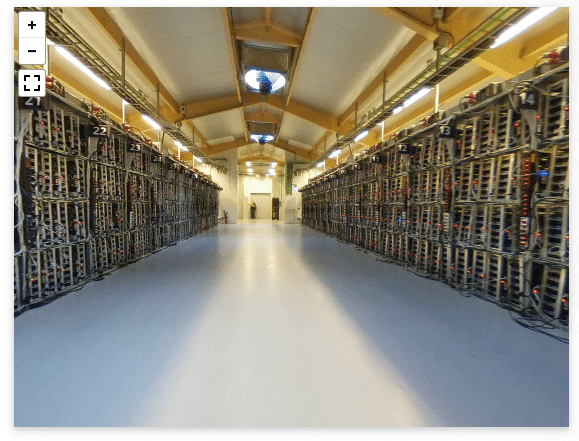
Genesis Mining continued to shape the industry from day one. The developers created the first exclusive Ethereum mining farm known as Enigma. The facility utilizes a combination of state-of-the-art mining chips and geothermal energy to offer users competitive payouts on their investments. The facility is regarded as one of the largest mining farms in the world and is located in Iceland’s capital city, Reykjavik.
Enigma Mining Facility Via Genesis Mining Website

Genesis Mining Features

The Genesis Mining platform offers competitively priced cloud mining contracts to corporations and individuals globally. The platform provides users with a plethora of unique features such as Radiant. Radiant takes into account the entire spectrum of mining concerns including electricity costs, Bitcoin prices, and processing power. The platform automatically adjusts the mining rigs performance to provide you with maximum profitability.

Genesis Mining in the Crypto Community

Currently, the Genesis Mining platform has over two million registered users, and the company’s founders are pillars of the crypto community. The company’s CEO, Marco Streng, frequently speaks publicly at blockchain events around the globe. Forbes did a piece on Streng in which the magazine described him as a “27-year old mathematician building a Bitcoin empire.” Streng proved to be an advantageous entrepreneur, and his company made some strategic partnerships along their journey to bolster their market stance.

Genesis Mining Partners with Hive Blockchain

In September 2017, HIVE Blockchain Technologies Ltd. acquired Genesis Mining’s Reykjavik data center for $9 million and 67,975,428 common shares in the capital produced by the company. HIVE Blockchain is a partnership between Genesis Mining and Foire Group. The connection made HIVE Blockchain the largestlisted blockchain infrastructure company in the world.

Cease and Desist from South Carolina Attorney General

It’s not always great being an industry pioneer, as Genesis Mining recently learned. In March of this year, the firm received a cease and desist from the South Carolina Attorney General. The cease and desist was meant to pause cloud mining operations while the Attorney General researched the validity of these operations. After five months of investigation, the court withdrew the cease and desist order, and the company was permitted to continue operations.
Genesis Mining company officials used the investigation as a way to educate lawmakers on the nuances of the crypto mining sector. The chief compliance officer of Genesis Mining, Shah Hafizi spoke publicly on the matter. He explained how his company is proud to work with regulators to provide a safer investment climate in the market.

Genesis Mining Ends Contracts Temporarily

This year saw some large market corrections befall the crypto space. Genesis Mining payouts took a big hit in January 2018 due to these massive losses in the crypto market. These losses resulted in smaller Bitcoin mining agreements becoming unprofitable. As a result, company officials decided to force users to upgrade to more substantial contracts or risk losing them.
The pause in lower tier Bitcoin mining contracts didn’t last that long, and by June, the company had reinstated many of its Bitcoin mining agreements. Today, the company offers a wide range of cloud mining contracts to users of all financial means. Users can now mine multiple cryptocurrencies from the platform. These cryptos include Bitcoin, Ethereum, Litecoin, Monero, and Zcash.

Genesis Mining: More Still to Come

Genesis Mining has managed to carve out a vital niche in the crypto market. This large cloud mining operation is now a critical component in the strategies of many crypto investors. When you consider the rising costs of electricity in many regions, it’s easy to see where firms such as Genesis Mining find their use. You should expect to see the cloud mining sector increase as more corporations follow in Genesis Mining’s footsteps.
This article by DAVID HAMILTON was originally published at "CoinCentral.com: https://coincentral.com/genesis-mining/