Friday, 11 May 2018

5 Ways to Increase Customer Retention

clicktime.com
Resultado de imagem para 5 Ways to Increase Customer Retention
Depending on who you ask, retaining customers is either valuable — or really, reallyvaluable.
By some estimates, a repeat customer is the equivalent of striking gold. One study found that increasing customer retention rates by 5% increased a business’s profits by 25% to 95%. On the other hand, the cost of acquiring a new customer can be steep: anywhere from five to 25 times more expensive than the cost of retaining an existing one.
Cut down on expenses and increase your profit, all in one marketing strategy. Customer retention doesn’t have to be complicated, especially when your business is well established. Focus less on reaching new customers, and more on increasing the frequency and spend amount of the customers you already have. Here are five ways to increase customer retention and start growing your revenue to new heights.

1. Figure out where you’re losing customers.

There are two benefits to digging into your retention rates to see where you’re losing customers. The first, obviously, is you begin to identify areas where your customer experience can begin to improve. Are people frustrated trying to navigate your online ordering process? Is your customer service failing to resolve their issue? Do they feel disconnected from your brand after being loyal customers for so many years? When a customer closes their account or decides to stop frequenting your business, send them an email to find out why. If sending a personal email feels uncomfortable, send them a survey. You can also start to pay attention to your online reviews — and follow up directly to learn more about your customer feedback. When customer experience is the root of the problem, a better time tracker can make employees more aware of their tasks and ultimately provide better service.
The second benefit? By asking these questions, you begin to build a personal relationship with your customers. Not many companies take the time to connect directly with their clients. Even if you may not convince someone to return to your business, you will start to build a reputation as someone who cares.

2. Increase customer retention by building personal relationships.

Customers — especially millennials — want the brands they shop from to be more “authentic.” What does that mean? They want transparency, great customer service, and a personal touch. Again, customers want to see that there’s a human person behind the businesses they frequent. Look to Everlane’s “Radical Transparency” or Harry’s Shave Club for inspiration on how to make transparency work for you.
To be more authentic, you need to be committed to being honest, open, and personal. If a customer doesn’t trust you, they will find a company they can trust. Look for ways to recognize your customer as an individual with personal touches: hand-written notes, small gifts and remembering birthdays are all details that can go a long way. Even when you mess up — and every company messes up at some point — be sincere about what went wrong and open about your process to fix the problem.

3. Make your customers feel they’re part of something bigger.

It’s easier for customers to switch companies if they do not perceive any differentiated value between your company and your competitors. One way to create value in your brand? Include customers in a larger social mission. Research shows that customers are likely to ignore brands that don’t “stand for anything.” Of customers who cited they had a strong relationship with a brand, 64% reported their “shared values” as the primary driver behind that relationship.
Start by identifying who your best customers are. If you’re a local business, think about what issues in the community you can support: the local animal shelter, for example, or donating to a food drive. If your company is bigger, dive into your data to get a clear picture of your customers’ goals, pain points, and desires. Then, craft a mission statement that mirrors their language and goals.

4. Use customer accounts to make it easy for repeat purchases.

Getting your customers to set up an online account can be a tricky proposition. Some customers may not want that level of commitment: they may be wary of sharing their personal data with a business. But, customer accounts make repurchasing much easier (and pre-filled shipping information can be enough incentive for a customer to sign up!).
One tactic you may take to lead customers to create accounts? Provide the option to “create account” after the first order has been placed. This does not disrupt the checkout flow or distract someone from finishing their final purchase. At the same time, once someone has an account, it becomes much easier to retain their business. Some platforms will even allow your business to send email invitations to activate their account after the purchase is complete.

5. Start a customer loyalty program with perks!

Everyone loves free stuff! It turns out loyalty can be bought: and surprising your loyal customers with great perks can lead to much higher lifetime value. Discounts and free rewards are the obvious extras you can offer your best customers.
Don’t be afraid to get a little more creative. If you’re running a B2B company, reward your customers by returning the favor (customer loyalty programs, anyone?) — and using their products or services when you can. Use your social media channels to do a little cross-promotion, or let a customer take over your account for the day. Some companies will tie their rewards back to their mission — REI’s Co-Op Dividend and American Express’ Small Business Saturday are a great examples of this. Show your customers you appreciate them, and they will return the favor!

Original Post: https://www.clicktime.com/blog/5-ways-to-increase-customer-retention/

Thursday, 10 May 2018

11 Profile Picture Hacks That Actually Work On Dating Apps

bustle.com
When you're single and looking to mingle, there's absolutely no shame in turning to online dating (aka the ol' millennial standby) to help you find someone. There's also no shame in doing some research to figure out how to get more matches on dating apps — because putting a little time and effort upfront into updating your dating profile can really pay off in the long run. One thing that can seriously make all the difference? Knowing what kinds of pictures to use on dating apps, and which ones are better left to collect virtual dust on your old Photobucket account.
 "I like to call dating app photos 'prime advertising space,'" Meredith Davis, Head of Communications at dating app The League, tells Bustle. "On The League, you only have up to six photos to advertise what is important to you whether that be family, sports, travel, etc. Rather than trying to optimize for the most hearts, I always suggest trying to optimize for the right hearts. The people with similar passions or interests as you will get excited about potentially matching if they see that you also enjoy hiking, cooking, or hanging out with your family."
In the fast-paced world of online dating, first impressions make a big difference, and the photos you choose should say something about who you are. So if you feel like you need to hit refresh on your dating profile, here are 11 hacks for making the most of your profile pics — and hopefully raking in even more matches as a result.

1. Pose With Your Mom

When you see your mom this upcoming Mother's Day, you might want to press pause on brunch to ask her to pose for a few pictures with you: according to new data from The League, users who have at least one photo with their mom saw a seven percent higher match rate than those without. Because who doesn't want a date who appreciates their mama?

2. Take Off Your Hat And Glasses
According to a 2016 study from Tinder — which analyzed 12,000 photographs from users aged 18 to 40 from multiple major U.S. metro cities — you're better off ditching hats and glasses in your dating app pics. Users wearing glasses in a profile picture (prescription or sunglasses) were 15 percent less likely to be right-swiped; for those wearing a hat, their chances of being swiped right on decreased by 12 percent.

3. Wear Something Bright To Stand Out

If your goal is to attract a mate (or just a date) online, you might want to take a leaf from the peacock's book and flaunt some brightly colored attire in your dating app pics. According to the Tinder study, 72 percent of Tinder users opt for outfits in neutral colors like black, white, or beige in their profile pictures — which means if you wear something bright, you'll be more likely to stand out (and hopefully catch a cutie's eye).

4. Don't Upload Only One Photo
If you're camera shy, coming up with more than one or two good photos of yourself for your dating apps can be tough — but it's totally worth the effort if you want more matches.
"I would encourage users to provide multiple shots that feature them in different ways, such as a full-length shot, a shot from the waist up, etc.," Dr. Jess Carbino, Bumble Sociologist (formerly Tinder Sociologist), tells Bustle. "You should be providing different perspectives of who you are in all facets."
5. Take Candid Pics
According to Hinge's 2017 Profile Picture Report, 80 percent of Hinge users' profile pictures were posed — but those that were candid were 15 percent more likely to be liked by other users. Some practical advice? Have a handful of both candids and posed shots to get the best of both worlds and wow everyone.

6. Pose With Your Friends

Although it's not a good idea to have *only* group photos on your dating apps (no one can tell who's who!), having a couple shots of you and your friends enjoying a night out can go a long way. Hinge's Profile Picture Report found that pictures of users having fun with their friends somewhere were 74 percent more likely to get a like;

7. Show Off Your Pearly Whites
You might have put a lot of hard work into learning how to perfectly smize, but a regular old smile might be more beneficial for your dating profile: the Hinge Profile Picture Report found that photos of users showing off their pearly whites were 23 percent more likely to be liked.

8. Get Old-Timey With A Black & White Filter
You might typically be Team #NoFilter, but trying out a black and white filter for one (but not all) of your dating app pictures might not be a bad idea. According to the Hinge Profile Picture Report, although only three percent of users' pictures were black and white, those that were were 106 times more likely to be liked than color photos — talk about good odds!

9. Channel Your Inner Sporty Spice
If sports are your thing, you're in luck: the Hinge data found that photos of users playing a sport or doing something athletic performed 75 percent better than the average, non-sporty photo. If you need me, I'll be over here editing donuts out of my pictures and replacing them with basketballs.

10. Share Photos Of Your Travel
In a 2017 study to see if travel photos fare better than other dating app photos, Hinge analyzed around 180,000 user photos and found that, while only 3.4 percent of were of travel, those that were received 30 percent more likes. There you have it: a ready-made excuse to book a plane ticket to the exotic locale of your dreams, all in the name of boosting your dating profile.

11. Avoid These Profile Picture Cliches
If you're wondering what you should absolutely not do in your dating app pics, here are the biggest no-nos, courtesy of the Hinge Profile Picture Report: wearing sunglasses, using Snapchat filters, posing with a possible significant other, beach photos, and selfies — particularly bathroom selfies.
Ultimately, the trick to getting more matches online is simple: don't be afraid to make a real connection, and always be your most authentic self. So upload whichever photos make you feel like your best, most beautiful self, and watch as the matches roll in!

Monday, 7 May 2018

How Will Blockchain Revolutionize IT Infrastructure?

coincentral.com
Image result for How Will Blockchain Revolutionize IT Infrastructure?

Blockchain & IT Infrastructure

Advancements in blockchain technology have certainly had a major impact on the cryptocurrency market. As new tokens present alternatives to old financial systems, many people are perhaps overlooking the power of blockchain technology behind the projects themselves. Let’s take a look at some of the biggest blockchain projects on the market today and how they can potentially influence the future of IT infrastructure.

File Storage

When most people think of file storage from a traditional standpoint, it seems like a binary system. Either you have enough storage or you don’t. Just a few decades ago, people had to rely upon CDs and floppy disks, which were slow and added very minimal amounts of memory. Of course, external hard drives improved this. Finally, today there are cloud storage solutions like Dropbox, OneDrive, iCloud, and others that offer some degree of improvement. While these solutions are better, they are still far from optimal.
Blockchain projects like Filecoin (FIL) and Storj (STORJ) could be the solutions that change the future of file storage. First of all, these solutions are considered to be much better than today’s most popular cloud storage products because they promise to have higher bandwidth and fewer unexpected outages. In addition, decentralized file storage applications also address the issue of privacy. Because traditional cloud storage products hold data in centralized databases, every user’s files are at risk of being hacked. In fact, this happened to Dropbox back in 2012 when 68 million users were hacked. The most alarming thing is that the company didn’t even report this issue until 2016. With decentralized file storage solutions, hacks are extremely more difficult to execute, and any data breach wouldn’t affect nearly as many users.
Another vital component driving the adoption of decentralized file storage is the fact that prices will be much lower than current solutions. That’s because files will be stored across a P2P network instead of via expensive database centers. This will likely be done by using cryptocurrency payments as incentives for individual users to join the network.
Check out our complete guide to decentralized file storage solutions.

Mesh Networks

Mesh networking has grown from a commercially-used technology to a consumer-level technology in just a few short years. Today’s products like Eero, Luma, and Google Wi-Fi all help to decrease wireless internet connection dead spots and boost connectivity levels for devices. Mesh networks work by adding nodes to Wi-FI network so that devices have multiple possible connection points, not just the single connection point offered by traditional routers and existing IT infrastructure.
Projects like Althea and SmartMesh (SMT) can be applied to solve internet connectivity problems in previously unconnected, remote places as well as those with high network congestion (i.e. sport stadiums and concert venues). Because data with SmartMesh, for example, doesn’t have to go through centralized networks and can instead remain within the mesh network, connection speeds are faster and electricity consumption is lower. Althea goes beyond just offering wireless internet to coffee shops and airports. It offers the ability for communities to create their own decentralized ISPs, which also make browsing private and neutral by default. Decentralized mesh network projects won’t just make the internet itself faster and more widely available but will also advance the capabilities of newer technologies like IoT and IoE.

Computation

While the computing power of regular computers is increasing every year, the capabilities of one machine are still no match for that of a supercomputer. That’s why projects like Golem (GNT) and iExec RLC (RLC) have become popular.
Allowing people to buy and sell computing power necessary to complete more complex tasks essentially allows anyone to create a supercomputer from using the power of multiple computers across the network. For now, Golem is focusing on a single use case: CGI rendering. However, as the projects like these continue to develop their technologies, it’s easy to see how this concept could also be applied to solve current computation limitations. For example, scientific modeling, data science, machine learning, and many more potential applications could all benefit from decentralized computation.
Decentralized computation will allow businesses to scale their IT infrastructure by giving them more computing power at lower costs. Instead of having to buy a supercomputer which could run in the millions or even billions of dollars, businesses could one day have access to a similar level of computing power at a fraction of the cost. The best part about this model is the flexibility it can offer for those needing extra computing power. Instead of having to buy a large amount of dedicated equipment, users would simply pay the network only when extra amounts of computation are required.

Conclusion

File storage, mesh networks, and computation will all see the benefits of advancements in blockchain technology. Even though the above-mentioned projects have already produced some promising results, there could very well be even more projects that will change these and other important sectors of IT. In the coming years for IT infrastructure, we will likely see increased security and privacy as well as decreasing costs.
This article by Delton Rhodes was originally published at CoinCentral.com": https://coincentral.com/blockchain-it-infrastructure/

Wednesday, 2 May 2018

Blockchain Real Estate: Selling Property Is Getting Easier

coincentral.com
Resultado de imagem para Blockchain Real Estate: Selling Property Is Getting Easier

Blockchain Real Estate Is Coming Sooner Than You Think

Blockchain real estate transactions, records, and marketplaces could radically change the way we think about property. Current systems for tracking and trading real estate are disjointed and inefficient. There’s an enormous opportunity for blockchain to standardize and secure real estate data. Land records, property listings, leases and mortgages, and government property tax offices could all benefit from a blockchain real estate revolution.
The challenge, of course, is that real estate is an enormous industry with many players including lenders, brokers, local governments, and private citizens. Changing to a blockchain-based real estate system isn’t as simple as flipping a switch. That said, various parties are experimenting with blockchain all along the real estate value chain to find ways to integrate the new technology.

Land Records

Land records are the foundation of real estate. Titles and deeds make it clear who owns what property. They power everything else that happens in real estate. However, they’re highly fragmented. Each individual local jurisdiction has its own rules regarding property records. Sometimes, these records aren’t even available online.
All that is changing. Chicago’s Cook County ran a pilot project for land records starting in 2016 that digitized all information and tested blockchain solutions. South Burlington, Vermont launched a similar pilot project in January 2018. Sweden recently implemented the second phase of its transition to blockchain land registry, using smart contracts on a private blockchain to facilitate transactions. That project will save Swedish taxpayers an estimated $100 million per year when it comes to full fruition.
Once we have property records listed and secured on the blockchain, it opens a lot of doors. Now, those records can easily change hands. We can use smart contracts to manage and trade those records as well.

Property Listings

Right now, if you want to sell a piece of property, your best bet is to list it with a local real estate agent. Sure, you could list the property for sale by owner, but you don’t have access to the multiple listing service (MLS) that real estate agents use to search for property when they have a new buyer.
The MLS is notoriously fragmented, walled off, and difficult to understand. Transferring property listings to the blockchain would mean opening up access to all available property for anyone to review. Along with the listing, you could include any terms or conditions that would need to be met for a successful sale. In the future, shopping for a home or an office space could be as simple as visiting an e-commerce website and adding the property to your shopping cart. Smart contracts behind the scenes could handle the rest of the transaction–transferring funds in exchange for the blockchain title to the property.

Smart Contract Property Management

One of the most exciting applications of blockchain real estate is smart contract management. Currently, any real estate transaction requires mountains of paperwork and hours of coordination between the bank, broker, seller, buyer, and local government. It’s possible to imagine a world where smart contracts handle most of that burden.
Not only that, but what if smart contracts handled rental agreements, commercial real estate tenancy, and other ongoing types of real estate transactions. Smart contracts could also help brokers automate due diligence on potential buyers/lessees. Blockchain real estate could create trust between parties on a level that doesn’t currently exist.

Crowd Ownership & Investing

Another exciting idea in blockchain real estate is crowd ownership of property. With blockchain governance models, a group of people could come together to purchase property and then vote on decisions about what to do with that property. Participants would essentially own a share of the property that they could then sell at any time.
Taken a step further, real estate investment trusts (REITs) and other real estate development investment vehicles could benefit from lower overhead as a result of blockchain.

What Happens to Realtors & Brokers?

The real estate industry is slow to change, and that won’t be any different with the blockchain transition. The truth is lenders, insurers, and other parties make a lot of money off the inefficiencies and challenges of navigating the current system. Blockchain poses a serious threat to these administrative and regulatory companies.
That said, there will always be a role for realtors and brokers in real estate. Even with blockchain real estate, people will want to see the homes or offices they’re considering purchasing. They’ll still need the help of an expert in the field to navigate such a large transaction and make sure the physical asset they’re purchasing is in good shape. Even if the transaction is much simpler and quicker, buyers will always need an expert guide.

Conclusion

Many trends in real estate are changing at the same time. Housing prices in cities are skyrocketing. Homeownership among young people is down. Brick and mortar retail is facing a threat from online shopping. Our neighborhoods are changing around us, and blockchain real estate is poised to become part of and accelerate that change.

This article by Bennett Garner was originally published at CoinCentral.com": https://coincentral.com/blockchain-real-estate-selling-property-is-getting-easier/

Apps that Help you Start your Business as a Delivery Driver

By Michael Kordvani


Are you 18+ and looking to make fast, fun cash that you can access quickly? Do you want to set your own schedule, take charge, and be your own boss? Then you've come to the right article! Here, we will be covering a few of the app-based delivery driving gigs that will help you start making cash NOW. And don't worry, you'll have your pick of any delivery driver app you choose - they're all pretty easy to qualify for!

1. Udely

Udely is truly unique in the delivery driver app scene. That's because, in addition to fulfilling orders as normal, you can list your own products through their app. They don't take any percentage of your transactions and allow you all the freedom of your own time, money, and life. This unique twist is great for anyone who wants to earn cash while they get their business off the ground.

2. DoorDash

DoorDash offers great features like "Drive", which allows you to get paid even more for catering gigs before they're given out to the general pool of drivers. They also work with other apps that allow you to pay a small fee ($1.99 - $2.99) to receive your pay from completed shifts either the next or same day! A very cool feature for anyone who wants or needs to see their money right away.

3. Caviar

Bigger tips, better pay, but not an app for everyone. This delivery app is truly amazing, but, as the name suggests, it expects a certain level of maturity, professionalism, and a dress code that some of the other apps don't really require. You also have to jump through a few extra hoops to sign up to drive for them. While it's a great option for anyone who qualifies, the more professional attitude may be off-putting to the more casual driver.

4. Uber & UberEats

While Uber has been under some fire recently about the "poor treatment" of drivers, they've also been in (and leading) the game from the word "go". They constantly try to improve the app for both drivers and clients. Besides, if you get lonely you can switch to driving folks around, and if you get tired of people, you can switch to delivering food!

5. PostMates

This app is pretty awesome for newbies. It has a more comprehensive map that shows you right where all the action is. The pay takes a little longer than some of the other apps, but you can find work at pretty much any hour of the day. You can enjoy picking up a variety of things to deliver (not just food). They have a more relaxed pace and will pay mileage bonus (which most apps don't!)

There are a ton of great delivery driver apps out there. We've tried to include those that are in multiple states, but check out local delivery apps - like Favor! - that can help you rake in even more cash. And once you get the hang of it, you can totally stack up orders from multiple platforms for even more cash. Just don't bite off more than you can chew!

Monday, 30 April 2018

The Role Of Localization In Marketing Your App Internationally

inc42.com
App Localization Means The Process Of Making Your App According To The Needs And Behavior Of The Local Audience
Your app cannot afford to get lost in the crowd of 2.8 Mn Android apps and 2.2 million iOS apps. Months of ideating, prototyping, coding, testing and undergoing the app store approval process would amount to nothing if your app fails to receive any downloads!
Irrespective of how great the user experience is, or the significant problem your app solves, failure to get downloads and climb the top of the app leaderboard ensures that your app will soon be forgotten.
However, localization is one proven technique most apps use to maximize their app downloads on an international level.

So What Is Localization?

App localization means the process of making your app according to the needs and behavior of the local audience.
This doesn’t just mean translating the language but several other important aspects such as the app’s name, units of currency, designs, symbols, keywords, dates and time zones among many others.
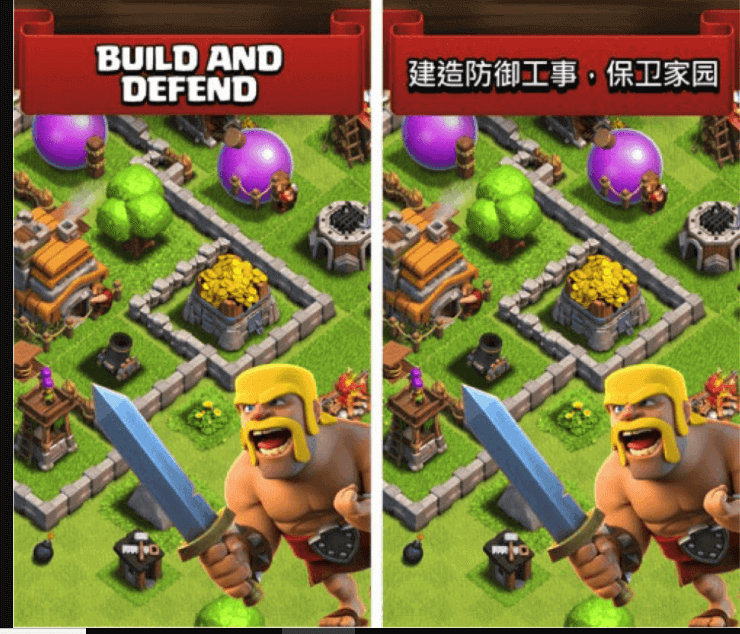
Here’s an example of the app Clash of Titans in English and Chinese. The headings and the language in the app are translated so that the local users feel comfortable using the app in their native language.
Source – KISSmetrics

Importance Of Localization

With each passing year, the web has become more multilingual. Your app is going to be accessed by people all around the world. Provide them with the option of being able to use it in their preferred native language.
According to Internet World Stats, 804 Mn internet users are Chinese, and 337 Mn internet users are Spanish.
Localization is the key to optimizing app downloads in your targeted local markets. For example, the Facebook app can be accessed in over 80 languages while the Twitter app is available in over 30 languages. 72 percent of app users are not native English speakers, which implies that not localizing your app would lead you to miss out on a huge share of the market.
  • Forbes study found that app downloads increased 120% and revenue went up 26% after releasing apps in native languages.
  • A study by Statista found 48% of app users stop using apps and uninstall them if the apps are not localized properly.
Localizing an app is vital to forge a personal bond with the users to make them habitual users.
A few ways to localize your app are:
  • Use localized languages
  • Localize your app store optimization
  • Localize videos and images
  • Conduct app localization testing
This infographic from Translate by Humans shows you the techniques to market your app internationally.
How to Market Your App Internationally - Infographic