Wednesday, 21 February 2018

The Dazzling Allure of Cryptocurrency (Infographic)

coincentral.com
The cryptocurrency world is evolving at a speed that leaves many newcomers lost in a haze of uncertainty. The following graphic will help dispell some of the most popular myths and help get you on track to a better and more complete understanding.
coincentral cryptocurrency myths
This article was originally published at CoinCentral.com”:https://coincentral.com/dispelling-myths-cryptocurrency-world/

Wednesday, 14 February 2018

Major Content Marketing Trends For 2018

business2community.com

Resultado de imagem para Content Marketing Trend
Content marketing is well on its way to continuing its momentum. Every year opens and the progression of content marketing is still constant. The investment will seem to be on the rise and the effectiveness of this practice more important than ever. This is why we have concocted an article that gives pride of place to the trends we have estimated the most interesting for the year 2018. An overview.
From creation to diffusion, technological innovations are forcing brands to rethink their content marketing strategy to adapt to consumers’ new buying habits.
But then with a multitude of different platforms available to you in 2018, how to communicate the right message at different stages of the funnel? What formats of content and innovations to focus on to raise awareness, engage and retain? How to boost traffic and implement a content strategy that leads to conversions and sales?
1
As 2018 begins, this study shows that brands are increasingly taking content marketing seriously, increasing their investments in the field. In the same way, content and preferences evolve over time. We have compiled, below, the major trends for 2018.

The Growth of Augmented Reality

Beyond the buzz of VR, always expensive, too immersive and constraining, augmented reality presents a real opportunity in terms of applications for marketing. We can already see various uses here and there (Ikea app for example) and with the improvement of the technology, the user experience should also improve. And with companies like Apple pushing augmented reality, there is no doubt that technology will continue to grow.

Content Marketing Will Continue To Take Shares of Traditional Advertising

Initially, content marketing was the exact opposite of advertising. The cream of the cream content reached heights through its quality. Conversely, advertising was based mainly on the amounts paid. Nowadays, lines tend to cross – sponsored content, for example, halfway between content creation and paid advertising – and it’s important to keep in mind a desire to attract customers and prospects in the future. Offering quality content rather than trying to sell at any price (and at all advertising prices).

Hyper-Personalization of the Content

Earlier scenario was that the leading brands no longer just produce an article, audio or video, but merchants can now produce thousands of content for the same campaign.
You must be thinking the reason behind this massive increase. It’s simply the Hyper-customization of content by merchants to better meet the needs of their many customer segments.
In this regard, video channels like YouTube has recently unveiled new tools to create personalized ads, video clips, etc., which allows brands to broadcast thousands of videos in a single campaign. The video a consumer looks and search is determined by a wide variety of factors, including, behavior, statistics, downloaded apps, and even where they are (physically, using Google data).
With all these numeric data points, tradesperson now access the data and information they need to deliver the exact quality content for the consumer. For example, a buyer looking for a consumer goods store could see a video about purchasing skills if he had just wanted to use his money wisely.

Content Accessible To Everyone

This is a relatively recent trend. Brands are beginning to pay attention to populations with disabilities (blind, deaf, etc.). We are still in the early stages but it is positive that some brands are now integrating these populations into their marketing strategies. An approach also facilitated by technological developments and social networks (Facebook, Twitter, etc.) facilitating, for example, adding a written description of an image for people who cannot see it.

LinkedIn 2.0

Whether for large brands or small businesses, LinkedIn is the platform of the moment. The end of the year 2017 has shown, LinkedIn seems to have found a second wind and finally comes to Facebook B2B. At present, it is a platform that should not be overlooked in terms of presence, visibility, and promotion. And with the contribution of video, LinkedIn is already at the top of the 2018 trend.

Facebook Is Looking For Itself, Instagram Dominates

Admittedly, in recent times, Facebook seems to be looking for a course. Between changes in the “news feed” and willingness to give preference to relations/friends rather than brands. In the meantime, Facebook is also full-fledged Instagram, taking advantage of photo and video trends (while relying on the FB network). The marks are there, the hearings are there. The year looks good for Instagram.

Snapchat Still Behind

Snapchat seems to be fighting to try to keep its head out of the water right now. The tool has had good hours but does not really see any growth. Despite recent updates – and the ability, from now on, to share beyond the network (a potential to use filters, always quality, to create a post) – the application is now more of the gadget than the marketing tool.

Influence Marketing In the Continuity

The statistics are in favor of influence marketing. With this, the number of “specialized” agencies continues to grow, current influencers structure their approach and have combined experience and we see, now, to increase the power of micro-influencers. The difference, beyond the prestige, will be on the ability of these influencers to develop relevant price models and, above all, provide statistics and demonstrate a return on investment. With a little more maturity, so-called influencers should be more easily identifiable by brands and leave room for “real” influencers.

The mobile will continue to take market share

The trend is in “mobile-first”. The experiments (contents) are created, in priority, to be seen on mobile (smartphone or tablet). It is now a virtual necessity (beyond having a site that is also optimized for mobile). More than half of the population consumes mobile content, and in the United States, an average of 3 hours per day is spent on their mobile.

The beautiful days of storytelling

Storytelling is the art of telling a story. Beyond the buzzword is the story of marketing well done? Instead of a piece of content without logic, storytelling involves creating a narration, staging a brand, a product, and advancing the story. Today we see all kinds of content created and published without a clear link to a brand or a product. With a little more maturity, storytelling – and marketing of quality content – will have to replace these poor content.

Data and statistics

Marketers are gaining experience, tools are improving and it is now crucial to provide quantified results. The way the best marketers stand out – beyond successful campaigns – is their ability to use statistics and data. Not only to make informed decisions and avoid wasting time and money but also to justify their results.

The growth of content recycling

Content recycling? In this case, it is about re-using existing content (and creating interaction) on other networks. Sharing is not enough. Sharing content that is relevant to each network and significantly differentiated is the key. If a blog article works pretty well, you can use key phrases on Twitter for example. The article presents figures or statistics? Create a visual with these and share on Instagram or Twitter. Etc. This is a winning strategy, not only because it relies on the use of quality content that has already found an audience but also because it saves time for marketers. Recycling content is easier than creating a new one.

Editing the content schedule

Instead of creating content on the base:
Audience> Message> Channels (a message for the audience delivered identically on all channels)
we hopefully see more of:
Audience> Channels> Message (the same message but adapted in its form and tone to the channels)
Finally, as the year rolls on, it’s important to remember that content marketing is not a sprint but a marathon. The efforts bear fruit over time.

Lunching into Cryptocurrency? (Infographic)

fundera.com
Virtual currency is becoming increasingly important. Organizations are starting to understand the value of this relatively new form of currency and are investing in it rapidly. The currency is estimated to be worth as much as nine billion dollars today. While there are still some that are perplexed by what cryptocurrency is and why it’s important, most people understand that it is significant implications for society.

The phenomenon of cryptocurrency began with the invention of cryptocurrency. Since then, many other digital currencies have emerged on the market. More businesses than ever are accepting it as a legitimate form of currency. Companies are strategically thinking about how digital currency will affect their business down the road.

Cryptocurrencies like bitcoin are important because they are revolutionizing monetary transactions around the world. Bitcoin is permissionless and irreversible, so many people see the system as an attack on the traditional control that banks and governments have over the finances of their citizens.  

Despite its rise in popularity, many people still struggle to understand the complexities of digital currency. To understand where cryptocurrency is headed, it’s important to understand the fundamentals of the system. Fundera created a guide that breaks down the complexities of cryptocurrencies and outlines the essentials of how the system works. Read on for everything that you need to know about cryptocurrency.

Tuesday, 13 February 2018

NEO and Blockchains Across China


coincentral.com
Resultado de imagem para NEO and Blockchains Across China

NEO’s Vision

The developers of NEO are looking to spread blockchains across all of China. Their company, Onchain, has developed a Distributed Networks Architecture (DNA) to allow for the easy implementation and development of standardized blockchains. They want every interested field to easily be able to migrate their data and assets onto a private or public blockchain. The founder, Dr. Da Hongfei said“We want to be the place people go to when they want to do serious and reliable transactions.” Onchain and NEO are not only succeeding in their vision, but they are set up to thrive within the regulations of the Chinese government.
Onchain

Cryptocurrencies in China

On the surface, it seems as if cryptocurrencies and China don’t always get along. “Two things are infinite: the universe and the number of times China can ban Bitcoin, and I’m not sure about the former.
There is a 50,000 USD yearly cap on moving money out of China without special permission. People found a loophole in this system by buying cryptocurrency and easily moving funds and accessing them anywhere in the world. The Chinese government tried to close this loophole through the banning of online exchanges. The government was also worried about the levels of speculation, thinking back to their recent stock market crash.
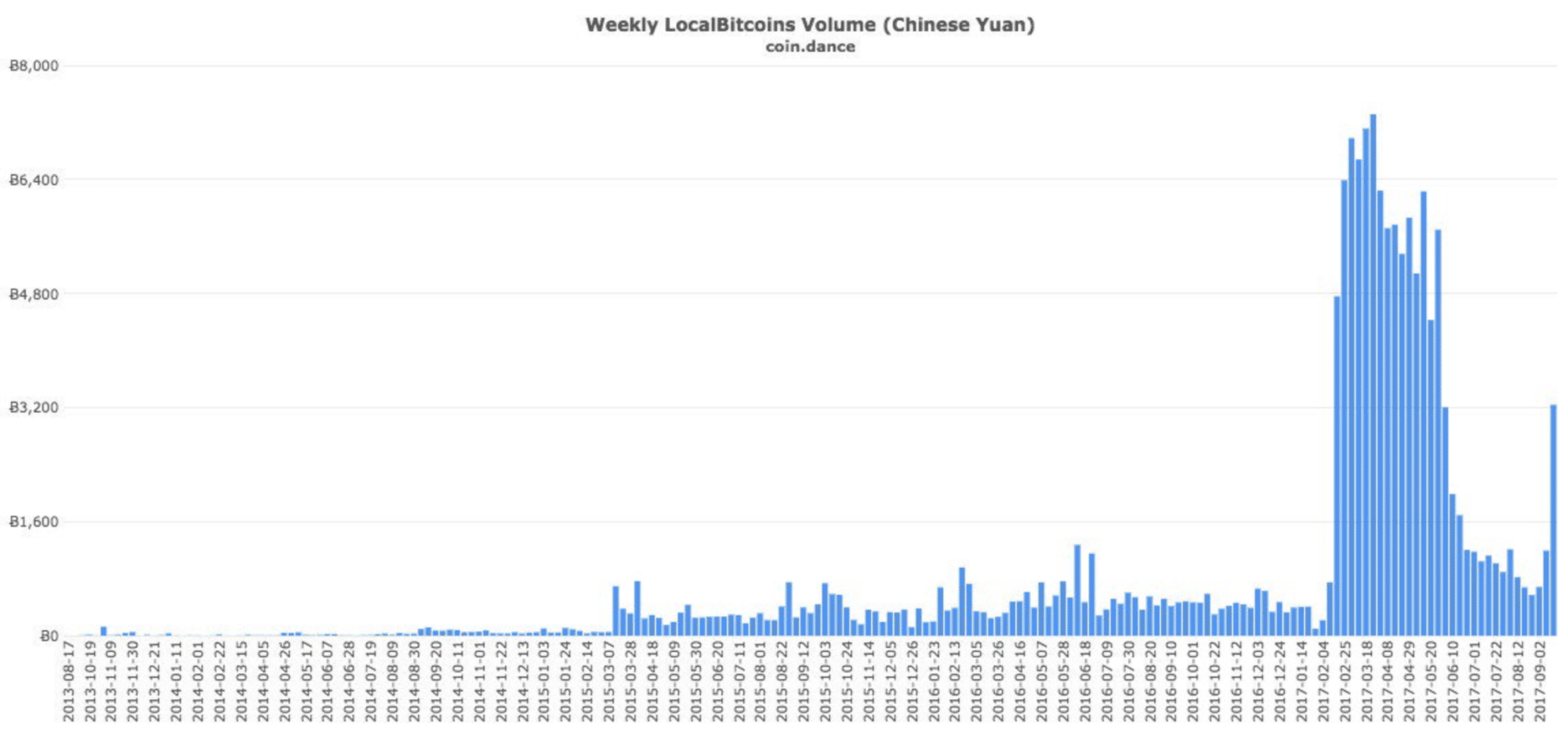
After China banned exchanges and ICOs, interest in cryptocurrency didn’t simply roll over and die. People moved to a p2p model, making local transactions, often referred to as the “over the counter market.” Here’s a look at the change in volume on localbitcoins around the time of the bannings. 
Localbitcoin Volume

Buying Coins in China Today

People would also organize trades on WeChat, the most popular chatting service in China. This was especially convenient at first since users could use WeChat Pay to send each other fiat currency. Government monitoring of WeChat led to increased popularity of the encrypted chatting service Telegram. China then banned Telegram. It’s unclear if the new p2p models are legal in China, but there has been no direct intervention as of yet. Realistically, it’s not feasible to stop all cryptocurrency trading.
Residents of China can also hop on the train into Hong Kong to obtain cryptocurrency. Over 100,000 Chinese tourists travel to Hong Kong every dayThey can buy coins from any of the large exchanges or use one of the many BTC ATMs It’s no wonder why the Hong Kong BTC ATMs frequently have large lines.
All of this regulation may sound like discouraging news for NEO and cryptocurrency but Hongfei sees it differently. He said, “It’s time for regulators to step in.”

Onchain and NEO in China

The Chinese government has a history of protecting local companies willing to cooperate with regulations. Playing by China’s rules has proved fruitful for several tech companies. You won’t find Google, Facebook, Twitter, WhatsApp, Uber, or Amazon in China. Instead, you see the success of Baidu, RenRen, Weibo, WeChat, Didi, and Alibaba. WeChat, for example, has over 1 billion accounts registered. NEO and Onchain are positioning themselves to be the next big names on this list of tech giants.
While not exactly friendly to Bitcoin, the Chinese government does actually support the development of blockchains. The Ministry of Industry and Information Technology (MIIT) of the People’s Republic of China, with the help of Onchain and other companies, explored several areas where blockchains can increase efficiency and prevent fraud. The government believes supply chains, assets, finance, welfare, and identity management can all potentially benefit from the use of Blockchain Technology. The government has even experimented with the idea of its own national cryptocurrency. It’s obvious that Hongfei anticipated the future demands and requirements of the Chinese government as these are all areas that Onchain is hoping to tackle with its custom and flexible Distributed Networks Architecture.
The MIIT also proposed that there should be greater standardization across blockchains. Hongfei said“Our vision is to make Onchain a truly universal Blockchain framework. Utilizing different plug-in modules, our framework could be applied for a public chain, a consortium chain or even a private chain. Our cross-chain adaptor module, currently under development, creates interoperability among these different chains.” 

Onchain Technology

This is your last chance. After this, there is no turning back. You take the blue pill – the story ends, you wake up in your bed and believe in whatever altcoin you want to believe. You take the red pill – you stay in China and I show you how deep the blockchain goes.
NEO was designed from a technology standpoint to be able to comply with regulations and work within the system. Bitcoin was designed with decentralization as a focus. While there are advantages to decentralization, it can lead to disagreements on the direction of the coin and slow implementation of new ideas. Decentralization is not the immediate goal of Onchain and NEO. Hongfei believes the centralization is worth it, in the beginning, allowing them to implement changes quickly.
NEO pre-mined 50% of their tokens to pay developers and help promote the growth of the coin. Dr. Hongfei compares NEO to eastern Asian countries, saying it will be “more authoritative in the beginning, but eventually be democratic.” He believes NEO will be “eventually fully decentralized… like Bitcoin.”

NEO Mining

The NEO blockchain confirms transactions in a relatively centralized, but unique way. Rather than using proof of work or proof of stake, NEO uses Delegated Byzantine Fault Tolerance also known asdBFT. In this system, holders of NEO elect nodes to confirm transactions.
To become a node, you must have a computer reach certain technical requirements, stake 1000 GAS coins, and then become elected by NEO holders. All 12 active nodes currently provide free transactions. The NEO holders are certainly more likely to vote for people that promise free transactions. Once you are elected as a node, you might be randomly selected to confirm the transactions on the blockchain. If over 66% of the other nodes agree with your ledger, the block is confirmed. If less than 66% agree, another node is selected to propose transactions that should go on the block. This process continues until a consensus is reached. NEO holders would most likely vote out nodes consistently failing to propose correct transactions.

No Forks

The Delegated Byzantine Fault Tolerance makes it clear which transactions are confirmed on the blockchain at all times. In The Matrix, we learned there is no spoon, but they forgot to mention there are no forks either. Unlike Bitcoin or Ethereum, which often fork until reaching a consensus, the NEO blockchain cannot fork. The lack of forks is essential to Onchain’s goal of digitizing assets such as stocks, bonds, and digital identities. If companies want to digitize regularly traded assets, it must be clear who is the owner of the assets at all times. 
Neo Spoon

Chinese Partnerships

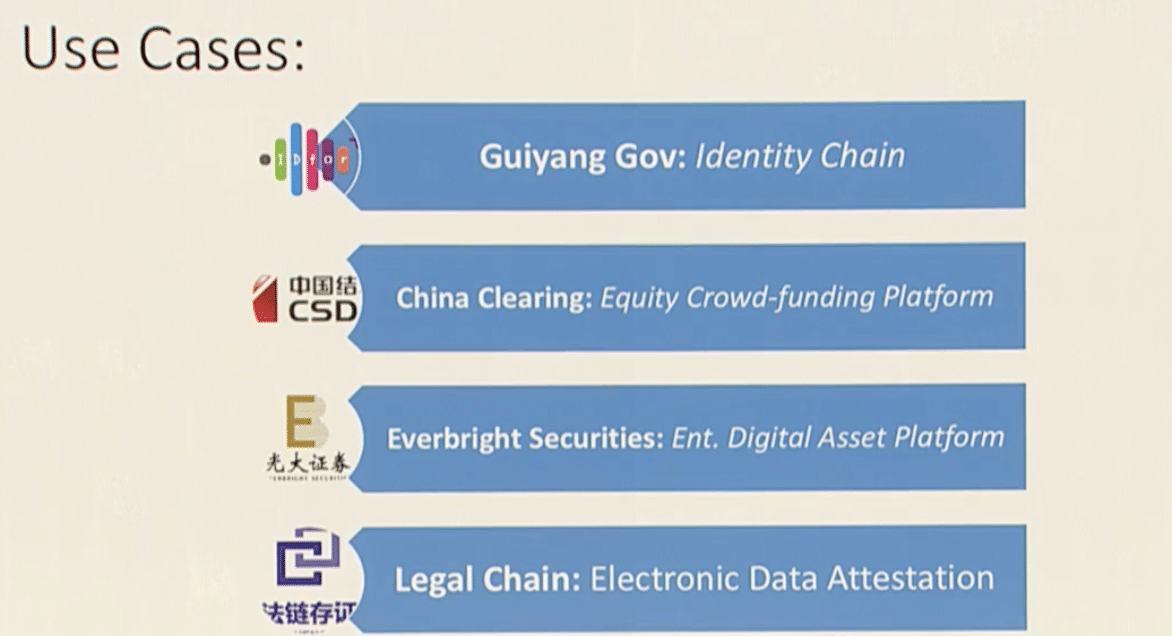
Onchain is working hard to spread their blockchain technology to private and government institutions. Here is a slide from a recent presentation by Hongfei.
Onchain Partnerships

Identity Chain – Integrity System Based on Blockchain

This project was “initiated by Guizhou Far East Integrity Management Company” and is based on the Distributed Networks Architecture. Onchain is helping build a blockchain to keep track of and manage identification. 

Security Company – Enterprise Level Digital Asset Platform

Onchain is applying the blockchain in financial institutions. It’s already working on a chain for Everbright Securities, a large securities brokerage in China.

Legal Chain – Digital Evidence Storage Alliance

Onchain helped develop a blockchain for the digital storage of enterprise emails as evidence. No one can delete or tamper evidence once it’s in the blockchain.

Alibaba

Onchain developed an email repository system for Alibaba to allow users to store important data or emails. This has several applications, including saving emails for the use of judicial proceedings.
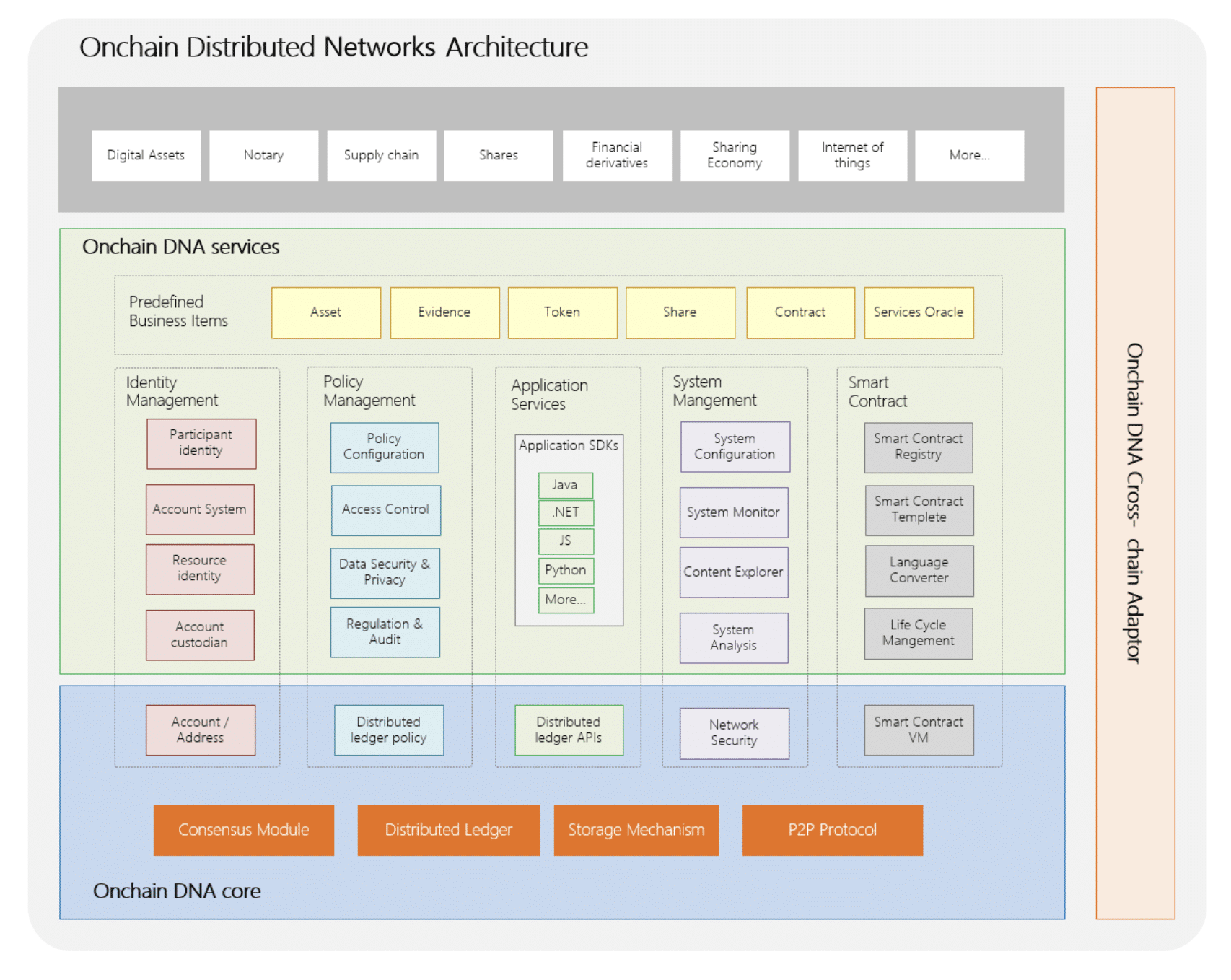
The following diagram outlines many of the different uses for the Distributed NetworkArchitecturee.
Onchain DNA

Future of Onchain and NEO

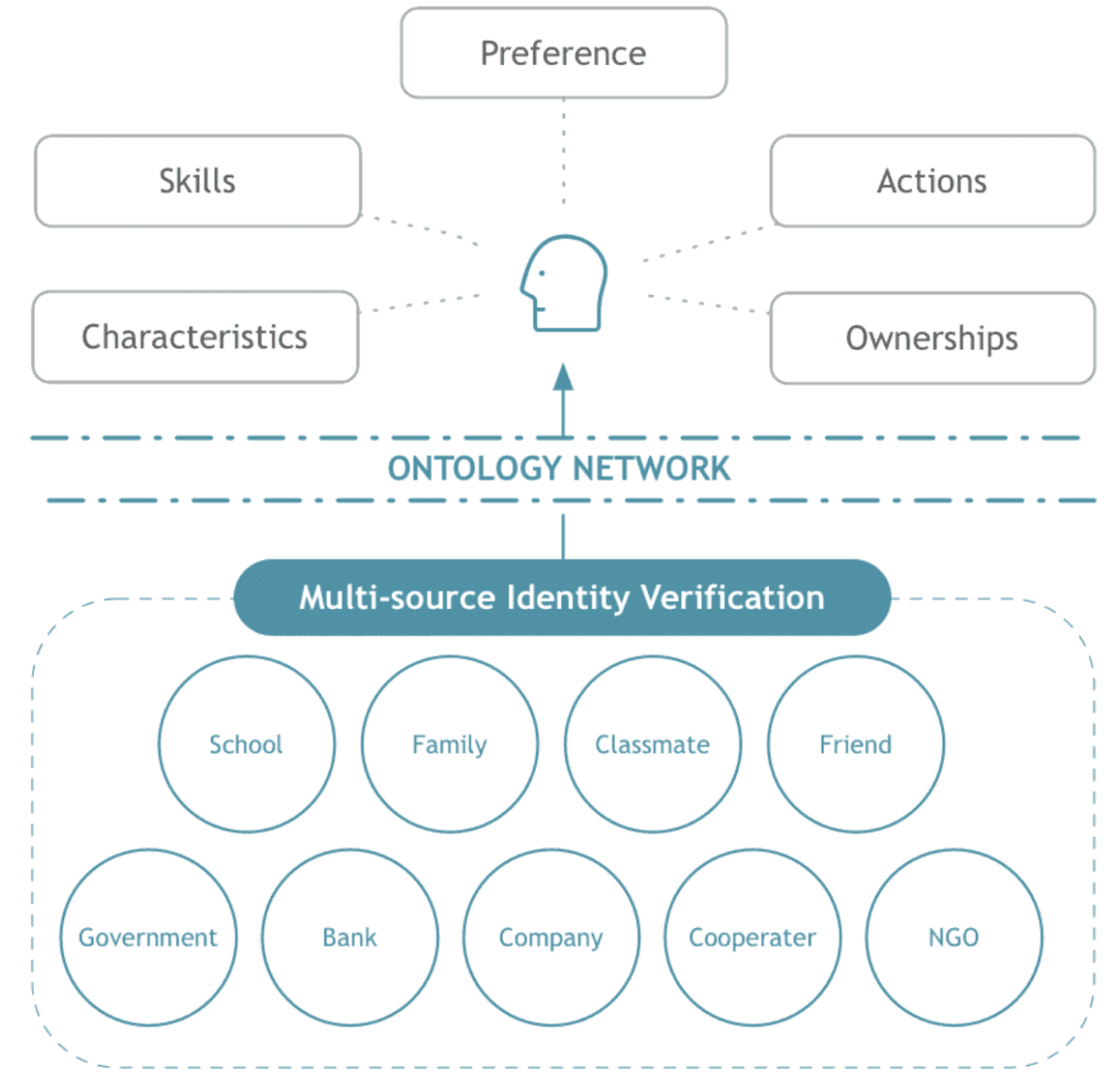
Onchain would like to continue building partnerships in China, eventually moving fiat and identities onto blockchains. They are starting a new blockchain called Ontology focusing specifically on identities. Hongfei would like to attach data to ID’s, such as universities and working experience. Authorization on ID’s would be the ability to authorize people to view your information, such as your finances when applying for a loan. 
Ontology Identity Management
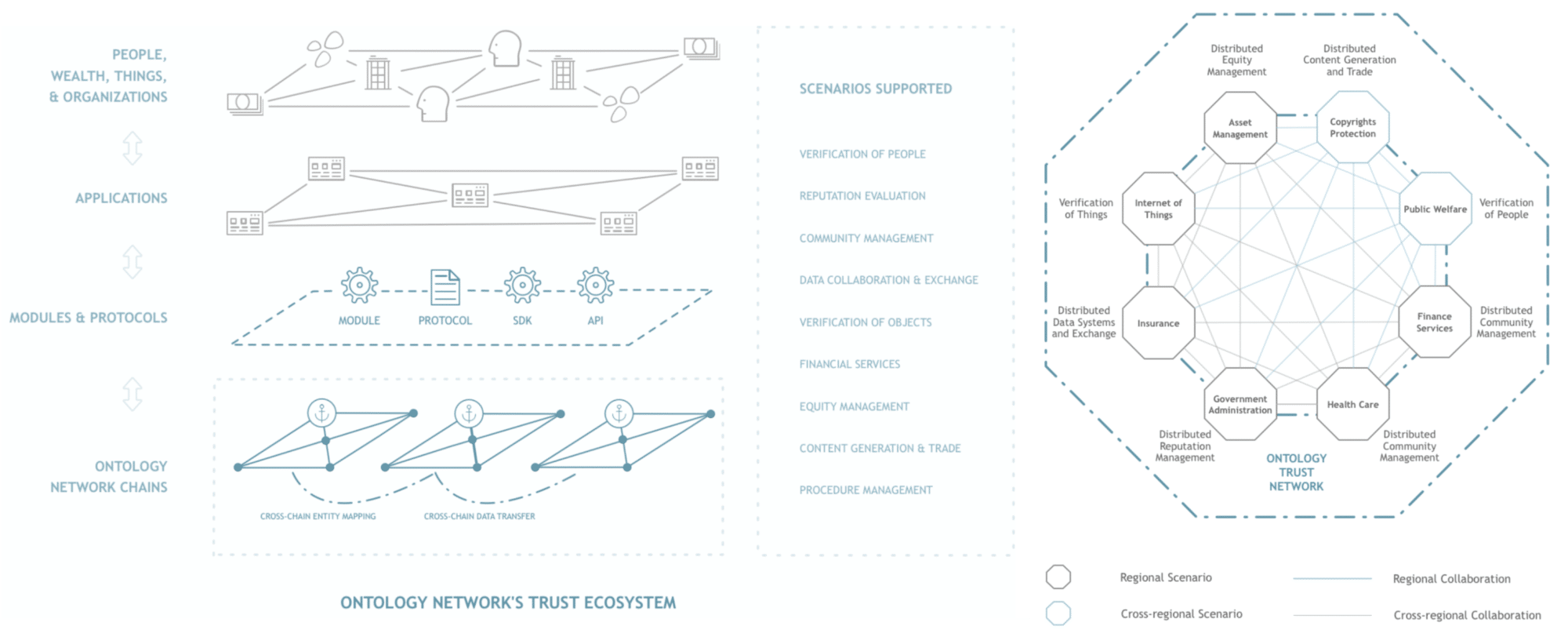
These next diagrams show how Ontology would achieve the goal of truly spreading blockchains across China.
Ontology diagrams
These digital identities also tie into Onchain’s and NEO’s desire to be compliant. China cannot effectively monitor these platforms if they don’t know who is using it.
All of these public and private blockchains created by Onchain, including Ontology, will eventually be able to connect to NEO. The Ontology token sale will accept NEO tokens. “NEO will be the primary digital assets service provider for clearing and settlement on Ontology.” Ontology wants to become the government compliant connection between businesses and NEO.

Ontology and NEO

While some worry that Ontology will compete with NEO, it seems that the developers have every intention to create synergy between the two. When the Ontology network wants to hold an ICO, they will be able to through the NEO platform. Currently, an ICO would cost you 50,000 USD worth of GAS. This means we will see more serious and less frequent ICO’s on the NEO platform. This runs in sharp contrast to a recent joke Ethereum ICO called the Useless Ethereum Token (UET), which promised to steal your money and give you a worthless token in returnThe creator begged people not to buy it and insisted he would just take their money and buy expensive electronics with it. Of course, people still spent over 300,000 USD on UET.
NEO seems to have such a bright future that it has even caught the attention of Litecoin founder Charlie Lee.


Charlie Lee [LTC]
@SatoshiLite
There's a guy trying to catch up to us. We've been dropping 🐢 and 🍌, but he's been dodging them using bullet time. That's just unfair! 😂

Summary

Onchain is clearly executing on their ambitious plan to create an entire ecosystem of standardized and connected blockchains in China, all of which will be able to connect to the already successful NEO ecosystem.
We could say the future of NEO is reminiscent of a conversation from The Matrix movie.
Neo asked, “What are you trying to tell me? That I can dodge Chinese regulation?”
Morpheus replied, “No NEO, I’m trying to tell you that when you’re ready, you won’t have to.”
Hong Fei Neo
This article by Paul Andrew was originally published at CoinCentral.com”: https://coincentral.com/neo-and-blockchains-across-china/

Wednesday, 7 February 2018

3 Mobile App Stocks to Buy, 1 to Avoid

fool.com

The mobile economy continues to take over the world. Here are three stocks to let you take advantage of it.

Ten years ago, an app was something you got at a restaurant before your entree. Today, it's the center of a $5 trillion industry. Mobile apps (short for applications) have revolutionized computing, taking it from mouse clicks to touch screens, and have spawned a multi-trillion dollar economy for developers, start-ups, and tech giants along way.
Not surprisingly, the most popular mobile apps often belong to the most successful companies, as technical performance, ease of use, and utility are key criteria for apps to get downloaded onto billions of smartphones around the world.
With global time spent on apps expected to increase from 1.6 trillion hours in 2016 to 3.5 trillion in 2021, it's no surprise investors are hungry for a piece of the space. 
A man looks at his smartphone and smiles.
IMAGE SOURCE: GETTY IMAGES.

The mobile app industry today

So many publicly traded companies depend on their apps to compete in today's market. Beyond tech companies, apps are key for banks, retailers, airlines, hotels, restaurants, and industries. Even segments that once operated smoothly offline, like transportation and video entertainment, have been disrupted by app-based brands like Uber and Netflix.
Apple's iOS and Alphabet's Android dominate the market in smartphone operating systems. But despite Android's much larger market share, developers make apps for iOS first and then Android second -- iOS users have higher incomes, so they're more likely to pay for apps; it's easier to design for iOS because there's a limited number of devices that use the software; and apps are safer inside iOS.
That advantage is a key driver of Apple's huge profit margins, as app-related services have grown into a significant revenue stream to complement the sale of its devices. But Apple isn't the only one benefiting from the app economy -- the owners of the most popular paid and free apps are also raking in cash from mobile.
The top app players
The chart below shows some of the stocks that are thriving from the app economy.
Company
Market Cap 
Trailing P/E Ratio
1-Year Stock Growth (Loss)
Apple App Store Rank
Apple
$851.9 billion
18.2
38%
Not applicable
Alphabet
$821.1 billion
39.4
43.7%
#3, #7, #9, #14, and more (YouTube, Gmail, Google Maps, Google Docs)
Facebook (NASDAQ:FB)
$561.3 billion
37.4
48.2%
#1,#2, #5, #18 (Facebook Messenger, Instagram, Facebook, What's App)
Snap Inc (NYSE:SNAP)
$16.7 billion
N/A (not profitable)
(43.3%)
#4 (Snapchat)
Match Group (NASDAQ:MTCH)
$9.6 billion
23.4
102.8%
#50 (Tinder)
Paypal Holdings (NASDAQ:PYPL)
$95.7 billion
61.6
100.2%
#28, #37 (Paypal, Venmo)
With its Android platform, Alphabet has built out its own impressive app-driven business. Android apps collected $27 billion in sales in 2016, and like Apple the company keeps 15% of app-based sales, giving it a multi-billion-dollar revenue stream. Outside of Android, Alphabet also owns some of the most popular apps in the world, including YouTube, Gmail, Google Maps, and Google Docs, which have burnished its advertising business. YouTube, for example, has 1.5 billion monthly users, and claims that its users watch more than an hour a day on mobile devices. The company does not break out YouTube financial results, but the high monetization rate of video ads makes that another valuable revenue stream.As the king of the App Store, Apple has made quite a killing from the mobile economy. In the most recent quarter, services revenue, which is derived largely from in-app payments and its own apps like Apple Music, increased 34% from the previous year to $8.5 billion, making it the company's largest segment after the iPhone. Increasingly, Apple's focus has been leveraging its installed base of devices to grow its services business through in-app purchases and tangential business like Apple Music, iTunes, and its expected upcoming television service.
No one dominates the app game like Facebook. The social media giant owns three of the top five apps in the app store, and has three apps with a billion users or more, with Instagram likely to become the fourth sometime this year. While mobile gave the company headaches in its early public history, it has now mastered mobile advertising, which has become the primary driver of its business. In its most recent quarter, 89% of its advertising revenue came from mobile, and it's leveraged that expertise to build businesses out of native app brands like Instagram -- and should eventually do the same with Whatsapp. As long as people are using their phones to communicate, Facebook should remain a winner.
Snapchat-parent Snap owns the fourth-most popular app on the App Store, which, like Instagram, is a mobile-only app based around the camera, allowing users to post photos with different lenses and record video that's collected into stories. While Snapchat is the rare social media company that has actually mounted a challenge to Facebook, gaining popularity with teens and young adults, the company has lost momentum as Instagram has co-opted many of the features that made it unique. Growth is slowing, and the company is struggling to demonstrate its value to advertisers, who prefer Instagram.
Match Group may not have one of the top downloaded apps on the App Store, but the company, thanks to mobile-first Tinder, is remaking the online dating industry. Its swipe-based method of matching potential daters has made Tinder the #1 dating app and driven strong growth for the company as it continues to monetize Tinder with add-ons like Tinder Boost, Tinder Plus, and Tinder Gold. The company and its other apps, like OkCupid, PlentyofFish, Match, and dozens more, should continue to grow as online dating becomes more popular.
Finally, Paypal has long been the leader in mobile payments with more than 200 million active accounts. Its acquisition of Venmo has also proven key, becoming a favorite among millennials for allowing quick, fee-free payments to split restaurant checks, pay rent, or reimburse other expenses. In its most recent quarter, the company said mobile payments rose 53% to $48 billion driven by strong engagement during the holiday season. As mobile payments become more convenient, Paypal likely has a long tail of growth ahead of it.
A woman in running pants holds a smartphone in her hands.

What is blockchain?

coincentral.com
by Steven Buchko

Image result for What is blockchain?
Simply put, a blockchain is just a list of digital records (blocks) that are chained together using cryptography.
The financial industry today contains all types of middlemen – payments processors, banks, and credit card companies are just a few. These intermediaries help to establish trust between buyers and sellers and ensure the accuracy of data in the transactions. However, adding additional people and steps to the process oftentimes leads to cost increases and reductions in speed.
Enter blockchain. This technology eliminates the need for middlemen by providing a decentralized, trustless ledger system with little exposure to fraud. Bitcoin is the most famous example.
Although you primarily hear about the financial sector’s use of blockchain, the technology expands far beyond just simple transactions. Blockchain companies are disrupting tons of industries from data storage and supply chain to gambling and the Internet of Things.

How does blockchain work?

Nodes

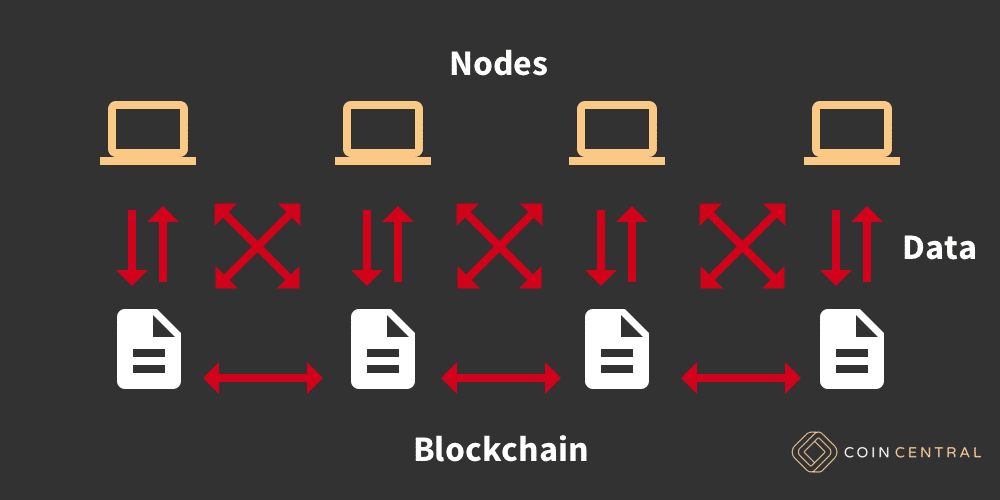
A blockchain is run by a large network of computers, called nodes. These computers validate and record transaction data on the network by solving complex mathematical algorithms.
Every node has a complete history of transactions, so if one were to try and maliciously change a record, the entire network would know and reject the change.
blockchain graphic

Transaction example

Bob wants to send Sally $5, so he submits his transaction to the blockchain. Every node in the network then receives his transaction request.
Each node checks for two things with the transaction data:
  1. That Bob is who he says he is
  2. That Bob has the $5 to send to Sally
First, the nodes check Bob’s identity using the private key that he provides. A private key is an ownership tool that identifies a source of funds.
Next, the nodes make sure Bob isn’t trying to spend money that he doesn’t have. Because the nodes all have a copy of the ledger of transactions, they can easily check whether or not Bob has the $5 that he’s trying to send.
If at least 51% of the nodes agree that Bob’s identity is truthful and he has enough money to send, then the transaction will go through. The nodes will also update the ledger on the network with the new transaction.
With each new transaction added to the chain, the previous transactions become harder and harder to manipulate. 
This immutability is supported by hash pointers. A hash pointer is a cryptographic hash that refers to the previous data block in the chain. They allow you to confirm that no one has tampered with earlier transaction blocks.
A transaction becomes like a fly trapped in amber. You would need to remove each additional block (layer of amber) from the chain to access and manipulate the previous transaction data (the fly).    

The benefits of blockchain

Faster

Cutting out the middleman shortens the process of transactions and data transfer. Validations are inherently built into a blockchain system, so there’s no need for lengthy approvals or complicated record checks.

Cheaper

As mentioned earlier, the more people and entities involved in a process, the more costly it becomes. The cost of running a blockchain network is far less than an intermediary doing the same job.

More accurate

Data on the blockchain is immutable and validated by mathematical computations. It’s nearly impossible to have any human error and/or fraud.

Blockchain TL;DR – Final Thoughts

A blockchain is a distributed ledger system that uses cryptography to link together bits of data. It removes the need for middlemen in transactions which leads to faster processes, reduced costs, and greater data accuracy.

This article is originally posted at Coincentral.com: https://coincentral.com/what-is-blockchain/