Monday, 30 June 2014

7 Mobile Social Marketing Tips to Connect With Mobile Users (socialmediaexaminer.com)

How many of your fans, readers and followers use a mobile device?
Have you considered how mobile can benefit your business?
Consumers expect companies to communicate seamlessly–not only from one social platform to the next, but also from one mobile device to the next.
In this article I’ll share seven ways you can tweak your social media to appeal to mobile users.

Why Consider Mobile Users?

Users are spending more time accessing social media from mobile devices compared to desktop computers.
How much more? Pinterest users are 92% mobile; Twitter users are 86% mobile; Facebook is 68% mobile; and Tumblr is 46% mobile.
Given those numbers, it’s imperative that companies recognize the importance of delivering social media messaging that caters to and targets mobile device users.

#1: Make Facebook Tabs Accessible

Facebook tabs are an integral part of marketing your business on Facebook and a good user interface experience is important for your tabs.
You don’t want your users to waste time trying to view or navigate your custom Facebook tabs, you want them to easily read and interact with each tab.
shortstack app
Make it easy for mobile users to navigate your Facebook apps.
To ensure your Facebook tabs are accessible to both desktop and mobile users, you can either create your own mobile Facebook tab using this templateor use a third-party app provider such as WooboxShortStack or Tabsite.

#2: Engage With Nearby Customers

Smartphones have an interesting perk for social media marketers: they allow you to tailor information based on the user’s location. You can use that opportunity to serve hyper-targeted Foursquare ads based on a user’s location.
foursquare ads
Foursquare lets you target nearby mobile users with their location-based ad platform.
Make the most of your location-based ads by writing localized ad copycreating sites optimized for mobile devices and using click-to-call extensions on Google.

#3: Design a Mobile-Friendly Blog

responsive web design ensures your blog or website appears properly formatted on various mobile devices.
It’s not too hard to find a responsive design theme, but hiring a developer may make things easier for you. A good developer can either install a new responsive theme or make a few changes to the code on your existing theme.
whole foods market mobile site
Whole Foods has a mobile-friendly version of its blog and website.
Have you checked to see if your online properties are as beautiful on mobile as they are on a desktop? If you’re not sure, test your site.
social media examiner resolution test
The Website Resolution Tool lets you test your website on smartphones and tablets, as well as desktops and laptops.
You’ll also want to make sure your blog’s load times are in line with consumers’ expectations.
keynote study found that 64% of smartphone users expect websites to load in 4 seconds or less. When a mobile site doesn’t load quickly, those users often click away.
To make your mobile blog load as quickly as possible, Johan Johansson suggests reducing image dimensions, client-side processing and the number of files that need to be downloaded.
Find out if your mobile site loads fast enough at Mobitest.
mobitest load time results for social media examiner
Social Media Examiner’s loading time on an iPad3 via Mobitest.

#4: Eliminate Message Fatigue

Mobile device users don’t log in and out of their separate social networks to check the activity of people and brands they follow. Most often they’ve enabled push alerts so they can get updates in real time.
Message fatigue happens when you post the same updates across all social channels at the same time and you inundate your followers and fans with repetitive messages from each network.
As you put together your mobile social strategy, create a way to tailor your message to specific platforms. Start with the platforms that have the highest return for your brand.
Ask yourself which social platform is working best for you on desktop. What about mobile? Are you watching your analytics to see whether platform success varies depending on how people are accessing it (i.e., via desktop or smartphone)?
Jim Yu has good advice: “Content, device and audience aren’t one-size-fits-all when it comes to engagement and your mobile approach should reflect this.”
sproutsocial publishing features
Scheduling tools like SproutSocial keep everyone informed of which messages are publishing where and when.
To balance the delivery of your updates so they’re not constant or repetitive, use a scheduling tool like Buffer or a dashboard such as SproutSocial orHootSuite.

#5: Monitor Social On-the-Go

Followers don’t stop engaging with you when you leave your desk and monitoring social media activity shouldn’t stop there either.
Social listening tools like Mention have mobile apps that let you filter sources and create alerts (and they’re easy to set up).
Being able to monitor social channels on the go ensures that you don’t miss social mentions that you may need to jump on right away. For example, especially when they concern your company’s reputation.
getapp tool comparisons
GetApp helps you compare a variety of listening and monitoring tools so you find the right fit for your brand.
To see more social listening options and how they compare to each other, check out GetApp.

#6: Claim Your Local Google+ Page

Given that 79% of mobile phone owners and 81% of tablet owners use those devices for local searches, it makes sense to create or claim your local Google+ page and ensure that the listing has the correct information.
You can learn more about how to use a local Google+ Page to target mobile in this video featuring Martin Shervington.
#7: 

Use Camera-Dependent Networks

Instagram and Vine rely on the thing many of us have with us at all times: our smartphones.
These platforms, which were designed specifically for mobile devices, allow your brand to take pictures and video in the moment and immediately share the experience with your followers.
This Ben & Jerry’s post on Instagram helped remind their followers of how the ice cream company got its start.
While just about everyone uses these apps, they’re particularly attractive to younger users (a demographic many brands would like to reach).
Make sure you’ve integrated Instagram and Vine into your real-time social mobile messaging.
Conclusion
This article takes an aerial view of the rather large mobile social landscape. Take a few of these actionable steps today to better serve your social media followers on their mobile devices.

Friday, 27 June 2014

Restaurants seek to enhance in-store experience through customers' smart devices (mobilepaymentstoday.com)

Consumers are at the point where they demand a more frictionless relationship with their favorite brands through their smart devices. It is also giving brands the ability to develop a one-one-one relationship with their guests, according to Caleb Mitsvotai, senior manager of IT Innovation and Technology Strategies at Panda Restaurant Group.
Mitsvotai was joined by IT execs Don Long, from White Castle, and Jeff Weiss, from Dave & Buster's, at last month's NRA Show to provide a roadmap on how to navigate all this new technology in order to enhance the in-store experience. Mobile Payments Today sister publication Fast Casual was at the annual conference. 
Richard Crone, CEO of Crone Consulting, also pitched in with his tips, claiming the mobile experience has five trigger points that restaurant operators need to keep in mind when creating a strategy:
  • Restaurant discovery and online pre-ordering;
  • Check-in, menu preview and data-driven offers;
  • In-restaurant and table-mobile interaction;
  • Mobile payment and check out. "This is the moment of truth; this is why we rendered the service. We want to get paid and mobile payment in-store has real opportunity," Crone said.
  • E-receipts, social sharing and promotions.
  • There is a long list of third party providers that can help restaurant operators build their own customer management platform, such as GrubHub and Google, but Crone warns that you don't want them to directly manage that relationship.
"The one who enrolls the customer for an online interaction will control the database and the data that comes with it," he said. "You want to look for tech connections – ideally mobile connections – that you can make with the customer."
Examples of how to use technology to influence trigger points 
Mitsvotai, Weiss and Long offered examples on how their brands use technology to influence the aforementioned trigger points.
White Castle developed its own app after finding it was easier to set up products, pricing, coupons, etc., through its enterprise system, with some coding help from its POS provider.
"We have everything integrated. It's important that we have the ability to interface the information in our systems and get it right," Long said.
Panda is in a pilot mobile app phase and Mitsvotai said the platform is aimed at the brand’' most loyal customers.
"Those are the ones who are going to download the app and they're worth nine times more than an average customer, so we want to make it a perfect experience for them," he said. "We don't want a third party intermediary app doing the analytics on our best customers."
Weiss said the most important detail for Dave and Buster's was making sure the payment is secured and the brand is attempting to remove the middleman (server) from handling the credit card payment process. The company installed kiosks about eight years ago.
"Everyone told us not to install machines, that they won't provide good service. But we learned that not only do our customers not mind the machines, the machines upsell better than over 50 percent of our servers," Weiss said. "A lot of ROI comes from that upselling."
Pros and cons
There are numerous pros to list when it comes to developing a robust mobile platform for your brand. They include the frictionless relationship Mitsvotai described, as well as the ability to mine consumer data.
"We know their behaviors and can have an influence on those behaviors and extend their experience beyond brick and mortar," Mitsvotai added. "If you have a guest coming in three times a week for lunch, that's a really loyal guest. But if they never come in for dinner, then you can target them and give them incentives to do so. You already know he loves your food and experience."
Long said mobile technology also expedites service, particularly when a customer orders a Crave case (30 Sliders) at the drive-thru. Those who order through White Castle's mobile app also spend more. A lot more.
"Our average check is $6. Our mobile average is $27," he said.
The major "con" on the list presents itself if the app isn't done right.
"If it doesn't work, the customer will delete it and likely delete the experience," Mitsvotai said.
Patience then becomes a virtue with app development, as a majority of food orders are moving to mobile.
"If you expect to connect with the best customers, and connect with them more than once, you need a mobile app. That is where you're going to build your database and your loyalty," Crone said.
Which wallet will win?
Which type of app you go with depends on your brand and your customer. It's important to note, for example, that just because Starbucks has had much success with its mobile presence, that doesn't mean your brand should emulate its characteristics. Having a pre-loaded gift card payment opportunity does save a small percentage per transaction, however.
Mitsvotai likes the prepaid gift card advantages.
"But that doesn't mean it should be the only payment tender in your app," he said. I want as many customers to download this as possible and if I just offer the gift card, will people avoid that?"
Long said White Castle is pursuing electronic gift cards, but "something has to evolve" with payment technology before they go full speed ahead.
"Our customers aren't the same as Starbucks' customers. They don't come in every day. When you have a technology – NFC – that isn't supported by Apple, it makes us not want to lead the bandwagon," he said. "We'e been looking for vendors that will support different technologies and just trying to get to where our customer can communicate with us more."
Mitsvotai said it shouldn't matter to restaurant operators which mobile wallet technology emerges as the winner.

"That's not what it's about. It's about getting data on my customers and creating a genuine value-add app," he said. "It's a win-win – I can know more about them and target their campaigns, and I can extend their experience so they can love me more."

The App Store and the Top Tenth of One Percent (huffingtonpost.com)

At this year's WWDC in June, Tim Cook announced the App Store has reached over 1.2 million apps. While this diverse and competitive app ecosystem has proven incredibly successful for the top-performing 200-300 apps, being discovered is a daunting and increasingly expensive proposition for the hundreds of thousands of other apps. Many app developers think the fault lies with the App Store, whose heavy bias towards surfacing and keeping 'top performing' apps in the spotlight reinforces this disparity. Currently, just 1/10th of 1 percent of apps control the entire App Store market, leaving the rest of the 1.2 million apps virtually unknown.
Apple's main effort to increase app diversity and discoverability has been to feature unique and exceptional apps on the main App Store screen. For larger iOS developers and mobile development companies, this is an amazing opportunity to gain access to the most-valued real estate in the store. For indie developers or smaller shops, this can sometimes be the only way to get an app noticed at all. Unfortunately, the current App Store has very limited real estate and limited time (usually just one week) for the app to be featured. To further complicate things, selection is entirely based on Apple's changing internal criteria and interests, which means there's no way to anticipate or plan to be featured.
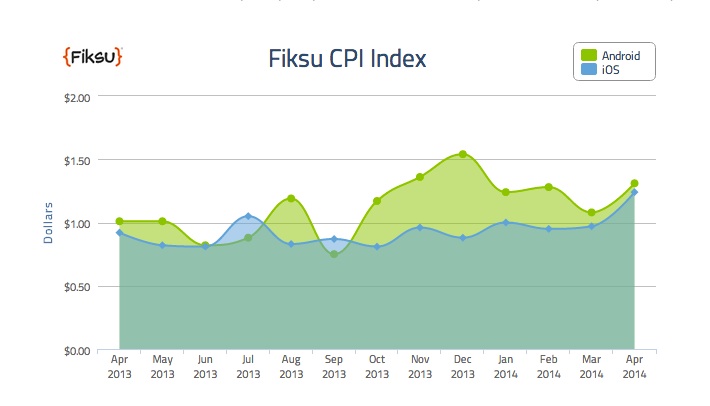
With natural App Store discoverability a major issue for developers, the price for marketing apps continues to increase. As more firms bid for limited marketing options they drive the price up. Fiksu's estimate of cost per app install has been steadily rising since 9/13 from $.83 to its current $1.24.
2014-06-20-Fisku.jpg
It was these problems that inspired the massive overhaul of the the App Store. We think these changes will have a huge impact on discoverability and CPI costs:
Trending Searches: Details on this are scarce, but we suspect this will display apps as they start getting traction in the app store, rather than simply highlighting the hits in the Top sections. This is an incredibly exciting feature, since it will provide tools for well-designed apps to get exposure as they rise. Marketing campaigns can be shorter and smaller, using ads to spark initial discovery then allowing this new feature to carry the app up through the ranks.
Video Previews: App Store shoppers will soon get to watch short videos of an app in use. These previews will be a huge improvement in communicating each app's value props, features, usability and design. While not related specifically to discoverability, these should nonetheless reduce the cost of marketing great apps by sparking user interest.
Continuous Scroll: This fantastic feature eliminates the concept of "the fold", and further encourages users to browse and explore freely. With the ubiquity of LTE data and continuous scrolling throughout the Internet this is a necessary (and overdue) usability improvement.
Editor's Choice Logo: Apps awarded Editor's Choice often fade after their week in that spotlight. Soon, Editor's Choice selections will have that logo stamped clearly on the app's details page. Continuing to surface Apple's stamp of approval on an app will invariably increase downloads per impression, thereby decreasing CPI.
App Bundling: Developers with larger portfolios can sell their apps in groups, encouraging users with bulk-purchase discounts. This could significantly reduce CPI rates, with a single ad potentially spurring multiple downloads.
At the WWDC Tim Cook said, "We are really investing a ton in the App Store." We believe him. These changes should increase overall downloads, diversify the apps downloaded and significantly reduce apps' CPI.

Banks lag behind retailers, telcos in providing mobile wallets (mobilepaymentstoday.com)

Banks worldwide are in trouble, at least as it relates to their position in providing mobile wallets that rely on a prepaid card as the primary payment instrument. And banks currently lag in that race as retailers and telcos lead the way.
That was one of several conclusions the Mobey Forum made in its new white paper, "The Prepaid Mobile Wallet: Taking Prepaid into Account." Mobey Forum is a global trade industry association meant to help banks lead the changes happening in mobile financial services.
"Prepaid is a major driving force in the near future of mobile wallets," Amir Tabakovic, board director and chair of the mobile wallet workgroup for Mobey Forum, said during a webinar Tuesday that introduced the white paper. "In this future of prepaid mobile commerce, banks will be forced to question their strategy when it comes to mobile payments."
It should come as no surprise to anyone in the industry that prepaid cards, particularly open loop, are growing at a faster rate than credit and debit cards. Mobey Forum cited a MasterCard study that found the compound annual growth rate for open-loop prepaid cards has skyrocketed since 2010 and will continue to do so until 2017. And that growth is not limited to one particular region. It is a global trend and one not limited to open-loop cards.
Closed-loop prepaid card programs from retailers such as Apple and Starbucks, and transportation entities like Transport for London's Oyster Card have made a significant impact on the market as well.
"In the mobile Internet era, we see huge opportunities in prepaid," Tabakovic said. "We believe the emergence of prepaid and mobile will be a powerful catalyst that will push both prepaid and mobile commerce."
One of Mobey Forum's other main recommendations in the white paper is the emergence of Host Card Emulation and how banks can use that technology to make a significant contribution to the mobile payments market.
HCE enables NFC applications on Android devices to emulate smart cards and financial institutions to host payment accounts in a virtual cloud.

The technology received a significant shot in the arm when MasterCard and Visa both voiced their support for HCE. Visa has made available a payWave standard and software development kit for cloud-based NFC payments. MasterCard published a specification that uses HCE for secure NFC-enabled mobile payments.

Brazil's mobile payments market comes into focus after regulations (mobilepaymentstoday.com)

Brazil at the moment is putting its best foot forward to showcase the country during the FIFA World Cup, but it is also showing the rest of the globe how regulations can make a positive impact on the payments industry. Yes, you read that right. 
In fall 2013, Brazilian President Dilma Rousseff signed into law legislation meant to clarify expectations from different mobile payments players for that emerging market.
At the center of the new law is an emphasis (though not a mandate yet) on interoperability between mobile network operators, bank card issuers, acquirers and the card brands. The result of this should spur more consumer adoption, especially among the 65 million unbanked adults the Brazilian government wants to include in the financial mainstream.
While NFC pilots in Brazil are in their infancy, there is an ongoing concentrated effort behind the scenes between different players to bring the entire mobile payments infrastructure to a larger scale for consumers.
"This is a silent revolution," Percival Jatobá, Visa’s vice president of product development for Brazil, told Mobile Payments Today in an interview. "We’re not scaling commercially just yet, but it will happen. The needed infrastructure is already in place. It makes it a lot easier to scale and go commercial."
Visa at the moment is involved in an NFC pilot with MNO Oi and FI Banco do Brasil. Consumers involved in the pilot can link a Visa-branded Banco do Brasil card to the contactless SIM card in their smartphone via an Oi app. Users can then make NFC-enabled mobile payments at the 1.4 million contactless terminals scattered throughout the country.
The contactless infrastructure is important to keep in mind as NFC pilots and rollouts emerge going forward, Jatobá said.
When Brazil started the transition to EMV chip-and-PIN technology in 2003, the acquirers and banks there made sure the terminals also featured contactless capabilities to accept cards, and eventually phones.
"[The contactless infrastructure] gave issuers the confidence to start issuing not only contactless cards, but they also started playing with NFC," Jatobá said.
Hybrid approach to mobile payments
To get a better understanding of the potential for widespread mobile payments in Brazil, a glance at some numbers helps put things in perspective.
Brazil has 273 million active mobiles lines, according to industry estimates. Some 100 million (37 percent) of those lines are smartphones. Out of those 100 million, roughly 15 percent (15 million) are NFC-enabled smartphones.
"The affluent consumers are using these devices and driving payments on them," Jatobá said. "Banks are taking advantage of this and launching programs for these types of consumers."

But Brazil is not too concerned with how the affluent consumer is using mobile payments. The government wants the 65 million unbanked adults in the country to have a place at the table as well. That’s where the interoperability portion of the government’s efforts comes into play.

Building a business not just an app? Start with the revenue model (developereconomics.com)

The number of app developers using business models that don’t rely on app store payments is increasing. In some cases this is sophisticated app developers adapting to the market. In many cases it’s simply a greater number of existing businesses starting to use apps as a channel to reach potential customers. We can use the data from our Q1 Developer Economics survey to examine which strategies carry the most risk and which have the greatest chances of success. Could you use one of the more successful models for your next app?
business models - mobile platforms
We asked developers to tell us all of the revenue models they use and also whether their business was loss making, breaking even, making a slight profit, or generating comfortable profits. Revenue model popularity and a sample of profit & loss distributions are shown below.

Build apps for other people

Contracting is the most popular revenue model and also the one associated with the second lowest probability of making a loss and third highest probability of comfortable profits. Of course, contract work also has strictly limited upside – it’s not really possible to build a scalable business around contract work without becoming a global giant consulting company. That said, the majority of developers would be better off if they spent most of their time on contract work rather than their own apps.

App store payments and advertisers

The next most popular revenue models, in-app advertising, paid downloads, in-app purchases and freemium are all relying on directly monetising an app. Together they are the four most risky models with the lowest chances of profit. Paid downloads are the least successful revenue model. Although easy to implement there are very few cases where offering a straight paid download will create a financial success. Even on iOS, despite a still growing user base, the paid download market appears to be contracting fairly rapidly in the face of free app alternatives with in-app purchases. Despite the advantages of the in-app purchase model, it’s still quite far behind other models.

Selling services

Subscriptions are the next most popular and also relatively low risk and successful. However, implementing subscription based services is usually more complex than selling apps or virtual goods. Many subscription based businesses are simply using an app to sell subscription content. Another interesting possibility for developers in this area is to resell generic cloud services by adding value on top. As very basic (and already well served) examples, re-sell storage by adding document collaboration or photo management features on top.
Providing services that app developers can resell is one model for those selling developer services. Others include tools or services that help developers design, build, market or monetise their apps. This is one of the lower risk models with a good probability of profit. It follows the classic advice that when there’s a gold rush, the best thing to do is sell picks and shovels. There are still plenty of opportunities in this space (where are all the tools that help me prototype animations?) but also others with too much competition (some BaaS providers are already shutting down).

Selling stuff

Apps that make money through e-Commerce are the most successful in terms of making comfortable profits and have by far the lowest risk of making a loss. Most developers using this model had existing e-Commerce businesses and have just added mobile apps as another sales channel. There are some startups with mobile first commerce apps though. More than 50% of developers using this model make comfortable profits related to their apps, so the cost of building apps is more than paid for by sales through them.
Affiliate and CPI programs allow developers to sell other people’s stuff. Using an affiliate program could be selling products related to your app through Amazon. Alternatively, a travel guide app might integrate a flight search SDK that provides a native search experience within their app – the developer gets paid whenever anyone books a flight. Affiliate programs were very popular on the web and their native counterparts are likely to be as well. CPI programs are for selling other developers apps, or at least getting users to install them. The top free-to-play games have extremely high ARPU and as they try to grow rapidly it makes sense for them to pay almost anything less than their ARPU for a new user (since new users boost chart ranking and thus organic installs). Other apps are a good place to advertise apps, so this is likely to be quite a lucrative option until either there’s an oversupply of quality advertising inventory or a crackdown on free-to-play games.

Royalties or licensing

We skipped per-device royalties or licensing in the middle of those last two. Overall this doesn’t have much lower risk than relying on the app stores or ads. However, this is inherently a higher risk strategy with bigger rewards for success. It usually involves building a product for large companies or even OEMs. The downside is that the number of direct customers in the target market is usually quite small. This is usually a model for those with great connections, a lot of funding, or both.

Build a business, not just an app

The app stores made it really easy for developers to sell software to a very large audience for the first time. With over a million apps each for iOS and Android, that is no longer the case. Discovery is hard and larger, more sophisticated organisations are dominating the top charts. If you have a great idea for an app, see if you can find a great revenue model to fit it. If not, try to come up with another idea. Outside of the VC-funded startups, developers that succeed will be the ones that think about where their revenue will come from before they’ve started building the app.

Wednesday, 25 June 2014

How A/B Testing Boosted In-App Purchase Conversion by 124% and More (blog.sensortower.com)

Spot the Difference With Friends! is a kids’ game that is popular in the UK, Singapore, Philippines, and Malaysia. It is produced and published by ReignDesign, a Shanghai-based app studio.
Players can challenge their Facebook friends to spot the difference between two pictures. To make things even more challenging there is also a time limit.

They can compete with the larger community by trying to get to the top of the overall leaderboard. This adds even more engagement to the game.

Since this is a free game that monetizes through in-app purchases and ads, ReignDesign wanted to figure out how to increase their revenue by optimizing gameplay. This post will show you exactly what we did to help them tune three aspects of their game.
ReignDesign worked with us to run a series of A/B tests on in-app elements controlling user experience and rules of Spot the Difference With Friends! We tested: purchase funnel optimization, game level difficulty and time penalties.
Here is what we discovered.

Driving More In-App Purchase (IAP) Conversions By Optimizing The Funnel

With the increasing popularity of free-to-play and users’ clear preference for ad-free apps, IAPs have become a popular way for game and app publishers to earn revenue.
In this game, new players are given 6 stars, which act as a virtual currency that is spent during gameplay. One star is spent for each round of play. When players run out of stars, they can no longer play the game, until they buy more.

Original Design

Initially, ReignDesign had included an in-app notification which encouraged users to go to the in-app store and buy more stars when they tapped on the Play button but had no stars.
This in-app purchase funnel was not performing well, with about 0.5% of users actually converting to paid customers. ReignDesign decided to test another funnel, in which the in-app notification was removed and users were sent directly to the in-app store.

New Design

The new funnel converted free users into paid user at 1.12%, representing 124% increase in ReignDesign’s IAP conversion rate. This may not seem like a huge difference at first, but across the app’s 1,000+ daily active users a 1% increase represents 10 more sales every day.
In addition, as the user base of the game grows, small increases in the conversion rate will become even more significant in terms of revenue.

Optimizing Level Difficulty

When designing a social game, a lot of questions are tough to answer without data. In particular, ReignDesign wasn’t initially sure how to set the progression of level difficulty.
Make the game too easy, and people might get bored. Make it too hard, and people might become frustrated.
Instead of guessing at the optimal difficulty levels, ReignDesign tested three different variations of game difficulty progression:
  • Variation 1: Easy – Medium – Hard (EMH)
  • Variation 2: Easy – Medium – Medium (EMM)
  • Variation 3: Easy – Easy – Medium (EEM)
In order to measure the difference in user behavior when exposed to the different level difficulty progressions, ReignDesign implemented quantified goals to log the total number of levels played by users for each variation.

The Result

Users that were exposed to the third variation (Easy -Easy – Medium) played an average of 1.76% more levels than users exposed to the baseline. This had a direct impact on ReignDesign’s ad revenues, as ads are shown between levels and gameplay.

Time Penalties: A Hypothesis Reversed

In the single-player version of ReignDesign’s game, a 3-second time penalty is deducted when players make an error.
The game design team believed that this time penalty would discourage users from playing more in the multiplayer version, but decided to test and see if that was indeed the case.

After running a test comparing time penalty versus no time penalty in the multiplayer version, the data clearly showed that users with a time penalty played 6.3% more rounds than users without.

In this case, running an A/B test prevented ReignDesign from removing a feature that they believed would have a negative impact on user engagement. Through testing they discovered that the time penalty feature was actually good for engaging users, which was a result contrary to their initial business intuition.
The increases in play time as a result of these tests were reflected in additional ad revenue earned from the Spot the Difference With Friends! game since launch.

Conclusion

Getting a game downloaded is just the first step in making it successful. From there, you have to optimize the different elements of the game to make sure that you are getting the most revenue possible.
As the results have shown, sometimes what works goes against your initial impressions. This is why it is important to actually test ideas and let the results determine your direction