The blockchain market is anticipated to grow to over $7.5 billion by 2024 according to a report by Grandview Research. This is largely due to its adoption across multiple industries as more companies emerge with different use cases for the technology. In a world filled with flaws in every major system, there is potentially no limit to the applications of technology like blockchain.
A blockchain is a distributed ledger which stores data in an immutable way. Since records cannot be altered, the technology targets systems in which transparency, authentication, and tracking are required. This covers a wide range of applications from shipping, to real estate, global supply chain management, art, financial transactions and more.
There is also the added bonus of high-level security due to the more technical aspects of blockchain in which transactions are added to it. When blockchain first emerged, it was known mainly as the supporting technology behind Bitcoin and soon after, other cryptocurrencies as well.
As the frenzy behind the major digital currencies reduced, newer blockchain startups emerged and with time, older corporations like IBM, Microsoft, Mastercard, and Amazon carved out their own operations in what has become a rapidly growing niche.

Today, the blockchain ecosystem is a diverse ball of large and small corporations, merchants, governments, research and development. The blockchain ball does not seem like it will stop rolling anytime soon. For now, a handful of blockchain startups are dominating the space and providing opportunities for growth, employment, and even investment. Here are the top 15 blockchain startups.
1. MOBILEGO
This is one of the most interesting and successful blockchain startups that has emerged over the past few years. It was created by a group of young developers with the vision of combining the entertainment of the gaming industrywith the financial efficiency of blockchain technology.
MobileGo is a mobile cryptocurrency gaming platform which allows gamers to benefit from playing up to 500 free games. The gaming industry has proven to be a profitable one, and there are many opportunities for the application of emerging technologies to make the experience even better for its users. Games like Fortnite and PUBG have shown that there is an interest in multiplayer games which allow communication between gamers in different locations.
As an example, Fortnite has amassed a user base of more than 200 million players and about $1.2 billion in sales so far. MobileGo offers a similar model with its platform. In return for playing, gamers are credited with cryptocurrency known as Gshare Gold, with which they are allowed to enter into tournaments. When they enter these tournaments on the website, they can win MGO tokens which can be stored in a wallet like Lumi, Coinomi or Myetherwallet. It can also be exchanged for other currencies on a cryptocurrency exchange like HitBTC, DigiFinex, or Bitfinex.
According to the MobileGo website, “The MGO token has an extremely broad scope of application, providing numerous benefits for different populations. For gamers, it will facilitate peer-to-peer matchplay and decentralized tournaments, serving both as a match reward and an entrance fee. Moreover, token holders will be able to earn additional discounts for purchasing in-game content.”
2. BRAVE
Brave is popular for gaining over 20 million downloads of what is credited as the first blockchain-fueled browser in the world. The company was first established and incorporated in 2015, as Hyperware Labs Inc in Delaware. Later, it was registered in California with its name changed to Brave Software, Inc. and is currently headquartered there.
The uniqueness of the Brave browser lies in the distribution of tokens to users as a reward for watching ads. These tokens, known as Basic Attention Token (BAT), can be exchanged for cash on a cryptocurrency exchange later. Brave aims to give users control over their data and the ads they view by blocking off invasive ads and refusing to monitor user location and activity. There has been discontent over how larger corporations such as Google or Facebook distribute content and show ads.
Brave Software's newer developments include a feature that will allow users to choose which ads to receive, between those sold by the company and those blocked by the browser. The company will pay its content publishers 55% of ad revenue, while the company, its users and ad partners will get 15% each.
Users will also be allowed to donate a portion of their proceeds to content publishers through simple micropayments. To launch its platform, Brave Software and its Basic Attention Token ad platform have been backed by investors such as Founders Fund, Digital Currency Group, Propel Venture Partners, Foundation Capital, Huiyin Blockchain Venture, Danhua Capital, and Pantera Capital.
3. TENX
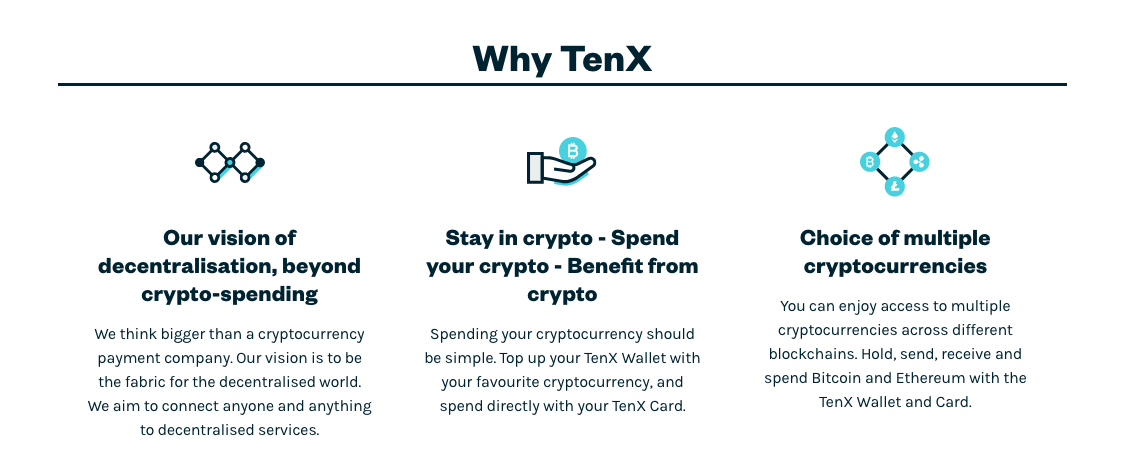
This is a Singapore-based blockchain project that is bringing digital currencies closer to people by allowing them to safely store their cryptocurrency in a cloud multicurrency wallet.
TenX offers a digital wallet and physical card that people can use to spend digital currencies, even at stores that do not normally accept cryptocurrency. This solves the problem of not having enough places to spend all the digital currency that users continue to accumulate.
Users can set spending rules as well as daily spending limits, purchase limits, and withdrawal limits for their cards using a DSS. This gives them control over their funds. Cardholders can also choose which cryptocurrencies they would like to spend and even split them into percentages.
Currently, the platform has no transaction fees. However, there is an issuing fee of $15 for a physical card and $1.50 for a digital one. Users are also required to pay an annual fee of $10 if they don’t spend up to $1000 in a year.
The TenX platform has modern safety and efficiency features such as:
- 2-factor authentication (2FA) to secure and protect all accounts
- Multi-signature cold storage wallet management for the long-term safety of user funds.
- Industry standard private key storage for every TenX Wallet which will eventually give way for their COMIT network, which will allow users to store the keys themselves.
- Email account notifications for any account activity or breaches.
- Data encryption
- Fingerprint unlock on mobile devices.
TenX has plans to release new developer tools for businesses, startups, and merchants and explore other asset classes such as blockchain ETFs.
4. STATUS
Status is similar to telegram but comes off as a more sophisticated platform. It provides an easy way for users to interact with decentralized applications on the Ethereum blockchain. Decentralized applications (DApps) became popular after the creation of Ethereum, the platform which enables developers to build them.
As the capabilities of the Ethereum blockchain grew, so did the number of decentralized applications and projects which there are now thousands of. However, they are so many that it can be difficult for users to keep track of all their favorite applications.
This is where Status comes in, allowing such users to interact with these decentralized applications on Android or iOS. According to Status, connected devices become light client nodes on the Ethereum blockchain network and as a result, they can be used to access the Ethereum ecosystem from anywhere in the world.
The building blocks of the Status ecosystem include:
- Its app on which users can chat, carry out transactions, and access DApps.
- Incubate, an incubator for early-stage startups that require funding, legal support, and mentorship.
- Embark, a simple framework for developers who want to build and deploy their own decentralized applications.
- Studio, an integrated developer environment designed to give educational support for DApp development.
- Nimbus, a research project and light client implementation for Ethereum 2.0
- Keycard, a card-form hardware wallet.
Status is slated to function as both an Ethereum browser and a decentralized messenger platform. Using this hybrid system, the company plans to increase its reach and level of user adoption, while staying close to Ethereum's mission and principles.
The messenger will be a way for users across the globe to effectively communicate and carry out private transactions with each other. The browser, on the other hand, will be able to find and run any Misk or Metamask-compatible decentralized applications. It is open source and any developer can list their applications whenever they want. Currently, there are already some DApps listed on the platform, including Gnosis, uPort, Ethlance, Oasis Exchange, Aragon, Ujo, and Etherisc.
5. EOS
This is a decentralized platform for the creation of smart contracts and has been one of Ethereum's biggest competitors, in light of the larger currency's poor performance. EOS is extremely popular in the blockchain ecosystem, mostly due to its groundbreaking ICO in which the company raised $170 million. Block.One, the company behind the EOS ICO first revealed its testing environment at BlockshowAsia in 2017.
Soon after, the company published its plans in a whitepaper and the EOS platform was released as an open source software platform in June 2018. Block.One sold 1 billion EOS tokens on Ethereum's network to ensure fair distribution of their tokens. 10% is reserved for the company, 20% were sold off in the first five days of the ICO, and 70% is reserved and traded at market value.
The popularity of EOS is also largely due to the launch of the platform’s mainnet, as well as a steady rise in its price and market capitalization which has landed it a position as the fifth-largest cryptocurrency.
Like Ethereum, EOS is a decentralized operating system which supports and hosts decentralized applications through a series of interesting features and functionalities.
Businesses can successfully build the blockchain version of apps and retain the feel of a regular web-based application with the added benefits of blockchain technology such as security, efficiency, and transparency. EOS also claims that it has eliminated transaction fees and promises speeds of millions of transactions per second. This is not the case for many other digital decentralized platforms.
6. PATRON
Founded by Japanese influencer Atsushi Hisatsumi, Patron is a blockchain platform geared towards modifying the current influencer marketing model. It is a modern influencer ecosystem, in which people can pay for influential posts or influencers, through the system’s token.
Although influencer marketing has been predicted to grow into an $8 billion industry by 2020, influencers still encounter earning problems in the system. For one thing, a lot of them are held back by agents and agencies which charge large commissions of up to 40% and without these agencies, influencers find it difficult to get new clients.
Patron basically cuts off the intermediary from the process, giving clients a way to search for influencers on the platform, hire them, and pay directly to them. It works on the same principle as Airbnb, which allows people to become hosts without being subjected to outrageous requirements.
Not only will this allow influencers to earn more, but it will also boost the way marketing is done in that part of the world. Companies will be able to reach influencers easily, and more influencers will be willing to enter the market due to the positive environment which encourages the establishment and growth of their own brands.
Atsushi Hisatsumi is a popular influencer, award-winning singer, dancer, DJ, and entrepreneur who specializes in marketing and creating a better environment for marketing professionals. The budding blockchain startup conducted its ICO private sale and pre-sale in February 2018, raising $10 million and $20 million each.
The token sale event was backed by software development and ICO marketing company Extravaganza, and raised $40 million in total. Patron was also supported by IOTA co-founder, David Cohen, and Coinhills founder, Francisco Jo.
7. TRADOVE
This decentralized platform is trying to change the way B2B marketing is typically done. According to its statement, "The marketing effect for B2B is different from consumers. In the consumer space, it is users who generate users. In the B2B space, it is opportunities that generate opportunities. We aim to create a go-to place for companies to advertise to other companies over the Internet in a precise way, just like Google does in the consumer space, and eventually create a B2B ecosystem in which anyone who wants to do business will come to our site, a multibillion-dollar company."
Its platform is a light, fast and secure B2B payment network for cross-border transactions and became immensely popular when it had one of the top ICOs in 2018. TraDove is responsible for launching the world’s first B2B token, which will possibly create a demand for cryptocurrency within marketing circles.
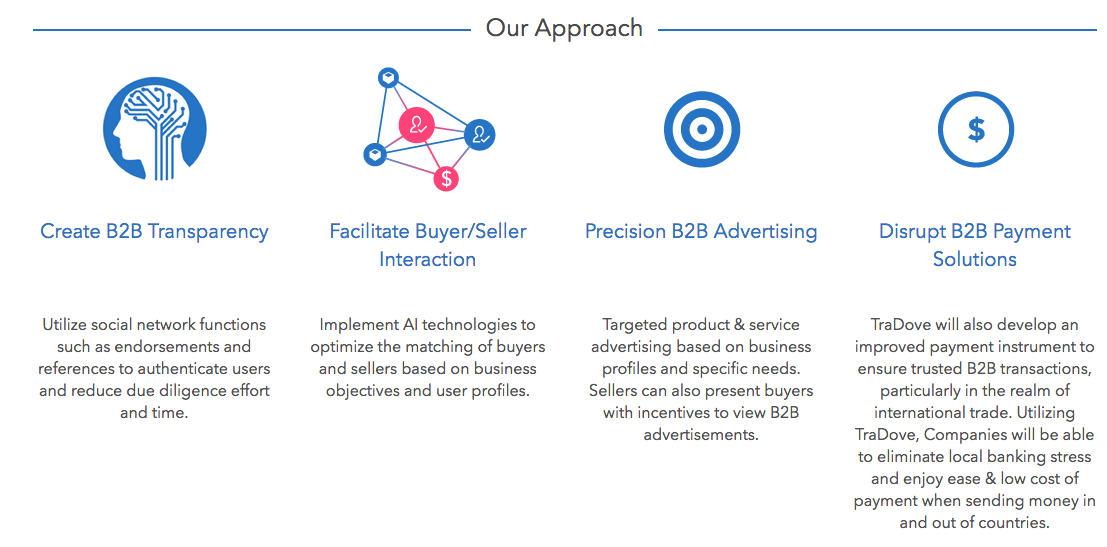
Tradove claims to do the following things:
- Connect people, products/services and companies using a private business network and industry associations, etc.
- Help buyers and sellers to save time by providing a way for them to find each other.
- Provide transparency within the B2B space by making information less one-sided.
- Give companies a better way to target other companies for advertisement, more accurately and efficiently over the internet.
- Provide a B2B cloud storage service for companies to store marketing material such as whitepapers.
- Offer B2B Big Data, Machine Learning and Analytics services for matching people and companies.
TraDove's main asset is an ERC20 standard token known as B2BCoin. It will be used on the platform for B2B sales and marketing campaigns. The company issued 1,000,000,000 B2BCoins of which 50% were released for its ICO and 20% is reserved for operational use.
8. CELSIUS NETWORK
Celsius network is a blockchain lending startup which allows borrowers to use their digital currency holdings as collateral. The platform has been doing well since its establishment and recently announced that it lent out $630 million worth of cryptocurrency-backed loans within the last five months of 2018.
The statement on their website reads: "Celsius launched its services in July 2018 and since, we have done over $600M in coin loans. We used the interest we earned from these coin loans to buy BTC, ETH, and other cryptocurrencies to pay interest to our community of Crypto depositors and to buy back CEL tokens. We also funded the industry's largest single dollar loan of $5,000,000."
Lending is one of the many ways to monetize the growing popularity of crypto-assets. It happens on an individual level on many exchanges already. Having a trusted platform in which users who do not want to spend their cryptocurrency but require fiat currency is necessary.
For example, a user may hold Bitcoin but need fiat currency to pay bills and may not want to go through the hassle of exchanging their cryptocurrency which they’ve decided to HODL for fiat currency. With Celsius, they can just put it up as collateral and take it back when the loan is repaid.
Based in London, Celsius Network also provides users with the option of interest-earning wallets, and claims that they have a user base of more than 15,000 people spread across 100 countries. Since the interest rates that Celsius offers are relatively low, borrowers find it an attractive deal. Loans can be secured for as low as 4.5% APR, but the company only accepts a limited number of digital currencies-- Bitcoin (BTC), Ethereum (ETH), Litecoin (LTC) andRipple (XRP).
9. MENLO ONE
Menlo is a blockchain framework for developing and deploying decentralized applications (DApps) in a simple and efficient way. While the idea of decentralized applications may come off as complex, Menlo is letting developers create them in a similar way to the centralized applications that they are used to developing.
It can be used to build various types of decentralized applications such as blogs, censorship-resistant social networks, eCommerce sites, or cryptocurrency exchanges, and is popular for their Proof-of-Reputation protocol which brings extra security measures to blockchain technology.
According to Menlo, their goal is "to aid the adoption of blockchain technology by helping people build great software. Our framework is designed as a launching point for entrepreneurs, startups and enterprise to build blockchain software by minimizing learning and cost of entry barriers. We'll help you build the future of decentralized technology through discovery, design, rapid prototyping, solution delivery, system integration, and ongoing support."
Menlo also gives companies the opportunity to outsource the development of decentralized applications without overshooting their IT or logistics budgets. The platform handles the installation, management, and provision of Blockchain as a Service (BaaS) tools so that companies can focus on their other tasks.
The Menlo Ecosystem consists of:
- The Menlo ONE Token, an open source ERC20 Standard token on the Ethereum blockchain, which powers the entire system in terms of Gas and other payments. According to Menlo, it integrates seamlessly with the platform and ensures user-friendly transactions.
- Content Nodes, which provide security and speed for the platform's operations, from developer to enterprise frameworks. According to Menlo, "They create a decentralized cloud server network run by individual users who are incentivized to deliver the correct content to websites or applications. Even the fastest blockchain today can't deliver content as quickly as a centralized cloud-based server."
10. GAMEFLIP
Gameflip is a Silicon Valley-based platform that allows users to trade digital games and goods in such games. Gamers own and develop every part of the platform, which now has more than 2 million members and a huge global digital goods marketplace in which more than 500,000 active monthly users transact millions in digital goods each month. The platform has the goal of becoming one of the best gaming marketplaces by offering a high level of security and transparency. It is achieving this through blockchain technology, which powers its ecosystem and digital asset, FLIP token.
Gamers can move their digital goods onto the blockchain when transacting and are provided enough flexibility to buy and sell them for cash. According to GameFlip, this ensures that the goods maintain their value. This, in turn, encourages more gamers to participate in the ecosystem.
Game publishers on the platform receive a commission for every transaction conducted by another gamer using FLIP, via the digital goods of the partnering publisher. The platform has plugins which monitor the blockchain history of all published goods so that payments and commissions are accounted for.
The gaming industry is embracing further technological advancement and platforms like GameFlip make things even more interesting. The idea of communicating with multiple players was one of the first exciting steps taken within the industry. Next, there were marketplaces which allowed users to trade items using in-game tokens. Now those tokens can be exchanged for real cash across the globe without any restrictions because of platforms like Gameflip. It’s no surprise that the company made it to this list.

11. BUDDY
Buddy is an application store that seeks to promote creativity among developers. It was created by a group of developers as a bedrock for other programmers who want to create on or off-chain blockchain apps and services. Basically, Buddy removes the load and pressure that developers face in automated processes, to give them more creative freedom. Although these automated processes are in place to simplify tasks, especially those that can easily become monotonous, they do not leave room for much creativity.
Usually, large organizations run many heavy daily operations, which take a long time to complete. This is why they use automation infrastructure to build systems faster. However, this also increases the amount of money spent on their DevOps while making it complicated and difficult to maintain. Such companies also face issues in speeding up shipping, delivery, and deployment for the technological products, and this puts pressure on their infrastructure because they rush to put out many items at the same time while also trying to bypass queues. Such operations are not sustainable without external help. Buddy has a large framework to allow these companies to focus on their shipping and other important metrics while DevOps is handled by the framework. This allows the companies increased speed, a reduction in cost and errors, greater efficiency, and flexibility.
Currently, the Buddy platform has more than 80 automation tools and actions categorized into work pipelines to simplify and speed up the building, testing, and deployment process for any type of DevOps work. In this marketplace, users can develop and deploy any software they want and the entire system runs on blockchain technology.
12. ADBIT
ADBIT is a media-focused blockchain startup with the aim of solving the issues of efficiency, distribution, and centralization within the media marketplace. The firm operates under the belief that media planning and buying should be autonomous, and has launched a solution to make this possible. The solution is known as CINCH Media Marketplace, the world's first blockchain powered media planning and buying platform for traditional media.
The media industry has several issues including monitoring and metrics. Currently, the process is carried out using ad surveys, which many users do not take out time to fill. This leads to an inaccurate assessment. There is also a lack of transparency regarding pricing, between sellers, buyers, and third-parties. There are extra costs incurred during reconciliation accounts, and using spreadsheets leads to even more errors and time consumption. ADBIT is giving media users a better way to manage workflow, reconciliation, a more transparent pricing process, and better monitoring using more accurate techniques like digital analytics.
CINCH, an already existing platform allows ad agencies (its primary consumers) to view their media accounts and proposals easily while automating their workflow to increase efficiency. Since 2016, the platform has completed ad purchases worth more than $200 million. By acquiring the platform, ADBIT is buying itself an existing user base and a great starting point. This will also go well with the startup's media exchange which will have data collection tools to boost its sales process.
ADBIT is clearly one to watch since the ad space is highly separated. Larger companies like Google have conquered the space and it is a lot harder for the smaller companies to break through. Hopefully, with the help of blockchain technology, there may be some breakthroughs or completely newer ad models in some years.
13. DACC
This is considered the world's first content-based blockchain platform and organization that focuses on access and identity management at the infrastructure level. It seeks to offer content creators full ownership and control over their creative process, access to their work, money earned from it, as well as its storage. It already has a convincing value proposition and raised $4.7 million during its ICO.
Decentralized Accessible Content (DACC) is a platform that is set to revolutionize the digital content and media industry. Its blockchain will securely initiate, store, and manage access permissions to user and creator data. Creators can upload and share various types of content including songs, samples, and audiobooks.
Since the platform handles all processes, there are no third party fees or any other fees charged. As a result, creators can distribute their work freely with complete control over the proceeds. The process of distribution is via consensus, not influencers or label politics like those within the traditional music industry so the results are unbiased. The intellectual property of creators is also protected during this process, which is entirely straightforward. To use DACC, after uploading their work, content creators simply configure pricing settings, stating how much they want users to pay for their content. After this, the content is accessible to users who fulfill pricing conditions.
Each creator has to place a deposit for each uploaded content piece which will be refunded after one month from the date of publication if no plagiarism has been reported and sales, as well as reviews, have reached an 80% threshold. Depending on what the content creators want, the pricing options for content can be in the form of one-time payments, subscriptions or free of charge.
Contributors are rewarded with incentives for using the platform in many ways such as creating content, actively participating, and curating content. These rewards can come in the form of revenue as well.
14. GOLDILOCK
Goldilock aims to change the way data is stored and secured across the internet; the innovations allow for individuals and institutions to secure digital assets in storage that are physically disconnected from the internet
Goldilock is a cryptocurrency custodial service which hopes to make private key storage safer. It is launching on the NEO blockchain and will provide individuals and organizations with a better alternative to cryptocurrency data storage systems that are already on ground. These include cloud storage and hardware or digital wallets.
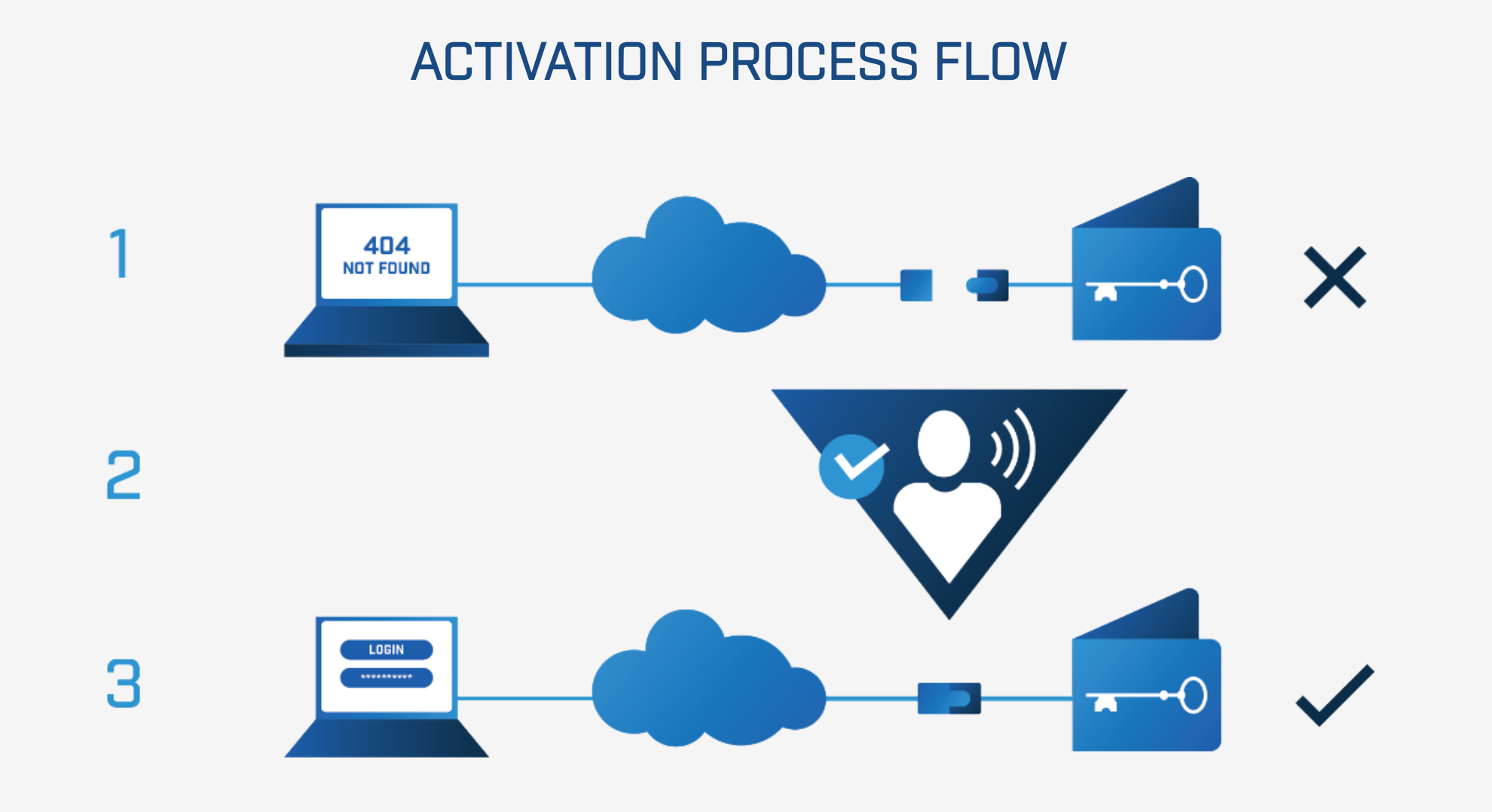
Goldilock is inventing a new type of secure digital asset management and storage service through its pending patent. The patent describes remote automated airgap security (RAAS) for the secure storage of cryptocurrency keys. This method will hopefully allow users to store private keys offline and online as needed. When the keys are not in use, they will be disconnected from the internet where they cannot be reached by cybercriminals and other unauthorized parties.
Private keys are the backbone of a user’s cryptocurrency wallet. If they fall into the wrong hands, the results can be the loss of funds and user data. This is why they have to be stored in a safe place. This hybrid method by Goldilock will adapt the online security of an exchange with the offline security of a hardware wallet. The Goldilock team is apparently still in talks with commercial clients concerning partnerships and applications of the technology in other industries.
15. FCOIN
FCoin is one of the most popular and successful blockchain startups on this list and has made headlines several times for controversy. It is a China-based decentralized and fully transparent cryptocurrency exchange which has created a new exchange model that the Chinese cryptocurrency community, as well as other exchanges, do not support. This model is known as trans-fee mining; it awards users with FT tokens, the official FCoin digital asset, for exchanging cryptocurrency. In fact, 51% of all FT is reserved for this purpose. This has made the exchange incredibly popular since users can earn more FT the more they exchange.
In 2018, FCoin reported daily volumes of up to $ 6 billion, which was more than the volume of all other exchanges combined. That is a startling figure for an exchange so young and the company has denied any wrongdoing. However, other exchanges like Binance argue that if FCoin's revenue depends on its token, then there is nothing to stop the company from fixing its asset price. It has also been compared to a Ponzi scheme, but there is no evidence to corroborate these claims. For now, FCoin and its new model have been successful despite never holding an ICO. The 80% profit sharing will return up to 80% to its active community.
FINAL THOUGHTS
Blockchain startups are emerging every day with fresher, bolder and more imaginative use-cases for the technology. However, many are swept under the carpet for unsustainable models and unachievable plans. Still, some companies have persevered and are proving lucrative and successful in such a competitive field. Whether it’s a company searching for better ways to distribute content or one that's inventing a better mining model, each of these companies is striving to make the world a better place. Success will always change hands as rapid development continues, so it's interesting to see which companies will emerge as success stories in the future.