Tuesday, 13 February 2018

NEO and Blockchains Across China


coincentral.com
Resultado de imagem para NEO and Blockchains Across China

NEO’s Vision

The developers of NEO are looking to spread blockchains across all of China. Their company, Onchain, has developed a Distributed Networks Architecture (DNA) to allow for the easy implementation and development of standardized blockchains. They want every interested field to easily be able to migrate their data and assets onto a private or public blockchain. The founder, Dr. Da Hongfei said“We want to be the place people go to when they want to do serious and reliable transactions.” Onchain and NEO are not only succeeding in their vision, but they are set up to thrive within the regulations of the Chinese government.
Onchain

Cryptocurrencies in China

On the surface, it seems as if cryptocurrencies and China don’t always get along. “Two things are infinite: the universe and the number of times China can ban Bitcoin, and I’m not sure about the former.
There is a 50,000 USD yearly cap on moving money out of China without special permission. People found a loophole in this system by buying cryptocurrency and easily moving funds and accessing them anywhere in the world. The Chinese government tried to close this loophole through the banning of online exchanges. The government was also worried about the levels of speculation, thinking back to their recent stock market crash.
After China banned exchanges and ICOs, interest in cryptocurrency didn’t simply roll over and die. People moved to a p2p model, making local transactions, often referred to as the “over the counter market.” Here’s a look at the change in volume on localbitcoins around the time of the bannings. 
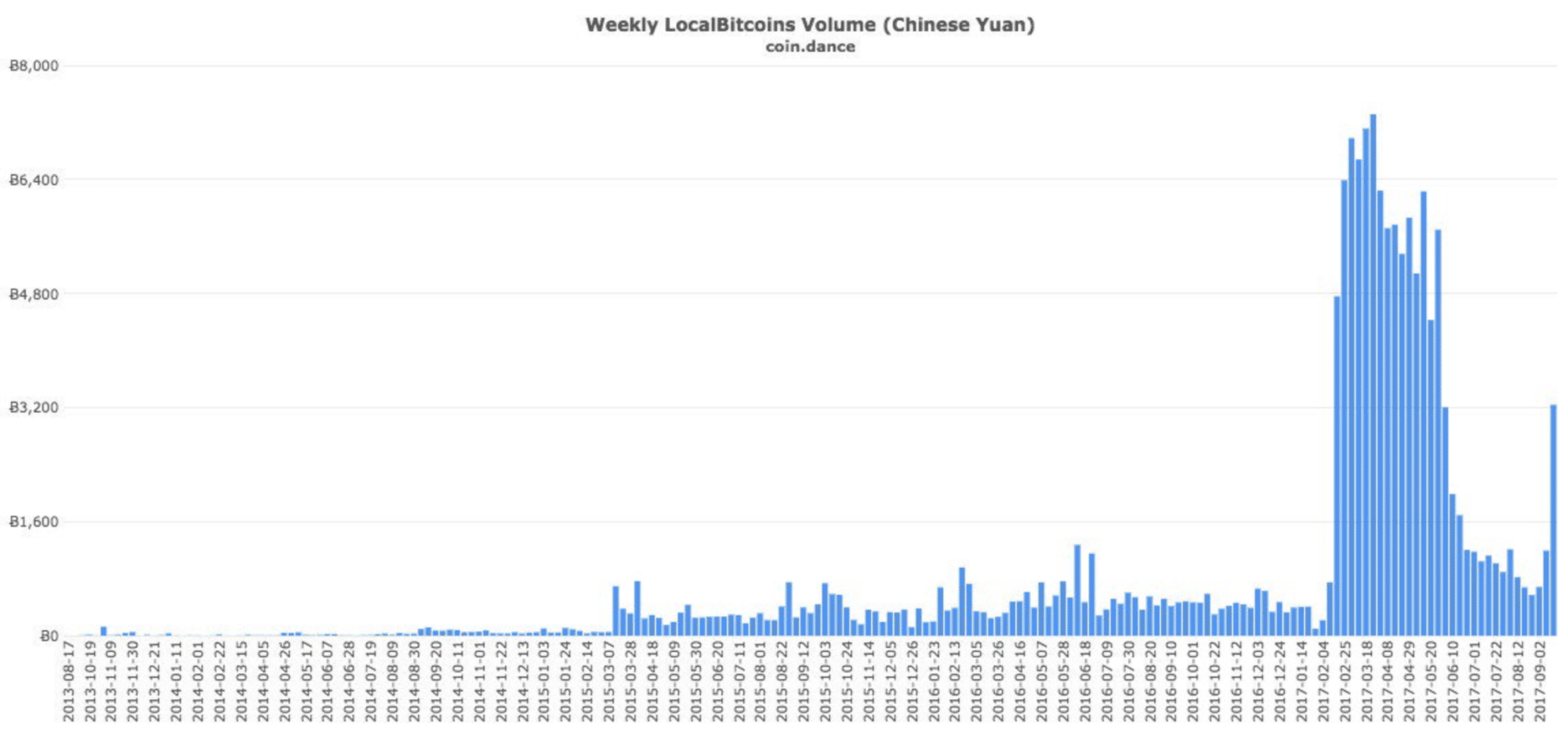
Localbitcoin Volume

Buying Coins in China Today

People would also organize trades on WeChat, the most popular chatting service in China. This was especially convenient at first since users could use WeChat Pay to send each other fiat currency. Government monitoring of WeChat led to increased popularity of the encrypted chatting service Telegram. China then banned Telegram. It’s unclear if the new p2p models are legal in China, but there has been no direct intervention as of yet. Realistically, it’s not feasible to stop all cryptocurrency trading.
Residents of China can also hop on the train into Hong Kong to obtain cryptocurrency. Over 100,000 Chinese tourists travel to Hong Kong every dayThey can buy coins from any of the large exchanges or use one of the many BTC ATMs It’s no wonder why the Hong Kong BTC ATMs frequently have large lines.
All of this regulation may sound like discouraging news for NEO and cryptocurrency but Hongfei sees it differently. He said, “It’s time for regulators to step in.”

Onchain and NEO in China

The Chinese government has a history of protecting local companies willing to cooperate with regulations. Playing by China’s rules has proved fruitful for several tech companies. You won’t find Google, Facebook, Twitter, WhatsApp, Uber, or Amazon in China. Instead, you see the success of Baidu, RenRen, Weibo, WeChat, Didi, and Alibaba. WeChat, for example, has over 1 billion accounts registered. NEO and Onchain are positioning themselves to be the next big names on this list of tech giants.
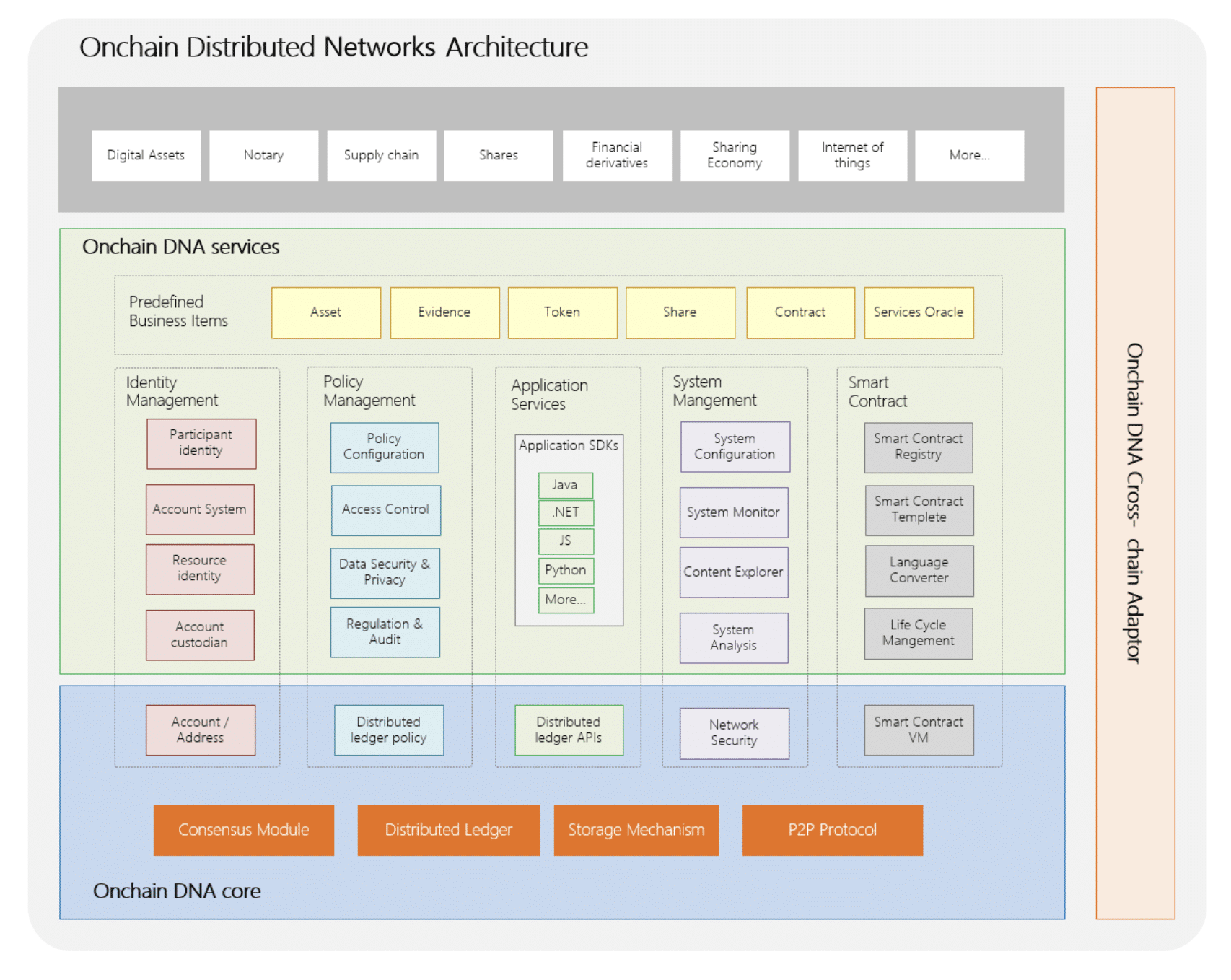
While not exactly friendly to Bitcoin, the Chinese government does actually support the development of blockchains. The Ministry of Industry and Information Technology (MIIT) of the People’s Republic of China, with the help of Onchain and other companies, explored several areas where blockchains can increase efficiency and prevent fraud. The government believes supply chains, assets, finance, welfare, and identity management can all potentially benefit from the use of Blockchain Technology. The government has even experimented with the idea of its own national cryptocurrency. It’s obvious that Hongfei anticipated the future demands and requirements of the Chinese government as these are all areas that Onchain is hoping to tackle with its custom and flexible Distributed Networks Architecture.
The MIIT also proposed that there should be greater standardization across blockchains. Hongfei said“Our vision is to make Onchain a truly universal Blockchain framework. Utilizing different plug-in modules, our framework could be applied for a public chain, a consortium chain or even a private chain. Our cross-chain adaptor module, currently under development, creates interoperability among these different chains.” 

Onchain Technology

This is your last chance. After this, there is no turning back. You take the blue pill – the story ends, you wake up in your bed and believe in whatever altcoin you want to believe. You take the red pill – you stay in China and I show you how deep the blockchain goes.
NEO was designed from a technology standpoint to be able to comply with regulations and work within the system. Bitcoin was designed with decentralization as a focus. While there are advantages to decentralization, it can lead to disagreements on the direction of the coin and slow implementation of new ideas. Decentralization is not the immediate goal of Onchain and NEO. Hongfei believes the centralization is worth it, in the beginning, allowing them to implement changes quickly.
NEO pre-mined 50% of their tokens to pay developers and help promote the growth of the coin. Dr. Hongfei compares NEO to eastern Asian countries, saying it will be “more authoritative in the beginning, but eventually be democratic.” He believes NEO will be “eventually fully decentralized… like Bitcoin.”

NEO Mining

The NEO blockchain confirms transactions in a relatively centralized, but unique way. Rather than using proof of work or proof of stake, NEO uses Delegated Byzantine Fault Tolerance also known asdBFT. In this system, holders of NEO elect nodes to confirm transactions.
To become a node, you must have a computer reach certain technical requirements, stake 1000 GAS coins, and then become elected by NEO holders. All 12 active nodes currently provide free transactions. The NEO holders are certainly more likely to vote for people that promise free transactions. Once you are elected as a node, you might be randomly selected to confirm the transactions on the blockchain. If over 66% of the other nodes agree with your ledger, the block is confirmed. If less than 66% agree, another node is selected to propose transactions that should go on the block. This process continues until a consensus is reached. NEO holders would most likely vote out nodes consistently failing to propose correct transactions.

No Forks

The Delegated Byzantine Fault Tolerance makes it clear which transactions are confirmed on the blockchain at all times. In The Matrix, we learned there is no spoon, but they forgot to mention there are no forks either. Unlike Bitcoin or Ethereum, which often fork until reaching a consensus, the NEO blockchain cannot fork. The lack of forks is essential to Onchain’s goal of digitizing assets such as stocks, bonds, and digital identities. If companies want to digitize regularly traded assets, it must be clear who is the owner of the assets at all times. 

Neo Spoon

Chinese Partnerships

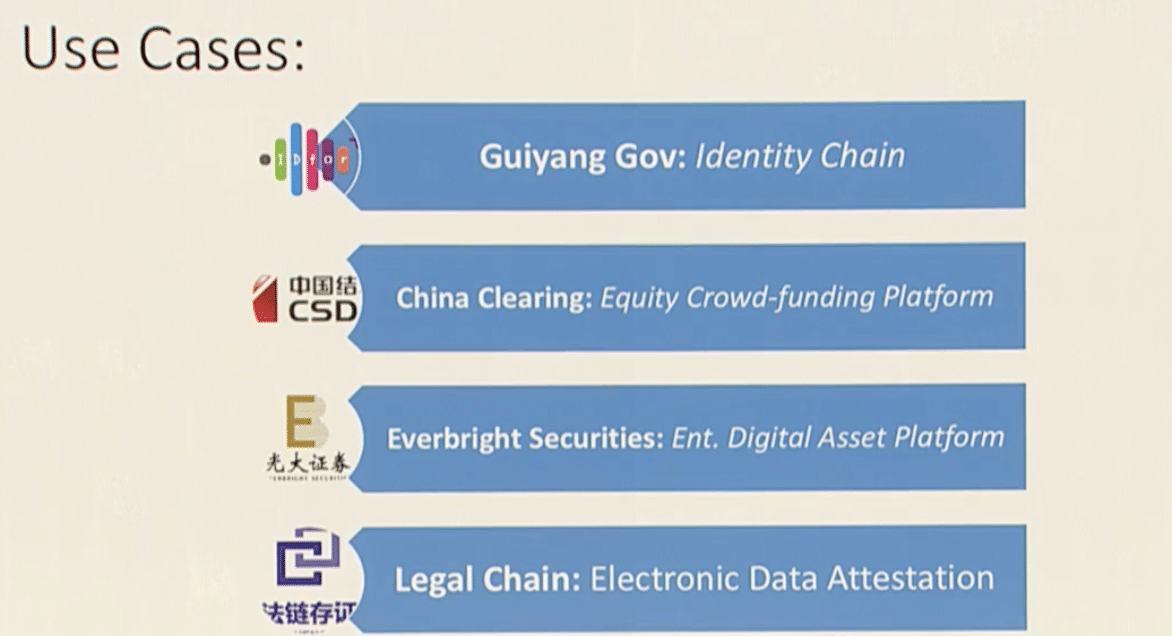
Onchain is working hard to spread their blockchain technology to private and government institutions. Here is a slide from a recent presentation by Hongfei.
Onchain Partnerships

Identity Chain – Integrity System Based on Blockchain

This project was “initiated by Guizhou Far East Integrity Management Company” and is based on the Distributed Networks Architecture. Onchain is helping build a blockchain to keep track of and manage identification. 

Security Company – Enterprise Level Digital Asset Platform

Onchain is applying the blockchain in financial institutions. It’s already working on a chain for Everbright Securities, a large securities brokerage in China.

Legal Chain – Digital Evidence Storage Alliance

Onchain helped develop a blockchain for the digital storage of enterprise emails as evidence. No one can delete or tamper evidence once it’s in the blockchain.

Alibaba

Onchain developed an email repository system for Alibaba to allow users to store important data or emails. This has several applications, including saving emails for the use of judicial proceedings.
The following diagram outlines many of the different uses for the Distributed NetworkArchitecturee.
Onchain DNA

Future of Onchain and NEO

Onchain would like to continue building partnerships in China, eventually moving fiat and identities onto blockchains. They are starting a new blockchain called Ontology focusing specifically on identities. Hongfei would like to attach data to ID’s, such as universities and working experience. Authorization on ID’s would be the ability to authorize people to view your information, such as your finances when applying for a loan. 
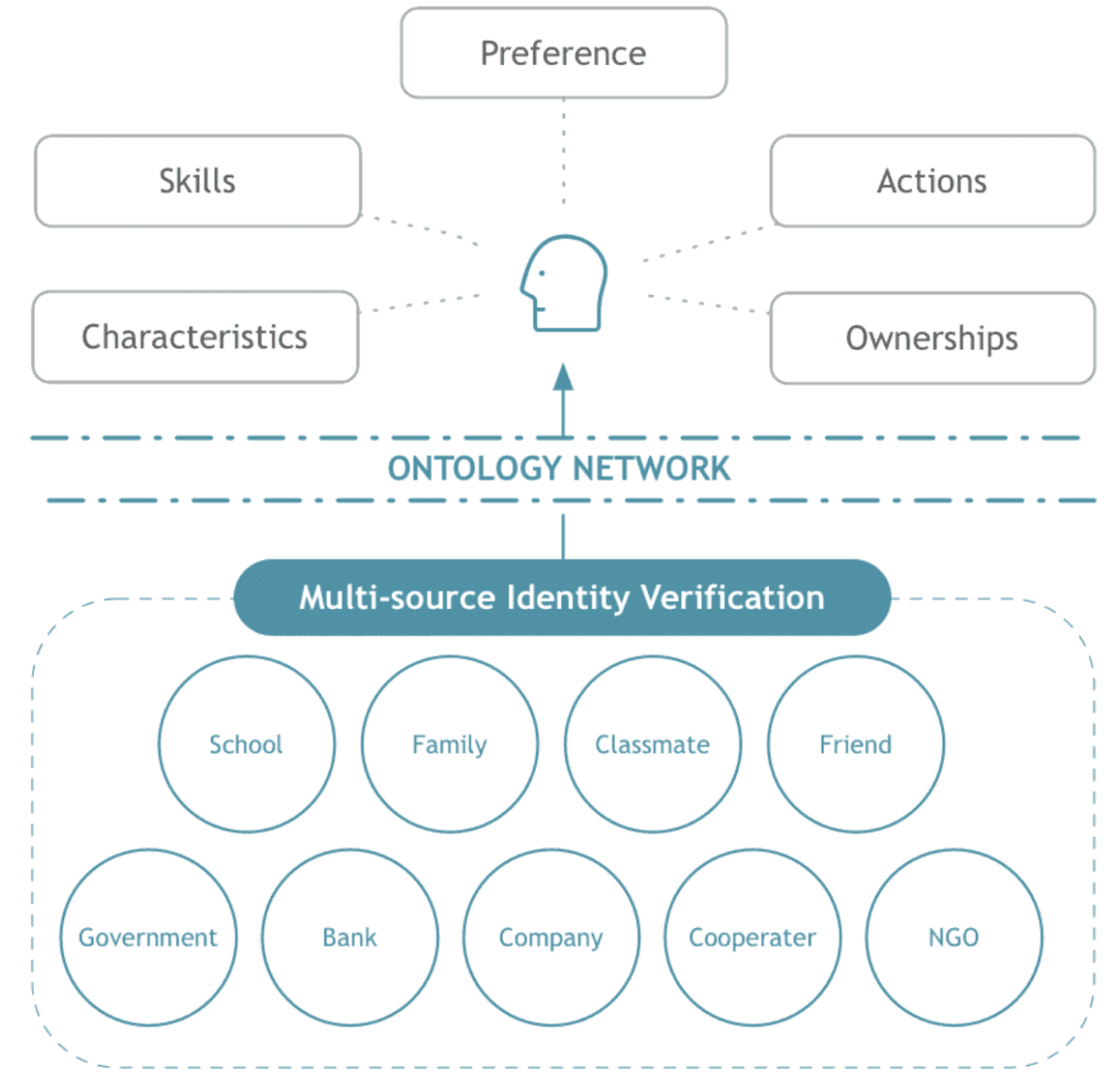
Ontology Identity Management
These next diagrams show how Ontology would achieve the goal of truly spreading blockchains across China.
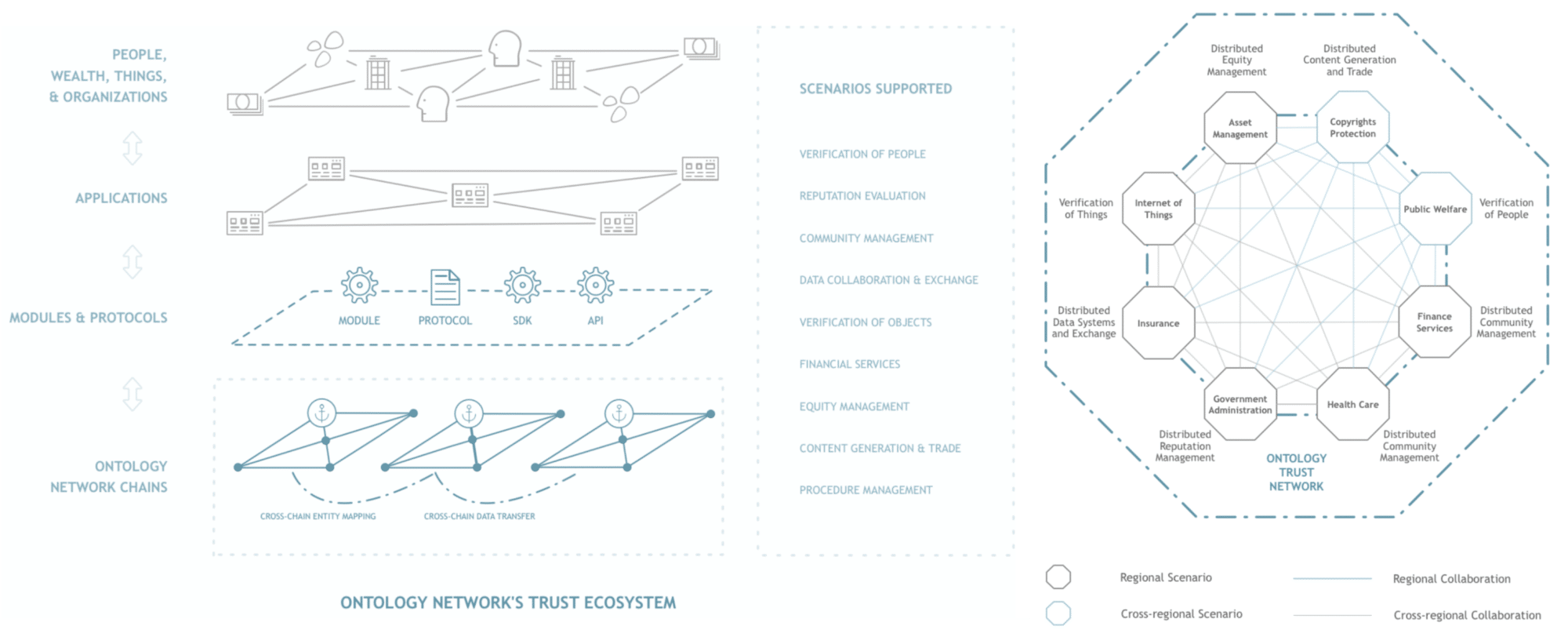
Ontology diagrams
These digital identities also tie into Onchain’s and NEO’s desire to be compliant. China cannot effectively monitor these platforms if they don’t know who is using it.
All of these public and private blockchains created by Onchain, including Ontology, will eventually be able to connect to NEO. The Ontology token sale will accept NEO tokens. “NEO will be the primary digital assets service provider for clearing and settlement on Ontology.” Ontology wants to become the government compliant connection between businesses and NEO.

Ontology and NEO

While some worry that Ontology will compete with NEO, it seems that the developers have every intention to create synergy between the two. When the Ontology network wants to hold an ICO, they will be able to through the NEO platform. Currently, an ICO would cost you 50,000 USD worth of GAS. This means we will see more serious and less frequent ICO’s on the NEO platform. This runs in sharp contrast to a recent joke Ethereum ICO called the Useless Ethereum Token (UET), which promised to steal your money and give you a worthless token in returnThe creator begged people not to buy it and insisted he would just take their money and buy expensive electronics with it. Of course, people still spent over 300,000 USD on UET.
NEO seems to have such a bright future that it has even caught the attention of Litecoin founder Charlie Lee.



Charlie Lee [LTC]
@SatoshiLite
There's a guy trying to catch up to us. We've been dropping 🐢 and 🍌, but he's been dodging them using bullet time. That's just unfair! 😂

Summary

Onchain is clearly executing on their ambitious plan to create an entire ecosystem of standardized and connected blockchains in China, all of which will be able to connect to the already successful NEO ecosystem.
We could say the future of NEO is reminiscent of a conversation from The Matrix movie.
Neo asked, “What are you trying to tell me? That I can dodge Chinese regulation?”
Morpheus replied, “No NEO, I’m trying to tell you that when you’re ready, you won’t have to.”

Hong Fei Neo
This article by Paul Andrew was originally published at CoinCentral.com”: https://coincentral.com/neo-and-blockchains-across-china/

Wednesday, 7 February 2018

3 Mobile App Stocks to Buy, 1 to Avoid

fool.com

The mobile economy continues to take over the world. Here are three stocks to let you take advantage of it.

Ten years ago, an app was something you got at a restaurant before your entree. Today, it's the center of a $5 trillion industry. Mobile apps (short for applications) have revolutionized computing, taking it from mouse clicks to touch screens, and have spawned a multi-trillion dollar economy for developers, start-ups, and tech giants along way.
Not surprisingly, the most popular mobile apps often belong to the most successful companies, as technical performance, ease of use, and utility are key criteria for apps to get downloaded onto billions of smartphones around the world.
With global time spent on apps expected to increase from 1.6 trillion hours in 2016 to 3.5 trillion in 2021, it's no surprise investors are hungry for a piece of the space. 
A man looks at his smartphone and smiles.
IMAGE SOURCE: GETTY IMAGES.

The mobile app industry today

So many publicly traded companies depend on their apps to compete in today's market. Beyond tech companies, apps are key for banks, retailers, airlines, hotels, restaurants, and industries. Even segments that once operated smoothly offline, like transportation and video entertainment, have been disrupted by app-based brands like Uber and Netflix.
Apple's iOS and Alphabet's Android dominate the market in smartphone operating systems. But despite Android's much larger market share, developers make apps for iOS first and then Android second -- iOS users have higher incomes, so they're more likely to pay for apps; it's easier to design for iOS because there's a limited number of devices that use the software; and apps are safer inside iOS.
That advantage is a key driver of Apple's huge profit margins, as app-related services have grown into a significant revenue stream to complement the sale of its devices. But Apple isn't the only one benefiting from the app economy -- the owners of the most popular paid and free apps are also raking in cash from mobile.
The top app players
The chart below shows some of the stocks that are thriving from the app economy.
Company
Market Cap 
Trailing P/E Ratio
1-Year Stock Growth (Loss)
Apple App Store Rank
Apple
$851.9 billion
18.2
38%
Not applicable
Alphabet
$821.1 billion
39.4
43.7%
#3, #7, #9, #14, and more (YouTube, Gmail, Google Maps, Google Docs)
Facebook (NASDAQ:FB)
$561.3 billion
37.4
48.2%
#1,#2, #5, #18 (Facebook Messenger, Instagram, Facebook, What's App)
Snap Inc (NYSE:SNAP)
$16.7 billion
N/A (not profitable)
(43.3%)
#4 (Snapchat)
Match Group (NASDAQ:MTCH)
$9.6 billion
23.4
102.8%
#50 (Tinder)
Paypal Holdings (NASDAQ:PYPL)
$95.7 billion
61.6
100.2%
#28, #37 (Paypal, Venmo)
With its Android platform, Alphabet has built out its own impressive app-driven business. Android apps collected $27 billion in sales in 2016, and like Apple the company keeps 15% of app-based sales, giving it a multi-billion-dollar revenue stream. Outside of Android, Alphabet also owns some of the most popular apps in the world, including YouTube, Gmail, Google Maps, and Google Docs, which have burnished its advertising business. YouTube, for example, has 1.5 billion monthly users, and claims that its users watch more than an hour a day on mobile devices. The company does not break out YouTube financial results, but the high monetization rate of video ads makes that another valuable revenue stream.As the king of the App Store, Apple has made quite a killing from the mobile economy. In the most recent quarter, services revenue, which is derived largely from in-app payments and its own apps like Apple Music, increased 34% from the previous year to $8.5 billion, making it the company's largest segment after the iPhone. Increasingly, Apple's focus has been leveraging its installed base of devices to grow its services business through in-app purchases and tangential business like Apple Music, iTunes, and its expected upcoming television service.
No one dominates the app game like Facebook. The social media giant owns three of the top five apps in the app store, and has three apps with a billion users or more, with Instagram likely to become the fourth sometime this year. While mobile gave the company headaches in its early public history, it has now mastered mobile advertising, which has become the primary driver of its business. In its most recent quarter, 89% of its advertising revenue came from mobile, and it's leveraged that expertise to build businesses out of native app brands like Instagram -- and should eventually do the same with Whatsapp. As long as people are using their phones to communicate, Facebook should remain a winner.
Snapchat-parent Snap owns the fourth-most popular app on the App Store, which, like Instagram, is a mobile-only app based around the camera, allowing users to post photos with different lenses and record video that's collected into stories. While Snapchat is the rare social media company that has actually mounted a challenge to Facebook, gaining popularity with teens and young adults, the company has lost momentum as Instagram has co-opted many of the features that made it unique. Growth is slowing, and the company is struggling to demonstrate its value to advertisers, who prefer Instagram.
Match Group may not have one of the top downloaded apps on the App Store, but the company, thanks to mobile-first Tinder, is remaking the online dating industry. Its swipe-based method of matching potential daters has made Tinder the #1 dating app and driven strong growth for the company as it continues to monetize Tinder with add-ons like Tinder Boost, Tinder Plus, and Tinder Gold. The company and its other apps, like OkCupid, PlentyofFish, Match, and dozens more, should continue to grow as online dating becomes more popular.
Finally, Paypal has long been the leader in mobile payments with more than 200 million active accounts. Its acquisition of Venmo has also proven key, becoming a favorite among millennials for allowing quick, fee-free payments to split restaurant checks, pay rent, or reimburse other expenses. In its most recent quarter, the company said mobile payments rose 53% to $48 billion driven by strong engagement during the holiday season. As mobile payments become more convenient, Paypal likely has a long tail of growth ahead of it.
A woman in running pants holds a smartphone in her hands.

What is blockchain?

coincentral.com
by Steven Buchko

Image result for What is blockchain?
Simply put, a blockchain is just a list of digital records (blocks) that are chained together using cryptography.
The financial industry today contains all types of middlemen – payments processors, banks, and credit card companies are just a few. These intermediaries help to establish trust between buyers and sellers and ensure the accuracy of data in the transactions. However, adding additional people and steps to the process oftentimes leads to cost increases and reductions in speed.
Enter blockchain. This technology eliminates the need for middlemen by providing a decentralized, trustless ledger system with little exposure to fraud. Bitcoin is the most famous example.
Although you primarily hear about the financial sector’s use of blockchain, the technology expands far beyond just simple transactions. Blockchain companies are disrupting tons of industries from data storage and supply chain to gambling and the Internet of Things.

How does blockchain work?

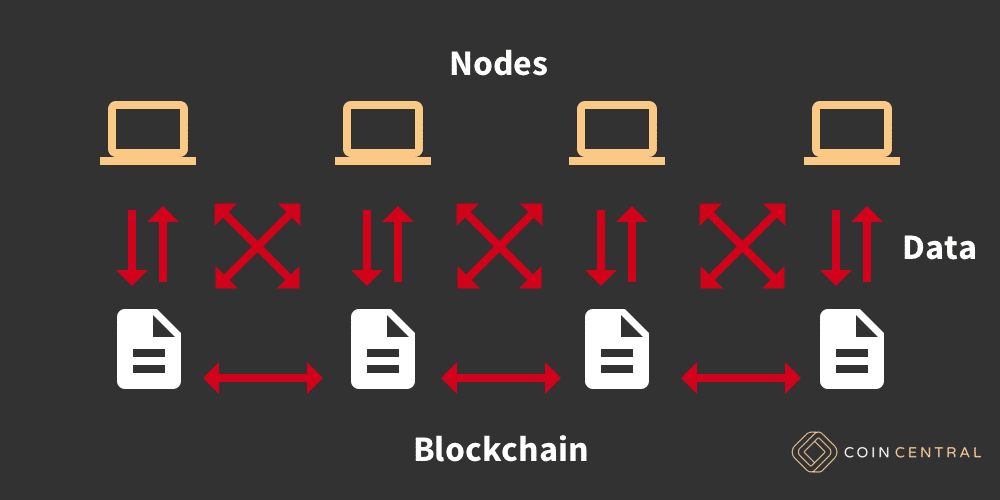
Nodes

A blockchain is run by a large network of computers, called nodes. These computers validate and record transaction data on the network by solving complex mathematical algorithms.
Every node has a complete history of transactions, so if one were to try and maliciously change a record, the entire network would know and reject the change.
blockchain graphic

Transaction example

Bob wants to send Sally $5, so he submits his transaction to the blockchain. Every node in the network then receives his transaction request.
Each node checks for two things with the transaction data:
  1. That Bob is who he says he is
  2. That Bob has the $5 to send to Sally
First, the nodes check Bob’s identity using the private key that he provides. A private key is an ownership tool that identifies a source of funds.
Next, the nodes make sure Bob isn’t trying to spend money that he doesn’t have. Because the nodes all have a copy of the ledger of transactions, they can easily check whether or not Bob has the $5 that he’s trying to send.
If at least 51% of the nodes agree that Bob’s identity is truthful and he has enough money to send, then the transaction will go through. The nodes will also update the ledger on the network with the new transaction.
With each new transaction added to the chain, the previous transactions become harder and harder to manipulate. 
This immutability is supported by hash pointers. A hash pointer is a cryptographic hash that refers to the previous data block in the chain. They allow you to confirm that no one has tampered with earlier transaction blocks.
A transaction becomes like a fly trapped in amber. You would need to remove each additional block (layer of amber) from the chain to access and manipulate the previous transaction data (the fly).    

The benefits of blockchain

Faster

Cutting out the middleman shortens the process of transactions and data transfer. Validations are inherently built into a blockchain system, so there’s no need for lengthy approvals or complicated record checks.

Cheaper

As mentioned earlier, the more people and entities involved in a process, the more costly it becomes. The cost of running a blockchain network is far less than an intermediary doing the same job.

More accurate

Data on the blockchain is immutable and validated by mathematical computations. It’s nearly impossible to have any human error and/or fraud.

Blockchain TL;DR – Final Thoughts

A blockchain is a distributed ledger system that uses cryptography to link together bits of data. It removes the need for middlemen in transactions which leads to faster processes, reduced costs, and greater data accuracy.

This article is originally posted at Coincentral.com: https://coincentral.com/what-is-blockchain/

Tuesday, 6 February 2018

3 Key Elements of Effective Mobile Learning Content

blogs.edweek.org
Education Futures: Emerging Trends in K-12
With nearly 1 million education apps available today, how can pre-K-12 educators leverage this vast amount of content to support the individual needs of students?
Increasing investments in mobile computing devices such as Chromebooks and tablets are driving significant growth in the education apps market. As schools spend more money and students spend more time on mobile devices, there are a few critical elements to ensure an "education" app is actually educational.
1. An education app should meet the same high standard as any other educational content
A key benefit of education apps is that they can engage and motivate students. The problem is too many apps place the primary focus on engagement rather than learning. If an app is well designed around a specific instructional objective, students can achieve positive learning outcomes. Not all apps, however, are based in sound pedagogical theory. Some market themselves within the education category but require little more than swiping or tapping a screen around a weakly formed instructional objective. While an app can integrate play to increase engagement, the idea of "fun" shouldn't blind the educator to the importance of its ability to produce the desired learning outcome.
Research has shown that students' enjoyment of a learning game doesn't automatically mean learning success. In a 2016 article, Nina Iten and Dominik Petko reported that in the realm of "serious games" -- an active, problem-solving, social form of learning with rapid, differentiated feedback that also promotes the enjoyment of learning -- anticipated enjoyment played only a minor part in students' desire to play the learning game and their willingness to learn. Of greater importance was their expectation that the game would be easy to comprehend and help them learn.
Taking this idea further, education apps that incorporate elements of deliberate practice can also be very beneficial to student learning. Deliberate practice is defined as intense practice or a regimen of effortful activities to achieve expert ability. To promote deliberate practice, education apps should incorporate goal setting, focus, feedback, coaching, and reflection. This "loop" of activities gives students the opportunity and the means to take control of their learning.  
2. It should eliminate the potential for cognitive overload.
Education apps can also produce emotions other than enjoyment, such as frustration or irritation, which are not conducive to learning. In some cases, the bells and whistles designed to capture students' interest and increase their enjoyment can have the opposite effect. For example, apps that contain excessive amounts of noise or movement, or activities that are not related to the instructional objective, can distract students and disrupt their learning.
Thus, it is crucial to keep extraneous elements to a minimum while increasing the germane cognitive load, e.g., the learning objective. Toward that end, mobile learning content should demonstrate clear learning outcomes while emphasizing clarity and ease of use. Educational apps should have clean design elements, simplified engagement, and linear movement, all of which contribute to a focus on the learning objective.
3. It should meet the unique learning needs of each individual
Educators have a wide array of choices and so should consider apps that target the individual needs of each learner. But how can teachers quickly access and deliver the right content to the right student at the right time? Using an online platform that supports managing mobile content, educators can easily source, assign, and monitor a student's progress across all of their education apps. By streamlining the ability to leverage the most relevant mobile content for a student, the promise of a more personalized learning experience begins to take shape.  
That experience can become even more powerful when platforms work together. By linking a mobile learning platform with formative assessment software, an online individualized education plan (IEP) program, or a standards-based gradebook, teachers can simply click a button and produce a list of recommended apps to support the personalized learning needs of their students.
With the right education apps, schools can realize the potential of personalized learning that tablets and Chromebooks can offer and make the most of their investment in these devices. When apps have an instructional focus, employ sound pedagogy, and are coupled with elements of engagement and a clean design, they can support the achievement of learning outcomes. Further, by combining apps and linking them to targeted skill development goals, educators can form a cohesive, meaningful, and appropriate learning experience for each and every one of their students. 

Friday, 2 February 2018

Facebook ad revenue up 49% despite user number fall

campaignlive.co.uk
Despite reporting a healthy 20% increase in net income for 2017 to $15.9bn (£10.5bn), Facebook reported declines in user numbers and usage time.

Facebook ad revenue up 49% despite user number fall
Facebook’s daily active user numbers dropped by 700,000 in the US and Canada in the last quarter. 
Further, time spent on the platform dropped by 50 million hours everyday, or 5% of total time spent.
But the social media network's advertising revenue is still growing strongly at 49% for the financial year, taking in $39.9bn.
Founder and chief executive Mark Zuckerberg attributed these declines to the changes made on the platform, such as its alteration of the newsfeed algorithm: "Already last quarter, we made changes to show fewer viral videos to make sure people's time is well spent. In total, we made changes that reduced time spent on Facebook by roughly 50 million hours every day. By focusing on meaningful connections, our community and business will be stronger over the long term."
The trending decline in user numbers, however, may predate the changes Facebook instituted. Pivotal senior research analyst for advertising, Brian Wieser, noted that these trends had been spotted previously based on data from Nielsen’s digital content ratings product.
"GDPR in Europe could impact user levels as well (presuming that Facebook would limit use to consumers who do not provide appropriate consent to share their data)," he further speculated.
Facebook’s drop in DAU within its heartland was offset by growth in India, Indonesia and Brazil. In total, DAU  the fourth water was 1.4 billion, up 14% year-on-year. This number is 66% of the platform’s 2.12 billion monthly active users in the quarter. 
Facebook’s awareness of the problems the company is facing and their hands-on approach to dealing with them, even at the cost of short-term revenue, should be viewed positively in a long-term context, Wieser said.
Nevertheless, the platform's shares dropped by about 5% in the hours immediately after the announcement but have recovered since the markets reopened. 
"No doubt investors stared at the notable slowdown in daily user growth, which highlights just how important it is for Facebook to strike that delicate balance between staying true to users and encouraging quality content with continued monetisation," David Barker, managing director and senior vice-president of Amobee EMEA commented.
Going forward it will be interesting to see how Facebook will advance its video platform and position it as a challenger to YouTube this year, Barker continued. "If there’s anything Facebook can learn from Netflix (which just earlier this week announced its best-ever quarter in user subscriptions and impressive earnings) is that there’s nothing like quality, original content to acquire new users and capture time spent on the platform. Facebook has fingers in a couple of jars at the moment (What's App, Instagram, Oculus), but the momentum of its video offering is definitely one to watch."

Full-year ad revenue grew 49% year on year 

Facebook’s revenue jumped 47% to $40.7bn in the past year versus 2016. Of this, 98% or $39.9bn was from advertising – a growth of 49%.
In the final quarter, the platform’s ad revenue grew 48% year-on-year to $12.8bn.
During the earnings call, Facebook chief operating officer, Sheryl Sandberg, shared that mobile-first video represented half of the platform’s video ad revenue in the fourth quarter, compared with 41% in the third quarter.
"In 2017, mobile conversions continued to accelerate. Data from 17 markets shows mobile accounted for 69% of online conversions on Black Friday and 64% on Cyber Monday," she said. "It also drove 80% of conversions on Singles’ Day, a popular day for online shopping in China and increasingly other countries. Big shopping days like these are the kind of global events that Facebook and Instagram are uniquely positioned to support." 
Sandberg also said that Facebook was working on improving the optimisation of ads placed on Facebook. "We’re continuing to invest in Value Optimization, which helps advertisers show their ads to people who are likely to spend more with them. We’ve been gradually rolling this out to advertisers using Web Conversion, Dynamic Ads and Mobile App Install ads."
So far, the early results are promising, she said. "Over 2,500 businesses have tried Value Optimization since June and many are putting more of their budgets toward it."
Of the changes Facebook is making to the way it is used, marketers are confident that any concerns can be offset by the platform’s scale and utility, Wieser said.
At an event yesterday organised by We Are Social aimed at discussing the newsfeed algorithm changes, speakers, which included Rich Burgess, social media manager, Audi UK and Lauren Davey, head of social media & display at Barclaycard Business, were confident that Facebook would still work for great brand content.
"It is also a chance to shift focus from the main platform to Facebook’s other properties, such as Instagram and Messenger," Burgess pointed out.
Basically, the changes to the algorithm, and the decision to ban Bitcoin ads, are Facebook’s attempt to clean up the user experience, Leo Ryan, vice-president of customer success EMEA at Spredfast, said. "Just don’t do crap." 

More changes announced

Zuckerberg elaborated on Facebook’s announcement that it would be asking its users to rank news sites in terms of trustworthiness.
"The second update we announced is about making sure the information you see on Facebook comes from broadly trusted and high-quality sources, in order to counter misinformation and polarization," he said.
The goal is to decrease the "bubble" effect, by showing more news from sources that are broadly trusted rather than allowing communities to be isolated by only reading the news they trust.
"For example, take the Wall Street Journal or The New York Times. Even if you don't read them or don't agree with everything they write, most people have confidence that they're high quality journalism. On the flip side, there are blogs that have intense followings but are not widely trusted beyond their core audience. We will show those publications somewhat less." he explained.
Using AI, the platform has been demoting false news in the News Feed, typically dropping the article’s traffic by 80% and "destroying" the economic incentives behind generating these false articles, he said.
Facebook will also be investing in people and technology to "protect the security and integrity" of its platform, Zuckerberg continued.
"We now have around 14,000 people working across community ops, online ops, and our security efforts. That's almost double where we were a year ago," he said.
Finally, Facebook is introducing an "ads transparency" programme.
 "We've already begun launching a way for anyone to view the ads a page is running on Facebook, Instagram, Messenger — even if they aren't the intended audience. We're testing in Canada first with the goal of rolling it out in the US this summer ahead of the midterm elections," Zuckerberg concluded. 

Instagram, Messenger and Whatsapp

While Facebook doesn’t break out revenue figures for its different platforms, some insights were shared during the earnings call.
Instagram has been growing, Zuckerberg said. "There are more than 2 million active advertisers on Instagram and we announced in November that more than 25 million businesses have profiles on Instagram – up from 15 million in July."
While highlighting Facebook’s renewed focus on small businesses, Zuckerberg said around two-thirds of visits to Instagram business profiles are from people who don’t yet follow them. "This is how many businesses are finding new customers."
Videos are also working well on Instagram Stories, Sandberg shared later. "Sixty percent of these ads are viewed with sound on". 
Facebook is also working on ways for businesses to communicate with customers on Messenger and WhatsApp.
"We launched a plug-in for Messenger so people can chat live with companies on their websites, and now more than 2 billion messages are sent between businesses and customers every month," Zuckerberg said.
He added that WhatsApp has recently crossed 1.5 billion monthly actives, with people sending more than 60 billion messages every day. 
"A growing number of these messages are between people and companies, which is why we launched WhatsApp Business — a new app designed specifically for small and medium businesses to connect with people they want to reach," he said.

Monday, 29 January 2018

Sir Martin In Davos; Amazon's Ad Business In Context

adexchanger.com

Swiss Cheddar
Of the $50 billion or so WPP spent on media in the past year, about $5 billion went to Google and $2 billion to Facebook, according to CEO Martin Sorrell, speaking to Fox Business Network at the World Economic Forum in Davos, Switzerland. Though the digital juggernauts are the biggest growth channels, the combined media investment in Disney and 21st Century Fox’s film and TV studio, which Disney acquired in December, would make up $3 billion on WPP media plans. Amazon Advertising Platform is expected to grow from $200 million last year to $300 million this year – a strong growth rate, though far behind the incumbents. Sorrell also bemoaned the challenges faced by ad agencies globally. “We’re increasingly viewed as a cost. And we’re not, we’re an investment.” Watch the segment.
Tricks Of The Trade
Morgan Stanley is calling bluff on Amazon’s ability to take on the digital ad duopoly, reports Mike Shields for Business Insider. Despite being on trajectory to rake in nearly $8 billion in ad revenue by 2019, most of Amazon’s ad revenue will come from trade promotions, like coupons and in-store branding, rather than the digital ad budgets possessed by Facebook and Google. Trade marketing is a $178 billion category in the US, and Amazon is poised to push trade budgets to data-driven product display and search ads. By wading deeper into trade marketing, the financial services firm predicts Amazon could increase the digital ad spend pie by 50%. More.
Tale Of Two OSs
The Google Play store exceeded 19 billion new global app downloads – its most ever in a quarter – and is pulling further away from Apple’s Apple Store, which had about 8 billion downloads, per App Annie’s Q4 2017 app economy report (read the release). Meanwhile, Apple accounted for almost twice the mobile consumer spending for the same period: $11.5 billion to Google’s $6 billion. The reason: Google’s download surge is powered by emerging markets, where discretionary spending is far more limited than in Apple’s first-world stronghold.
Spur Of The Moment
Twitter launched an ad product Friday, Sponsored Moments, which allows brands to promote themselves in the platform’s section of tweets curated around events. The feature will let brands include a branded image and around a specific moment and insert its own tweets about the event onto the Moments page. Bloomberg, for example, is running a Sponsored Moment around the World Economic Forum in Davos with Bank of America. Sponsored Moments can be targeted to different audiences using Twitter’s ad products. TechCrunch has more.