Tuesday, 9 January 2018

How AI and CLV help app marketers drive business growth

martechtoday.com

Brian Solis says marketers need to move away from traditional vanity metrics and look toward AI and machine learning to identify the most valuable customers and deliver targeted experiences.


Did you know that 80 percent of users churn within three months of downloading an app? That’s because most apps are marketed to the masses and not necessarily to the right customers.
Oftentimes, the goal of app marketing is to reach as many consumers as possible with the hopes of recruiting en masse and converting at better-than-average ratios. But part of the challenge for marketers is that many of today’s strategies are driven by metrics that don’t link to advanced user targeting and growth.
More specifically, app marketers aren’t using available data strategically to deliver productive user experiences that ultimately drive greater business profitability.
Now more than ever, marketers must shift from tracking traditional vanity metrics to measuring the very things that contribute to retention and growth. More and more, successful companies are investing in customer-centric metrics such as CLV (customer lifetime value) to gain intelligent, consumer-centered insights that not only identify the most valuable customers but also key behaviors and preferences to continually improve consumers’ experiences and journey.

Next-generation marketing and CX are about identifying and engaging valuable consumers

CLV is more important than apps in isolation. It helps apps and other touch points work together to deliver value-added, cohesive experiences.
CLV measures the value a consumer represents to the business across all interactions over their lifetime, not just a single transaction or touch point. That is ultimately the definition of customer experience. It is the sum of all moments a customer has with your brand throughout their life cycle. Marketing and customer engagement is now a cross-functional mandate.
Not all app users are the right users. If you use the Pareto Principle, you can assume that 80 percent of business value is attributed to 20 percent of your active consumers. While these percentages aren’t by any means a standard, they do emphasize the need to identify and cultivate the important customers who drive your business.
Instead of casting a wide net and attracting as many users as possible in the hopes of retaining a reasonably active base, CLV tied to artificial intelligence (AI) and machine learning focuses marketers and also developers on targeted engagement and growth. The idea is to drive profit by investing in more value-added user experiences and personalized offers. Doing so intentionally cultivates meaningful relationships with key customers.

Next-generation customer engagement is about cross-functional collaboration and data sharing

Unfortunately, customer experience today is largely siloed. Marketing, mobile, in-store, e-commerce, digital and so on are not collaborating nor operating against the same customer and market data. But that’s all about to change with the proliferation of AI and machine learning tied to smart CLV initiatives.
When the goal is to deliver targeted and integrated experiences, not just in-app, but across each touch point and the life cycle overall, companies create a truly customer-centric approach. AI then helps brands get a more complete, shared view and understanding of customer behaviors and expectations.
Additionally, AI-driven customer-centricity fosters cross-functional collaboration and data sharing that, by design, boosts customer experiences, along with CLV and business growth.

Identify highest-value customers and deliver targeted experiences

AI/machine learning platforms offer intelligent insights when pointed in the right direction. Successful brands study how much revenue highest-value customers drive over their lifetime and how much it costs to manage those relationships. And they examine CLV across all channels to get a holistic view of high-value behavior in all interactions. When the system can analyze important traits of high-value users, it can learn how to optimize CLV.
For example, to reach potential high-value customers, AI/machine learning uses data from existing high-value customers to optimize campaigns and touch points. In a study by Bain aimed at retail banking, it was found that it costs banks $4 every time a customer calls or visits. However, if consumers can complete the transaction via an app, it costs only 10 cents.
The key is to deliver capabilities in ways that consumers prefer and appreciate. Imagine how much AI and machine learning could additionally uncover when tasked with identifying friction points and new opportunities.

AI and CLV call for a new customer-centric playbook

You’ve probably heard time and time again that it costs more to acquire a new customer than to retain one. Brands that are winning prioritize CLV and AI and are drafting the playbook as they go. They:
  • develop a customer-centric mindset.
  • open doors between silos around in-store, digital and mobile so teams can focus on one clear business goal, rather than individual metrics (such as engagement or clicks).
  • align customer-facing groups to a business outcome such as CLV and promote cross-functional collaboration and data sharing to assemble a holistic view of the customer across all touch points.
  • understand who their highest-value customers are, how much revenue they drive over their lifetime and how much it costs to manage the relationship — across all channels.
  • focus on measuring and communicating clear business goals rather than individual or vanity metrics.
AI and machine learning improve both by using existing data without cognitive bias. The more the system learns, the more it optimizes.
In the end, not all customers are created equal. By identifying those who drive value, how and why, you can learn how to design and deliver personalized value to them and enhance customer engagement and experiences to grow your business now and over time.

Monday, 8 January 2018

AD AGE'S 2018 INDUSTRY PREDICTIONS

adage.com
It's a week into 2018 and your first quarter is just beginning. Take a break from going about your business to take in our predictions—because in a world that's gotten so chaotic, it's good to know there are a few things we can definitely (maybe) count on. Even if they aren't all good.

Threats persist in auto market
Auto sales dipped 1.8 percent in 2017, ending a seven-year streak of yearly gains. While newly passed federal tax cuts are expected to help boost buyer confidence in 2018, marketers must contend with rising threats from car-sharing services that offer young urban dwellers an alternative to ownership. As a result, brands and dealers will need to continue to experiment with alternative methods like subscription-based buying. Meanwhile, marketing will have to work harder to convince people why it still makes sense to buy.
Amazon eats up (almost) everything
After getting its private-label ducks in a row in 2017, the company looks ready to dominate with its in-house lines of grocery, fashion and recently launched activewear. It currently has dozens of private-label brands, with many more trademarks in the works. Watch out, brands. Bezos is coming for you.
Big food will need to watch its wallet
To avoid being gobbled up, packaged food makers with weak sales growth are buying faster-growth companies. Kellogg Co. already makes better-for-you snack bars, but paid $600 million for snack bar maker RXBar. Campbell Soup is spending more on Snyder's-Lance (its sixth acquisition in five years) than it has on any other deal. Hershey Co. is also digesting its biggest deal to date, for SkinnyPop maker Amplify. As pacts persist, especially with diminished corporate tax concerns, companies must make sure not to overspend.
Infrastructure shakeout
Retailers who have yet to align their brick-and-mortar and e-commerce operations, and can't afford to acquire a start-up to help with the digital transition, may have a hard time modernizing their infrastructure. Target, for instance, with money in the bank, was able to pay $550 million for same-day delivery company Shipt. Expect those with debt to be left out in the cold when consumers open their wallets.
More TV rivals to make nice
In 2017, frenemy consortiums popped up, such as OpenAP—created by Turner, Fox and Viacom to help standardize audience buying on TV—and NBC Universal gathered a group of leaders (in media, marketing, agency and digital spaces) to kick off a campaign to fix issues like measurement across platforms and devices. This year, A&E Networks, Discovery Communications and AMC Networks will begin testing a method that would prove whether a commercial led a viewer to take action. The word "collaboration" will be overused, but the moves could result in some unusual partnerships between legacy TV networks and digital rivals.
In-house they go
Big advertisers buying small brands have learned bootstrap operations don't put down big retainers for urban-based ad agencies with high overheads, but instead use low-cost influencers or in-house studios to turn out social media content. Expect more to do this themselves. (Johnson & Johnson, for instance, discovered the pleasing simplicity—and saving of expenses—of the in-house studio used by the Vogue International business it bought last year.) There are a growing number of options for hooking up big brands with middling or micro influencers, and more transparent marketplaces like Tongal and StudioNow where brands can find creative and production help for projects.
The cookie crumbles
This year, identity solutions will take off as consortiums of publishers and ad-tech companies—such as the one formed by half of the ComScore 250 and ad-tech company Sonobi—continue to pool their own signed-in users and data to go up against Facebook and Google, thereby offering marketers the ability to target large amounts of logged-in users. While none have yet to build an alternative as effective as the duopoly's, give them time.
Facebook gets down with OTT
Facebook needs a hit show to get Watch off the ground, and needs to encourage more lean-back viewing, the kind where someone fires up the Facebook video feed and stays for longer sessions. Where better to get those kinds of viewers than from TV? Expect Facebook to make a bigger effort to get into over-the-top television, with a better app for digital streaming. Watch could even be spun off into its own app, and appear on devices like Roku, where Facebook has yet to make inroads. A Roku tie-up could be just what Facebook needs. But even better? Facebook buying Roku, which would give it instant credibility in digital TV.
Pepsi works on its core
Coke got the better of Pepsi in 2017 with its carbonated beverage sales off just 1 percent in the 52 weeks ending Nov. 4, compared with PepsiCo's 5.9 percent plummet, according to Nielsen data from Wells Fargo. PepsiCo CEO Indra Nooyi recently conceded too much media spending and shelf space was given to low-calorie smaller brands and not enough to Pepsi and Mtn Dew. So, look for PepsiCo to boost marketing behind its core soda brands. The marketer's Super Bowl ad plans could provide an early clue. The new efforts, though, might not be enough as consumers continue to gravitate to alternatives like bottled water.
Blockchain changes everything
Blockchain has the potential to significantly disrupt the digital advertising ecosystem and, while 2018 won't be the year it sees mass adoption, its ability to provide three solutions to problems as old as digital advertising itself—transparency, authentication and auditing—means this year, marketers (those who have yet to) will sit up and take notice.
Indie media agencies break out
In 2017, independent media agencies continued to scoop up big-name clients (like Horizon winning Sprint and Crossmedia taking on HomeAway). As clients deign to understand exactly where their dollars are going, more will turn to agencies that might not give them the cheapest rates, but can give them bang for their buck—and give them a CEO as their point of contact, instead of a lower-level account manager.
YouTube stars collide
The biggest threat to YouTube is its own stars. The video service couldn't get through one day in 2018 without another blowup about the content it allows to stream online: One of its top stars, Logan Paul, pulled a PewDiePie and posted an offensive video that showed a person who'd committed suicide. Just the kind of video brands can't run from fast enough, and a continuation from the previous year's problems with bad videos. YouTube will distance itself from these unpredictable so-called stars and sign more steady, true celebrities to create on the site.
Amazon's gloves come off
This is the year it rolls out a coherent, unified ad platform that can compete with Facebook and Google's duopoly and will move like the Death Star all over Madison Avenue. There is one big unknown confronting CEO Jeff Bezos, however, and it's the president of the United States. Donald Trump has not been shy about, well, anything, but grudges with rival billionaires in particular. Look for Trump to mess with Amazon any way he can, including its ad business.
Digital-native publishers consolidate
Mashable getting swallowed in December by legacy publisher Ziff Davis for a relative song ($50 million, or roughly one-fifth of its theoretical former valuation) was just the beginning. The latest go-go era of digital-native publishing, fueled by stupidly optimistic VC funny money, is officially over. We've seen this kind of reckoning before. (Remember PaidContent? GigaOm 1.0?) But the stakes are higher, and more and more investors will look for fast exits (even if they end up under water) after failing to learn the hard lessons that established publishers have spent the last couple of decades grappling with (e.g., the ad-supported online content business is relentlessly brutal, and abrupt strategy shifts—hello "pivot to video!"—almost never live up to hype). Look for at least one big general-interest digital media brand to get swallowed whole at a fire-sale price by a good old-fashioned "traditional" publisher (think Hearst or The New York Times Co.) that's been busy figuring out how digital content actually works.
Netflix embraces advertising
Don't expect commercials in between episodes of "The Crown," but Netflix could formalize its brand partnerships. In 2017, for instance, Kellogg's Eggo waffles received plenty of attention for its integration into "Stranger Things" (and for some quirky merchandise), but there was no financial transaction. And with network viewing continuing to wane, and the recent availability of Netflix Nielsen numbers—despite Netflix arguing they're inaccurate—the strategy gets even more attractive. Plus, it's hard to believe the company can spend $8 billion on content in 2018, as it noted in an earnings call, without an additional revenue stream.
China's rise has caveats
GroupM predicts healthy ad spending growth of 5.2 percent in the world's No. 2 ad market—but things aren't as easy as they used to be. The consumer goods sector and the mass-market car business are weak spots, plus multinational marketers and holding companies have increasing competition from smart and nimble local players. Big Western advertisers and agencies need to follow trends faster and experiment more in China's super-mobile digital culture, or they'll be left behind.
Big CPGs will go small...
Flush with cash—from the Trump tax cut and elsewhere—big packaged-goods companies will acquire small ones even faster in an effort to buy the growth they can't generate internally. They'll also invest more in internal innovation groups that give small teams relative autonomy to launch new brands. The reason: Smaller players are growing faster than bigger ones, and the big ones need to capture that energy in an investment market that increasingly values growth over profitability.
...but it won't help them
It's the math, stupid. Say a $40 billion company acquires or launches 10 $100 million brands growing an average of 20 percent annually. Best-case scenario, that adds just a half percentage point to growth. Plus, venture capital and buyout funds, also flush with cash, will turn to consumer goods startups amid doubts that tech startups can successfully compete against the Big Four (Google, Facebook, Amazon and Apple), which will drive up prices.
Consultancies take Cannes
Last year's Cannes Lions Festival of Creativity saw consultancies make a splash with sponsorships and events, but this June some are sure to walk away with Lions. Accenture Interactive, PwC Digital Services, IBM iX and Deloitte Digital—heretofore distant if looming threats to creative agencies as they pick up accounts in dribs and drabs—could show off their creative chops with a breakthrough campaign or ad, turning heads at Cannes even more than Marcel did.
Players play
Last year, a number of major creative players—including Mark Fitzloff, Craig Allen and Rafael Rizuto—left agencies to open up shops they said would address the demands of marketers and an increasingly fickle and independent creative workforce. The new shops, along with the emergence of consultancies from top marketers like Jonathan Mildenhall and Brad Jakeman, could level up the competition in the agency arena and put the pressure on bigger shops to be more accountable.
Bundling goes big
As the saying goes, history repeats itself. Back in the day, agencies housed many disciplines under one roof, and were one-stop shops for clients. Then marketers sought different agencies for different services. And then, in 2017, there was a slight shift back to bundling (clients can save money, plus it helps with transparency and internal collaboration). The model's picking up speed. Expect more combined media and creative RFPs, as well as more creative agencies bringing media back in-house for another revenue stream as budgets continue to be slashed. The model could also lead to more bespoke We Are Unlimited-type shops.
Fast-food bargains with the devil
Fast-food chains are kicking off 2018 with deals, from $1 items to $5 complete meals. That's great for diners, but does little to promote brand loyalty. Restaurants with food that people actually crave, and are willing to pay for, will come out ahead.
Snapchat wins—or loses
It's a make-or-break year for Snapchat, which will prove detractors wrong—or continue to bleed money. No longer the "it" app, it has to prove why it belongs in the conversation with Facebook and Google. Its biggest threat, aside from Facebook and Instagram copying everything it does, is stagnating user growth and media companies—such as CNN, which just canceled an experimental show—running from the app instead of embracing it.

Wednesday, 3 January 2018

THE 2018 MARKETING TRENDS YOU NEED TO KNOW

chiefmarketer.com
2018 Marketing Trends
From AI to hyper-personalization to voice-optimized content, 2018 will be the year that marketing strategies and tactics elevate to new levels. Each New Year brings a bevy of trends and predictions from the likes of Forbes, Entrepreneur, Social Media Today and others. There’s plenty of crossover, like the increase in the importance of personalization, integrating marketing across the entire customer lifecycle and the growth of live video.
Here’s a sampling of the hottest 2018 marketing trends you need to know:
• Voice-optimized Content
Last year 20 percent of online searches were conducted through voice search. By 2020, that number is expected to increase to 50 percent. Just as marketers have optimized content for web 2.0 and mobile, they will start optimizing content for voice search as well. (Entrepreneur)
• App Capitalization
We’ll see more app capitalization—more brands purchasing ads and making deals to earn exposure on highly popular apps like map, transportation and review apps, as well as others. (Forbes)
• Live Events in the SpotlightApproximately two-thirds of marketers say that they will increase the number of live events they host in 2018. This is because marketers recognize that live events are one of the most effective marketing channels.(Entrepreneur)
• The Move to Micro influencersWhen it comes to social influencing, to be considered a celebrity, one has to have over 1 million followers. People with 500k–1 million followers and 100k–500k followers fall into the macro influencer and middle influencer categories, respectively. Micro influencers have between 1k–100k followers on social media. Brands are reaching out to micro influencers because it’s easier for people to relate to them. (QuickSprout)
Check out Chief Marketer’s New Interactive Special Report: 
View from the Top—20 CMOs sound off on the trends, challenges and opportunities
B2C and B2B marketers face in 2018
• The Shift to Gen ZStart to shift your focus toward Generation Z. The oldest people in this generation are entering their early 20s. As they get ready to graduate from college, they’ll enter the workforce, which means their consumption habits will change and a steady job means they will have more buying power. (QuickSprout)
• Micro Moments
The brands that spend the most time trying to learn, understand, and capitalize on mobile micro-moments are going to have the highest possibilities of success. It requires deeper demographic research and a mobile-intensive strategy, but with the new tools we’ll see develop, it’s going to be easier to approach for modern brands. (Forbes)
• Diversify ContentRather than focusing too heavily on top-of-the-funnel content to fuel your customer acquisition, your strategy should switch to supporting every stage of that buyer’s journey. Going forward, your content will need to be more diverse, purposeful, nurturing, and interconnected so it propels the customer forward. (Neil Patel Blog)
• TV Ads Move to Digital
As TV migrates to the digital world—Facebook, YouTube, Amazon, Netflix and Hulu among others—so will savvy business owners, opting for social media and YouTube ads rather than local TV commercials. (Social Media Today)
• Privacy PriorityWith more than 143 million Americans affected by the Equifax breach in 2017, consumers are worried about their privacy. Start using privacy protection as a selling point by letting customers know how you are protecting their information. (QuickSprout)
• The Human ConnectionWe’ll see more acts of transparency in 2018, so beef up your review marketing strategy and start giving consumers a behind-the-scenes look at your business. Add a human element to your marketing so that you’re more than a logo, a product, a service. Bring the transparency in 2018 and you will be rewarded. (Social Media Today)

How Will McDonald’s Gaming Strategy Influence Its 2018 Marketing?

geomarketing.com

"McDonald's is historically a fun brand" says Tim Snyder, McDonald's digital business optimization director. "Gaming is just a natural extension of what we're doing right now with Uber Eats and delivery."

For the most part, McDonald’s mobile strategy over the past year has largely revolved around omnichannel convenience: making it easy for customers to order and get what they want as fast as possible.
To be sure, that’s helped McDonald’s consistently win the QSR foot-traffic wars. As McDonald’s President and CEO Stephen Easterbrook told analysts during the company’s Q3 earnings call in October,  the chain’s Experience of The Future digital program added mobile ordering and pay at roughly all of its 14,000 restaurants by the end of 2017.
And through McDonald’s partnership with Uber’s on-demand food delivery offering, UberEATS, consumers can order items to their door from 5,000 franchises.
But in a conversation with Tim Snyder, McDonald’s digital business optimization director, a big part of McDonald’s interactive marketing focus is about fun and games — literally. (Snyder was a speaker at Yext’s Onward 17 conference in November. Full disclosure: Yext owns GeoMarketing. More details on our relationship here.)
GeoMarketing: You talked about reaching McDonald’s consumers through gaming. Why is that important?
Tim Snyder: The reason is that we want to be able to provide opportunities to transact in more places – not just at our actual restaurants. In a larger sense, gaming works for us because McDonald’s is historically a fun brand. Gaming is just a natural extension of what we’re doing right now with Uber Eats and delivery. It could be a great opportunity for us to reach customers at a great moment in time to enjoy McDonald’s.
Is any particular form of gaming meaningful for marketers? Are we mainly talking about mobile app gaming? Can McDonald’s use a console experience like Xbox?
Gaming in general is really interesting. You obviously have your console gaming, which is huge. There’s a lot of digital connectivity around that when you’re playing players from across the world. And mobile is naturally important. We already have an active mobile user base within our own app. I’m looking to introduce fun moments in time for those customers, as well. Again, the point is to find customers when they’re ready to transact. Unlike other kinds of digital formats, gaming has natural breaks that you don’t necessarily have when using, for example, social media.
The Yext Onward panel you were on discussed the use of unstructured data and making unbranded menu items searchable. Considering how deeply ingrained McDonald’s brand is in the minds of consumers globally, does the concept of unbranded menu search have any meaning for you?
Absolutely. 96 percent of our listings display from unbranded queries. People are searching for “Burgers near me.” So with that in mind, it’s definitely important to us. And what we’re doing with Yext is really just making sure all of our information is accurate. Phone number, location, hours, key amenities like PlayPlace and our menu.
McDonald’s is one of the largest franchisees in the world and the brand has pioneered the use of digital presence in terms of ensuring that those locations are all easily discoverable. How has the strategy and approach of digital and location discovery changed?
The next natural step for a consumer when they find a McDonald’s that they want to visit is to launch a navigation app to bring you to the restaurant or to place an order from their phone. We had a very big clean-up effort initially with Yext. Our next focus is to continue to find opportunities to remove friction from the customer journey.
As you said, the franchises are part of a co-op program. Are they on they’re own to a certain extent when it comes to cleaning up the data around locations? Or is this kind of your issue or a corporate issue? Or is it both?
It’s a total McDonald’s issue to address. Both corporate and franchisees understand the importance of accurate data, which is why we initially engaged Yext. Maintaining accuracy and continuing to create more structured data for all elements of the restaurant experience is a collective effort.

Thursday, 28 December 2017

Growth Marketing Lessons you can Learn from Tinder

edgylabs.com

Tinder has been downloaded over 50M times. We discuss growth lessons you can learn from the dating app’s astronomical growth.

Image result for Growth Marketing Lessons you can Learn from TinderTinder was launched in September 2012 but didn’t grow much in the first few months.
It was in 2013 that the location-based dating app gained massive popularity in the app world. In just over a year, Tinder had 10 million users and generated over 20 million matches.
By the end of 2014, Tinder had been downloaded over 40 million times.


Tinder growth graph
Tinder Growth | Parantap

How did Tinder achieve such staggering growth in a short amount of time in a niche that is pretty much considered to be saturated?

Short answer: Tinder did things differently. Long answer: read on in detail below.

1. Create a Flawless User Experience

One of the key levers to Tinder’s growth was its amazing user experience.
Before Tinder, all dating platforms were mostly web-based and pretty much the same. All of them would require you to create a lengthy profile of yourself to attract potential dates.
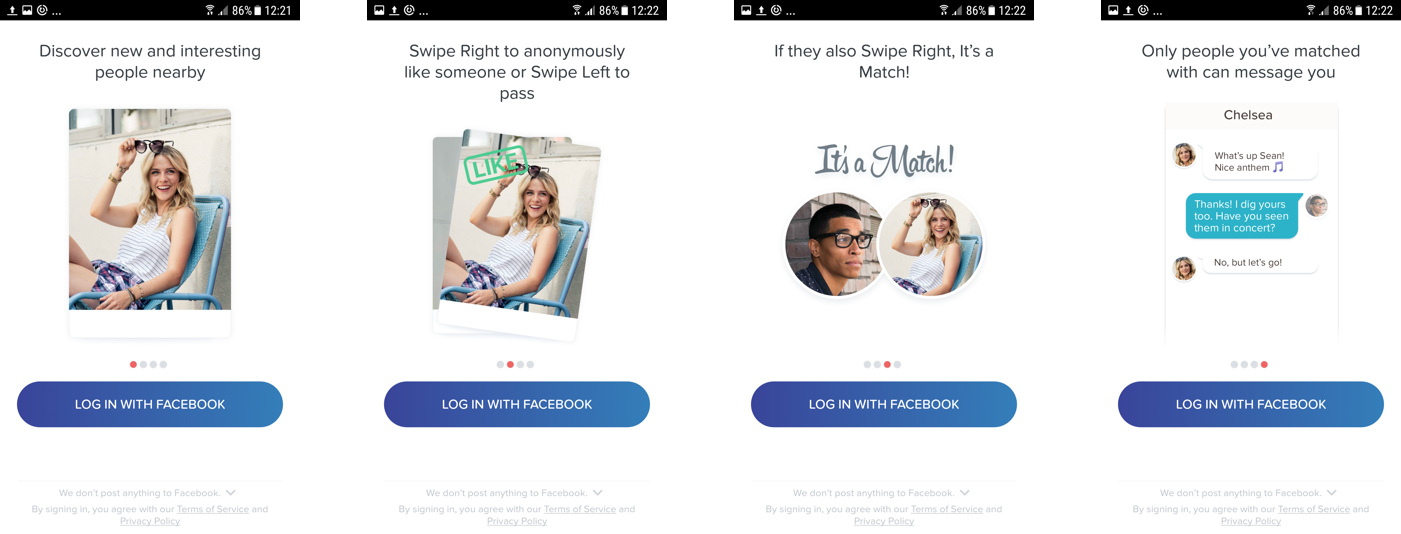
Tinder changed this. Tinder created a gamified experience that resembled how we make snap decisions in real life.
“WE WANT TO CREATE EXPERIENCES THAT EMULATE HUMAN BEHAVIOR. WHAT WE DO ON TINDER IS NO DIFFERENT THAN WHAT WE ALREADY DO.” – SEAN RAD, TINDER CEO
With a simple swipe to either left or right, with left meaning “No” and right meaning “Yes“, a user could express interest or disinterest in potential dates based on a few photos.


Tinder Onboarding | Apptimize

Only when a match is created (when two people swipe right to each other’s profile), would users be able to message each other.

2. Identify and Leverage the Right Network

“If you build it they will come” mentality doesn’t work anymore. No matter how awesome your product is, you still have to find a way to get the word out there.
Like most startups, Tinder faced a similar problem of getting people to use their app. They had a great product but they needed users.
Tinder faced the classic chicken and egg problem two-sided marketplaces face. They needed men and women on the platform to achieve liquidity.
Most importantly, they needed women first to get the guys to use it.
Whitney Wolfe, Tinder’s VP of Marketing at the time came up with a plan to recruit influencers on U.S. college campuses as brand ambassadors. This immediately fueled a network effect spreading the product across multiple campuses through word of mouth.
Soon Tinder downloads were being used as tickets to attend frat parties.
Wolfe also gave presentations about the app on various campuses and got people who attended the presentations to download the app.
As a result, Tinder became very popular among people between the ages of 18-23. To date, this age range makes up 57% of all Tinder users.
In a nutshell, Tinder created a product with an awesome UX experience and introduced it to the right audience who also had the power to promote it.

Snapchat will push content outside its own app

uk.businessinsider.com

evanSnapchat is reportedly looking to publish its content outside its app for the first time with 'Stories Everywhere'

  • Snap is reportedly developing a program called Stories Everywhere that will allow third-party publishers to embed Snapchat content on their websites.
  • Stories Everywhere will be used to accelerate Snapchat's user growth, which has been stalling. 
SnapChat maker Snap is getting ready to take some of its content beyond its app: Snap is developing a new program dubbed Stories Everywhere that will allow third-party publishers to embed Snapchat content on their websites, according to a new Cheddar report.
Snap didn’t immediately respond to a request for comment.
The project is being led by Rahul Chopra, who perviously served as CEO of the social news aggregation service Storyful, as well as global head of video for News Corp. Chopra joined Snap in December, according to his Linkedin profile, which calls him the company’s “head of stories everywhere, content.”
The idea behind Stories Everywhere is to accelerate user growth for Snapchat, which has been stalling. Cheddar’s report likened it to Twitter’s decision to allow the embedding of tweets in third-party websites.
Allowing publishers to embed Snapchat Stories on their websites could potentially also help convince the company’s partners to stick with the format, which has been a bit of a mixed bag for some. Last week, news broke that CNN is axing its daily Snapchat news show “The Update”just four months after its launch because of a lack of monetization opportunities.

Wednesday, 27 December 2017

4 Features to Highlight When Launching Your New Business App

business.com

It's hard to make an app stand out in the crowded market. These are four aspects you'll want to emphasize about yours to make sure users know it's a quality app when you launch it.
If you are preparing to launch your new app into the market soon, you are likely aware of the stiff competition you will face. With over 12 million apps available across the leading online stores, making your program stand out can be a daunting task.
Across the board, developers and users agree that ease of use and intuitive capabilities are the most important features. So, while user experience must be at the top of your priorities list, it is also important to highlight the unique features that make your app appealing.
To attract customers to your new app, you must create a strong and enticing value proposition that encourages them to give it a shot. Here are some of the top features that should play a prominent role in your promotion.

1. Graphics and user experience

Seventy-five percent of mobile app revenue is generated by apps that feature high-quality graphics, making them one of the key factors for success. These apps are set apart by their superior design, strong graphics quality and innovative elements that keep audiences entertained for hours on end. Graphics signal quality to the user. They are what creates a unique visual experience.
Remember, graphics are not limited to the gaming category, though they do play an important role in the success of an entertainment app. No matter what category your app falls into, high-quality graphics will always make it a clear choice against the competition. Ultimately, the graphics are what create the intrinsic feel of your program.

2. Nostalgia

Millennials make up the largest consumer group of mobile app usage, making them the most profitable and sought-after segment in the market. Interestingly enough, if you really want to capture their attention, all you need to do is remind them of the good old days.
Millennials strongly connect with apps that evoke sentiment. This is due to the strong emotional connection they have to the toys they played with and the stories that kept them entertained when they were children. Need proof? There are entire categories of content on BuzzFeed dedicated to the '90s.
Unsurprisingly, businesses have a lot to learn from the entertainment sector here. Connect with your audience by stirring up some nostalgia with throwback storylines and characters. Tapping into nostalgia by bringing back beloved characters and stories from childhood is a great way to get this large market excited about your app.

3. Personalization

Personalizing the UX is one of the best tactics for app design. In fact, 71 percent of consumers have paid more for a brand service that offered more personalized experiences for them.
Take Pandora's music app as a great example. When Pandora introduced its Music Genome Project, it made sure all of its customers knew what a difference personalization could make in the streaming service. The unique technology gave Pandora a strong value proposition as it went head-to-head with competing music streaming services like Spotify and Tidal.
Tell your customers just how your app can be tailored to them specifically, whether it be customizable colors and layouts or curated content based on their preferences. A little personalization can provide a more engaging and authentic UX, which can dramatically improve customer loyalty.

4. Multiplatform capabilities

Making your app compatible with multiple screen sizes and capabilities may take some extra work for your development team, but it's a feature you simply cannot omit. Bock & Company conducted a study to determine which features were most important in mobile app development, and 71 percent of respondents agreed that multiplatform capabilities were extremely valuable to end users.
Emphasize your app's usability across all devices, like Yelp did with its featured blog post announcing its Apple Watch-friendly version. These days, users often switch back and forth between smartphones, tablets and wearable tech. The option to use the same app across multiple devices is a great feature to highlight.
The key to a successful launch is marketing the right way from the start and highlighting the key features. Always keep in mind that the end user is the most important piece of the puzzle for success. Make sure that you clearly explain just why that person needs to give your app a shot. Good luck!