Wednesday, 6 December 2017

Mobile app store spending to jump 30% in 2018

retaildive.com

Brief:

  • Consumer spending among all mobile app stores will rise 30% to more than $110 billion in 2018 from a year earlier, researcher App Annie forecast in a report made available to Mobile Marketer. Games will maintain their dominance in total spending, but spending on other kinds of apps, including retail, is predicted to grow faster due to a shift toward subscription-based revenue models.
  • Mobile platforms will make a greater push into becoming a full-fledged shopping platform instead of a research companion for product information, prices and reviews, App Annie said. U.S. and U.K. consumers spent an hour a month on average in shopping apps this year, and that usage will grow as retailers integrate their mobile apps with in-store experiences.
  • Netflix, Apple, Google, Facebook, Snap Inc. and Disney are among the companies that will drive more fragmentation of the video streaming market to feed a growing demand for content on smartphones, per App Annie. The share of iPhone users who have four or more streaming apps on their phones grew to 31% this year from 25% in October 2016 as consumers seek a wider variety of video content.

Insight:

App Annie’s forecast for 2018 holds nuggets of insights based on the in-app spending and downloads it tracks. The retail industry will increasingly become less segmented between traditional categories of "digital-first" like Amazon and eBay, and "bricks-and-clicks" like Walmart and Target.
One key driver lies in the growth of mobile payments, as Western countries will become more like China, where cashless mobile commerce is becoming increasingly popular in major urban centers, App Annie said. Several tech companies and retailers like Apple and Walmart are ramping up efforts to integrate mobile pay options in the $49 billion market that's faced some difficulty gaining traction among consumers. For shoppers, enhanced mobile apps could lead to people using physical stores as a place to pick up items purchased on smartphones, while cash registers will gradually lose their role in the checkout and payment process as mobile solutions become more prominent.
On the interactive app front, mobile programs that use augmented reality (AR) are set to jump in popularity in the coming year as developers use the new software tools that came out this year that could make the emerging tech more accessible. App Annie saw a surge in iPhone app downloads in the AR category in September after Apple released its latest mobile operating system to support the tech.
Voice-activated digital assistants also will also likely become increasingly popular as more tech companies offer devices to compete with Amazon Echo and Google Home. Apple, Samsung, Alibaba and Baidu are among the companies that seek a greater share of the in-home device market, App Annie said. The most popular applications for the devices will likely be consistent with past uses such as listening to music, web searches and basic tasks that are becoming increasingly more complex and useful for consumers.

Snap's Redesign Isn't Groundbreaking, But A Step In The Right Direction

forbes.com
Image result for snapchat redesign app
Last week, Snap Inc. unveiled a redesigned version of the Snapchat app that offers a simpler user interface, while emphasizing more relevant content as the company looks to drive user growth and engagement. Snap has started to roll out the update to a portion of its users, with a large-scale rollout happening in the coming weeks. The redesign comes at a time when Snap’s quarterly daily user growth has slowed to all-time lows of just 2.9% in Q3, while its ARPU growth in the bread-and-butter North American market has also moderated. Below we take a look at the changes and the impact they could have on Snap’s user base and valuation.
Trefis has a $15 price estimate for Snap, which is slightly ahead of the current market price.

Splitting The Social From The Media, Doubling Down On Algorithmic Feeds
With the redesign, Snapchat will essentially separate social content from its media offerings. While messages and Stories from friends will appear on the left side of the Snap camera screen, content from media publishers (Discover), social media influencers and amateur content curated by Snap will appear to the right of the camera. In previous versions of the app, Snap intertwined Discover content with posts that are shared by friends. With the redesign, Snap is hoping that it will become a more focused app, allowing people to communicate with friends by separating those conversations from other content. Moreover, publishers and influencers will also get a more clearly demarcated platform for their offerings. Separately, Snap is also doubling down on its algorithmic feeds that personalize and highlight the most relevant content for users in both the friends and media tabs. Unlike Facebook, which typically sorts content by its popularity, Snap will curate its timeline based on what each user watches the most. This could be an important change, as Snap previously used a chronological feed for its content, which emphasized the most recent posts.
Redesign Is A Step In The Right Direction
Ultimately, the success of Snap’s redesign will hinge on driving value for advertisers, and we will have to wait to see how things pan out. By separating the social aspect of the application from the Discover section, Snap could impact engagement levels on the more commercial part of the application, as users could use Snap as a core messaging app without exploring its media features. While Snap says that it will still be displaying stories in the Friends section, it’s likely that ad loads will be lower, impacting monetization. This could potentially cause some concern among Snap’s advertisers and investors, who are seeking higher levels of revenue growth. However, Snap’s move towards algorithmic feeds might help to improve user engagement, as Snap could show users Stories and content that they are interested in, which could potentially lead them to use the app more regularly, boosting opportunities for advertising. Overall, we don’t see the redesign as being a breakthrough that will bring in more older users, or mainstream users in international markets, where Facebook’s products are more deeply entrenched. That said, the redesign does appear to be a step in the right direction in terms of making the app more user-friendly and engaging.

Tuesday, 5 December 2017

This Is How Much Marketers Know About You Based on One Facebook Like

motherboard.vice.com

A new study indicates that it’s incredibly easy to target ads based on users’ personality types.


In the wake of the 2016 presidential election, Democrats and pundits shocked by Donald Trump’s victory scrambled to explain how he could have possibly won. Some pointed to Cambridge Analytica, a data analytics firm employed by the Trump campaign that claims to have built extensive personality profiles, with over 5,000 data points, on every American, based on their online habits.
Cambridge Analytica says it uses them for so-called “psychographic targeting,” or crafting political advertisements and marketing campaigns that cater to people’s specific personality types. Some argued the firm’s shady techniques manipulated Americans into voting for Trump.
Exactly what Cambridge Analytica did, and how how much of an impact it had on the election has been debated in the press for the past year. But its tactics are still frightening to people concerned about online privacy, who believed they represent a future in which political campaigns and corporations exploit our unique vulnerabilities for their gain. It turns out, their fears were not unwarranted.
A massive new peer-reviewed study published in the journal Proceedings of the National Academy of Sciences (PNAS) last month indicates that psychographic targeting techniques are incredibly effective, and don’t require much knowledge about marketing to execute.
Psychological persuasion starts by building a profile about you using public information available online, like your tweets, Facebook Likes, or Instagram photos. Previous research shows that people’s psychological characteristics can be accurately predicted from their digital footprints.
The researchers conducted three field experiments that collectively reached 3.5 million individuals on Facebook, Instagram, and Audience Networks, a Facebook service that allows advertisers to reach people on other apps. In each of their experiments, the researchers used a single Facebook like to predict a person’s personality type.
They found that tailoring advertisements to people’s unique psychologies “significantly altered” their behavior, as measured by clicks and purchases. Their findings suggest that psychographic targeting makes it possible to influence the actions of large groups of people. The study demonstrates that we need to start thinking about what kinds of safeguards should be put in place to regulate online advertising
“We need to think about the contexts in which we actually want or do not want to use this technology,” Sandra Matz, an assistant professor at Columbia University's Business School and the lead author of the study told me over the phone. She said it likely won’t be effective to make psychographic targeting illegal outright, but that she hopes online platforms like Facebook regulate its use.
“I don’t think it makes sense to shut down this technology all together,” she said. Matz explained that what she believes would be useful is to prohibit advertisers from exploiting people’s psychologies in certain situations. For example, you shouldn’t be allowed to create an ad that persuades people based on their personality to not vote. In the paper, she also outlines another example: It should be forbidden to target people who have addictive tendencies with gambling ads.
Matz says what’s crucial is presenting Facebook and other social platforms with clear guidelines they can follow, because tech companies already have demonstrated that they have trouble figuring out what's happening on their own sites because they run so many ads.
If we do not restrict the application of psychological targeting, “It will basically take a whole Facebook unit of thousands of employees” to regulate the practice, Matz said. “It’s just not feasible.”
Of course, Facebook is one of the most profitable companies in the world, and if it wanted to focus on regulating psychological marketing techniques, it certainly has the resources to do so. Though it would be a difficult feat, as Matz points out.
Matz stressed simply getting off Facebook or similar platforms won’t exempt you from psychological marketing tactics. “You can make the exact same inferences about people based on their credit card data or smartphone data,” she said.
Here’s how the study was carried out. Facebook doesn’t let advertisers target people directly based on their psychological traits, but it’s fairly easy to work around this. Marketers can target them based on what Pages they like, which can be incredibly illuminative. It’s not hard to deduce, for example, that at least some of the thousands of people who have chosen to like various Facebook pages about alleviating anxiety suffer from it. The study predicted people’s personality traits based on a single like per person—they didn’t even utilize comprehensive digital footprints.
For their first two experiments, the researchers sought to target people based on the traits extraversion and openness to experience. Based on their Facebook likes, they organized people into two groups: those with predicted high levels of each trait, and those with low levels.
So what kind of pages does a extroverted person like? According to the researchers, things like “Making People Laugh,” and the band Slightly Stoopid. Introverts like pages such as “Computers” and the television series Stargate.
In the first experiment, two sets of advertisements for a UK beauty retailer (meant to influence extraverted and introverted women respectively) ran on Facebook for seven days. The ads were seen by over 3.1 million women, attracted over 10,000 clicks, and resulted in nearly 400 purchases. In that experiment, the researchers found that users were about 1.5 times more likely to make a purchase after viewing an ad that matched their personality. Their findings held even after controlling for age.
“The effects are strong,” Matz told me. “But you’re not going to suddenly turn a Hillary voter into a Trump voter. It’s just shifting you in a slight direction.”
In the second experiment, ads were tailored for a crossword app based on a user’s predicted level of openness, meaning how much they like to try new things. That campaign reached over 80,000 users, and resulted in over 1,000 clicks. In that experiment, the researchers too found that targeting a user based on their personality is more effective, even after controlling for age and gender. The study found that users were 1.38 times more likely to click an ad if it was tailored to their personality type.
For the third experiment, the researchers essentially reverse-engineered their technique. They started with a predetermined audience segment designed by marketers for a “bubble app shooter game.” It predictably included users who already played similar games, like FarmVille and Bubble Popp. The researchers analyzed the overall personality type of the users, and found that they were highly introverted.
The study’s authors then promoted the app with a message designed around their personalities, and compared it to what the marketers used before. Previously, the marketers used the phrase “Ready? FIRE! Grab the latest puzzle shooter now! Intense action and brain-bending puzzles!” which is not exactly well-suited to introverts. The researchers instead went with “Phew! Hard day? How about a puzzle to wind down?”
Both campaigns ran on Facebook for seven days, and were seen by over 500,000 users. In all, 1,837 of them downloaded the app. The ad designed for introverts attracted significantly more engagement. Those who saw it were 1.2 and 1.3 times more likely to click (the researchers did the test twice).
Overall, Matz said, what is surprising is not that people respond to advertisements that are crafted based on their personalities. “The assumption was always that people of different personalities would behave differently,” she told me. “This is just the first time we can actually capture that.”
What was surprising was how easy it was to execute. “This technology, it’s feasible with existing advertising platforms. You can actually use something that’s already available and it has an effect,” Matz explained. “Everybody can run Facebook ads. It’s super simple, that’s the whole point.”

The Rise Of Conversational AI

forbes.com

The chatbot craze began in 2016 with Facebook’s announcement of a developer-friendly platform to build chatbots on Facebook messenger. Soon, chatbots were heralded as the next stage of the conversational revolution. Toolkits that helped you build a bot in five minutes grew popular, companies raced to the market with new bot announcements and technology conferences headlined buzzword-driven keynotes about how bots would take over human jobs.
The hype that bots would become the next great thing can be attributed directly to app fatigue. Consumers currently spend most of their time using apps created by Apple, Google and Facebook. However, most smartphone owners don't buy any apps each month. Bots presented a new way for companies to adopt nascent natural language technologies to generate traffic, usage and engagement -- the buzzwords of the app economy. Fueled by free platforms such as Facebook’s Wit.ai acquisition and others, developers and brands alike raced to jump on the post-app-fatigue bandwagon.
Now, less than two years later, 100,000 bots litter the Facebook messenger landscape. While the effort brought focus and media glare, it’s safe to say the chatbot revolution did not go well. As most of these chatbots have been deemed useless, the time has come to separate the wheat from the chaff.
What Is A Chatbot?
Chatbots are primarily natural language text interfaces that are constructed using rules that encourage canned, linear-driven interactions. They are typically easy to build and navigated by pre-defined flows. For example, instead of clicking on a menu of choices or speaking predetermined commands, you can type or talk as if you were having a normal conversation in natural language.
This approach is wearing thin, despite new bots arriving in the marketplace, because it only works well for those conversations with a predefined flow -- such as ordering flowers, finding a yoga teacher or booking a reservation. Attempt to ask a bot complex questions, full of unexpected stops and starts, word choices or implied meanings and suddenly, you find yourself with the bot version of Twitter’s infamous Fail Whale.
These natural, everyday and highly complex conversations require a level of comprehension and cognition that goes far beyond the predefined flow of today’s chatbots.
As chatbots failed to deliver on expectations, the enterprise market in particular has turned toward conversational AI platforms, especially in complex use cases such as banking, insurance and telecommunications.
These platforms offer more than a natural language interface (NLI): they demonstrate true advancements in combining a variety of emerging technologies -- everything from speech synthesis to natural language understanding (NLU) to cognitive and machine learning technologies -- and are capable of replacing humans in a variety of tasks.
These new platforms are so sophisticated that Juniper Research projects advanced chatbots may cut business expenses by as much as $8 billion in the less than five years.
Companies that wish to avoid the chatbot trap should consider the following when assessing their AI strategy:
• Can it talk, text or chat? Conversational AI should be available on voice, text or Web, and it should be ubiquitous and seamless across channels. It can be available through Alexa, Google Assistant or even your company enterprise portal. Truly omnichannel interactions are the future, and they should be a priority for your business.

• Can it learn? A conversational AI solution should be able to use the abundant history available from existing enterprise interactions, including chat and voice transcripts, transactions and other preexisting corpora of enterprise data to learn. What’s more, you need AI that can converse, suggest, recommend and engage based on these learnings.
• Can it understand? Beyond chatbot capabilities, conversational AI should understand complex sentences of human speech in the same way humans do. Real human conversation is never straightforward -- it is full of imperfections consisting of slang, multi-string words, abbreviations, fragments, mispronunciations and a host of other issues. Conversational AI is a form of technology that can be used to both navigate and comprehend these give-and-take interactions.
• Does it know? By integrating into your enterprise systems, conversational AI should know who you are. It can reference the previous transactions made by you and try to fix things. It can then use this history to make current interactions smoother, troubleshoot or solve issues in customer service, IT or invoice processing.
• Can it transact? Conversational AI is secure and can support sophisticated enterprise security considerations. It can be used to complete complex transactions, replacing humans beyond a mere shopping cart click. Examples of transactions that true conversational AI can manage include buying life insurance, processing a healthcare claim, troubleshooting Wi-Fi issues or approving a supplier invoice.
The Future Of Conversational AI Is Enterprise
Despite the bursting of the “consumer chat bubble” in 2017, technology is moving forward with great strides in the enterprise.
Intelligent conversational interfaces are the simplest way for businesses to interact with devices, services, customers, suppliers and employees everywhere. There are lots of companies that provide AI-driven conversational platforms specifically focused on high impact use cases, including IBM's Watson, KAI and my own company, Avaamo.
Intelligent assistants built on these conversational AI platforms can be taught and continue to learn every day. Meaningful applications of conversational AI are already quietly up and running, and as cost benefits continue to pile up, the trend will accelerate in 2018.

Monday, 4 December 2017

E-shoppers embrace smart apps

ecns.cn
A fish-eye view of customers experiencing 'New Retail' hall of Tmall in Hangzhou in October. (Photo by Li Zhong/For China Daily)
Intelligent software helps customize product recommendations and sales
Chinese e-retailers are using artificial intelligence or AI to enhance and redefine the entire shopping experience for the consumer. [Special coverage]
In doing so, they are dispelling the notion that the newage technology is all about driverless cars, futuristic robots and supercomputers such as the Go (that beat human players in a complex board game).
For instance, Tencent Holdings Ltd, known for its killer app WeChat and video game apps, is deploying AI to recommend products and services to users of its mobile wallet WeChat Pay.
Such users win virtual red packets containing real cash for offline purchases, which can be redeemed later in online shopping at partner sites.
According to Ren Yuxin, Tencent's chief operating officer, the company is also empowering partner merchants to personalize their virtual storefronts for individual visitors. The idea is to offer real-time, tailor-made product recommendations based on a variety of factors like age, gender, location and purchasing power.
Tencent has also teamed up with China's second-largest online site JD.com, offering merchants customized content marketing opportunities via WeChat's Moments, an information-sharing function, banking on algorithms that analyze a person's interests, location and purchasing power.
Alibaba Group Holding Ltd, the world's largest e-commerce site by transaction volume, has embedded AI into its digital infrastructure, aiming to provide more precise search results and relevant product recommendations to users, and thus drive sales.
The tech giant has developed a so-called "E-commerce Brain" to understand people's needs and deliver relevant holistic recommendations.
By adopting real-time online data to build models to predict what consumers want, the system generates recommendations for not only products they have shown an interest in but related products and other information.
"Alibaba's Brain can home in on a consumer's predilections for certain products, price ranges, brands, product specifications and other key parameters," said Zhao Binqiang, an algorithm expert at Alibaba who now leads the firm's digital marketing unit.
The software works in tandem with Alibaba's vast social media networks. Algorithms allow the system to determine correlations between content consumption and purchasing behavior.
For example, if a mother has purchased diapers via Alibaba's Taobao site, she is likely to receive maternity and child-care related content from Weitao, a micro-blogging service for brands, or from Taobao Headlines, a sister newsfeed. Via such online destinations, she might receive sponsored content on products such as infant formula or supplements.
Alibaba also introduced an AI-powered electronic assistant or chatbot called Ali Xiaomi (Ali Assistant) to handle up to 95 percent of general inquiries ranging from refunds to complaints.
According to Alibaba, the chatbot, when provided with a text or voice description or even a photo, can even help users find products, returning a list of recommendations that they could filter by brand, color and other characteristics.
A Goldman Sachs report earlier this year said, "Big data, cloud services and the coming of age of machine learning technology should continue to deliver a personalized shopping experience to consumers and targeted marketing solutions to brands and merchants."

Is a Trivia App the Answer to Questions About Live Streaming?

nytimes.com

“We have ambitions to essentially build the future of TV,” said Rus Yusupov, right, with Colin Kroll, his co-founder of HQ Trivia. CreditSasha Maslov for The New York Times
These are heady times for the creators of HQ Trivia.

The app, which broadcasts live shows to iPhones and iPads twice a day, has taken off since its debut in August. Its ability to attract tens of thousands of people to log in for each 15-minute segment in hopes of winning money by answering a dozen trivia questions has some wondering if it has reimagined the TV game show for the cord-cutting era.

And its success with live-streaming video on phones — an area in which Facebook and Twitter have heavily invested, with mixed results — has the technology and media worlds buzzing. It has even weathered its first public relations crisis, after Rus Yusupov, one of HQ Trivia’s founders, tried to quash a profile of the show’s host by The Daily Beast, an embarrassing kerfuffle that nonetheless increased awareness of the app.

“It’s clear that there’s a lot of attention on us now because this thing has blown up overnight practically,” Mr. Yusupov said in an interview. “We have ambitions to essentially build the future of TV, and, yeah — there is a lot of pressure to get everything right all the time, and I admit that I made a mistake.”

Mr. Yusupov and his co-founder, Colin Kroll, both 33, previously founded the six-second video app Vine, which Twitter bought in 2012 and shuttered this year. The two, based in New York, have been working to develop video apps for the past two years with “a few million dollars” in funding from Lightspeed Venture Partners, the first institution to invest in Snapchat. (The firm is also the source of HQ’s daily cash prizes, at least until the company figures out an advertising model.)

HQ emerged from the ashes of a less popular live-streaming video app the men created called Hype, which sought to let users add pictures and music to broadcasts but lost its audience over time. HQ takes its cues from traditional game shows like “Jeopardy!” as well as Twitch, the video streaming site for gamers that Amazon owns.

It’s easy to feel that a strange new future has arrived upon opening the free app for the first time. The game — currently available only on Apple devices, though an Android version is scheduled to arrive around Christmas — features a counter in the corner of the screen that ticks up as people log on to play at 3 p.m. and 9 p.m. Eastern Time on weekdays and 9 p.m. on weekends. (Its highest number of concurrent viewers was 240,000 on Nov. 26. For comparison, the exploding watermelon that BuzzFeed live-streamed on Facebook last year reached just over 800,000 concurrent viewers at its peak.)

The show, which can be glitchy, is typically hosted by an energetic comedian, Scott Rogowsky, who cracks jokes as he asks a dozen multiple-choice questions of increasing difficulty. Players use their touch screens to respond in less than 10 seconds, and the app shows how many people are eliminated after each round. Players can also share their reactions via a rapid-fire chat function at the bottom of the screen.

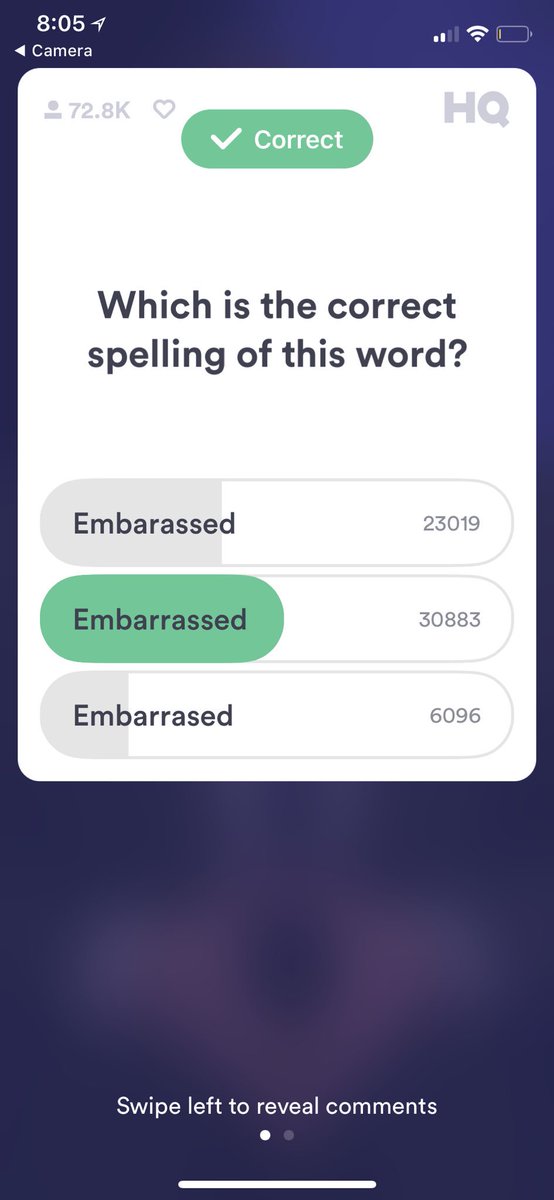
It can make one cringe to see what questions lead to a “savage” (translation: major) elimination of players. For example, at least 20,000 people were unable to identify the correct spelling of “embarrassed.” But the app tests a range of knowledge: Carson Daly, the former MTV host, posted on Instagram that he was excited to be an option for “Who co-hosted the first season of American Idol with Ryan Seacrest in 2002?”

Early questions tend to be on the easier side, like: “Which president is featured on the U.S. one dollar bill?” Those who answer all the questions correctly share in a prize that has fluctuated between hundreds and thousands of dollars and is distributed via PayPal.

Over reliance on spell check slayed almost half the players at @hqtrivia tonight.  
Mr. Kroll, a Twitch fan, said that much of what people knew as live video from apps like Twitter’s Periscope lacked a sense of urgency and participation.

“There’s a point-of-view live, where you’re experiencing something through someone else’s phone, and then there’s this idea of interactive video, where the audience is actually a key component of driving the content,” he said. “I became really interested in the latter and saw there was a real absence in the market of that sort of experience.”

It’s of note that for all the investment Silicon Valley has made into live video — a bid for the billions of ad dollars that remain locked in TV — HQ is a New York product. Mr. Yusupov said HQ could “only be built in New York or L.A.,” because the inspiration comes from Hollywood-style production values, not software. (Their start-up is called Intermedia Labs in a nod to interactivity and media.)

“We schedule our lives, but the apps on our phones have been designed to make content available anytime, anywhere,” Mr. Yusupov said. “We suffer from the paradox of choice ultimately — you search Netflix for 20 minutes and end up watching nothing.”

Mr. Kroll added that HQ’s schedule was inspiring people to play with co-workers in the afternoon and again with family and friends in the evening, making it more akin to a broadcast TV program.

“It’s a little bit trite to say, but things grow because they’re fun,” said Jeremy Liew, a partner at Lightspeed Venture Partners. “This is way more fun than playing a quiz game on your phone and way more fun than watching ‘Jeopardy!’ on TV.”

Still, whether HQ can turn its sudden popularity into a long-term business is an open question. Could it ultimately serve as a blueprint for bigger tech companies that have been looking for ways to drum up interest in live video content? Mr. Kroll and Mr. Yusupov were hesitant to share details around how they produce the show and what, if any, parts of HQ could be patented. They also declined to disclose the number of people they employ.

Such guardedness is perhaps understandable in a landscape where companies like Facebook are quick to replicate good ideas from competitors on a massive scale. (See, for example, Instagram Stories.) But the lack of transparency caused some trouble for HQ recently, when Mr. Yusupov told The Daily Beast that it was “completely unauthorized” to write a profile of Mr. Rogowsky, even threatening to fire the host if the article was published.

“I learned what I do know, and that’s apps and engineers and designers, and I learned what I don’t know, which is how to work with talent and celebrities,” Mr. Yusupov said. He added that the company had since hired a public relations representative and a person to manage talent.

The men said that HQ had been approached by a bevy of ad agencies and chief marketing officers but that they were still determining how sponsorships could be worked into the app. Mr. Yusupov said brands could potentially fund the prizes, adding that a goal was offering a $1 million prize.

Mr. Liew said he was confident in the start-up and its eventual business plan even as he expected other companies to mimic what HQ Trivia had done.


“You have to let time talk and figure out how people are interacting and using something before you have clarity with a business model,” he said. More important, he added, “if you can become part of popular culture, you can figure out a way to make money.”

Friday, 1 December 2017

Digital experience management: The next phase of WCM

searchcontentmanagement.techtarget.co
Static content is a thing of the past. It's no longer about just managing content, expert Geoffrey Bock explains. Organizations need to be ready to manage digital experiences.
Image result for Digital experience management: The next phase of WCM
It's not enough to publish content anymore and let it sit in a content management system for end users to read. Content must now form an experience that drives actions.
With the continuous evolution of the web, the shift from web content management (WCM) to digital experience management boils down to one critical factor: Rather than just being published and available, content becomes useful and actionable.
WCM begins as a publishing environment and steadily adds interactive capabilities. Digital experience management delivers content-enabled applications for performing targeted tasks. This is a critical transformation that has wide-ranging implications.

A digital experience in action

Let's highlight the transition from WCM platforms to digital experience management with a hypothetical example that Acquia used in a series of presentations at its October Engage user conference in Boston.
In the desktop days, a cook planning a dinner party would have to gather recipes, create a grocery list and write it all down on paper. In a digital experience management implementation, actionable data -- perhaps even fished from a data lake using artificial intelligence -- would find recipes based on a voice request, generate a shopping list from the recipes and store it on a mobile app.
Automatically, the list arranges itself, so each ingredient appears in order of placement in the store, because it's hashed against the store's floor plan.
Finding even the most specialized products is simple -- intelligence baked into the app combines with in-store Wi-Fi beacons to pinpoint the right shelves. Concerned about the ingredients of a packaged good? Scanning the product immediately produces detailed health and nutritional descriptions, as well as product reviews, as an integral part of the shopping experience. And perhaps a coupon or two may pop up in the app, as different brands jockey for the cook's dollar.
Back in the kitchen, the app repurposes the same content into the cooking experience, with step-by-step instructions displayed on the screen, followed by spoken text. Need to understand a new technique? A video snippet is immediately available. And, of course, the cook can navigate the recipe by voice response. No need to tap a screen with sticky fingers.

Bringing experiences to life

Far-fetched? Hardly. These kinds of digital experiences are just around the corner, enabled by blending interactive application designs with new ways for making content useful. Certainly, location-aware and voice-response apps are at the cutting edge, spawned by the creativity of development teams together with new software technologies from Apple, Google, Amazon and multiple open source communities.
But notice the essential role for content -- how the right content delivered in the right context brings an experience to life. In fact, a digital experience requires snackable content that is intelligently assembled to support a targeted task.
A digital experience requires snackable content that is intelligently assembled to support a targeted task.
And the device revolution continues, leading to an exponential rise in the volume and velocity of snackable content. Not surprisingly, this content must be managed.
Fortunately, there are options. Third-generation WCM platforms separate content production from content distribution -- what's required to create, edit, organize and store content within a system of record, from what's needed to deliver content to PCs, mobile devices, kiosks, augmented reality displays, smart speakers and other types of digitally powered endpoints.
It is now time to capitalize on the decoupling of WCM platforms while using their content-modeling capabilities, defined by their underlying information architectures. Established players and new entrants alike are evolving their WCM platforms into content hubs to power digital experiences.
The race is on to rapidly build content-centric business applications that produce digital experiences. Rightly deployed WCM will be an essential aspect of digital experience management. Needed is a single source of truth for content, managed centrally and systematically, which then supports all kinds of delivery environments. To produce relevant and useful digital experiences, content hubs are going to be the way forward.

Acquia's open source digital experience management

Many major corporations and government agencies rely on the Acquia Platform, an extensive set of cloud-based deployment and support services, to run a commercially supported, open source Drupal instance for mission-critical business activities.
Drupal 8, the latest version of the platform, includes an extensive set of RESTful APIs, and it can be deployed as a content hub and enable facets of digital experience management.
Acquia already produces a personalization engine, Acquia Lift, which dynamically delivers content based on predefined customer segments and business rules. The firm is rolling out two additional product initiatives that will further reinforce its digital experience management capabilities:
  • Acquia Journey, an interactive experience design environment that enables designers to chart the content flows, decision points and actions to support discrete tasks and thus produce engaging digital experiences; and
  • Acquia Digital Asset Manager, which supports the single source of truth for maintaining rich media assets, including still images, full motion videos and sounds.
Moreover, Acquia is enhancing its application development capabilities by adding Acquia Platform support for Node.js, a popular open source JavaScript runtime technology. Application developers are going to be able to develop applications with multiple endpoints and rely on the same set of platform services as Drupal. Content production will be closely coupled with application development to produce ambitious digital experiences.
Acquia customers at Engage discussed how they used the platform to create digital experiences:
  • NBC Sports manages international sporting events, such as the Olympics, with Drupal running on the Acquia Platform in order to report scores and related news about the events.
  • The Metropolitan Transit Authority in New York City relies on Drupal and the Acquia Platform to manage time-sensitive information for riders across websites, mobile devices and many in-station displays.
  • Princess Cruises is deploying Drupal to support end-to-end digital experiences for its cruise customers, tracking their interests and needs and ensuring on-ship staff members have the right information readily at hand.
  • The state of Georgia uses Drupal as the content store to support an innovative voice-response application for Alexa.
These examples highlight how Drupal makes content actionable for a wide range of customer-centric applications.

Planning your own digital experience management initiative

Here is the secret sauce for developing ambitious digital experiences:
  • Be sure to get your content house in order. Define the content model upfront. Continue to extend and adapt it in light of ever-changing customer and business requirements.
  • Rely on the flexibility and extensibility of WCM platforms to manage the metadata for tagging content as part of the digital experience.
  • Focus on the capabilities of a content hub to create, edit, organize and store information.
  • Be prepared for omnichannel content delivery.
Remember, great experiences are in the eyes of the beholders. Delivering the useful content for achieving these experiences remains both the challenge and the opportunity.