Friday, 27 October 2017

How chat and voice-related tech is changing retailer-customer interactions

retaildive.com
New chat channels are emerging as a real-time alternative to email, along other technologies, but a comprehensive view matters most.

Image result for chat and voice-related tech
There is no shortage of companies, white papers, studies and advice blogs aimed at helping retailers write perfect emails to their customers before and after they visit stores (Google "email marketing" if you don’t believe us.)
Yet email isn’t the only avenue available to companies trying to communicate with customers outside of stores. Retailers and brands now have more online and mobile communications tools at their disposal than ever before — mobile messaging; text, voice and video chat; and even website and in-app content and community forums. These tools enable more direct, real-time communication with customers than email could ever hope to offer.
"There are various factors driving this trend," Adam Pressman, principal in A.T. Kearney’s digital transformation practice told Retail Dive in an email. "Timeliness, scale and costs/value are all in play. Also, with e-commerce continuing to grow, it’s now necessary to support interactions outside of the store in order to succeed. It’s no longer a nice-to-have capability."
"Retailers definitely need to be mindful of the balance between being helpful and being annoying. They should never push information on customers."

Adam Pressman
Principal, Digital Transformation, A.T. Kearney
As retailers sort through new options, at least one long-standing rule about customer engagement still applies, according to Pressman. "Retailers definitely need to be mindful of the balance between being helpful and being annoying," he said. "They should never push information on customers."
It’s a rule that retailers may feel tempted to break as they try to beat the competition, win customer loyalty and unify their offline, online and mobile engagement efforts.
"Retailers need to think about the before, during and after of purchases and tailor their communications and interactions accordingly," he said. "Combining context and content can create a very powerful understanding of behavior and the ability to shape the interaction. 

Opening the chat channel

Mobile messaging and chat applications are not new tools for retailers, but increasingly look like the best way for immediate, direct contact between consumers and retailers. Automated chatbots running off mobile messaging platforms are another mobile-first avenue for consumers to engage with their favorite brands.
Retailers such as Sephora have gamely explored their potential, offering a variety of capabilities through chatbots on Facebook, Kik and elsewhere, and Facebook Messenger has promoted itself aggressively as a home for chatbots.
The first generation of these bots were somewhat limited in what they could, but now artificial intelligence is being used to create the next generation of chatbots, capable of learning from customer interactions and switching to live human helpers at the moment a customer need to do so.
However another evolution in chat communication between retailers and customers already may be upon us. In June, Apple announced plans for Apple Business Chat, a dedicated chat service for customers to communicate with the staff of businesses, including retailers, for the types of customer service exchanges that otherwise would take place by phone or email.

Thursday, 26 October 2017

McDonald's readies marketing push for mobile ordering

mobilemarketer.com

Brief:

  • McDonald's, the biggest U.S. burger chain with more than 14,000 U.S. restaurants, is preparing to enhance marketing efforts for its mobile pay and ordering, Marketing Week reported. The company has spent this year working out kinks in its mobile platforms and setting the stage for a larger push next year.
  • The company offered mobile order-and-pay in more than 6,000 restaurants by the end of September and expects to reach all 14,000 restaurants by the end of 2017, according to its Q3 earnings report.
  • McDonald's said about 30 million people have downloaded its mobile app, while nine million actively use it. Same-store sales grew 4.1% in Q3 2017 from a year earlier, as total revenue reached $5.8 billion.  

Insight:

McDonald's is in the midst of a significant push to upgrade its in-store and online use of digital and mobile technology, as it addresses the need for updated digital experiences to appeal to today's tech-savvy consumers, especially millennials who generally like to eat out or order in — but often not with fast food chains, according to data from the USDA via Forbes.
This emphasis on mobile presents several challenges, the company acknowledged in its conference call with investors on Oct. 24
"We're really at this point focused on getting the operations right," said Chris Kempczinski, McDonald's U.S. president. "Getting, for example, the crew to understand when a curbside order comes up, how do they take that order, how do they go out and bring the food to the customer. We're spending a lot of time on mobile order and pay.
As the chain is starting to get a handle on these challenges, it is planning to ramp up marketing behind mobile ordering. Doing so any sooner could have turned off customers if, when they arrived to pick up their order, they had to wait. Chains like Starbucks and Chipotle have similarly had to manage behind-the-counter operational changes demanded by the introduction of mobile ordering. 
"What will happen then in 2018 is we're going to flip the marketing switch on it and start to drive really much more increased usage," he added. 
In the past few years, the fast food giant has begun to embrace new technology to reach the next generation of consumers, including digital ordering kiosks and delivery options. It partnered with ride-hailing company Uber earlier this year for UberEats delivery to address consumers' shifting preferences toward convenience. Customers can now request food on a smartphone without ever leaving their home.
As the company realigns its operations to respond to mobile capabilities, it plans to drive orders and store visits with fresh digital offers. "We are increasingly driving traffic and check growth with digital offers," CEO Steve Easterbrook said in the call. "Retention of mobile offers continues to grow month-on-month, with a meaningful portion of the redemptions representing incremental visits."
Despite its efforts to emphasize mobile engagement, McDonald's saw its biggest mobile misstep in July when its app crashed during a free ice cream offer to celebrate National Ice Cream Day, causing customers to take to social media to air their frustrations.

AMAZON INTRODUCES APPSTORE MOBILE APP WITH A FOCUS ON COINS

mobilemarketingmagazine.com
Amazon Appstore
Amazon has launched a standalone Appstore mobile app, bringing the apps and games from Fire TV and Fire tablets to smartphones.
The Amazon Appstore is exclusive to Android devices. It features an overhauled user interface, with a navigation bar located at the bottom of the app, as well as an increased focus on Amazon’s virtual currency, Amazon Coins.
Amazon Coins, which were introduced in 2013, have got their own dedicated tab within the app and customers can now purchase coins from anywhere within the app.
With Amazon Coins, customers can buy apps, games, and in-app items from the Appstore ‘for less’. Coins can be purchased from Amazon, or acquired for free as rewards in games. Those who bulk-buy coins receive larger discounts on the price of virtual currency. Either way, however customers acquire coins, developers will still earn 70 per cent royalty on purchases.
For Appstore developers that have already selected to distribute their apps on ‘All other Android devices’, their apps will automatically become available to customers on the mobile app. If not, this can be toggled via the developer portal.
In addition to the new Amazon Appstore, the eCommerce giant has also introduced a new Kindle app with updated look, one-tap access, and improved search bar.

Wednesday, 25 October 2017

Google Play and App Store downloads and spending hit record levels

gamasutra.com
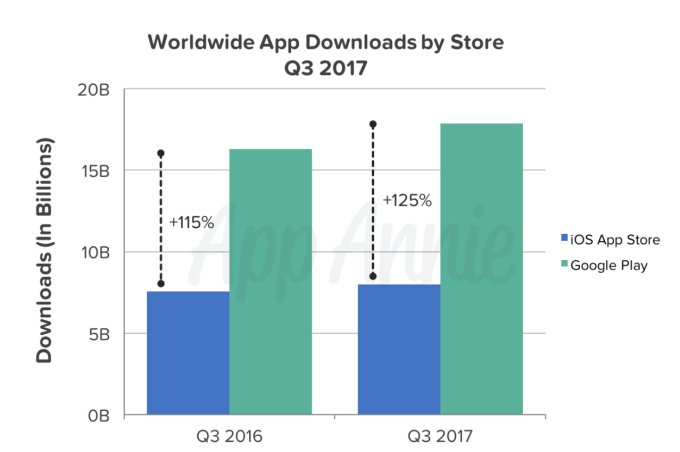
The mobile app economy shows no signs of slowing, with Google Play and the App Store both seeing record levels of downloads and consumer spending during the third quarter of 2017. 
According to a new report from App Annie, the two stores pulled in combined downloads of nearly 26 billion worldwide -- a year-over-year increase of 8 percent. 
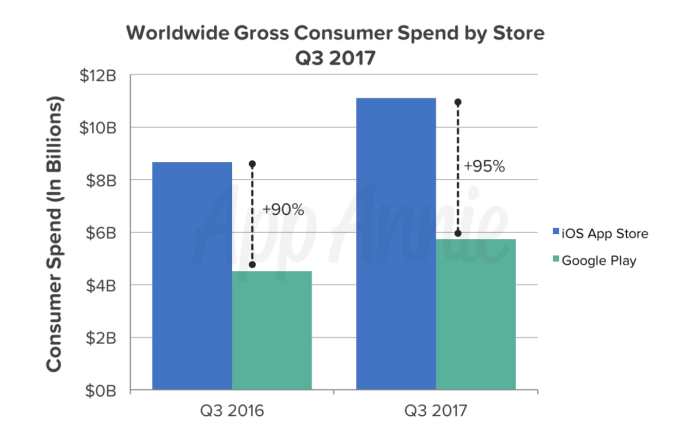
Combined worldwide consumer spending increased even more, leaping up by 28 percent year-over-year to $17 billion. 
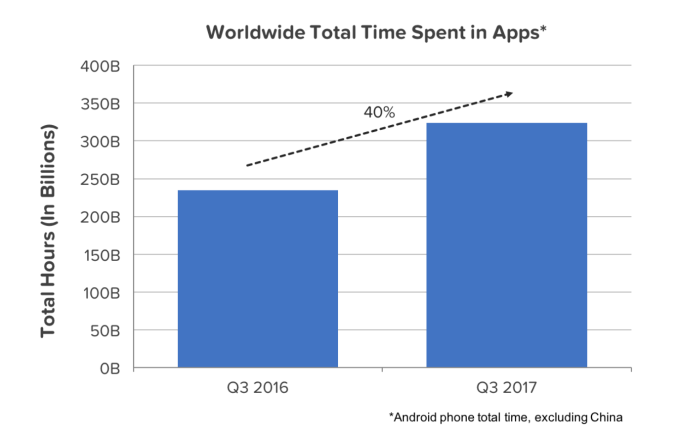
More people are actually spending time using apps as well, with app usage among Android phone users growing by 40 percent to 325 billion hours. 
As was the case in previous quarters, Google Play maintained a healthy lead over iOS in terms of worldwide downloads, and actually widened its lead by 10 percent. 
That growth was largely driven by emerging markets, and particularly the influx of first-time smartphone owners in those regions.
India, for instance, was the biggest contributor to download growth by a large margin, and has been the largest market for Google Play downloads since Q4 2016.
On the other side of the coin, worldwide consumer spending on iOS was nearly double that of Google Play, and Apple's marketplace increased it's lead compared to Q3 2016. Both stores, however, reached record levels as growth rates exceeded 25 percent.
The graphs below illusturate how both storefronts are faring in terms of consumer spending and downloads. For more information, you can grab the full report from App Annie.

Tuesday, 24 October 2017

Global app revenue and downloads hit record levels in Q3

techcrunch.com

App downloads and revenue hit record levels in the third quarter of 2017, according to a new report out this morning from App Annie. Downloads across the two major app stores, Apple’s App Store and Google Play, reached nearly 26 billion worldwide – up 8 percent over the same time last year. That figure doesn’t include reinstalls or app updates, only new downloads. In other words, it paints a picture of the app economy’s true growth, rather than including downloads from people who were just grabbing a new version of an existing app, or re-downloading an app they had previously installed.
In addition, app revenue reached a record of nearly $17 billion, App Annie said.
Much of the download growth is coming from emerging markets where smartphone penetration is still relatively low. That means we’ll likely see continued increases in worldwide downloads for some time.
In particular, App Annie found that the download growth on Google Play was heavily fueled by emerging markets, with the biggest contributor being India. In that country, downloads nearly doubled from Q3 2016 to Q3 2017.
Other Southeast Asian nations, and particularly Vietnam and Indonesia, contributed to Google Play growth, too. Both countries saw double-digit growth rates year-over-year, with Indonesia in 4th place, and Vietnam moving into 7th.
Overall, Google Play led iOS in worldwide downloads, having grown downloads by 10 percent since last year.
Meanwhile, iOS download growth was up 8 percent from last quarter – its highest quarter over quarter growth rate since Q1 2016. This is largely attributable to China, which saw the highest quarter over quarter market share growth, followed by the U.S. and Saudi Arabia.
Alongside the increase in downloads, consumer spend is also still growing. In the third quarter, revenue from iOS apps and those on Google Play combined reached nearly $17 billion, up 28 percent over the year prior.
In this case, it’s iOS that’s leading the app revenue growth. In Q3 2017, consumer spend on iOS was almost double that of Google Play. But both stores reached record levels of consumer spend, thanks to year over year growth rates over 25 percent.
China, again, is a major factor. It was the largest market overall for consumer spend and saw the highest year over year growth in absolute spend. South Korea – now at its highest ranking ever as 4th overall in consumer spend – saw the second highest market share growth.
App Annie attributed a lot of South Korea’s performance across iOS and Android to NCSOFT’s game, Lineage M, which became the highest grossing app on both platforms in the quarter.
Entertainment apps, and particularly video streaming apps, also had a strong showing in Q3, with worldwide consumer spend in the category up by 30 percent quarter over quarter on iOS, and up 45 percent on Google Play.
On iOS. Tencent Video grew the most, followed by Youku and Starz. And on Google Play, HBO NOW had the highest share change, followed by Netflix and Starz.
Apps are also continuing to capture more of consumers’ time and attention, with the total time spent using apps grew 40 percent year over year to reach almost 325 billion hours in the quarter, App Annie found. (This figure comes from measurements on Android phones only and excludes China, meaning it’s not fully representative. But it does give you an idea of the growth trend.)
App Annie’s current forecast estimates that worldwide downloads will reach nearly 240 billion and consumer spend will top $100 billion by 2021.

Monday, 23 October 2017

Snap is turning to programmatic ads for Snapchat shows

digiday.com

Image result for snapchat
Snap has told Snapchat shows partners that it plans to bring in more programmatic ads after struggling to fill space inside the programming.
According to three sources, including two media executives who have aired shows on Snapchat Discover and one ad buyer who has knowledge of Snap’s plans, Snap plans to inject more programmatic ads within Snapchat shows. Advertisers can already buy Snap Ads programmatically through the company’s ad manager, which gives advertisers the option to run ads inside Snapchat shows. However, during the first round of Snapchat shows, Snap was hesitant to run ads bought in the auction, according to the two media executives. This “depressed revenue dramatically,” said one source, which has led Snap to promise to open up the programmatic doors even more.
Currently, advertisers can make programmatic buys on Snap Ads — 10-second vertical video units — across the app’s public user stories, Snapchat-curated live stories and Discover publisher channels and Snapchat shows. Advertisers can make make these buys through Snap’s ads application programming interface partners such as 4C, Kenshoo and Videology. Advertisers can also use Snap’s self-serve platform, which the company launched in the summer.
For Snapchat shows, Snap has mostly sold the inventory directly. In some cases, Snap has worked with major media giants, including NBCUniversal and Viacom, to co-sell advertising within shows produced by those companies.
So far, these efforts have yielded mixed results. For instance, a review of the six shows available on Snapchat on the afternoon of Oct. 20 found that three of the six shows — CNN’s “The Update,” NBA’s “Versus” and E! News’ “The Rundown” — featured no commercials. Of the three shows that did — NBC’s “Stay Tuned,” Barstool Sports’ “5th Year” and B17 Entertainment’s “Nail the Look” — sponsors included Wendy’s, TD Bank and Tresemmé.
A new show from E!, “Face Forward,” premiered on Oct. 21 with Abercrombie & Fitch as a sponsor. (It’s E!’s third show on Snapchat, following “The Rundown” and “Ask Kylie.”)
Snapchat shows typically have three to four ad breaks within each episode.
One Snapchat shows partner said Snap, which was responsible for selling advertising within its program, had a difficult time filling inventory. The show was popular, too, with total views far exceeding 50 million, he said. This executive said Snap struggled to fill ad inventory because of two reasons: inexperience with selling this type of content and a lack of data to show advertisers how successful the program was. For the second season of the show, the media partner is taking the lead on selling advertising, with Snap promising to use programmatic ads to fill any remaining space.
“I can go to Pepsi and sell them on adding $500,000 [for the Snapchat show] on top of an existing buy,” this executive said. “That $500,000 isn’t a lot for Pepsi, but it is a lot for Snapchat.”
When reached for comment, a Snap spokesperson did not provide additional details on Snap’s plans for programmatic advertising within Snapchat shows.
One of the issues media companies face in producing shows for Snapchat is that Snap is not fronting them any cash to make the content. The media partner is responsible for funding the show, after which they can make their money back through advertising — with Snap taking a 50 percent cut of all ad revenue.
That could be easier to justify to some of the bigger media companies, which can treat Snapchat as a marketing experiment, but might be a tougher for digital publishers that don’t have the same level of resources as an NBC, Turner or Viacom. But even one TV network executive said their network won’t make more shows for Snapchat if it “can’t make any money.”
Getting more revenue from Snapchat shows is a growing priority for Snap, which is also searching for a headof brand integration who can sell brand and product placements inside the programming.
One issue has been pricing. As Digiday previously reported, Snapchat has high price tags for series sponsorships. A second ad buyer told Digiday the price for a 33 percent share of voice on one show was $350,000. The price then dropped to less than $200,000 for a sponsorship of just one episode.
Like with Snap’s other advertising products, the company is struggling to find the sweet spot for pricing its premium products, especially considering how cheap the media can be in the auction, ad buyers said.

“It’s inevitable that they open up programmatic,” said the first ad buyer. “The shows don’t have enough scale to begin with. Programmatic definitely makes Snapchat a buy that advertisers can just plug in for their existing campaigns.”

Saturday, 21 October 2017

20 Data-Driven Tips for Improving Ecommerce Conversion Rates

redstagfulfillment.com
In 2016, eCommerce represented 41 percent of all retail sales growth, with eCommerce sales totaling $394 billion. You may be surprised after hearing these numbers to find eCommerce still represents less than 9 percent of total retail sales, according to the U.S. Department of Commerce. You may be even more surprised when you learn the average eCommerce site’s conversion rate is below 5 percent.
As billions of people around the globe enter the eCommerce marketplace, these numbers will likely rise precipitously. The environment for conducting business online is a highly distributed and competitive arena where consumers have a nearly bottomless sea of choices. Some of the challenges eCommerce companies face today are almost identical to their brick and mortar predecessors. One common problem is converting a window shopper into a customer.
Even in-store shoppers are comparing prices online before purchasing. In fact, 72 percent of shoppers perform research online before traveling to a location, and nearly two-thirds report checking prices on their phone while in the store. These are moments when your eCommerce store could win the sale, and convert your competitor’s potential customer into your customer.
Average conversion rates across the entire eCommerce landscape are between 1 and 4 percent. When improving conversion rates by even a percentage point is an accomplishment, these data-backed, actionable tips can impact your bottom line.
There are many touch points in the life cycle of a site visitor that can impact their decision to make a purchase. Something as trivial as the lighting in product photography to as intricate as the fulfillment policy can influence someone to either add to car or abandon your site altogether. Improved conversion rates can place stress on your operations, it is important to have inventory management, fulfillment logistics, and delivery speeds optimized.