Tuesday, 5 September 2017

A complete guide to minimising the size of Android and iOS apps

itproportal.com

It is no coincidence that two of the most popular apps- Facebook and YouTube also offer a “lite” version of their app beside the regular one.


In an ideal world, if you were the sole provider of any service through app and the users had unlimited resources on their devices, there would be no question of optimisation and terms like ‘agility’ and even ‘user experience’ would be redundant. But as you might know, the current state of app industry is anything but ideal. There are dozens of apps competing for even the simplest of services and no matter how premium device a user has, there is always a limit to the number of apps it can operate smoothly. The worst part, however, is scenario where after spending considerable amount of time, money and resources into developing and marketing an app, the users perceive it to be bulky and either never install it or uninstall after they find the memory it consumes is disproportionate to the value it brings.
And be it iOS app development or Android app development services, this is one problem where both stand on the same page. For that reason, it is no coincidence that two of the most popular apps- Facebook and YouTube also offer a “lite” version of their app beside the regular one. If you are in iOS or Android app development business, you would realise that the problem isn’t just about those hesitant users, but keeping up the performance and even maintenance of large apps is exponentially tougher than small ones. So, let’s take a look at some of the tools & techniques using which the size of these apps can be reduced.

For iOS app development
App Thinning Tools
Apple offers a host of tools at both levels- store and OS, to help an app minimise its size, leverage device features and accommodate to future updates. The two most useful of such tools are:
Slicing- It enables the developers to upload a single full version of their app to the store, which then is converted into different variants and is distributed accordingly to the device.
On-Demand resources- Instead of packing everything in the initial app, it is much better to simply offer a basic version upon which the users can get only those content that they actually want. For example, if you have an app for magazine, instead of giving them the full version, offer them the option to download each section separately. 
Media Optimisation
Though media like image, audio, videos, etc are what drive user engagement, they are also responsible for shooting up the size of any app. Simple tasks like using proper resolution and formatting can help developers cut-short the size without compromising on the content quality. For instance, developers can choose to use PNG formats for displaying images, which not only consumes lesser memory, but also generates quality on par with more popular formats like JPEG.
Memory Allocation Manager
Unlike garbage collection in Java, iOS development never had a efficient memory management technique. Even with Automatic Reference Counting (ARC) that it does have, there are certain issues and lapses that keep happening over time. From simple issues like over caching to more complex ones like retain cycles, there are a host of problems that if paid proper attention, can not only resolve a lot of bugs, but also free up a lot of memory. 
Scanning IPA Files
.ipa files are the ones that stores the iOS app along with the binaries of ARM architecture upon which the operating system is based. These data in these files are continuously updated and when they get old enough, there can be plenty of irreverent data and outdated items which you easily delete after scanning.

For Android app development
Resource Shrinking Tools
Resource shrinking can be availed from the Android plugin for Gradle, which removes unused resources from the packaged app, including those in the code libraries. Also, since it works in conjunction with code shrinking tools, the moment you eliminate some part of code, the resources corresponding to it are also eliminated.
Image Compressor
As discussed for iOS, images are a crucial part of Android apps as well and since majority of the content in modern apps are image based, compressing them to consume less memory is perhaps the simplest of step you can take to reduce the app size. Also, reducing the size of images will also make them load faster, thus contributing to better user experience.
Code Shrinking Tools
Code shrinking is available with ProGuard, which detects and removes unused classes, fields, methods, and attributes from the packaged app, including those from included code libraries. It also optimises the bytecode, removes unused code instructions, and obfuscates the remaining classes, fields, and methods with short names, that is known to drastically reduce the size of the .apk file and even aid in its security by some degree.
Architecture Reduction
Creating am elegant app is no less than a work of art. While two mobile applications may perform similar tasks, the underlying architecture is what actually determines the size and consequently their performance. A clean architecture is one where different layers of the software align similar to that in an onion, with progressive dependencies pointing inwards. When compared to common architectures where the dependencies and connections between different components appear more like a mesh, this model drastically reduces the size and makes further improvements a breeze.

For both
Static Code Analyser
There are a number of static code analysing tools available for both iOS and Android development which when deployed can quickly detect any unused functions, variable, logic flaws, etc., and thus reduce the overall size.
Code Recycling
Creating an app is not a one-time feat but more like a continuous process. If you wish you app to preserve its compact size and performance, you should consider recycling the code every chance you get. Also, every time you update an app, there are bound be some sections of code that lose relevance, which you must promptly remove to keep the size from escalating. 

Final thoughts

While there are no debates over the efficiency and higher adoption of apps with smaller size, the procedures to achieve that goal requires sophisticated tools and expertise that only those companies with ample experience in both iOS app development and Android app development can bring.

Decoding The Future Of Mobile App Economy

cxotoday.com
app
Thanks to the unprecedented sales of smartphones, and a remarkable improvement in internet speeds, the use of Mobile Apps has become almost pandemic. And it isn’t just the gaming and entertainment based apps that are being welcomed by the masses but also apps that are dedicated to news, business and shopping, and also those that are intended to ease the act of travelling, banking and other such services. Today, if come to speak of the Mobile App economy, we are practically talking about the entire world - with the developers, providers, and users, all included.
The Numbers: As far as speculations are concerned, it can be easily deduced that the present day Mobile App economy will almost double itself by 2020. While the gross revenues from the economy clocked at about $41 billion in the year 2016, they are expected to spike to a whopping $101 billion in 2020. Hence, it doesn’t come as a surprise that right from your street side fast food vendor to centralised banks are all allocating a dedicated budget to app marketing strategy.
Internet of Things: Not only will the increased penetration of smartphones will contribute to this booming economy, but the much-coveted Internet of Things, or IoT as we know it, will also have an important role to play. How? Well, it is believed that as many as 20 billion devices will be web-connected by the year 2020, and if we go by the speculations of certain analysts, this figure may well touch a staggering 100 billion. Whatever the figure might turn out to be, one thing is for sure, it is too massive to be ignored or taken lightly. In fact, for what it’s worth, it will prove to be a complete game changer.
Beacon Technology: With the revenues from apps expected to grow by manifolds, the inclination towards introducing new apps with novel ideas seem only justified. This unparalleled boost in the app market can also be attributed to the improvement in the location-based beacon technology, especially in the healthcare and retail space. Thanks to the increased vitality of personalisation, this technology’s attempt at bridging the gap between on-ground and online experience is witnessing astounding success. The technology helps the app users to rely on real-time data such as average time spent by a customer, footfall, etc. thus acting not just as a promotional but also an engagement tool.
Downloads: Now coming to the number of downloads.  If we were to go by expert opinion, app downloads by the year 2020 are believed to be in excess of 280 billion. If that’s true, it will not come as surprise, that the developing economies of China and India will be the front runners, thanks to their extensive share in world population. As a matter of fact, India alone is expected to contribute to at least 20 billion downloads by 2020, thus emerging as the 4th strongest Mobile App economy, next only to China, US, and Brazil. With the nation’s 25% Android users, using at least one cab service app, the future of apps offering commonplace services like travel, food, and beverage, and banking is rather bright. For what it’s worth, even health care services including medical supplies, pathology centres, and even emergency services, are on their way to finding a place in the common man’s smartphones. 
From what it looks like, the future of Mobile App economy is more than just promising. Moreover, it has something in store for almost every line of business. Hence, no business, whether in the B-to-C space or in the B-to-B space, should miss out on the opportunity to maximise its sales and revenues using the rather simple yet rewarding marketing tool that the modern-day Mobile Apps have grown to become!

Monday, 4 September 2017

7 ways to run your marketing department like a software startup

cmo.com.au
Koala co-founder and marketing leader, Dany Milham, shares how he's tapping growth hacking techniques and Agile methodologies to keep the mattress online retailer on a steep growth curve
In less than two years, Koala has soared up the ecommerce charts with its breakthrough in-a-box mattress featuring anti-disturbance technology, delivered to the consumer within four hours and supported by a 120-day trial.
Having chalked up $14 million in revenue in its first year, the business has since doubled its headcount and today has 40 people driving rapid expansion across Australia, New Zealand and more recently, Hong Kong. Now on the cusp of its official launch into Japan, the business is speeding up once more, stepping out of its one-product strategy with a range of pillows, a bed base, and sofas.
The ambition over the next 12 months is to have up to 20 products while maintaining agility and customer service performance.
To help, Koala’s marketing strategy and approach is equally disruptive, driven by co-founder and CMO, Dany Milham and his heritage as a software developer and data-driven agency consultant.
Over the past 12 months, Milham has taken control of structuring the organisation to “live and breathe” Agile. It’s just one of many software methodologies and growth hacking techniques he’s employing to not only drive efficiency and rapid growth, but to also ensure teams are collaborating around the common aim of solving customer pain points.
Here, we detail key ways he’s fuelling customer and growth success.  
Embrace Agile
“Being a software developer, Agile is something that comes naturally to projects you run,” Milham tells CMO. “But trying to get that across customer service, marketing, communications functions and even performance media has been a tough thing to get people’s heads around.”
But it’s vital if Koala is to maintain both its ability to service its delivery guarantee, as well as continue to experience rapid growth. Key to being Agile has been embracing weekly sprints plus retros [retrospectives], along with storyboarding.
“It’s through these that we really make sure we’re looking at what the customer’s problems are, and how we solve them every time,” he says. “What we like to do is put the focus on what are this week’s challenges and this week’s customer problems, and how do we get to solve those.”  
Harness automation
Another key efficiency driver is the automation technology powering Koala’s data-driven efforts. Milham says the automation engine was set up from the start in order to deliver on the brand’s promise of speed and ease of purchase. The group’s overarching brand pillars are affordability, speed and convenience.  
“Once you start looking into the customer data, it’s really easy to work out what triggers purchasing behaviour,” he explains. “Those pain points were decided before we launched: It had to be an amazing customer experience from landing on the website. The first impression you get from our website is speed, and all the way through to speed of delivery and last mile we have made sure there are no bottlenecks or things that will slow that down.”
In addition, Koala has moved away from a traditional website and built a Progressive Web App, claiming to be one of the first five companies in Australia to adopt it from Google.
“This turns your website into an offline-like app, so you don’t see lag or images loading, and it increases the speed of your website by 300-400 times,”Milham says. “It allows you to store on iPhone as an app, but optimises across all browsers and devices regardless of Internet speed.”
For Milham, customer experience is clearly something that should be driven by marketing. But he also believes marketing should be responsible for technology decision making, too.
“All technology is run out of the marketing side of our business because if marketing is the voice of your customer, technology needs to be driving that voice,” he says.  
“Automation has been huge, from our email funnels to our customer feedback loops. We have also built our own logistics platform, Gumleaf, which includes live tracking and capitalises on location intelligence.
“That is a massive differentiator still today. There still isn’t any other Australian brand besides Iconic doing 3-4 hour delivery who does it Australia wide. But what’s the point of focusing on 50 per cent of your customers? That’s why we delivered Gumleaf.”  
Be performance marketing nerds
On the skills front, one of the big areas of investment for Koala has been in performance marketing. To facilitate this, agency-like skills have been brought in-house, including creative design, media buying and data management.
“Doing things in-house allows us the agility to be able to change our creative or campaigns on an hourly or daily basis,” Milham says.
“For example, we now have a creative director always working on ads on a weekly basis. We have a good content website that will be pushed out soon. That’s all done in house and aligns with our SEO strategy.”
Koala is also a Facebook certified partner and tests new features both from the social media giant as well as Google.
“We picture it as building a marketing engine. We have strong targeting both on search, programmatic, display and in terms of our email. And our website changes based on how many times you view the website,” Milham says.
Having the engine also allows Koala to change its awareness focus swiftly and successfully. For example, the company undertook AM radio advertising in July, targeting an older demographic from its traditional base of millennials and those experiencing life changes, such as moving out of home, going to university or getting married.
“We’re now moving into TV and doing cheap TV after morning shows, targeting another segment,” Milham continues. “Because we have this powerful engine built, it’s almost channel irrelevant. Once we keep moving the awareness focus, regardless of channel, and plug it into the engine we’ve built, it’s the best way for us to achieve consistent growth.”  
Equally, it’s this automation engine that’s enabling Koala to expand into adjacent categories by quickly plugging in products and customers.
“We feel we have built this amazing customer experience engine that we happen to be selling a mattress through. But we don’t really picture ourselves as a mattress company,” he adds.
Co-create with customers and beta test
Having a customer feedback emphasis, meanwhile, is driving product and marketing efforts. Over the past 12 months, Koala has built up its own research team, and runs the Koala Club to constantly research new products with customers. Participants answer surveys and share insights, participate in beta testing and get first access to new and discounted products. Koala staff use this to constantly refine and decide on product features and what categories to go into next.
“We have designed our bed base to be assembled in two minutes, no screws, no bolts and four-hour delivery and that’s come off the back of direct feedback,” Milham says. “We did look at different life events but also segments of people in general. That’s again keeping our focus on what are the next 2-3 steps for our customers in terms of products and features and ensures we’re working on the highest impact stuff.”
As a case in point, Koala recently undertook a sprint on designing a sofa, investigating personas and participating in all-day workshops, then encouraging staff to shop at 10-15 different lounge companies while imagining themselves as the target persona.
“We went back, sketched and prototyped it and came to a design for what the lounge will be. Now we’re going through the testing phase,” Milham says. 
Unite product with marketing
Equally important is removing any disconnect between product and marketing. “If the marketing is again the voice of the customer, they should be intertwined with products,” Milham says.
“If you look at most agile businesses, the products normally come from the marketing side because they’re so in tune with what people want. Whereas if you’re in a business where product makes products without going through marketing, you’re not staying true to your customers and you’re probably going to be looking to build a relationship with a new customer all over again.”
Analytics gets fed back into the insights team and product team, creating a closed feedback loop.
“You’re constantly learning about pain points, putting it through an innovation principle, feeding that back into marketing and product coming inbetween innovation and the innovation requirements,” Milham says.
Having a 120-day trial also supplies teams with a constant stream of feedback on product. “When we get a return, we send a full survey, asking them why, talk about the foam, and it goes straight back into the product and marketing teams,” Milham says. “If it’s something to do with our website, or delivery, it’s marketing responsibility to make that better.
“This also makes sure everyone in the business is working towards one goal.”  
Adopt OKRs
Rather than use KPIs, Koala has introduced Objectives and Key Results (OKRs) as a quarterly filter for getting teams aligned across the organisation.
“OKRs are great at getting everyone on the same piece of paper, focusing on the same goals,” Milham says, adding that the company will set five OKRs, such as revenue, profitability, employee or customer satisfaction. “Everyone can see OKRs.
“Once they’re set, it goes department level, then to a team level. We sit down and talk about if we can reach them. For example, we have so many events coming up, but someone who manages our events has a filter that says for the next quarter, my goal is to target inner city mothers. Once we set up for the quarter, it allows people to judge based on will it affect their OKRs.”
With OKRs too, you can never fail, Milham claims. This is also because the company runs based on small team collaboration.
“We run 3-4 people teams, decentralised to a point where it’s the team fails, not an individual,” he says.  
Small teams are great because everyone is working to a central goal and they’re empowered to achieve it. Teams also change depending on the goal.
“Each team has a designer, developer if they need one and they can work on their own so they’re their own mini company with their own metrics,” Milham says. “It creates smaller groups but also more cooperation and transparency for that team to work towards a goal. And we have weekly reviews, so at the end of each sprint, we have burn down charts where we see where the effort was done and not done.”
Prioritise on ICE
Prioritisation of tasks is then undertaken using the growth hacking ‘ICE’ methodology – impact, confidence, ease.
For instance, if there’s a trade show the team is thinking about participating in, questions the group will ask are firstly, what is the impact going to be? Will the brand reach its target audience, or generate sales, or more increased awareness, and where does it sit in the funnel? This is given a score out of 10. Similarly, in terms of confidence, questions might include whether the activity can be executed and meet bang for buck. Thirdly, ease of execution is also considered.
Scores and then views in aggregate across items and the business prioritises those with the higher overall scores.
“With a limited amount of time and resources, you want something that has the biggest impact,” Milham says.  
“Being a fast-growth startup, everyone has amazing ideas. But this gives us a sheet where everyone can see what the top five will be. If there’s conflict in the room, it’s a really good tool for decision making: We just run it through the ICE method.”  

Viral loops: the futuristic marketing approach for mobile app development business/startups

whatech.com

The fundamental concern for every mobile app development business in the 21st century is to grow BIG!! Be it the traditional marketing, the use of specific strategies or practicing the economies of scale, the core desire (primary goal) is to get global and to make huge yearly revenue. A craving for mobile app developers today!
image
The promotional ways of mobile app development businesses have certainly changed today. And, it’s all about the “Viral Loops” that is trending currently.
Let’s get started with real start-up examples that adopted the similar strategy for their successful growth and development. Before that let’s consider what Viral Loops is all about?
INTRODUCTION OF VIRAL LOOP - ?
Why Viral Loops Marketing?
The human mind is really good at perceiving the images rather than skimming through the words.
“Visualization” is, of course, the gen next marketing technique and the perfect blend of “Viral Loops” is going to get it to a whole new level altogether.
Virality is the trending mantra today and to get there at the peak of success, mobile app developers must follow the trend. Let’s get along with us on this journey to get a closer look at Viral Loops marketing.
Unlike the traditional method of marketing, the viral loops marketing helps in adding the new customer with every new addon in your business in the similar manner the picture depicts below.
image
Viral marketing has its roots through the use of the products. For example, a person using the Facebook sees personal relativeness in the product.
And, in case the users likes the product they will surely suggest the product to their friends. In this way the user instead of the producer sells the product while consuming it.
Thus, adding more number of users to the existing ones.
Register---->use product------->evaluate product--------->tell the friends
The Viral Loop Illustration
  • Relativity- The Product Must Relate To The Consumers And Their Way Of Living.
  • Tangibility - The Product Must Be Seen Or Felt By The Consumer Instead Of Being A Vague Idea.
One of the most crucial aspects of viral looping is to offer a product to the users and then get the incentive of the same. The goal for the mobile app development businesses is to offer value either with the products or with the services.
The product or the services should be presented in the form of a tangible object that makes them willing to refer the same to the friends and the family.
image 
The Success Story of Start-ups Through Loop Viral Marketing
Instagram
The cross-posting feature on Instagram i.e. sharing the posts to other social networking sites was the perfect move to bring the right kind of growth to this social networking site.
The users were able to share their stories on Facebook and Twitter. It encouraged people from other social networking sites to register their profiles on the Instagram.
Airbnb
Airbnb achieved massive expansion with the introduction of a bot that allowed users to share their listing with other users too thereby creating a huge network of users. That is because of this massive network only that more and more people found it interesting to get a space for their next vacation along with the morning breakfast promised.
The Upshot
These are the basics of going through a viral loop marketing. This futuristic marketing medium is sure to help startups to grow massively in the times to come.
The best thing about such a marketing medium is that recommendations come from the ones you know, which increases their profit probability.

Friday, 1 September 2017

Fantasy Football: Draft Like a Pro!


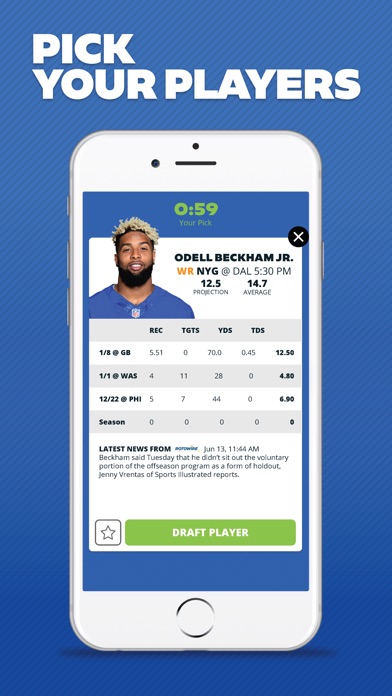
For three or four months out of the year literally only one thing matters in the world of sports: fantasy football. Yeah, the games are fun to watch and the Super Bowl is pretty important but nothing, and we mean nothing, trumps a fantasy football championship. Winning the championship against your buddies or colleagues is the ultimate triumphant moment and it all starts when you draft your fantasy football team. The 2017 fantasy football season is upon us and whether you are gearing up for your season long league or a season of DFS on DRAFT, you need to prepare. We're going to walk you through 2017's fascinating fantasy football drafting season.

iPhone showing DRAFT's NBA, NHL, NFL, and MLB daily fantasy lobbies, including cash tournaments and contests with various money prizes
The 1st Round Dilemma
There is a major problem in 2017 that has not been there in almost a decade: the 1st round is a crapshoot this year. Typically the first round of a fantasy football draft is the most bankable moment in your entire season. Whether you are picking #1 or #12 you know you are getting an elite talent. In 2017 that just isn't the case. So many first round picks have major question marks. Odell Beckham Jr has a pretty gnarly ankle injury. LeSean McCoy is the focal point of Buffalo's suddenly awful offense. Melvin Gordon and Jay Ajayi are potential one hit wonders. Understand that there are very real risks in the first round this year and try to navigate them accordingly. Our advice? Mitigate risks and go for proven talent even if you have to reach. We'd pick Mike Evans and Devonta Freeman over LeSean McCoy and Melvin Gordon.

iPhone Screenshot 2
Picking Your Spots
Having a successful fantasy football draft is all about knowing when to grab the right player. Guys like Rob Gronkowksi and Drew Brees are the best in the world at what they do, but they should never be selected in the first round. The reason is simple, you can get them much later in your leagues. Refer to the average draft position, available on websites around the 'net, in order to scout out which players are going when in the draft. There is nothing wrong with a slight reach, but grabbing a guy like Brees three or four rounds ahead of his ADP will do nothing but handicap you for the rest of the season. Pick your spots and make sure that they count when you do so.


Bye Week Blues

Every team in the NFL gets a bye week at some point in the season in order to rest their players. These bye weeks can start as early as week 4 or come as late as week 12. It doesn't really matter when your players are on bye week but you want to make sure that your stars don't all share the same bye week. If two equal players are available in the 2nd round but only one of them shares a bye week with your first round pick, well, you know our advice is. Fantasy football is a game of inches and every small decision like this will help you out. Having to sit two star players in the same week means you'll have to scrounge for those extra points elsewhere. The results, more often than not, are that you'll just end up losing the week and that's no good.

Putting an app between you and your customers could be doing more harm than good

mumbrella.com.au

Putting an app in between hangry potential customers and your business' burger is a surefire way to ensure they go down the road and order from your competitors. In the brave new world of mobile marketing, customer experience is key, explains Joel Norton, CEO of Kalido.

Many brands are increasing their spend on mobile marketing, but without putting much thought into how it should be integrated into the overall customer experience.
According to Salesforce’s Fourth Annual State of Marketing Report, 74% of brands have integrated mobile marketing into their overall marketing strategy.
Clearly this is being driven by the dramatic shift in consumer behaviour for mobile, as well as providing brands with a new way to capture customer data. But that doesn’t mean you should force customers to use your mobile app in an attempt to change their behaviour for your own benefit.
For example, there’s a boutique burger chain in Sydney that introduced a new burger to the menu that can only be ordered if you download their mobile app.
Imagine the frustrating customer experience, waiting in line to order, only to be told you can’t order unless you download the app and register your details. Multiply that frustration tenfold if you happen to be hangry, which there’s a fair chance you might be.
Instead of capturing valuable customer details, and starting the process of building some form of customer loyalty, the process creates frustration, a terrible customer experience, and potentially a lost customer as they go down the road to order from your competitor.
What’s the benefit?
There needs to be a benefit in downloading the app and registering. For example, join their loyalty program and receive special offers. Or maybe it’s a discount off their first purchase.
It’s ultimately about a value exchange. Consumers are increasingly savvy that brands want to capture data about them, and that it’s valuable, so there is increasing expectation there should be something in exchange.
According to IBM’s 2017 Customer Experience Index Study, 68% of brands do not personalise the mobile app experience. Yet part of the expected value exchange by consumers is that brands will use the data to personalise their experience and make it relevant to them – whether that’s within the app itself, or in-store, for example, delivering real-time, unexpected rewards or benefits.
Customer profile and behavioural data should be collected and leveraged to define the customer experience, and analytics can be used to refine it over time. Brands need to think about how the data might also be used to re-define how the organisation operates, how they go to market, what products and services they offer, or what promotions to run and when.
Incorporating mobile into your marketing or customer strategy is absolutely the right thing to do, but it should not be done in isolation. And you certainly should not be forcing your customers to download an app, as it could simply be doing more harm than good.

The blessing and curse of proximity marketing

marketingdive.com

Editor's Note: The following is a guest post from Vejay G. Lalla, partner, and Paavana L. Kumar, associate, at the advertising, marketing and promotion practice group at Davis & Gilbert.
Whether you are a fashion retailer or a chain drugstore, proximity marketing should be on your radar. Proximity marketing is a sophisticated way to target consumers in their daily lives: marketers can send consumers personalized messages triggered by factors such as their geolocation, their purchasing and preference history and even the weather. According to recent studies, including a report by Retail Touchpoints, nearly half of retailers in the U.S. launched proximity marketing programs going into 2016, and the number has only skyrocketed this year. 
The surge in campaigns harnessing this technology is not surprising. Over the last few years, retailers have increasingly seen consumers migrate away from brick-and-mortar retail stores in favor of convenient digital outlets. Many consumers feel that, with the ease of smartphone and "one-click" shopping, browsing for products in a physical store is almost obsolete. However, the very same digital technology that has caused such a crisis in the retail industry may now be poised to help retailers — that is, assuming they are able to understand and properly navigate the space's unique legal and regulatory hurdles:  

Catching consumers in the moment 

Today's consumers engage in a shorter purchasing process, but the essential principles that underlie business-to-consumer marketing have not changed — consumers still make emotional buying decisions, they still want to comparison shop to make the best choices and they still prefer to see content that is relevant and helpful to them. Proximity marketing is a way to appeal to these fundamental consumer desires without sacrificing a focus on the in-store experience. 
Proximity marketing comes most commonly in the form of beacon-based campaigns. Department stores such as Macy's, Nordstrom and Neiman Marcus, as well as major fashion retailers such as Urban Outfitters and American Eagle, are already using beacons to target consumers based on their physical location. At a basic level, beacons emit radio signals to connect with nearby consumers' mobile devices, working in conjunction with a retailer-specific app in order to push certain notifications to consumers when they are in proximity to the beacon — for example, a special offer for a product in the aisle in which they are browsing. By targeting the consumer in the moment, the technology can capitalize on a buyer's immediate reaction to a product, which can be even more effective than serving ads to them before they decide to go to the store.
Yet retailers and other marketers using this technology, and harnessing consumer data to tailor their advertising, should bear in mind that they are subject to a complex legal and regulatory framework which revolves around key principles of notice, choice and consent. From marketers' perspective, navigating these requirements poses a unique dilemma: how can they create content compelling enough to convince the consumer to stay committed through the opt-in process to share their data? And perhaps more importantly, how can the marketer stay transparent and give consumers the choice to easily opt-out of data tracking, while still maximizing the chances that they will choose to stay loyal?

Driving mobile engagement

Even while grappling with these regulatory issues, from a business perspective the biggest challenge for retailers using traditional beacon technology is the necessity of utilizing a retailer-specific app. Since the consumer needs to have downloaded the retailer's app to enable the digital engagement, these retailers are unlikely to attract new customers beyond the dedicated consumer base that they have already convinced to do so. A possible solution is to develop integration outlets with the Physical Web.
The Physical Web is a recent Google development utilizing beacons to broadcast a URL to nearby mobile devices. In the fashion retail context, a store location or a mannequin in the window could broadcast a URL which drives a consumer to a virtual fitting room or a special discounts page. This type of technology has potentially widespread applications for retailers and marketers working in partnership with each other and sharing data — for example, in airports or shopping malls where a specific marketer may not have a relationship with a particular consumer, but can provide a platform where other retailers can integrate their apps and reach out to that consumer.
However, these newer solutions to expand consumer reach also present business, legal and regulatory challenges. From a business standpoint, marketers need to be cognizant that targeting consumers who have not specifically downloaded a retailer app may annoy them or cause them to view the marketer's messaging as "spam" — even making them resort to ad blocking if the content seems depersonalized or otherwise uninteresting. And from a legal perspective, these campaigns need to be structured to stay in line with recent regulatory and self-regulatory guidance around the collection, use and maintenance of consumer data such as purchasing history, online activity, geolocation and demographic information — which in and of itself may pose logistical challenges when trying to win and keep consumers.
At a high level, consumers need to be notified that their data will be collected by virtue of interacting with a beacon or similar device, and they must be given the choice as to whether to proceed. If data is used to track consumers across devices, retailers must be transparent about their tracking choices and give consumers an easy way to opt-out of such tracking. Consider that for beacon marketing generally, consumers must not only download the retailer's app, but then must also separately opt-in to any location or other forms of tracking — and as such, it's especially important to develop compelling creative to sustain interest through that multi-step process. 

Different codes of conduct, different strategies  

The Federal Trade Commission (FTC) has brought several enforcement actions against both online and offline companies for failing to comply with their posted privacy policies, failing to adequately safeguard data, failing to honor consumer opt-out promises and for a general lack of transparency. Self-regulatory groups such as the Digital Advertising Alliance (the DAA) and the National Advertising Initiative (the NAI) have developed their own set of standards to promote transparency, consumer control, data security and accountability when tracking consumers and engaging in cross-app advertising.
For example, the Mobile Location Analytics Code of Conduct provides that retailers using in-store tracking technology must display conspicuous signage disclosing the presence of location-based data collection, which is connected to an opt-out mechanism alerting consumers of their right to opt-out and to decline participation in the retail analytics program. There has been an ensuing spate of enforcement actions in the mobile space which highlight these requirements and the importance of consumer choice.
So for the cutting-edge marketer engaging in proximity advertising, there are a host of issues to consider from both a creative and a compliance perspective, but there is also more to the story: proximity marketing is most effective when integrated into a broader campaign which uses big data across multiple devices and media to further succeed at personalizing advertising to the individual consumer (e.g. by tracking purchase preferences to variable factors such as the time of day) while also gathering data at the same time to improve future campaigns. 
For example, this broader tracking may enable retailers to know which consumers are the most receptive and to amp up their targeting efforts with respect to those consumers and demographics to minimize the amount of "opt-outs" across the campaign overall. But these cross-device practices may also be caught in the cross-hairs of FTC regulations. In recent years, the FTC, in particular, has issued reports on the Internet of Things and a 2017 report on Cross-Device Tracking.

Keeping consumers informed and secure

These reports and guidelines highlight the need for consumers to be informed of any data or tracking that they may not expect — for example, interaction with a broad-spectrum beacon that reaches beyond the confines of an affirmatively-downloaded retailer app. Per such FTC recommendations, retailers should also build data security features into any of these tracking services, collect the minimum amount of consumer data necessary to serve the marketing purpose and be aware that if collecting sensitive information (such as health, financial, and children's information), specific additional laws will likely apply.
Ultimately, while connected benefits may pique consumer interest, using connected technologies does not obviate the need for clearly communicated data practices, opt-out mechanisms and other elements that incorporate regulatory consumer protection requirements. While building in these notice and consent mechanisms may cause retailers to balk in the fear that consumers will not complete the opt-in process (or opt-out too quickly), there is a real potential for brand payoff: brands that are transparent with their consumers and let their consumers know that they are in control of their private information may win consumer loyalty while also mirroring key regulations on point. When developing these mechanisms, work closely with technology teams to enable a streamlined, creatively preferred process that won't lose consumers, but that will still comply with regulatory guidance. 
Remember that consumers will be most loyal to a brand that they trust, and that trust stems not from the individual messages they receive, but from the overall concept, messaging and authenticity of a brand.