Thursday, 16 February 2017

Number of marketers who understand consumer mobile usage ‘underwhelming’

marketingtechnews.net

The number of marketing executives who understand the importance of keeping pace with consumer levels of mobile engagement is ‘underwhelming’, according to a new report from MobileBridge.
The report, which surveyed more than 50 professionals in the EMEA and US, argued marketing teams have a ‘rich opportunity’ to integrate ‘beyond push messages’ and create greater integration with consumers. Key initiatives for respondents in their road to digital transformation include building responsive websites, cited by 59% of those polled, and building a new mobile app, cited by 54%. Only 35% of respondents said they would revamp or update their existing app.
Push messaging, as expected, was the most common method used by respondents for mobile customer engagement with 88% of responses. Social media (72%) was also used frequently, as were in-app messages (56%), but usage of surveys and games was thin on the ground. Overall, 70% of those polled said developing and implementing a mobile strategy was the responsibility of the marketing department.
Going a step further, more than three quarters (78%) of those polled said their ability to measure the success of a mobile campaign was ‘somewhat’ or ‘not very’ sufficient, while 59% said the ability of their app to engage customers was at a similar level. The data collected all has to go somewhere; yet respondents reported that the systems they use result in silos. “Today’s marketer should be looking for every opportunity to connect or integrate data to gain an accurate, timely view of their customers to ensure they can target and engage appropriately,” the report noted.
“The fluidity and omnipresent change in the way consumers engage with a brand via mobile presents obvious challenges to marketers in today’s business landscape,” said Eyal Oster, CEO of MobileBridge. “While it is clear marketers are only beginning to scratch the surface in creating truly engaging mobile experiences for consumers, expediting this learning curve is crucial for organisations to thrive in the present market.”
Writing for this publication in November, Alan Knitowski, CEO of Phunware, argued brands needed to have ‘clear and defined’ goals on mobile, as well as noting the importance of using the technology to give customers a different experience. “Mobile functionality can also turn a standard branded opportunity to a one-of-a-kind, engaging experience,” he wrote. “With clear goals in mind, brands that offer valuable content and engaging experiences and utilise the wealth of available mobile data will be on their way to success.”

Tuesday, 14 February 2017

App Store Optimization: A Huge Opportunity in 2017

mediapost.com
Image result for app store optimization
For around the past five years, the advertising industry has slowly moved from a desktop to a mobile-first world. As of 2016, two-thirds of all digital time is spent on mobile. About 85% of that time is spent in apps. And thanks to push notifications and ads for native, search, interstitial, and rewarded video apps, marketers have a new set of tools to drive users and new business through their app.  
One crucial but often forgotten app strategy is App Store Optimization. App Store Optimization (ASO) is the process of optimizing mobile app listings to rank higher organically in App Store search. According to Tune, 67% of apps are discovered and downloaded through App Store search. Yes, Apple’s new search ads have sent a ripple through the mobile ecosystem that has yet to be fully realized, but app store rankings and the app store experience should be a high priority for all app publishers. 
On a high level, ASO strategy is broken into two groups: keyword strategy and asset strategy. Keyword strategy involves identifying and tracking search terms that an app should rank in. The Google Play and Apple App Store are relatively young, and the ranking algorithms are still changing. With that said, we know that the app title, keywords (iOS), and app description (for Play Store) are strong signals for the app store ranking.  
A strong keyword strategy starts with extensive research. Understand your target users, what they search for, and how they search in the App Store. The Google Keyword Planner is a good place to start! Keep in mind that App Store search behavior is different than web search behavior; in general, app store searches are shorter and more direct (e.g. web search term "best flashlight app for iOS" vs. app store term "flashlight").
ASO tools such as Sensor Tower, Gummicube, and App Annie can identify your competitor keywords and estimate volume and competition by search term. Just as with traditional SEO, the ideal keyword strategy balances relevancy, competition, and search volume and must be tested and monitored over time. 
The other ASO strategy is asset strategy. Think of app store assets as the app's home page; they are what potential users view to inform their decision to download the app. App Store elements should be optimized to improve click-through rate and install rate. (Note: wins here can benefit both organic and paid acquisition programs.)
The main visual elements are the app icon and screenshots carousel. Video assets are important for games. The Play Store has a feature graphic at the top of the app page; the App Store only has it for featured apps. 
Google Play Store Experiments or vendors such as StoreMaven can be used to A/B test and optimize assets. Additionally, localizing assets by language can unlock growth internationally if your product is built for multiple markets.
ASO is an important strategy for all app publishers and has become increasingly valuable as more and more apps are added to the app store. Much search on the web, the app store is the number tool for app discovery so ASO strategy can help publishers find new customers and cut through the clutter. 

Stopping mobile ad fraud

appdevelopermagazine.com

Stopping mobile ad fraud
ClicksMob just released a data report that gives key insights into the $8.2 billion ad fraud problem by analyzing data collected throughout 2016. In the report they address not only the surface problem of the billions of wasted cash but they go on to talk about how all of this fraud is actually tainting a lot of mobile marketing analytics with "dirty data." As the fraudulent practices continue "the overall trust in the digital marketing industry erodes more and more."

The report goes on to address an array of other very interesting topics like how to fight ad fraud and in what countries it tends to happen the most in. They also provide a nice set of infographics to help readers achieve a better understanding of the problems that the advertising industry is facing. 

Below are some of their key findings:


- Fraudsters work when you don’t: ClicksMob found that Friday, Saturday, and Sunday were the most targeted days for attempted fraudulent advertising, with Fridays drawing 18% of total attempts.

- Gaming apps are the most attractive apps for fraudsters: Of the top 5 most targeted verticals, gaming claimed 39% of the total fraud attempts, double that of the runner-up, LifeStyle. With higher payouts because the user lifetime value is longer, gaming apps are a much more attractive target for fraudsters.

- Fraudsters favor leisure apps: The data suggests that the top 5 verticals most targeted by ad fraud are: Games, Lifestyle, Shopping, Travel & Local, and Sports.

- Fraudsters aim the most at apps downloaded in Japan: Out of the countries most targeted by ad fraud, Android-based fraudulent attempts in Japan accounted for 12% of the total detected fraudulent activity. On iOS, fraudulent traffic attempts in Japan accounted for 11% out of the total detected fraudulent activity.

- The top 5 most targeted countries by fraudsters vary by device type: For Apple iOS, the report has identified Japan, Saudi Arabia, Australia, Singapore and the United States as the top 5 most targeted by fraudsters. For Android, Japan, Malaysia, Singapore, United States and United Kingdom make up the most targeted by fraudsters.

- iOS is more prone to fraudulent traffic attempts than Android: According to the fraud attempts detected by ClicksMob’s Fraud Fighter, iOS was 50% percent more prone to fraudulent traffic than Android.

Monday, 13 February 2017

How Mobile Apps Will Transform E-commerce in 2017

business.com

Online retail trends in a mobile-connected world


How Mobile Apps Will Transform E-commerce in 2017
With the rise of smartphones, online customers have been buying more goods with their mobile devices instead of computers. Tech Crunch released numbers which reported a record $771 million in revenue from mobile customers over Thanksgiving. But while businesses scramble to make their businesses more mobile-friendly, they also have to figure out whether they will stick with a mobile website or create a mobile app.
Mobile apps are more popular than mobile websites and can provide businesses with more customer information compared to a website visit. Also, customers are more likely to remember and return to a mobile app which is more visible on a phone screen compared to an Internet browser’s bookmark.
What does the growing popularity of apps mean for e-commerce websites? Mobile apps are also affecting how shoppers behave, and an e-commerce business needs to understand these trends to get the most out of mobile apps.

The Importance of Loading Quickly

Every e-commerce owner should know that slow loading times can quickly kill your business as more impatient customers turned towards another store. Kissmetrics found that 40 percent of customers will abandon a website if it takes more than three seconds to load. Remember that not every mobile user will have access to a top-notch 4G network all the time. Your business needs to make sure that everyone with a mobile device can easily access your website or app.
The need to ensure fast loading times is one advantage which mobile apps have over mobile websites. Mobile apps are easier to load than a corresponding website, and apps can retain limited functionality without a connection. But customers who use mobile apps will move away from a slow-loading app just like they would with a slow-loading website.
To get around this, some companies, such as KandyPens, rely on adaptive websites, which can easily transfer to the mobile experience using HTML5, as well as on a desktop. But that approach can lead to the temptation to add additional features on an app to attract customers. Ecommerce businesses need to remember that functionality and faster loading times are some of the most important factors of all. Less is more when it comes to apps.

Knowing your Customers

“Data” is the current big buzzword around mobile ecommerce apps. Business can track where a customer goes on its app better than a website. This means that a business can better understand what each individual customer is interested in and personalize their app for them.
While there are legitimate concerns about how companies can abuse the data they collect with apps, there is incredible potential for how businesses can use gathered data to improve the customer experience. But while mobile apps can provide data, businesses need to have good data of their own to build the most effective app.
One major challenge with apps compared to websites is that it is harder to build an app which will work with every kind of phone. Consequently, an ecommerce website needs to figure out which phones their target demographics use and build an app for that phone.

Importance of Engagement

Mobile apps are not just useful as a way to conduct sales. They are also a great marketing tool. Recent data shows that customers spend 90 percent of their time on apps compared to on a mobile website. While this number is somewhat skewed by how customers use apps to check places like email or Facebook instead of going on a browser, it still showcases the incredible marketing power which apps possess.
Ecommerce businesses have multiple approaches for how to attract customers using apps, but one cost-effective approach is content marketing.
While there are numerous content marketing guides out on the Internet, the idea should be for your business to regularly put content on the app which will be interesting to potential customers. For example, you should detail life in your business’ specific niche or announce upcoming deals.
You can use social media networks like Twitter or set up a blog to launch a content marketing platform, but an app carries certain advantages. Customers on your app will stay and listen to your content instead of drifting to the next interesting thing they discover on Twitter. Your app can also connect to your online store, right at the point when the content marketing will have its biggest effect on a consumer.

The Continuing Rise of Apps

The growing popularity of apps will only increase in 2017 as the app experience improves and customers get more comfortable with using apps in place of websites. While some businesses are trying to expand their mobile websites, creative fronts should look into developing a mobile app that will be engaging, easy to load and can both provide and utilize data for your benefit.
Take a look at large and small developers who will be willing to build or improve a mobile app for your business, and then build an app which is responsive to your customers. There are already millions of apps, but there is still time for your business to make your app different and better compared to your competitors if you know what your customers want

How to Effectively Sell Your App to International Audience

finextra.com
Image result for sell your app
There is an increasing trend on smartphone adoption, all over the world. In 2016 alone, there is as many as 2 billion smartphone users, all over the world. But, most of this growth is not only limited to U.S, but rather more because of the developing countries such as China and India.
In such a scenario, you must direct all of your marketing efforts towards addressing international audience as that offers a great opportunity for growing your business. The progressive app developers believes that scaling the apps in the international market is the best way to grow your business.  In fact, the best marketing effort will be the one which helps to discovering your app and that would be a quite a difficult experience.
The app developers are always on the search for high quality and engaged users, which is achievable as you sell your app in the international markets. There are many hurdles of the likes of language, culture, Return on Investment(ROI) and many more.
Here are some of the tips for selling your apps to an international audience:
Language
There are many countries like Netherlands and the Nordic countries that allows English-only apps. Whether or not you want to pay for Asian language translation can only be decided when you test your app in countries like Singapore, Hong Kong and Malaysia.
Language as a barrier comes first in the mind of the app developers. It is not that difficult to translate the app store pitch or for that matter the entire content of the app. However, there are many countries that allow promotional platforms in English language.
ROI
The cost that you bear to get a customer in one country will vary from another. So, you might be investing more in North America than it is in South Korea, but Brazil may be relatively less costly. The usual practice is to use A/B testing of various price points by adopting a digital marketing platform, sales pitches and  other variables that work for different countries.
Culture
There is no need to develop an app that will be targeted for each country in the world. But, there are cultural differences between the users. But, there are universal apps such as Pokemon Go which will sell irrespective of whichever market is it aimed at.
Content
Local preferences also play an important role while buying an app. The Australian buyers are more into sports games, whereas the Asian buyers will be more into strategy and multi-player games. The developers are more likely to lean on the niche markets, for these respective markets. Some apps work for all countries, but some some are better suited than others.
Testing for Newer Markets
There is too low cost that is incurred for testing the mobile apps. Just acquire users in different countries and start testing the apps.
Before you spend money behind translating the app content to various languages, a localized product page is often helpful in understanding the response of the users in the various markets.
Localization of app descriptions are not expensive as these are short. The app descriptions are often translated into various languages, so that you test your mobile apps in the new markets.
Stepping into global markets always offer huge dividends. It is averse to reckless risk taking and is not that expensive. A good crowdfunding platform can help you to gauge demand in the overseas market for your app. Crowdfunding and localized app descriptions are all about catching hold of the early adopters for your app. Only the tech savvy and the well-connected users will be interested about the crowdfunding campaign or the localized app descriptions. Feedback is what matters from them in order to spread the word about your business.

Thursday, 9 February 2017

Getting Attention and Igniting Mobile Moments: A New Approach to Mobile App Marketing

finextra.com
Image result for mobile app marketing
Mobile marketing today emerged as a crucial element to ensure success as much as the development. With millions of apps mobile became the biggest battleground for most businesses to gain attention and customer engagement. Most people spent a considerable portion of the day looking at their handheld devices. Naturally, from retail companies two small and medium enterprises all jumped into the scene just to grab a pie of this market. When we look at the mobile app marketing trends, Most of them are focused on one thing, and that is grabbing user attention quickly by delivering up to the real life user situation.

As per a recent survey by comScore mobile apps now take two third of digital media engagement time. The same survey reports that mobile apps together make 60% of digital time spent by consumers across the platforms. Remaining “In-app”  has now become the default mode for many of us. With such an all-encompassing and massive presence no consumer brand, no business cannot remain silent when it comes to mobile apps. So, the whole business competition including the local one will transport to the mobile app marketplace. With such a situation underway, grabbing attention from users will play the ultimate role to make any app successful. In fact, we can say that drawing attention will be the key objective for mobile app marketers.
Context and mobile moment

But, It is not about grabbing quick attention, being downloaded and getting dumped in a few minutes or in a few days. It is more about engaging your users, remaining part of their mobile screen real estate and over time making them loyal users. No bites. If only you’d arrived at the party a little sooner. This is why making your app serve the user context, and their real life situations are so much valuable to mobile marketers.

A groundbreaking app alone is not enough

From few hundred mobile apps in 2008 to millions of apps in just less than five years,  represents a significant shift in the mindset of consumers, businesses, and developers. This massive growth has only become possible with the penetration of mobile apps in all spheres of life. Today we have mobile apps for almost everything in our life. Every day new apps are cropping up, and many of them are unique in one way or the other. But in spite of this tremendous innovation and creative spurt majority of mobile apps face the same fate of not earning enough to sustain as a business. For mobile apps, it has never been harder to make people press the install button and stay connected as a user.

For mobile apps, a groundbreaking idea is just the beginning followed by the equally daunting task of building the app and the more challenging task of marketing it. With the competition in mobile marketplace reaching its all-time high, almost every mobile app idea is represented by the gamut of apps. So,  even when you are considering your app to be a new one, the idea may not be as revolutionary as you think it. Moreover, your competitor apps might have already enjoyed user attention and popularity. With the same kind of app on offer, often it is the marketing output that becomes decisive.
Mobile moments:  the crucial microelement

Mobile marketing today has to take real-time customer engagement into account more than ever. What consumers want in a specific moment, what he expects from your app in a real life situation should guide your app marketing endeavors. To address the real-time presence of users with a Microelement is what widely referred as “mobile moment’. These are micro-moments referring to the small interactions when people connect to their device. The mobile movement has a lot of significance for mobile app marketing. It brings a whole new approach relevant to the real world situation and context of the use of the app. Thanks to this, marketers now need to push messages,  show advertisements and promotions as per the real world situation of the user. Users, on the other hand, cannot interact with certain promotional elements as per the need of the moment.

The real significance of mobile moment for mobile app marketing is broader than this. First of all, it would prevent annoying the users with wrongly timed promotional campaigns. Secondly, it would help minimizing the drainage of marketing resources by ensuring properly timed campaign with more engagement and positive response.  Marketing for the mobile moment of the users will have another significance. This will also initiate a more personalized approach to content marketing and advertising.

Consider making it free

If you look at the major app stores, you will see that for every premium app. There are several free alternative apps. Only an already successful app with quality user base can enjoy the same engagement and retention to earn enough from the price of downloading.  Otherwise, for a new app entering into a niche, it is incredibly challenging to make a good number of downloads with a premium price tag. This is why, at least for initial few months, it is advisable to offer your app for free. If the buyers find in your app what they were missing earlier, there may be ready to give a price in future. Moreover,  after launching a free version, you can launch a premium version letter on with additional features and benefits.
Follow five crucial metrics

Your marketing efforts need to be evaluated from time to time. Late us have a look once again at the five fundamental metrics to evaluate your achievement against the objectives.
  • Number of downloads
  • Average revenue per user
  • Average  session length per user
  • Number of screens by a user
  • Demographic data about the user
  • Time of the day with most user engagement
  • The number of new users  after a promotional campaign
  • Number of users using the  app one week or more
  • The frequency of use by individual users
Market to enterprises over customers

Do you know more than 40% app developers who cater to businesses make few hundred times more than they are counterparts who develop for consumers? Businesses beside having a bigger budget also are in increasing need of Automation tools and all sorts of digital maneuvers to boost production. Moreover, a sophisticated app built to deliver business output will gain more patronage than the consumer apps.
To conclude, Delivering up to the user needs in particular moments will continue to play the crucial role in mobile app marketing.  As the competition, he is getting tougher, only by delivering up to the user expectation in specific user situations mobile apps can stand out.

The race to the $22B mobile ads market

luxurydaily.com

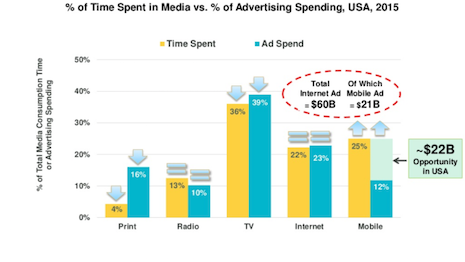
Advertisers remain over-indexed to legacy media. Chart: Kleiner Perkins Caufield & Byers Internet Trends 2016 report presented at Code Conference June 1, 2016
By Eric Stein
The mobile advertising market is booming. The IAB Internet advertising revenue report shows that mobile ad revenues have been growing at 100 percent CAGR [compound annual growth rate] since 2010. By some accounts, the mobile sector will account for almost all the growth in the worldwide advertising market in the coming years.
Of course, what is fueling this growth is consumers’ rapid shift in their media consumption habits to mobile, driving marketers to follow.
As she has done since the early days of Internet advertising, Kleiner Perkins Caufield & Byers partner Mary Meeker looks at the disparity between consumers’ media consumption time and marketers’ media buying share.
In the 2016 report (slide 45), desktop/Internet advertising, like most other channels (television, radio), has notably reached equilibrium (print has a long way still to fall). The biggest disparity now exists in the mobile channel, creating a $22 billion opportunity for the United States market.
Yet, if the mobile ad market is going to reach its full potential and fill that gap, it will have to address a unique set of challenges and obstacles first.
Compared to desktop advertising, which not too long ago had a similar gap in unfulfilled market opportunity, mobile advertising needs to address a multiplicity of standards that the Internet does not have.
Advertisers increasingly want to see a justified return from their ad dollars before further investment. That return is a combined effect of the ad dollar spend, the number of transactions driven by that spend, and advertisers’ ability to measure it – captured through return on ad spend (ROAS).
Depress the number of conversions or lose some of them in faulty attribution, and the appetite to spend will largely be diminished.
Unfortunately, today’s ad industry is doing just that by not adequately addressing the following issues.
1. Suboptimal ad experience for mobile users
In the digital era, many businesses tend to find their best customers to be their mobile application users, rather than mobile Web visitors.
For the ecommerce industry specifically, studies have shown that apps outperform mobile web by 3x conversion and 2x retention.
Ad campaigns to these customers, however, most likely drive them to visit the mobile Web, which takes longer to load, crashes frequently, and is generally a sub-optimal experience when compared with the app.
A bad user experience resulting from a click on an ad will not only hurt conversion, but also reduce that user’s likelihood to respond to an ad from the brand in the future.
2. Outdated advertising technology
The technology stack that advertisers use for their mobile ad campaigns were built for the desktop world, but not well suited to today’s mobile environment.*
Take linking for example. Some demand-side platforms (DSP) wrap destination URL links with click-tracking tags that break those links on mobile.
To be more specific, none of them allow for a click on the link to open an app directly from an ad click across all operating system platforms. This should be standard practice given the higher conversion performance in the app.
As Criteo noted in its first-half 2016 mobile commerce report: In-app conversion rates are three times higher than that of the mobile browser, and AOV in app was $127 compared with $91 in mobile browser.
These metrics all speak to the need for a smooth click-to-app experience, leading to better campaign results and higher return on spend in mobile.
* I recently spoke with a large agency trading desk that conducted an RFP for a mobile DSP that included 26 independent companies. Rather than going with their incumbent, they chose a purely mobile DSP because of the requirements they had for mobile could not be met by the “traditional” players.
3. Ineffective mobile ad measurement across platforms
As ad dollars have flowed into mobile, they have come from a growing breadth of advertisers with different measurement needs.
These advertisers are increasingly challenged to attribute downstream ROI activities back to the source campaign on mobile, especially when that activity happens on a different platform than the original campaign platform.
Got a click on a mobile Web ad that resulted in a purchase two days later in the app? You are lost to the advertiser, or, at least, the campaign. Same issue in the reverse scenario.
Without the ability to accurately attribute downstream activity to a campaign across platforms, the results of that campaign will be artificially depressed and advertisers will be less likely to increase spend going forward.
4. Need of more mobile-friendly ad types
The way people interact with their mobile devices is dramatically different from how they interact with Web sites on desktop. This different behavior calls for new ad types that can provide a better mobile user experience.
The industry is still in its infancy when it comes to being mobile-first for ad serving.
Companies such as Facebook have been experimenting with new ad formats including Dynamic Product Ads and Canvas ads that better fit the user behavior and are already seeing positive results.
Marrying these new creative formats with better post-click user experience and measurement will help ensure advertisers maximize results.
Grow the market together
In a world where all the above challenges are being addressed, the total market value will grow as a direct result.
Not all advertising is conversion focused and advertisers do not have unlimited budgets. But if we look at the entire market as if this were true then the market would grow in relation to marketers’ ability to drive returns.
Let us assume there is a 10 percent app adoption rate across the board. Given the positive impact this would have on conversion rates based on the Criteo study discussed above, this would increase conversion rates for the market overall to 19.4 percent (see breakdown below).
Applying this to the $20.7 billion mobile ad market, then the mobile ad market would have been 19.4 percent bigger in 2015, or $24.7 billion* -- and I did not even take into account the increase in average order value reported by Criteo.
Now, of course, this would only apply to a portion of the market, but the point is clear: the market will grow as a function of its ability to produce more effective mobile results for advertisers.
Here is how I arrived at that conclusion:
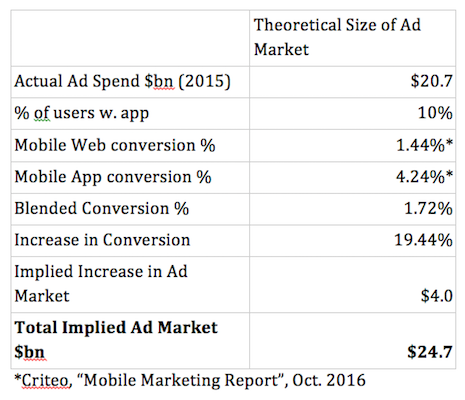
Criteo mobile marketing report, October 2016Criteo mobile marketing report, October 2016
There is no doubt that consumers will continue to migrate to mobile. A growing percentage of them will prefer to engage with mobile apps on their smartphones and marketers will continue to demand solutions that can solve these issues in order to better engage and convert them.
One simple thing for marketers to do is to conduct an audit of their own mobile ad campaigns across channels and ad types.
A couple key issues to look into are: do they link to the app when it is installed? If it is not installed what is the strategy to get your best customers to adopt your app?
These questions are critical for ad campaign marketers, but also worth contemplating for the rest of the industry.
It is a $22 billion opportunity in mobile advertising that will attract lots of innovative, mobile-native solutions to help the industry get there.
JUST LIKE Brian O'Kelley raised concerns about the dominance of Facebook and Google and posited in his recent post: We are on the brink of an “ad tech renaissance” that will help bring the fruits of a rising tide to more players.
While Facebook and Google are able to take much of the complexity out of the advertising ecosystem within their own walled gardens, these are challenges that the rest of the market can also work together to solve. Doing so will not only improve the state of ad tech for mobile, but will be critical to the mobile advertising market reaching its full potential.