The best articles, videos and links about App Ecosystem, Mobile Marketing, Mobile Commerce/Payments, Blockchain/Cryptocurrencies, Artificial Intelligence, Retail Media,..that help me in my daily work.
http://www.linkedin.com/in/agustingutierrezbazaco. Mail: agbazaco@yahoo.es
Twitter:@agbazaco
businessnewsdaily.com Do you ever wonder how consumers really feel about your mobile ads? Perhaps you want to know which type of ads best attract your target audience so you can increase your sales. MediaBrix, an in-app mobile video advertising platform, announced the results of a new study from neuromarketing leaders True Impact and Neurons Inc. on the impact of different kinds of video ads delivered in mobile apps. The study showed that some types of ads spur viewers to immediately close the videos, while other types attract user engagement. "This research allows marketers to understand the opportunities that lie in mobile and the implications of how we approach consumers there," Ari Brandt, CEO and co-founder of MediaBrix, said in a statement. To learn how different delivery methods affect a user's receptivity to in-app video ads, researchers asked subjects in a controlled environment to interact with a mobile app from developer Magmic. The researchers then monitored subjects' interactions, and neuro and biometric responses before, during and after the moment of ad delivery. The researchers looked at reactions to two types of ads: interstitial (full-screen ads that take over the host app) and embedded opt-in. The research found that interstitial ads elicited negative reactions from consumers. In fact, 22 percent of the research subjects' time was spent searching for the "X" button to close the ads, as part of a "fight-or-flight" tendency, the study said. These overwhelming ads seem to turn many mobile users away, especially in comparison to embedded, opt-in ads, in which viewers spent 9.5 times more time watching than with interstitials. Because viewers actually pay attention to these advertisements, consumers are more likely to remember and understand the brand or offer, which is crucial to the ad's success, the researchers said. However, only 25 percent of viewers watched the full video in an interstitial ad, the study showed. On the other hand, embedded, opt-in ads have a positive effect on their audiences. Nearly 90 percent of the study's viewers watched the entire video; these viewers also spent much more time fixated and cognitively engaged in the material, leading to higher levels of retention. Consequently, a whopping 70 percent of viewers remembered the products and 73 percent understood the offers with these ads, trumping the 40 percent and 49 percent of interstitial-ad viewers. "Positive indicators like cognitive load, or engagement, and motivation, the brain's manifestation of wanting, were much stronger in the [embedded opt-in] ad, whereas arousal, or erratic sentiment in the brain, was much more common for standard interstitial ads," said lead researcher Thomas Ramsoy, CEO of Neurons Inc. and adjunct professor at the University of Copenhagen in Denmark. Embedded ads also sparked four times the amount of motivation in their viewers, causing them to want to continue using the app. The underlying mental attraction to these opt-in ads contribute to their lasting impression, the researchers said. "What we've learned about the consumer's state in the moment of being approached by a brand speaks to how much a mobile ad can either alienate a consumer or inspire brand affinity," said neuromarketing expert Diana Lucaci, lead researcher and CEO of True Impact. "The stakes for marketers are huge here."
Modern technological developments continue to revolutionize the manner in which information is shared. Different fields are expected to benefit significantly from these technological changes. One of these fields is that of marketing and advertising. Contemporary methods of advertisement have made it possible for both small and large businesses to realize their potentials. These advertisement avenues have been vital for the commercial survival and success of many organizations. Mobile Display Advertising, a modern equivalent of contemporary methods of advertising, is becoming an accepted form of marketing and because of its healthy organic model it could become a bigger marketing discipline than SEO/SEA.
Here’s why:
For many years, marketers have used both SEO and SEA to realize their business potentials. Companies and marketers using these forms of marketing have recorded considerable results. However, these marketing disciplines are currently associated with a number of obstacles that suggest a new shift to better avenues. Mainly because advertisers find it increasingly harder to create a positive return of investment. Simply put: the cost of SEA campaigns is most often higher than its profits. The situation continues to encourage marketers and advertisers to identify better alternatives.
SEO is also associated with various limitations. SEO is considered profitable but has its limits in terms of marketing budget that can be allocated for search engine results (improvements in rankings). It’s considered a long-tail marketing-discipline and investments made, take a long time to return in the form of revenue. Simply put: SEO has it’s limits and is difficult to scale.
With these issues in place, experts have been focusing on new marketing strategies and disciplines in order to deliver positive results. One of the new alternatives, gaining worldwide traction, is Mobile Display Advertising (MDA). In the recent past, MDA has become more noticeable and evident as SEA/SEO. Many cases and research suggest that, in general, ROI’s are high. However, a detailed analysis shows conclusively that Mobile Display Advertising is still unknown to many advertisers and marketers while it’s considered a scalable model that is here to stay.
Mobile display has earned a major share of attention because of its increasing digital spend – estimates vary but 2016 is going to top 100 billion (several analyses show). Despite the fact that mobile advertising is seen as a major challenge by many marketers; mainly because of it’s complexity at first hand, MDA spends has been increasing rapidly. With this kind of growth, the ecosystem has come up with both challenges and opportunities. The opportunities associated with targeted mobile display campaigns explain why marketers should be ready to seize the opportunity. There is a huge amount of mobile inventory. This is because everybody in the world is on his phone all the time. This means people are visiting sites and apps. In those apps and sites can be advertised.
There are various formats and creative technologies that define the modern mobile platform. The proliferation of mobile display formats has emerged thereby creating actionable ads and with that, new opportunities. The market is becoming more professional; companies specialize in making cheap but professional banners that are pleasant for consumers. Many professionals encourage marketers to create mobile-centered banners that support a pleasant user experience. From video-banners to expandable formats, the MDA market is evolving rapidly.
It is also notable that some mobile marketing tools have numerous limitations. Some tools such as beacon technology have been characterized by various challenges. This is the case because Beacon technology is based on a Opt-in model. Pop-up ads have (f.e.) their limitations because the targeted consumer needs to have downloaded the app in question to receive these.
Many publishers (e.g. news companies) have created mobile apps that can distribute the intended content to more viewers. Within these apps can be advertised. These banners have the capability to create room for numerous interactions and communications. Some of the banners have the potential to initiate instant messages or phone calls. Rich media ads are customized depending on the needs of the advertiser. Another tactic associated with the MDA concept is the use of expandables. These formats can be considered as pleasant because action is required to view the full ad.
Real-time-bidding (RTB) is a relatively new business mechanism whereby advertising inventory is sold based on a per-impression basis in an auction model. Bidding occurs real-time thereby making it possible for the buyer’s ad to be displayed instantly on the website. This form of MDA is gained much attention because of it’s various (targeting) possibilities. Demand-side platforms (DSP) are systems that make it feasible for advertisers to manage data and multiple exchange accounts through a single interface.
The number of mobile apps and websites allowing ads in their content is a new wave characterizing the world of marketing. Such platforms make it possible for more visitors of the mobile websites and users of specific apps to become potential consumers of the intended information. Social media is (logically) also widely present on mobile devices. Facebook is currently being used by billeions of people in different parts of the world. The visitation by people of apps and mobile websites account for a very large portion of mobile traffic. Mobile Display Advertising is the most simple, scalable and organic marketingmodel which utilizes this huge amount of mobile traffic. In this sense ‘scalable’ and ‘organic’ refer to a model that has been around for decades if not centuries. Advertising in a newspaper or on television needs a publisher to carry that advertisement. For a newspaper for example, ads remain the biggest form of revenue. MDA can be described as the modern equivalent of advertising in newspapers or on TV. Simply because of the fact that billions of people visit and use apps and mobile websites which are owned by, let’s say; publishers (whom need to be profitable). suggests a modern duplicate of an established ecosystem of advertising that is here to stay.
MDA is a powerful model capable of transforming mobile advertising. It can be described as organic model because it’s viable and scalable for advertisers, it generates revenue for publishers and legal obstacles seem small. The MDA model is healthy and has the potential to transform the performance of many businesses. Research and the apparent growth of MDA suggests that it will become a bigger marketingtool than SEA and SEO are currently considered.
The lightweight game platform will allow users to challenge friends within Messenger, and offers Facebook a way to both drive engagement with its platform and potentially earn a cut of revenue from in-app purchases.
Facebook is reportedly testing Instant Games in New Zealand, but has yet to make any formal announcements about it. IBT reports that developers like King.com, the company behind Candy Crush, and Big Viking are already trying out the service.
Dive Insight:
Facebook continues to be proactive in making Messenger more than just a chat service following the introduction of thousands of branded bots to facilitate customer service and in-app payments in the spring. Mobile games present an opportunity for brands to strengthen engagement, providing an experience that holds users' attentions, is fun to play and can become a total time sink.
Instant Games also might open a significant revenue stream for Facebook. Offerings like King.com's Candy Crush thrive off of in-app purchases and a "freemium" content model, so Messenger possibly taking a cut of those micro-transactions would be a smart play for the social media giant.
This year Gartner has combined digital marketing and advertising into one hype cycle report to reflect the need for marketers to consider advertising technologies as part of their core technology focus.
Four key forces were identified as driving a data-centric future for marketers: the convergence of marketing technology (martech) and advertising technology (adtech), event-triggered and real-time marketing techniques, personalisation, and the use of contextual clues.
“As marketers embrace data-driven marketing strategies to improve customer experience through coherent content and messaging, and advertising adopts programmatic practices and real-time bidding markets, customers will increasingly expect consistency and coordination from all branded communications,” said Mike McGuire, research vice president at Gartner.
In terms of technology, product categories such as DMPs, marketing analytics, marketing automation and predictive analytics are increasingly shared in martech and adtech stacks.
“Real-time and event-triggered marketing are a key focus for marketers and advertisers alike. As all forms of marketing look for greater efficiency and effectiveness, predictive analytics are rapidly gaining the attention of advanced marketers,” McGuire said.
Sitting atop the peak of inflated expectations are mobile marketing analytics, digital marketing hubs, shoppable media, predictive analytics, voice of the customer, and mobile commerce. Down in the trough of disillusionment are social analytics, in-app advertising, and real-time bidding (advertising).
Key Technology Forces
Event-triggered and real-time marketing techniques: The drive to be able to react in the moment and move the customer or prospect along the path to purchase and advocacy puts the focus on mobile marketing and predictive analytics.
Personalisation: Personalisation and “personification” technology profiles are maturing at a rapid rate, as marketers look to create that one-to-one opportunity while balancing consumer concerns about privacy and security.
Contextual Clues: The use of the contextual cues signaled by consumer and prospect usage of mobile devices — cues such as the local weather, their presence near a mall or retail district — is driving marketers’ overall interest in proximity marketing, the Internet of Things (IoT) and wearables
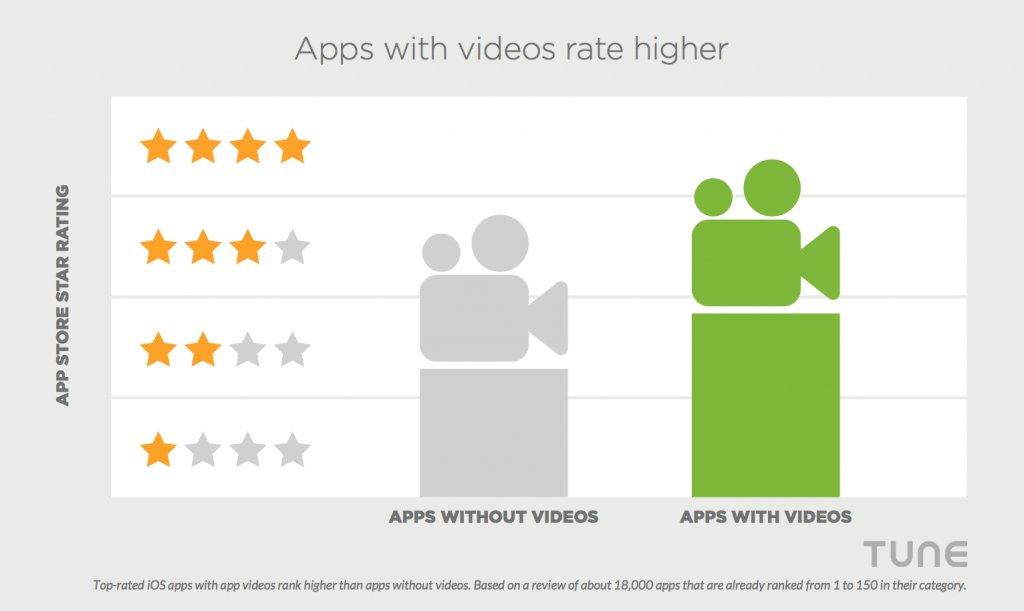
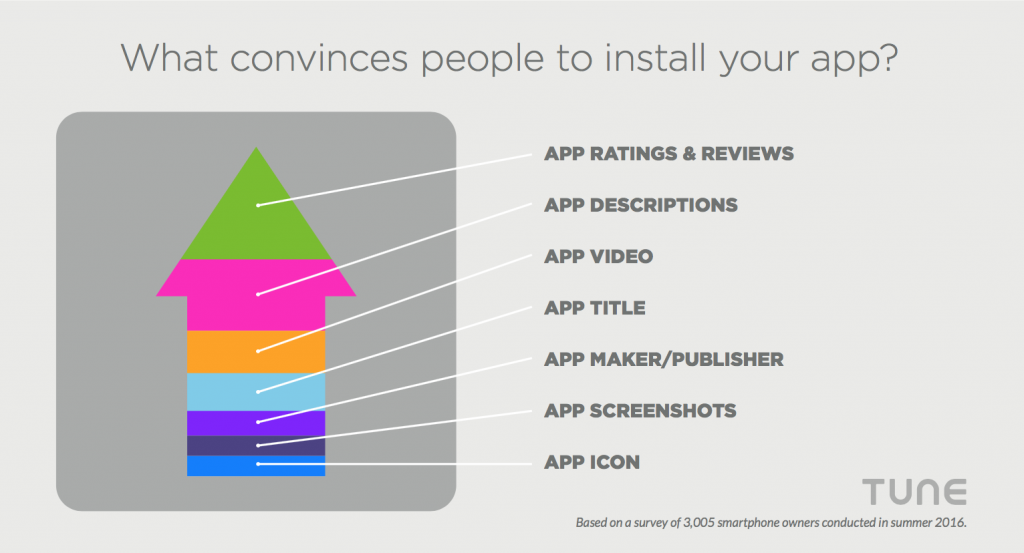
As we’ve found at TUNE, only 7% of top apps on the App Store have app videos. But the apps that do include videos get higher ratings. And smartphone owners that we’ve surveyed say that app videos are the third most important element of app listings. In other words, apps without videos are costing themselves higher ratings, better rankings, healthier conversion rates, and ultimately, more installs.
SUPERCELL’S APP VIDEO DOES A GREAT JOB OF SHOWING THE CLASH OF CLANS APP … AND THE SOCIAL/EMOTIONAL COMPONENTS OF ITS GAMEPLAY.
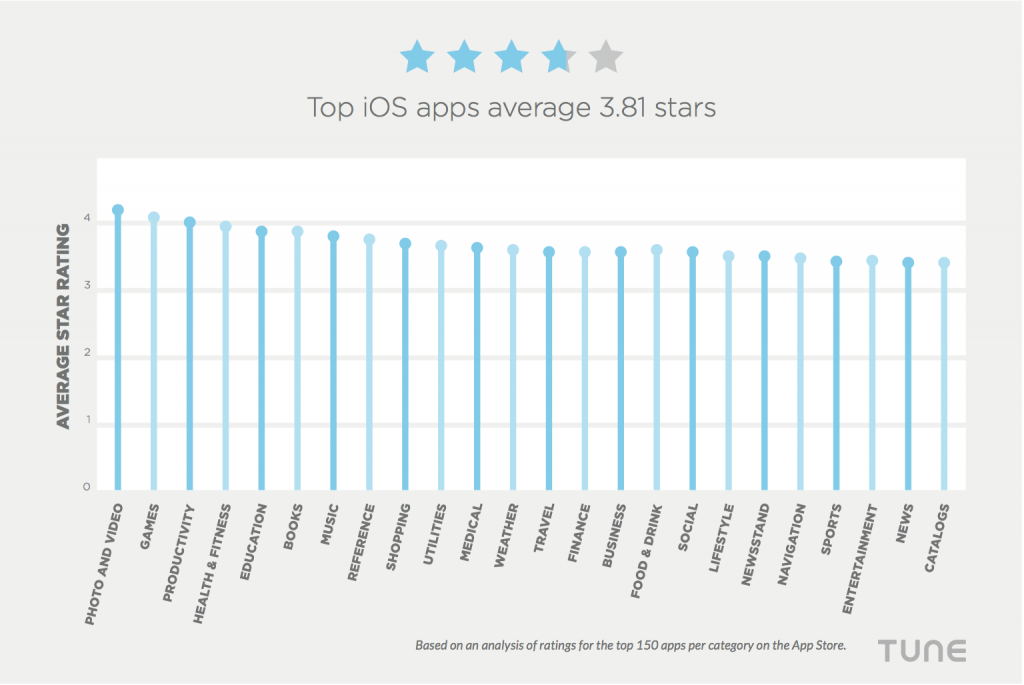
In spite of the fact that they are all top apps on the platform and therefore generally highly rated — 65% of all ratings on the App Store are 5-star ratings — there is a significant difference in ratings for those with a video and those without a video. The average rating for apps without a video is 3.81 stars, almost half a star lower than the average rating for apps with a video: 4.24 stars. High ratings are social proof that your app is worth installing, and social proof translates into more downloads.
Higher ratings also impact rankings — where your app sits in its category, and what position Apple or Google assign it in search results.
And rankings are incredibly important for installs. Moving from 150 to 15 is enormous in terms of download velocity — easily worth 10 to 100X in daily installs. So anything you can do to increase your odds of success at these already very competitive levels is extremely valuable.
The key in deciphering what parts of your app listing are persuasive is understanding how people make download decisions. When presented with an app to install, users employ a kind of waterfall logic: if your app passes the first test, they apply the second, and so on.
The first test is ratings.
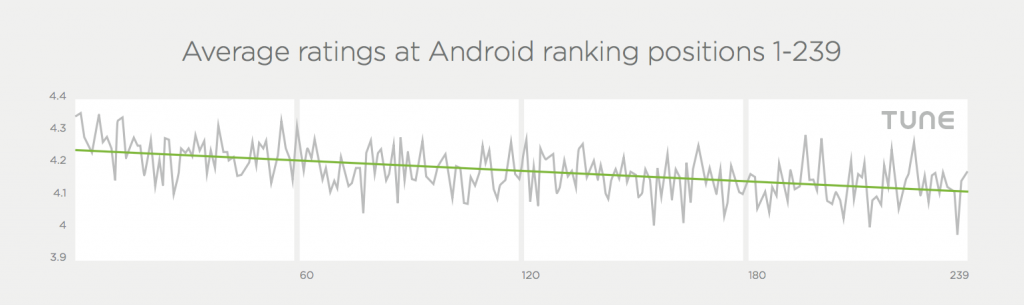
Why, after all, would anyone waste their time on a 1-star or 2-star app? People will only install these apps if they absolutely have no other options, not unlike previous generations of enterprise software. Even a 3-star or 3.5 star app is suspicious. Top apps have tips and tricks to inflate their ratings, so app ratings are very high in general — 3.81 on iOS, and 4.16 on Android (more details here).
High ratings are now table stakes. The simple result is that people don’t waste their time on apps with poor ratings … and that high ratings alone do not ensure an install.
Once the ratings waterfall is successfully negotiated, app installs skim through the app description. Mobile marketers can both win and lose the install in the description. In cases where potential users are still interested but not entirely convinced, the video provides an essential test drive so they can see the app in use and judge more deeply whether it’s something that looks good/fun/useful/quality.
The data tells a story, but so does the person who built Google Play search:
“Video previews are the next level of screenshots. With a short video, you’re able to show the user really what it’s like to play with your app. Giving potential users an accurate impression of what your app is all about is an approach that keeps on giving… developers have told us that uploading a video can really help gain user adoption, and users in a lot of studies have told us that video previews are amongst the most convincing features of an app details page.”
Snapchat is prepping to allow direct response specialists to get access to its API for app install ads next year according to Ad Age.
The frontline news from this move is that Snapchat is making a stronger push for app install ad dollars.
Snapchat is also setting up an internal “self-serve” ad product so marketers won’t have to go through third-parties to run app install campaigns.
Dive Insight:
App install ads are a major part of Facebook’s ad business so Snapchat going big into the space could be a signficant challenge. The news comes as Facebook has recently added a number of new features like masks and a 24-hour feed that clearly mimic Snapchat. While Facebook is the bigger platform, it is clearly feeling threatened by Snapchat's quick growth.
When it comes to app install ads, Snapchat could have an advantage. Facebook has by far the largest user base in social media, but Snapchat owns the Gen Z and millennial demo, a group more likely to add apps to their daily experience.
With the app install push a way to actively courting direct response marketers, per the Ad Age report, this also suggests that Snapchat is becoming more willing to embrace many forms of marketing as it gears up for an expected initial pubic offering next year. In the past Snapchat was known for essentially avoiding marketing altogether and promising its users it wouldn’t be “creepy," but direct response marketers are better known for their hard-sell tactics than the more subtle storytelling approach that has been a hallmark of marketing on Snapchat to date.
financialexpress.comMobile video advertising and native ads are becoming key components in a marketer’s arsenalIn mobile advertising, many new ad formats around video are gaining ground with brands considering call-to-action video campaigns. (Source: Reuters)
Mobile plays a pivotal role in overall marketing plans of not just new economy brands but traditional players as well, with the latter now going beyond brand awareness campaigns on digital. And rightly so. According to a Criteo survey, 36% of online traffic for major retail, e-commerce and travel companies in India, comes from mobile websites and apps generating overall sales of 32%. Online traffic from mobile apps alone comprises 11%, which gets totally converted into actual sales. No wonder mobile campaigns are increasingly becoming sophisticated with an increased focus on performance marketing.
Even campaigns on social media platforms like Twitter and Facebook are linked to performance metrics. “A lot of marketers now track the number of visits that lead back to the website and time spent by the user on the site. They focus not just on app downloads but also on downstream events, such as how users engage with the app post download,” says Akshay Mathur, SVP, Komli Media.
In mobile advertising, many new ad formats around video are gaining ground with brands considering call-to-action video campaigns. So far, video was only seen as an extension of TV and not directly linked to performance. “In terms of display and search, you are way more likely to survive a plane crash than you are to click through a banner ad,” muses Vijay Kunduri, commercial director, ASEAN and India, Unruly. “In the face of these declining metrics, marketers are looking at more impactful ad solutions and formats. That’s where video comes in, being the most impactful medium for storytelling.”
According to a recent Nielsen Consumer Neuroscience study, video ads with above average EEG scores (emotional ads) deliver a 23% uplift in sales volume, and according to Unruly EQ data, around 70% of viewers who experience an intense emotional response to an ad are more likely to buy the product.
On top of this, the emergence of OTT players implies a likely massive increase in advertisers adopting video. “We’ll also see a further rise in user-controlled outstream video formats, given that Indian consumers are the second most likely, after the UK, to want to control video ads,” Kunduri adds.
So while video gains momentum on mobile, native and display ads are not far behind when it comes to non-intrusive, performance-oriented ad solutions. BrandWagon looks into how publishers and advertisers are working with new ad formats as a part of their mobile strategy.
A mobile-first approach
Yahoo India rolled out its mobile ad format, Tiles in September this year. Yahoo Tiles, a post tap ad format, is cross-device, lightweight, mobile optimised and non-invasive in nature. “We built this using lightweight components that allow us to efficiently design and develop ads with swipable images, videos, social feeds and 360° content based on campaign objectives,” says Roger Li, director, ad creative technology, APAC, Yahoo.
As part of its mobile-first strategy, Yahoo India is working on re-imagining its global platforms (search, mail and Tumblr) and content verticals (news, sports, finance and lifestyle) to create immersive experiences and advertising opportunities that align with these new environments. “In fact, mobile is the largest contributor to MAVENS (mobile, video, native and social) adding over $1 billion, or nearly a quarter to our traffic-driven revenue,” says Gurmit Singh, VP and MD, Yahoo India.
In India, two ad formats lead the way when it comes to mobile advertising: video and native. Experts say in the last six to seven months, the Indian market has opened itself to video ads in a big way. “The number of videos played on our mobile network in India grew 150% between January and June this year,” says Arun Pattabhiraman, VP and global head of marketing, InMobi. The company is bringing advanced video ad formats in India this year such as vertical video, which is a full screen, immersive, 9:16 aspect ratio video format and second, 360 degree video. It is a VR experience and enables a 360 degree view of the location where the video was shot.
For Google, 55% of watch time for YouTube comes from mobile. “Most of our advertisers that prefer to go on
TV are also looking to reach out to individual consumers on mobile via YouTube,” says Nitin Bawankule, industry director, e-commerce, local and media, Google India.
In September, Google introduced its call-to-action TrueView ad format for YouTube. It is designed to move video beyond general branding where advertisers can display a call-to-action banner at the base of the video during and at the end of the video.
According to Google, three ad formats work well in India. One, TrueView video ad, which is a win-win for both consumers and advertisers. While consumers have the option to skip the ad and save time and bandwidth, advertisers don’t have to pay unless the consumer sees the complete ad, or for at least 20 seconds. Other ad formats are YouTube bumper ads and Google shopping ads. The former are five second ads and work well in the case of product launches or if an advertiser wants to push app downloads.
Even as video ads are hogging the limelight, it doesn’t mean the end of the road for search and display ads.
At Google, close to 60% of search queries come from mobile. However, there is a shift towards display on mobile. “More and more people are directly searching within the app instead of searching through the toolbar. On the mobile you get a better response by going directly to say, a Swiggy or Flipkart,” says Pattabhiraman of InMobi.
However, after video, the biggest growth driver is native ad format. “The advantage of native is that it lends itself to many different forms — depending on the content in which it is immersed,” says Singh of Yahoo. It could be text or video or image, ranging from in-stream advertising to in-game native formats. Studies of native campaigns on the Yahoo network show that as compared to display ads, native ads are more effective — a user is 3.6 times more likely to conduct a branded search and six times more likely to run a related search after seeing a native ad.
Focus on RoI
While mobile is clearly an established advertising medium for e-commerce, the story of traditional players in the FMCG, auto and insurance space is no different. Even FMCG has moved around 15 to 20% of its spends to digital. Consider this: HDFC Life gets 30% traffic monthly from mobile on its website and on an average spends 15-20% of the total media budget on digital for its campaigns. “Mobile is an inherent part of our marketing media mix constituting around 40% of the budget and it increases every year,” says Sanjay Tripathy, senior executive VP, marketing, e-commerce, analytics and digital, HDFC Life. According to HDFC Life, impact properties perform well on mobile. “The roadblock ad format on mobile gives us branding plus website visits, while standard 300×250 and native branding banners are good for regular campaigns,” Tripathy adds.
“The medium also allows us to directly connect with our customers through conversations; learn from their experiences and often surprise them with a ‘money-can’t-buy’ opportunity,” says Coca-Cola India spokesperson. The largest beverage maker in the country by revenue also uses performance advertising from time to time, such as during the launch of Coke Zero in India.
While newer ad formats have witnessed greater traction, it is the ‘topicality’ and ‘situational advertising’ that drives greater engagement for most traditional brands. However, the story is different for digital-born brands. For example, ShopClues decided to go digital for offer marketing this festive season unlike its peers who focussed on print and TV. “We spent about 30% of our budget during Diwali on digital, which was mostly videos,” says Nitin Agarwal, AVP, marketing, ShopClues where about 25-30% of the marketing spend is focussed on digital of which 70-75% is on mobile.
Online furnishing retailer Pepperfry, on the other hand, equally distributes its marketing budgets between online and offline. Within online, 70% of the budgets are attributed towards search, which include SEO, product listing, re-marketing, SEM and others. “For us performance marketing channels such as keyword search, Facebook and PLA have worked very well,” says Kashyap Vadapalli, CMO at Pepperfry. “We spend about 20-25% on mobile,” he adds.
However, any mobile strategy cannot work in a silo, given that TV is still a significant part of the ad spend. “With 230 minutes a day spent by the individual consumer, mobile has emerged as the largest device of shared consumption habit with television,” says Hitesh Chawla, co-founder and CEO, SilverPush, a digital marketing company. “In the future, we expect to see the use of mobile meshing as an effective behaviour tool to understand and optimise TV media spends in real time.”
Starting from creative optimisation to what kind of TV channels and day parts benefit the marketer to see action from the consumer post the appearance of the TV ad, brands could link digital goals to measure the effectiveness of TV ad campaigns.




 In mobile advertising, many new ad formats around video are gaining ground with brands considering call-to-action video campaigns. (Source: Reuters)