Friday, 7 August 2015

The rise of 'app only' organisations and other tech-fuelled disruptions

channelworld.inResultado de imagen para digitalisationDigitalisation is impacting all organisations and prompting CIOs, CTOs and CMOs to work more closely than ever.
"Every business has to be a real-time enterprise. They need to interconnect all their systems so they could get a more unified view of the customer," says Shantanu Narayen, President and CEO, Adobe, on a top issue facing all organisations today.
"We are swimming in these devices and data and more people are connected to the internet through something other than a computer as their primary device," he says. "All of us need to stretch our ideas on what it means to focus on this customer experience."
Markets no longer operate in silos, says Narayen at the 2015 Adobe Symposium in Sydney.
"We are in the era where your product is actually marketing," he states. "How do we deliver that right digital experience to the right person at the right time?"
He says traditionally, marketers were given a product and their job was to market it. The questions they sought to answer were how they shall position the product, deliver the brand message and allocate media spend.
"But I think the new question is, are we thinking broadly enough about what this product truly is? How can I bring the power of digital marketing not just into market a product but actually creating a product?"
He says other companies such as retail, travel and other services industries have known for quite a time that the product is marketing.
"The service they deliver is synonymous with the brand, and it is not what they sell, it is how they sell that makes them stand out from the competition. It is how they bring that entire experience together."
He says businesses that have operated in the digital realm, like WhatsApp and Uber, understand that the mobile app is their business, and the product is the marketing.
"We have to find brand new ways of communicating with our customers by extending the definition of our product," he states. "The customer expectation for personalisation is increasing the bar for all marketers, and it keeps on rising."
Going digital
"We're seeing a fundamental shift in the role marketing is playing in business strategies as today's marketers redefine fundamental concepts of marketing," says Paul Robson, president, of Adobe Asia Pacific.
Robson says the conference is the biggest digital marketing conference in the southern hemisphere.
He says 300 people attended the conference in 2012, and they were mainly marketing professionals.
Three years later, the attendees included CIOs, CTOs and those holding emerging roles in such as chief digital officer and customer journey manager.
"The greatest increase in the role in this event is the CTO and CIO, we are seeing more IT people join the audience."
"Marketing is changing the role of how the business strategy is put together," he says.
He says the region is increasingly disrupted by technology, and changing the way people live -- from the way a taxi is booked to making a restaurant reservation.
In Asia, for instance, he points to the rise of 'app only' organisations.
These are businesses building their model around mobile, and engaging their products and customers on mobile-only devices.
"Consumers are literally bypassing the PC and exist only on tablets and smartphones," he states.
"With much disruption, it is easy to get caught out and be confused on where to start this journey," says Robson.
"We are no longer looking at the future for digital, we are in the era of digital," he states.
The great disruptor
Brad Rencher, senior vice president and general manager, digital marketing, Adobe, says in the digital era, consumer behaviour is getting more complex and fragmented.
"Experience defines the brand today and tomorrow and why marketing must go beyond marketing," he states.
"Gone are the days when marketers come up with a great idea, a unique proposition and broadcast it and change behaviours," he states. "Digital is everywhere and technology is changing the definition of marketing."
If someone is opening their hotel door with their phone, is this marketing or is it the product or is it something else?
This change is happening across industries, whether bank, retail, university, government or media.
"The new digital reality is bringing massive transformation," he adds.
"The experience your customer has with you, that is the brand of your organisation and the gauge of your success."
Enterprises need to pivot, and these include members of the C-suite -- CIOs, COOs and even board members must focus on this as well.
When it comes to customer experience, he says, "marketing is no longer one department among many...It really is the epicentre of this transformation."
Consumers today have more opportunities than ever to interact with brands.
They expect instant access to instant information with the ability to buy whatever product or service they want, whenever, wherever and however they want in a secure and privacy compliant way.
They want their experiences to be consistent and continuous, the two words that he says are the most important when describing customer expectation.
Consistent means not asking the consumer to reintroduce or provide his or her details every time they interact with the brand. Continuous means having great experience mashups that are nonlinear in device and location.
"How are we making sure there is continuous experience in bridging the digital and analogue world?"
He points to mobile as the great disruptor that is moving experience beyond the desktop to what is in their pocket, wrist, wall or the car.
"Mobile increases the velocity in which consumers interact with the brand."
This means we have more opportunities than ever to meet consumers but also have more opportunities to disappoint them and miss the mark.
"Getting invited to be on someone else's risk is a level of intimacy that we have not dealt with as an industry," he says.
Marketing does not end when we identify our target audience, or optimise our advertising brand, or when consumers click and make a purchase.
"It goes beyond," he states. "Brands have to earn it every day; at each touchpoint, we either win or lose."
"Just because you can show an ad at 2.30pm on my watch, is that something we should do? Is that good for the brand, for the experience we are looking to provide?"
These are the questions we have to answer as an industry and being consistent and continuous is becoming more and more important, he says.
The best form of marketing
Create great apps, that is the best form of marketing you can have, advises Ann Lewnes, Adobe CMO.
She points out video is the best media format on mobile and desktop. "Online video is the killer app right now."
She says one one of the oldest principles in business is that the customer is king.
Today, the community is king and queen, she says.
"The community is your brand, they will tell you what they like and don't like. If you don't listen to them, shame on you. They will not stop until you listen to them.
"Transparency is key

7 Apps to Boost Your Social Media Marketing Productivity

business2community.com
8 5 blog
Marketing your business on social is not only an effort that requires time, but mobility as well. Mobile usage in general has risen year after year – heck, at the end of 2014 526 million of the 1.39 billion users of Facebook alone were accessing the social media network solely via a mobile device. In terms of social media, this isn’t entirely surprising considering the nature of content most individuals produce on their personal platforms.
In-the-moment, on-the-go; the power of mobile paired with social networking allows “friends” to travel with users in the comfort of their own pocket. One person’s experience becomes an experience for everyone in their virtual circles. But what does this mean for a social media marketer from a business perspective?
To connect with consumers on social, think like your consumers on social. And did we mention “mobile” yet? YES. Not just for consumption, a number of apps exist to aid in the production and activation of your business’ social strategy when on-the-go. The perfect moment for a brand experience can’t always be crafted, your fans won’t stop talking after the office lights go off for the day – don’t miss a single opportunity. Load your mobile device with these 7 apps and take your brand’s social efforts to the next level.
Facebook Pages
You can post, manage scheduled posts, respond to messages, “Like”, comment, check your insights and everything in between with the tap of a finger.

Hootsuite
Social media never sleeps and with Hootsuite in your back pocket, fans might think your brand never does either. The app gives access to all of your tabs and streams so you can monitor and respond to chatter across multiple platforms seamlessly.
Dropbox/Google Drive
Regardless of what cloud you store those logos, post graphics, etc., rest assured knowing they’re always accessible even when you have to scramble and draft a graphic on the bus at 7:30am.
Repost
Sometimes your fans produce content for you. Show them love on Instagram and easily post an image to your own feed.
Canva
Used regularly here in the SMB office, anyone can be a graphic designer thanks to this handy tool. Brand your images and give those social audiences unique pieces they’ll want to share out over and over again.
Over
Sometimes an image alone can’t convey the whole message. Overlay text in a variety of beautiful fonts onto any visual with this app available on iOS and Android.
Google Analytics
The top dogs need data and you’ve got it. Cool, calm and collected. Traffic stats and campaign reports are viewable from an easy-to-understand dashboard on iOS.

Thursday, 6 August 2015

App Store Optimization for Game Developers

gamasutra.com
Banner-09-10-ways-to-speed-up-your-design-process
This article was originally posted on the GameAnalytics blog.

App Store Optimization, or ASO, is an essential marketing tactic for game developers. App Store Optimization refers to improving an app’s keywords, description and other attributes in order to rank higher in that marketplace’s search results. Making your app more visible on its respective platform earns valuable organic (unpaid) downloads.
What’s better than free downloads? Many mobile game companies cite organic users as the most valuable type of users. They are more engaged than users acquired through advertising. They monetize at a higher rate than users acquired through advertising. As reported by TUNE, the majority of app users find new apps by searching the app marketplace, but neither Apple nor Google publish exactly what goes into their search algorithm. Below are a set of best practices to increase your organic downloads and app store visibility.
Competitive Keyword Analysis
Before diving into the nitty gritty of ASO, you’ll want to research your current and potential keywords. There are many tools for both keyword planning and keyword spying. These tools let you know what an app currently ranks for. They also recommend similar keywords and show what competitors are using as their keywords.
Since the App Store layout change from iOS 6, Apple users scroll through fewer results. It’s more important to appear near the top of the search results. With this in mind, focus on keywords where you can rank in the top ten results for that search query. For app marketers familiar with SEO and SEM, this is akin to going after long tail keywords. Major brands and established apps have an easier time ranking well for high volume keywords. But for the average mobile game developer, there is a larger opportunity in going after less competitive keywords.
The App Store field for keywords only allows 100 characters. Keyword planning and spying tools like Sensor Tower and App Annie facilitate keyword research. With only 100 characters to work with, using smart and efficient keywords is critical.
Google Play does not use a keyword field. We’ll discuss these keywords later, but researching and planning is still hugely important to ASO on the Android side. Google Play displays either rows or tiles of search results depending on the device. Android users may see more results for their app store queries, but ranking in the top ten yields the best ASO results regardless of platform.
Mechanics of ASO
There are many attributes that affect app search results, and some vary by platform. For example in the App Store, there is an explicit keyword field where developers enter their keywords. On the other hand Google Play crawls the app’s description for keywords. Like the keyword field above, we’ll make note of these discrepancies along the way.
Use a Descriptive Title
On the iOS platform, there are two different app titles. The bundle display name and the iTunes Connect app name. The bundle display name is what appears on a user’s phone. This title should be 11-14 characters long and has no impact on ASO. The iTunes Connect app name is what appears in the App Store and has a 255 character limit. This title doesn’t need to use the full 255 – in many cases that would be excessive. However, it should be descriptive and include strong keywords.
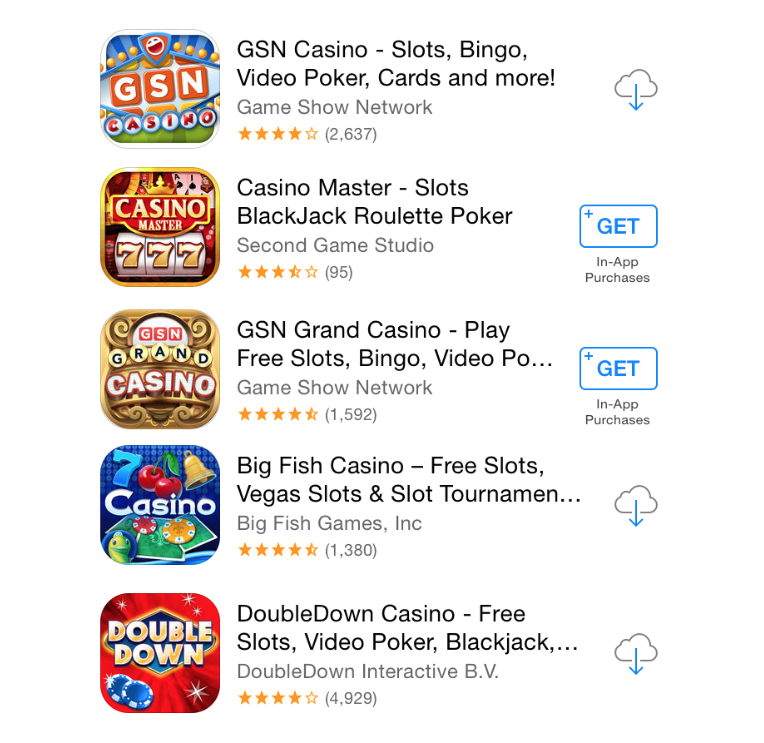
Apps rank higher for keywords placed in the title field. The title field is one of the most underutilized elements of ASO. Take the hyper-competitive Casino category. Below are the top five results for the query “casino” in the App Store:
ASO for game developers

All the above apps have at least six words in the title and anywhere from 40 to 100 characters. They all use many of the same casino-related keywords directly in the title.
Some app marketers argue that a long title is bad branding or an ellipsis at the end of the title is detrimental to a company’s branding. However, it is clear based on Apple’s search results that keywords in the title drive downloads. To maintain the brand experience, add a dash or colon after the app’s name like in the image above.
Google only allows 30 characters in the app’s title. These keywords are still important, but there is less opportunity in terms of ASO. On Google Play, the majority of ASO lies in the description.
On both platforms, it is well documented that changing the title frequently will hurt an app’s rank for keywords. Decide on a descriptive title for your app that includes multiple essential keywords.
I’m On Google Play. Where’s the Keyword Field?
As many game developers who have an app on Google Play are already aware, Google has no keyword field. Google crawls the description to gather keywords. The best practice is to repeat any major keyword five times. The description field on Google Play will be read by both human users and text crawlers. Make sure to write the description in a way that is friendly to both groups.
Apple does not currently use the description field for ASO purposes. This section is still important in helping users understand what your app is about and why they should download it.
A Picture is Worth 1,000 Words
Ok, that’s not quite true. But having an eye-catching icon and screenshots are essential for grabbing a user’s attention. Each app has a precious few seconds to show a potential user why they should install. Screenshots can show the user interface, gameplay, what makes your app unique, what problem your app solves or any other variety of activities. The important thing is that the screenshots are engaging.
Google Play has room for eight screenshots and the App Store allows five. In either case, the best screenshots should go in the first and second positions.
In addition to the screenshots, both Apple and Google also allow developers to upload a short video. Creating a game trailer is the ultimate opportunity to show a user why your app is amazing. Twenty to thirty seconds of gameplay will be more impactful than screenshots in most cases.
People Influence People
Ratings and reviews are another component of App Store Optimization. These pieces of user feedback don’t carry as much weight as the keywords or title, but can have an impact on how well an app ranks in the search results.
Between the two platforms, Google Play places more of an emphasis on ratings. Users will rarely see an app with a rating below 4.0 in the top ten for a competitive query. If you have any uncertainties about how users will respond to your app, it may be worthwhile to soft launch your game for a multitude of reasons including the impact on ASO.
It is rumored that Google also includes engagement data and uninstalls in their ranking algorithm. GameAnalytics can help improve these metrics, which we will cover in our upcoming post on Tutorials and First Time User Experience.
Localization
If you are uploading your app to multiple countries’ app marketplaces, localize the app to each country. It is only logical that users will download an app more frequently if it is offered in their primary language. BothApple and Google have guides on how to make the translation easier. Consider adding updated screenshots as well as offering support for each language to achieve the most effective localization. Localization can be tricky without a native language speaker. However, this will help cultivate the app’s user base in multiple countries.
——————–
As with any analytical pursuit, it is important to set goals and expectations. Implementing ASO best practices will not launch your mobile game to the top of the charts overnight. ASO is a gradual process. However, once you have implemented App Store Optimization, downloads will increase, users will find your app more easily and you will rank higher compared to your competitors. Be sure to continue to track your keywords throughout the process, and keep an eye on how many organic downloads you see each day.
TL;DR: App Store Optimization Key Takeaways
  • Use a keyword research tool to learn how you currently rank for keywords and see what keywords your competitors are targeting Add your most important keywords to the app’s title
  • Focus on keywords where you rank high in the search results – top ten is best
  • On iOS, keywords come from your title and keyword fields.
  • For Google Play, keywords come from your title and description fields. Important keywords should be included about five times.
  • Localize apps where possible. An app optimized for English won’t rank well in a Japanese app marketplace.

In the Moment Marketing With Mobile Advertising: The Next Big Leap

clickz.com
affluent-millennials
The new battle for the consumer is raging on mobile, as preferences and purchase decisions are made in “micro-moments”.
Online and offline now intersect on mobile, and the signs of change are everywhere. Visit just about any store and you’ll see shoppers on their smartphones or tablets, with 82 percent of consumers using their mobile devices when making purchase decisions instore, according to Google. But Internet thought leader and venture capitalist Mary Meeker reports a $25 billion mobile advertising gap, underscoring the growing amounts of media consumed on mobile (now at 24 percent) versus the advertising that marketers actually allocate for the mobile channel (8 percent). In other words, brands are not taking advantage of a massive opportunity to engage consumers on their channel of choice.
Mobile advertising is uncertain territory for many companies. It’s been just eight years since Apple introduced the first iPhone. We’ve now collectively downloaded more than 350 billion apps. Time on devices grew 76 percent in 2014. U.S. users now look at their mobile devices more than their TVs.
Just a short time ago, mobile was viewed as an “influencer”, affecting sales in non- mobile channels. But in the first quarter of 2015, m-commerce revenue from smartphones rose 123 percent while smartphone visits to e-commerce sites bounded 269 percent over the previous year. Mobile has changed consumer behaviors in radical ways. As Google argues, preferences and decisions are made in “micro-moments”, and that’s where the new battle for the consumer is taking place.

A Single View of the Customer

To support companies as they answer this competitive call, VentureBeat recently published extensive research on the topic “Brands and mobile advertising: How to win”. I had the distinct pleasure of chatting with their vice president of Research, John Koetsier, to gain a deeper perspective on the findings.VentureBeat research indicates that delivering an ad to a consumer that is targeted to his or needs at the right time and the right way greatly increases engagement: 49 percent of Americans will pay attention, 17 percent will engage further, 24 percent actively check out the product or service, and 10 percent will buy or consider a purchase. Not stats to ignore for any brand!
But before you can effectively personalize and target what in-the-moment offers, you need unified omnichannel data. That’s because personalization requires context. When brands integrate customer-level data from the Web, mobile apps, email, call centers, offsite ad impressions - and everything in between - a much richer profile emerges with the potential to drive the highest conversions. You also need analytics to drive mobile app utilization rates and the marketing agility to make app changes in real-time based on actual consumer engagement data.
It is this single view of the customer and agility that is key to marketing in the moment. This is the foundation for making mobile advertising work.
  • Launching Mobile Apps. It all starts with launching apps your customers will actually use. The average consumer may download 40 or 50 apps, but only uses five to seven consistently. Not surprisingly, relevance is crucial to app success. As Koetsier pointed out in his familiar, cheeky tone, apps need to “fill a hole, meet a need, solve a problem, anesthetize a pain, add awesomeness to a life”. And this is only possible with a thorough understanding of the customer across the entire omnichannel landscape.
  • Optimizing Mobile Apps. Optimizing app experiences drives engagement within the app, increases downloads of app updates and improves ratings. It may also increase app adoption and advertising effectiveness. Marketers rely on app analytics to understand how an app is being used, and continuously test and optimize different content and experiences to boost engagement. To do this well, however, you must remain nimble. You need to be able to make app changes in real time, rather than go through the time-consuming task of re-submitting changes to the App Store first. Remember, high app utilization will directly or indirectly boost sales.
  • Targeting and Personalization. While it is challenging to stitch data together across the customer journey, it’s essential to mobile advertising success. As Koetsier put it: “Brands that don’t connect online, offline, mobile and social look stupid. Customers expect you to know what product they have an interest in or bought in the past. If you haven’t connected the dots, you start to message things that don’t make sense, lack context, and strike the wrong tone.”
So what is the major take away? Know thy customer and meet their needs. Deliver on those critical micro-moments effectively, and you’ll be a hero by converting your prospects into customers. As Koetsier summarizes aptly: “If a brand can do this consistently, the brand becomes a superhero: liked, even loved, and promoted to friends and family.” Is your mobile strategy designed to create this level of fandom?

Wednesday, 5 August 2015

Why retailers need to understand the Internet of Things

retailgazette.co.uk
W1siziisijiwmtuvmdgvmdqvmdgvmdevmzcvodk2l0jyb2nvbgxplmpwzyjdlfsiccisinrodw1iiiwimtawmhg0mdbcdtawm2uixv0
We are now living in a digital world and consumers’ growing love for, and reliance on, technology has helped the UK turn into a hotbed of digital development. On average, UK consumers spend almost nine hours every day on media devices, and according to new research from Cisco, there will be over nine networked devices per person in the UK by 2019.

While we continue to become more connected with the online world through the use of these multiple devices, we are seeing a new dimension in retail which allows retailers to connect to and better understand their customers more fluently through the Internet of Things (IoT).  IoT can help retailers get smart by providing automated services without the need of human interaction. For example, recognising that a customer regularly buys apples and providing offers for apples on their next visit. But is this really smart? It may be helpful for regular shopping items, but what if a retailer continues to bombard shoppers for items that are not relevant based on a one-off purchase? This will more than likely force the customer to shop elsewhere.

There is a lot of talk about IoT but it is important for retailers to realise what it actually is and how it can revolutionise the sector. Many people now use automated technology in the home, for example technology which allows you to change the lights and temperature remotely with your smartphone. This is very familiar to millennials, or more specifically digital natives, but also there are others who are weary with the amount of technology being pushed onto them.

Because of this, one of the challenges of IoT is knowing how to exploit it in a way that is not invasive or unacceptable to customers. For example, “smart fridges” are under development which suggests a weekly shopping list based on the contents of a fridge – but not helpful if the consumer doesn’t want to buy the same items each week. It would be much more useful if it alerted to when the milk was about to expire!

As such, manufacturers and retailers need to find out what actually provides consumer value. For example, a smart washing machine connected to the web will allow it to diagnose any problems if it stops working. When a consumers buys a mobile device, they only use 10 apps rather than the 200 apps that are provide. It’s about canvasing what customers actually want and harnessing this, rather than irritating customers with offers that are just not relevant.
Waitrose seen success in this area, with its game-changing launch of “pick your own offer”, allowing customers to choose which products they would like discounts in.
IoT is also allowing different industries to merge such as retail and healthcare, with technology including Fit Bit now popular with many consumers. Whilst currently in their infancy these technologies have the potential to help users monitor aspects of their health, suggest offers on healthy alternatives to their normal shopping and help identify potential signs of illness at their early stages. This type of data collection has the ability to really transform the experience not just immediately but in the long term, by helping consumers making better decisions.


Internet of Things provides retailers with an unrivalled opportunity to monitor information and drive better decision making. However, it’s important for retailers to have a value exchange with the consumer, rewarding them for their time and efforts. Why should they provide their data if a retailer is just going to spam them with discounts that are not relevant? It’s time for retailers to get smarter and follow the best operators’ example by providing customers with what they actually want.

50+ Mobile Marketing Terms You Need to Know

business2community.com
mobile-terms-cover-img

Mobile marketing is a fairly new field with its very own lexicon and lingo. Becoming a mobile marketing master requires that you know the terms of the trade. From SoLoMo to SDKs, we’re detailing all the must-know pieces of mobile lingo to get you up to speed.

General Mobile Terminology

Web Apps. Applications that are accessible from the web – they don’t need to be downloaded (examples include HootSuite and Evernote). While websites cater to users who are simply browsing around the site, web apps are more task-oriented and help users meet specific objectives (such as scheduling social media posts for the upcoming week).
SoLoMo. SoLoMo is the abbreviation for Social, Local, Mobile – the perfect mobile-oriented triad. Use social elements and localization to create the perfect mobile app!
SDK. A Software Developer Kit (SDK) is a collection of tools for software developers. SDKs allow developers to create apps for specific platforms, and third-party SDKs can be installed into existing apps for analytics and marketing purposes.
Second Screen. Second screens are smartphones and tablets that an individual uses while simultaneously engaging with a larger screen (usually a TV). Common second screen activities are tweeting while watching a television show, or browsing Instagram on an iPad while watching a YouTube video on your desktop computer.
mobile-marketing-buzzwords

Jailbreaking. Jailbreaking is the practice of removing a phone’s hardware restrictions, allowing the user to make advanced changes and adjust settings that would normally be locked. Apple products are most commonly subjected to jailbreaking due to their rigid restrictions.
Unlocked. Unlocked phones are GSM phones that are not tied to any specific carrier and can be used with any cellular service carrier’s SIM card. GSM (Global System for Mobiles) and CDMA (Code Division Multiple Access) are the two major radio systems used in cell phones. In the U.S., Sprint and Verizon use CDMA, while AT&T and T-Mobile (and the majority of carriers outside the USA) use GSM.
Wearable Tech. Wearable tech is technology that can be worn on your body, such as Google Glass or a smart watch.
wearable-tech

iOS. The operating system developed by Apple and distributed for Apple devices, including iPhones, iPads, etc.
Android. Android is the operating system developed by Google (and is currently the most popular mobile operating system available).

Mobile Analytics Terms

App Analytics. Analytics information as it pertains to your mobile app! Because apps are task-oriented and websites are information-oriented, you need to measure your app’s performance using mobile metrics (like users, sessions, etc.) Understanding your app analytics is key to developing an intelligent mobile marketing strategy that wins over users.
MAU. MAU stands for Monthly Active Users, concerning the number of users who are using your app in any given month. MAU is often a better metric for analyzing app performance because it counts users who download your app and actually used it. Only looking at the number of app installs completed doesn’t provide a great overview of your app’s success because some users will install your app but never open it. MAU is a much more helpful metric for measuring your app’s performance.
DAU. DAU stands for Daily Average Users – a metric measuring how many users open your app each day.
Click-Through Rate. Click-Through Rate (CTR) is the ratio of clicks your ad receives compared to the number of impressions (aka views) the ad receives. CTR = clicks / impressions. High CTRs are a huge deal for marketers (both mobile and web).
Conversion Rate. Your conversion rate is the percent of users who complete your desired goal. Conversion goals are different depending on your business – some apps want e-mail addresses, some want in-app purchases, and others want ad clicks.
NPS Surveys. NPS (aka Net Promoter Score) is a metric that measures your user’s level of loyalty. NPS surveys ask a user to rate your app on a scale of 1 – 10. Those rate your app with a 9 or 10 are considered “promoters,” those who rate you at 6 or below are “detractors,” and anyone who rates you a 7-8 are “passives.” You can use NPS surveys to decide which users you want to ask for app reviews. Promoters are super valuable – send them to the app store so that they can write a raving review of your app (which they adore)! Passives probably won’t bother taking the time to review you. Detractors could potentially burn you in the app store, so avoid directing them there when possible.
User Segments. Groups of users that share similar profile data or behavior.
Platform. The operating system users use on their mobile devices to access the web and your app. You’ll likely need to create different versions of your app for different device platforms.
Cohorts. A group of users that have completed a specific action within a specific time frame. Cohorts are different from segments because they use the added dimension of time. For example, one cohort could be users who downloaded your app in the month of June.
Time in App. How much time are users spending in your app? This mobile metric differs from session length in that you can see the time a user spent in your app within the last day, week, or month. This is a great indicator of how valuable users consider your app.
Sessions. Sessions occur whenever a user opens your mobile app.
Session Length. How long a user spends actively engaging with your app. Session length is typically counted from app open to app close (or until they navigate away from the app for more than 15 seconds).
Session Interval. The time between a user’s last session with your app, and their next session, reflecting how frequently users are returning to your app.
Screens. The app version of website pages, screens tell you how many different app screens a user explored during their session.
Screen Flow. Screen flow tracks how users move through your app (which screens did they visit and in which order?).
Events. Actions that a user takes in your app during a session. Examples of events include logins, video plays, in-app purchases, information entries, setting changes, etc.
Event Attributes. Event attributes provide more context around events. For example, the event “article read” could have attributes like “article title” or “article publish date.”
App Funnels. Funnels are sets of events that allow you to get a better sense of how users interact with your app and track key behavior paths. In other words, an app funnel is a series of connected in-app events that lead to the “ultimate” in-app action (like a purchase or social share).
Dimensions. Dimensions are pieces of session-level data that can be used as filters. Examples of dimensions are new vs. returning users, device type, or time dimensions (days, weeks, months).
LTV. Lifetime value (LTV) is the value your user delivers over the course of their entire lifetime engagement with your app. For apps, lifetime value can be a traditional monetary amount, or a form of data, like levels completed, articles read, notes taken, or images taken.

Mobile Marketing Terms

App Marketing. App marketing involves all efforts in earning (and keeping) app users. App marketing involves everything from promoting your app to drive installs, to improving your app’s UX and sending the right messages to keep users engaged.
ASO. ASO stands for App Store Optimization – the process of refining your app store listing page to improve your app’s visibility. Key elements of ASO include optimizing your app’s title, selecting relevant keywords, and earning high user reviews.
App Reviews. As discussed above, app reviews are an essential part of ASO. In both the iOS App Store and the Google Play Store, users can rate and review your app. These reviews have tremendous power, as new users will be much more likely to install an app that has received favorable reviews over an app with 2 or 3 stars.
mobile-app-reviews

App Versions. When you improve and update your app, you create a new version of your app that users must download in order to get access to the latest features or bug fixes.
App Monetization. App monetization is how you make money from your app. When it comes to earning that great green stuff, you have a few different options:
  • In-app advertising (third-party apps advertising to your users).
  • Charge for your app (users pay to download your app).
  • In-app purchases (such an upgrade from a free to pro version with more features or a gaming app which allows you to buy levels or upgrades).
Want to learn more? Check out our larger, more in-depth post on app monetization strategies.
In-App Messaging. In-app messages are nurturing messages sent to users while they are actively using your app. In-app messages should be a natural part of the app experience because they highlight new features, offers, surveys, etc. These pop-up messages allow for more customization and design compared to standard push notifications.
mobile-marketing-terms

Push Notifications. Push notifications are messages delivered to a user’s home screen (or lockscreen) when he or she is not actively using your app. These messages are intended to drive attention and traffic back to your app – for example, a push notification from Amazon about a limited-time lightening deal could be the gentle nudge that gets the user back into the Amazon shopping app for a purchase.
mobile-terms

Banner Messages. These types of push notifications appear at the top of a user’s screen and disappear after a few seconds.
banner-screen-message

Alert Messages. Alerts are push notifications that take up prime real estate on a user’s screen and require action by the user. Alert messages are often associated with calendar and event-based apps.
alert-app-message

Lock Screen Messages. The lock screen is the screen users see when they begin to engage with their phone, or “wake” the phone up from sleep mode. Lock screen alerts are another form of push notifications. Lock screen messages are similar to banner alerts in that they don’t require user action, and disappear when the user unlocks their phone.
lock-screen-message

Geotargeting. Targeting users based on their current location (whether by country, state, or street) and sending app messages relevant to where they are.
geo-targeting

Mobile CRM. Customer relationship management (CRM) refers to strategies and tools used to manage interactions with customers, in hopes of improving retention and driving sales. A mobile CRM is focused specifically on managing your relationship with your app users.
User Behavior. The general term for what users are up to in your app.
App Store. Apple’s online store where iOS users can search for and purchase apps, which are then downloaded to their devices. The App Store is home to over 1.5 million apps for iOS users.
mobile-marketing-lingo

Google Play Store. Google’s version of the App Store, the one-stop shop for finding and downloading mobile apps, ebooks, music, video content, and more. The Google Play Store offers a selection of over 1.6 million apps to Android users.
google-play-store

CTAs. Call To Actions (CTA) are the directions you give mobile users, in hopes of spurring a conversion. Some common mobile CTAs could be “upgrade now” or, for mCommerce, simply “add to cart.” These CTAs can either be text only (for push notifications) or look like a button (for in-app messages).
mCommerce. It’s ecommerce – but for mobile! mCommerce apps are retail or shopping apps, focused on getting users to make product purchases via their mobile devices.
Opt-Out. When users choose to no longer receive push notifications from your app. To avoid getting unsubscribers, make sure you’re not spamming your users!
In-App Purchases. Purchases that users make from within your app. This can involve upgrades from the free to paid versions of your app, real money purchases used to obtain in-game currency, physical goods and services purchased within an app, etc.
in-app-purchase

Cross-Platform. Cross-platform apps can be used across multiple operating systems (for example, an app that is available for iOS, Android, and Windows phones).
Multi-Channel Marketing. Marketing that takes place across several avenues a user frequents. For example, a multi-channel marketing campaign might involve mobile app notifications, emails, and remarketing campaigns.
Personalization. The act of tailoring offers and messages to users based on their profile or previous actions in your app (and across your other marketing channels!)
A/B (or Multivariate) Testing. A/B testing is one of the cornerstones of online marketing, and it’s just as essential when dealing with mobile. A/B (or C/D/E) test multiple messages to see what resonates with users and what falls flat. For example, you can test different copy, colors, button sizes, offers, etc. to see which one drives the most clicks and conversions.
UX. UX refers to the overall user experience of someone using a mobile app. Developers and marketers should focus on creating an app that works smoothly, is well designed, and easy to use.
Geofencing. Geofencing uses GPS to create a virtual boundary or radius. Geofencing can be used to send app users offers or messages when they enter a certain range. For example, geofencing may be used to send an app user a coupon for 20% off hamburgers once they are within a half-mile radius of one of your brick and mortar stores.
That concludes our glossary of the mobile app terms you need to know for mobile marketing success. Did we miss anything? Add your favorite pieces of mobile lingo in the comments!

Why Your Business Shouldn’t Opt-Out of SMS Marketing

blogs.imediaconnection.com

I Have an App So Why Use SMS?

The rules and regulations for a text message marketing campaign are confusing. Trust me, I know. There are a lot of guidelines to follow and they are constantly evolving. For example, how are you supposed to know when to include the phrase “txt STOP 2 stop” or that you no longer need to say “msg & data rates may apply.” This is why many companies are turning to app push messages to interact with their clients instead of text messaging.App Push vs. SMS text
But before we discuss app push messages, let’s consider the process of app consumption. First, the consumer must know the app exists; then, learn about it; search it; download it; accept lengthy agreements about who even knows what; approve notifications; approve location; create login information; and finally, get started with the new app.
Now this is the moment of truth. It’s this moment that the consumer decides the fate of your app. According to Localytics, 20% of apps are used only once, therefore threatening the lifespan of your app on the consumer’s smartphone.
If your app does make the first round of cuts, it’s important to note the steady competition with other more important items in the mobile world. For starters, the average consumer has over 25 apps sitting on their smartphone home screen (Nielsen). Additionally, in a battery bind, consumers are less likely to use apps in order to leave the remaining battery life for receiving text messages or making phone calls. If storage space is low, what’s going to be deleted? That picture of the family from last year’s Christmas or that app that’s just sitting on one of the back pages on your smartphone? You got that right – that app is a goner.
There is one app that is almost guaranteed to always make the mobile team: text messaging. Text messaging is the one common denominator across all mobile platforms. It’s the way all mobile devices communicate. It’s personal; it’s high priority; and it’s effective.
According to Forbes’ 50 Essential Mobile Marketing Facts, 90% of all text messages (even promotional ones) are read within three minutes of delivery. But, how many people are reading your app push messages? Data from Localytics shows that only 3% of your app push messages are actually being opened and read. If you can customize the push message based on consumer preferences or behaviors, that number climbs to a mere 7%.
I know what you’re thinking. Smartphones have cool features like geo-locators, Siri, Apple Pay, and more. Therefore, text messaging is so yesterday. Not so fast. SMS continues to offer one of the most reliable and ever-present communication mediums.
Text message marketing can do more than just deliver a message. Text messaging can spur engagement. It can include a link to your mobile website, a ticket, a sales promotion, a reminder, an invitation, and more! You can find a list of SMS marketing best practices here.
Bottom line, it all comes down to engagement. The app is a necessary element of an effective marketing program, but it is not sufficient in itself. All mature mobile marketing programs must also include a text message feature to engage your audience through a wide variety of content on a personal level.  So take the time to learn the text message marketing rules; they aren’t so confusing that you should stop using the most ubiquitous medium out there. The statistics speak for themselves – app push messages are an enhancement to your marketing strategy, not a replacement.