Monday, 13 July 2015

Twitter Introduces Video App Ads, Bidding Based On Actions & Installs

marketingland.com
twitter-your-ad-here-ss-1920
Twitter announced several additions to its app install advertising tool kit today.
Advertisers will be able to promote apps within video ads and optimize bidding for installs and actions. Here’s how Twitter described the new bidding features, to be rolled out globally in the coming months, in a blog post:
Optimized action bidding: This new bidding type allows app install advertisers to optimize their bids according to install, while still paying by app click — offering another way to lower cost-per-installs and yield the highest possible ROI.
Cost per install bidding: Advertisers can bid, optimize and pay by install giving you cost-efficiency and maximum control over your cost per install.
Also, Twitter said app marketers will soon be able to target mobile users on Twitter partner apps on more than 1 billion mobile devices. Gaming company Kabam has seen strong results in testing. “We’ve been thrilled to have multiplied the scale of our top 10 grossing Marvel: Contest of Champions install campaigns by 5x by running them on Twitter partner apps,” Kabam vp of marketing Jordan Edelstein said in the Twitter blog post. “We look forward to the opportunity using mobile app promotion to help maintain Kabam’s market leadership position.”
Twitter, which introduced its app install ad products a year ago, said advertisers using the program are seeing high returns on investment across all verticals, from tech to entertainment to retail. It said delivery service Postmates doubled conversions and experienced cost per install rates 25% lower than other ad platforms. Lyft said it’s getting up to three times better performance than other social channels. Comedy Central said it has exceeded its CPI goals by 66%.
Ticketing service SeatGeek is also pleased. “Over the course of the last year, we’ve consistently been able to beat our cost per install targets by 20% on several hundred thousand installs,” SeatGeek director of growth Will Flaherty said in the Twitter post. “We saw strong gains in cost efficiency using tailored audiences to exclude previous app installs from our user acquisition campaigns, even as we’ve continued to scale our efforts.”

twitter-app-install-info

Friday, 10 July 2015

Building a content strategy for the internet of things

theguardian.com

In a connected world, marketers must use content to provide great experiences for people instead of just being a way to deliver advertising messages
USB plugs
Content in a connected world of things has endless possibilities. 

The idea of content is changing. It’s no longer just about videos, social posts and websites. Our fridges, washing machines and watches are serving us recipes, news, entertainment and advice. It’s all part of a new, encompassing, connected world – the internet of things (IoT).

IoT is a complex, adaptive performance of ideas and information – content – perfectly choreographed with our behaviours. What we want, where we want it, on whatever device is within reach.

Brands are racing to understand what this means for how they talk to customers. These new touchpoints require rethinking how content can work for these new screens in our homes, on our wrists and in places we haven’t even thought of yet.

While content strategy is part of a bigger process spanning technology, industrial engineering and experience design, understanding the role it can play is critical to success within IoT.
After all, the goal is to deliver relevant content in the right contexts.

Experience-first thinking

Content strategists usually plan the content that drives websites, apps and brands. Now, they are finding themselves in teams designing systems where hardware, human habits and physical spaces intertwine.

Alongside experience designers and creatives, content strategists are an important part of defining how content powers and populates these ever-evolving networks of connected things.

Does entertainment news only belong on the TV and recipes on the fridge? How should content respond to people’s behaviours? How does it adapt to different touchpoints?
As IoT systems get bigger and more complex, content strategists will also be a part of exploring the physical influence content can have over a connected space. Setting a room light to blink when a piece of content is most relevant, for example.
When it comes to IoT, we’re really coordinating something bigger than just a network of content – we’re building rich, lived experiences. This means we need to define the experience before we burrow into the technology, interfaces and content.
Experience-first thinking also illustrates how important content strategy is to the mechanics of ideas, information and behaviours we encounter in the connected world.

Innovative, insightful content marketing

Every day, businesses ask about IoT and what it means for their brands. Part of this is exploring what it means for content marketing and native advertising initiatives.

As we’ve seen with products like Nike+, brands can innovate their way into people’s daily routines. In the same way, to market within IoT, you need to find ways to enrich lives in exciting and valuable ways. After all, most people won’t want ads appearing on their expensive fridges.
The same principles apply to content marketing in connected spaces.

A precise understanding of where, when and how your brand should appear illuminates the right opportunities and ensures you emerge in sensible, welcome ways.

This also involves a layer of innovation: what are the latent or subconscious needs of your customers and how can you create something wonderful to satisfy them?
If we take the time to understand these things, there is unlimited potential to create a connected experience that does for content marketing what Nike+ did for mobile, apps and sports marketing.
Rule of thumb: build the right teams and don’t skimp on strategic thinking. Valuable content built around rigorous customer insights is the difference between Red Bull and preloading a U2 album.

Start with insights, finish with experiences

To make sure IoT-delivered experiences are meaningful and useful, we must take the time to carefully understand the role that real-time, personalised and poignant content can have. And part of this is defining how it’s made, maintained, and served – in other words, content strategy.
While content strategists can’t do this on their own, their traditional skills around change management, publishing and taxonomy design are valuable parts of building these experiences.
When it comes to connected content marketing, everything needs to start with careful insights and a strategy built around what people actually want – not simply what your brand wants to say.

Content in a connected world of things has endless possibilities. It can grow, change, adapt and connect with people in seemingly impossible ways. The best way to unlock this potential is to involve smart content thinkers.

How to take over the app store in 48 Hours

thenextweb.com
It’s obvious enough that a newly launched app can’t really take off on its own – vast marketing efforts are vital to accomplishing any kind of exposure and acquiring an initial user base. After launching their app, marketers often watch eagerly and anxiously as the first users pile on. However, in many cases early-stage apps take a long time to develop an active user ecosystem, and in most cases fail to do so.
It’s important to remember that the launch period of an app is a critical time for marketing since it’s an opportunity to be spotted as a hot new product. Many companies launch an app without the appropriate marketing efforts and end up regretting it after realizing the opportunity that escaped from them.
So app marketers – stop anxiously waiting for a miracle to happen and pursue the results yourselves! How do you launch with-a-bang and attract a maximum amount of users in a minimal amount of time?
The answer is “burst campaign.” Taking aggressive marketing measures using a relatively high budget in a time span of 48 hours in order to achieve visibility, increase organic download volumes, reach high app store rankings, and go viral.
appstoreoptimization
But first, let’s put things in context. In order to reach the app store’s top charts, an app needs to be one of the most downloaded apps in a certain country on a specific day. The exact figure varies from country to country, depending on the number of mobile devices used by its population as well as the total amount of daily downloads in the country’s app store on that day. Achieving such a high volume of downloads in a single day as a newly-launched app is extremely challenging and nearly impossible.
Most of you must be thinking it’s completely reckless to go through so much of a company’s budget after just launching an app, however, it’s worth the risk. Choosing the right launch strategy can make or break your app, so instead of thinking of this as a one-time splurge, consider it a long-term investment. Acquiring a large amount of organic users right in the beginning is only a launchpad for more and more to come.
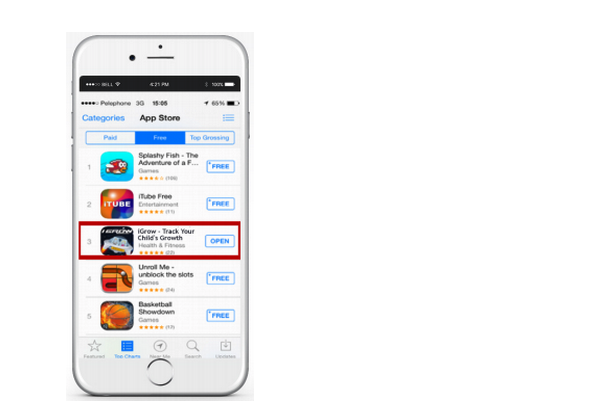
I’d like to use an example from my own experience working with Pfizer. The company set out to launch an app that aims to educate the market about its solution for Growth Hormone Deficiency in children, which enables parents to track their children’s development. Pfizer’s main goal was to promote the app to a prominent spot in the app store.
Our main goal was for the app to reach a prominent spot in the app store while attracting as many parents as possible to it. We starting by rolling out a highly targeted mobile campaign that lasted two days and ran on various social, RTBs and ad networks.
Screen Shot 2015-07-08 at 12.33.46
Within 48 hours, Pfizer Reached the App Store’s Top 3 most downloaded apps, thus increasing organic download rates and lowering CPI. The average CPI during the campaign period was half of the average cost in the market. Our most outstanding accomplishment however, was attracting quality users, ten of thousands of parents that used the app and remained active for a long period of time.
So how’s it really done? Let me break it down for you:

What to Do

Concentrate your efforts on a short period of time for an aggressive marketing campaign and focus on the following steps:

Media Buying

  • Run campaigns across as many ad networks, RTBs, exchanges and major social platforms as possible. The goal is to reach as many users as possible, and therefore maximizing your sources can be instrumental in reaching that goal.
  • Do not opt for incentivized platforms or bots as it’s against Google Play and Apple policy and compromises the quality of users. It might seem tempting but make an effort to refrain from incentivized platforms, as they won’t earn you engaged and active, loyal users.
  • Check the price of each offering and choose the cheaper kinds in order to maximize your budget. As mentioned earlier, the goal here is to purchase media from as many sources as possible, and if you opt for the more expensive ones you’ll simply run through your budget quicker.

Monitoring

  • Check your results in real time, ideally once every hour. Since the campaign runs for a relatively short period of time, it’s important to check in as frequently as possible to make sure you’re heading in the right direction.
  • Optimize your campaign results according to the data you receive. Checking your campaign results regularly allows you to catch problems and deal with them immediately.
  • Once you’ve reached the App Store’s Top Ten, continue purchasing downloads until your budget runs out in order to stay in the top ranking for as long as possible.

What to Expect

Appstore
  • A high App Store ranking
  • A dramatic boost in organic downloads as a direct result of a high placement in the App Store’s top ranked apps
  • A significantly lower CPI as a result of the massive amount of organic downloads
  • An established user base
As you’ve probably noticed, the actual process is more complex than it seems. Most global brands and startups don’t have an experienced team of media buyers and creative professionals who are able to deliver top level results. Achieving outstanding results requires an outstanding team, and therefore my last suggestion would be to spot a trusted partner to work with that’s able to perform to that level on mobile.

How the datafication of marketing is affecting the mobile experience

imediaconnection.com
Resultado de imagen para mobile marketing
Marketers have never had greater access to customer data than they do today. And as a result, we'll start to see greater uses of data to provide more context in how customers engage on mobile devices. Additionally, more and more marketers will get better at using their data for marketing purposes. It's going to be a scramble in the digital marketing world to harness and use customer data from the mobile experience, and as more people are starting to experiment with this, those who miss the boat will be left far, far behind.
We can see a trend in mobile advertising, where perhaps the biggest bucks are being spent on mobile. The CPC campaigns, where it all began, died at the hands of more complex CPI campaigns. Once advertisers started paying for installs, the focus shifted from enticing users to click to having them actually download the app. This would only be possible once conversion tracking tech becomes more commonplace and the tech stabilizes a little. Retargeting and re-engagement then comes into play, as the tech develops even a little further. All along, the ecosystem is working on using the data and tech that's being built up to provide users with better experiences. This next movement is growing out of that same drive.

Today, most mobile apps are static in that they don't respond well to context. Apps more or less always behave the same regardless of who you are, where you are, and what you do. Yet now we're starting to see more and more companies experiment with using customer source data and injecting it into apps for contextualizing the customer experience. Good targeting was just the first step. Now we're entering an era where marketers are able to move large quantities of data around in order to do some really innovative things to contextualize conversations with customers.
These techniques seem daunting to a lot of people, but they aren't that complicated.

So how can you ensure that you're not left in the dust?
If you have a tracking system in place, you already have tons of data to engage your customers on a much more personal level. The following are some key use cases that you can start using today:

Customize the on-boarding experience

Leverage your real-time advertising data to optimize the initial in-app user experience. By using data you're already capturing about your customers from the ads they click, you can dynamically match the content in your on-boarding process to the ads the customer was shown, and tailor the on-board views based on ad messaging and images that were clicked.

For instance, tech fashion startup Vinted decided to customize its initial customer on-boarding experience by using advertising data. The company tracks dozens of advertising sources and the performance of each ad creative displayed. By funneling data, such as the product image and message displayed, in the ad to the customer, Vinted was able to pull the ad creative shown and generate the on-boarding process dynamically when the customer opened the app for the first time. By creating a more contextually relevant in-app experience for new customers, Vinted was able to increase their conversion rates and customer engagement from the onset.
Through excellent targeting, many app businesses are great at targeting specific USPs and use cases to specific customers, but fall short when it comes to emphasizing those selling points in the product itself. In one case, a mobile payments provider converts customers from many different verticals: flea market stands, independent coffee shops, or service providers on the go. Each of these customers has varying contexts in which they use the service and problems that the service solves. By looking at the marketing data, the app is able to serve a different on-boarding process, including customized video material that seamlessly ties into the wording and USPs that the creatives sell to customers.

Drive social referrals

Did you know that social referrals can become smarter by mixing in tracking data?
More and more app developers are starting to build better social referral mechanisms. Each social referral is a source, like a creative, and many already track the performance of customers who are coming specifically from referrals from other customers. By plugging this data into the chain, the app can immediately pull up your friends' profiles and deliver rewards in real-time, before a standard funnel even takes place.
By building those social connections, you can create smart social recognition connections, close the referral circle to track results, and increase your customer referrals volume.

Streamline couponing

Especially in re-engagement campaigns, we're starting to see numerous apps offering special deals via coupons for customers who return to the app. Being able to pull this data directly from a straightforward API when the customer first opens the app allows your app to contain all its functionality, knowing in real-time immediately, and with no visible delay, if the coupon should be redeemed or not.
For instance, if you give someone a coupon for a pizza off Delivery Hero, you can not only start the app by showing the available pizza places, you'll immediately discount it at the checkout. This is a completely new experience we're starting to see rising among app marketing that's leading to increases in conversion rates.

It's not too late to start using more data

Marketing data is the future of mobile apps and customer experiences -- and there's no doubt in the industry that this need for more and better marketing data and the tools to manage it will continue to grow.

It's time to ask yourself if you are using the data sources that you have at your fingertips most efficiently to engage your customers.

How are you best using your advertising data? Your in-app data? Your partner data?

The future haves and have-nots in marketing will be separated by how effectively they are using their customer data. If you haven't already, now is the time to begin taking big steps in connecting your customer data and actions inside and outside the app experience to create a brighter future.

Thursday, 9 July 2015

Connected travel: Highlights of the 2015 Airline IT Trends Survey

kippreport.com
Three years from now, travelling will be an entirely different experience
Passenger plane above the clouds.

1. More than 80 per cent of airlines are focused on solutions to improve personalisation, according to SITA’s 2015 Airline IT Trends Survey
2. 74 per cent of airlines are planning to offer unassisted self bag-drop by 2018, compared with 17 per cent today
3. 70 per cent of airlines expect to have baggage location status updates by 2018, compared with the ten per cent who currently have that service
4. 86 per cent of airlines strongly agree that Internet of Things will present clear benefits in the next three years
Do you think airlines are focusing on the customer enough?
According to SITA’s 2015 Airline IT Trends Survey, more than 80 per cent of airlines are focused on solutions to improve personalisation, with 52 per cent investing in major programmes in the next three years.
Want to know how the aviation industry will mature by 2018? According to the survey:
1. Promotion of airline offers will become much more apparent, with a whopping 91 per cent of airlines planning on adding this service, compared with 55 per cent of airlines who currently have the service.
2. Ancillary services sales via kiosks are set to be added by 2018 by 73 per cent of airlines, up from only 19 per cent who currently offer the service.
3. 72 per cent of airlines are planning to add airlines services such as seat bookings, meals, Wi-Fi, lounge access, etc. by 2018, versus only 33 per cent who currently have these services.
4. 69 per cent of airlines are planning to add other travel services such as cars, hotels, transport, parking and more to their shopping services. Only 22 per cent have them today.
5. 47 per cent of airlines are planning to add a duty free shopping app to their services list, compared with 11 per cent who currently have the service.
According to the survey, unassisted self bag-drop is on the rise, with 74 per cent of airlines planning to offer the service by 2018, up from only 17 per cent today, allowing passengers to be independent during their travels. In addition to that, 70 per cent of airlines expect to have baggage location status updates by 2018 while only ten per cent who currently have that service.
The study also shows that airlines are embracing the digital world and are working hard to meet their customers on the platforms they are already on – their Smartphones. As many as 86 per cent of airlines strongly agree that Internet of Things (IoT) will present clear benefits in the next three years, but only 37 per cent have allocated a budget allowance to implement IoT.
Want to know more? Have a look at the infographic below.
1288 Airline Charts Infographic 2015 A4 v7.indd

3 Ways Data-Driven Marketing Drives Higher ROI

smartdatacollective.com

data driven marketer

3 Ways Data-Driven Marketing Drives Higher ROI

At the heart of good marketing is data. And when data drives your marketing, the average return on investment (ROI) is a whopping 224%! (VB Insight)
VB Insight surveyed over 3,000 marketers and looked at tools used on over 3 million websites. Even small improvements have the potential to drive higher ROI. According to the research, if your business has a 4-phase customer acquisition funnel, and you improve each phase of the customer acquisition funnel by as little as 5%, the overall improvement is 22% at the bottom of the funnel. 
Customer data has clearly become a valuable currency for marketers of all sizes and across all industries. However, if you feel as if you are downing in a sea of data, here are some key ways to drive more revenue with better marketing and better data.

Break Down the Silos

You may have loads of data, but if it’s sitting in different systems and in various formats, your data is doing you no good. For example, your billing records may be stored in one system with certain customer details, and your customer service logs may be stored in another database with an entirely different set of customer information.
Each of these sources contain important customer details – basic information such as contact details, as well as more detailed information, such as behavior information (frequency of purchase, transaction value, email click-throughs, and so on.)
data management, data silos
A data management solution should be implemented to integrate multiple data sources and automate data quality processes. Data management software will perform functions such as:
  • Cleanses and standardizes data so consistent formats can be integrated
  • Consolidates customer data into a single record
  • Eliminates duplicate data records
  • Monitors data to ensure it remains accurate
  • Appends missing customer information (email address, street address, etc.)

A 360-degree Customer View

By merging these systems of data into a single repository, customer details come together into a 360-degree view. With this singular customer view, you can apply analytics to accurately understand what your best customers look like and find answers to key questions such as:
  • What products have they purchased, and what is their purchasing behavior?
  • How do I keep my best customers loyal?
  • What channels do my customers and prospects prefer?
  • What opportunities are there to maximize customer value through up-sell or cross-sell offers?
  • What patterns may indicate unhappy customers and how can I mitigate attrition risk?
360 customer view

Customers Want Personalized Experiences

Your customers ultimately want to be understood – they expect a seamless experience with your company, want personalized offers and are more receptive to messages sent through the channels they prefer.
Salesforce.com asked consumers how they felt about their data being collected by companies to establish this comprehensive customer view. The overall feeling was that if their marketing data allowed companies to personalize offers, provide better customer service, or prevent situations in which they have to give the same information to multiple people over and over, then it was a good thing. One respondent said, “I don’t want to have to repeat my information to 5 different people when I call their support line,” and according to another, “It dramatically increases the likelihood that I would continue to give a company my business.”
Research shows that 45% of consumers are more likely to shop on a site that offers personalized recommendations, and 56% are more likely to return to a site that recommends products. (Invesp)
When deciding which types of personalization to utilize, consider the following statistics from MyBuy’s 2015 Personalization Consumer Survey. Consumers purchase more from brands who:
personalization, marketing stats

While there is obviously huge uplift when personalizing consumer interactions, many marketers are unaware of the negative impacts of sending impersonal messaging. A recent survey by Gigya revealed that 67% of consumers have unsubscribed from an email list when sent irrelevant information. An additional 43% ignored future communications from the company, and 32% stopped visiting the company’s website or mobile app.
At the heart of good marketing is data. Your data can tell you who your customers are, what will keep them loyal, what offers they will respond to, and ultimately, how to drive higher revenue.

Wednesday, 8 July 2015

How to make waking up more bearable with the internet of things

gadgetshow.channel5.com
Mr Coffee

Forcing yourself to wake up in the morning is never nice, but modern tech can help to take the edge off stumbling out of bed, and thanks to the internet of things and a load of incredibly cool gadgets you can now wake up to the smell of a fresh pot of coffee, surrounded by soft and friendly lighting and with the heating set at the perfect temperature.

The internet of things has seen some brilliant connected gadgets pop up over the past year or two, making it easy to control pretty much any household gadget using apps on your smartphone or tablet, and meaning there's no need to get out of bed in the morning to get the most out of them.
Soft lighting
Granted, for most of us it's not an issue at this time of year, but there's nothing worse than your alarm going off and waking up in the pitch black, fumbling around bleary-eyed for the light switch, and being jolted awake by overly bright lights. Replace your home lightbulbs with Philips Hue and that's a thing of the past, with the connected bulb offering control via your smartphone. Better yet, you can set the smart bulbs to lighten gradually in the morning, potentially waking you up to (admittedly simulated) daylight, with your body waking up naturally rather than your foghorn of an alarm - what's not to like? 
Netatmo Thermostat
Heating is another area that can make a massive difference when it comes to the start of your day, with none of us wanting to get out of bed when it's outrageously cold. The Netatmo Thermostat makes things a lot easier, letting you adjust the temperature via Wi-Fi or Bluetooth, and with an additional cube-shaped accessory designed by Phillppe Starck that you can place anywhere around the home to make changes to the temperature. We love the idea of being able to whack it on our bedside table, only having to reach out an arm from under the duvet when you get cold.
Netatmo Thermostat by Starck review
The connected oven
It's always easy to grab a bowl of cereal when you first wake up, but if you're the sort of person who wants something a little more substantial, the Discovery IQ Dual-Fuel Range cooker could be ideal. It packs in touchscreen tech and Wi-Fi, and like the other gadgets here you can control it straight from your smartphone. So as long as you've popped your ingredients into the oven, you'll be able to whip up breakfast without leaving the comfort of your bed - at least until that bacon needs flipping...
Coffee on demand
Waking up to a room full of light is great, but imagine if you could wake up to a fresh pot of coffee each morning. Even if you live on your own and have nobody willing to stick the kettle on for you, that's precisely what you can do with Mr. Coffee. Belkin is behind the Wi-Fi compatible gadget, which can be controlled by your smartphone or tablet, and it also throws in the ability to set schedules, making sure a fresh brew is ready the second your alarm goes off (or even before).
Wake up to fizzy drinks
OK, so carbonated drinks aren't typically great for us, but sometimes it's the first thing on your mind when you wake up in the morning, and the SodaStream MIX can turn pretty much any liquid into a fizzy refreshment at the touch of a button. Better yet, it's also part of the internet of things, with a smartphone app that lets you control it from afar (well, from your bed in this case), so that refreshing drink will be on hand as soon as you stagger into the kitchen in the morning. It's just a shame the SodaStream Mix can't deliver your drink to your bedside table, too!
sodastream mix
Nest Thermostat
The Netatmo Thermostat impressed us, but it's not quite as versatile as options from Nest, and you'll even be able to control your heating by speaking into your mobile. Use Nest alongside Android app Tasker on your smartphone, and you can set the AutoVoice action to work with Google Now to drop or whack up the temperature when you wake up in the morning.
Turn any other gadget into a smart device
Want to turn your toaster into something a little smarter, and wake up to the smell of fresh toast? You could do just that - or control any other number of gadgets around your home, using the D-Link DSP-W215 Wi-Fi Smart Plug, which can be controlled by an app on your phone or tablet, and let you activate any device without physically having to be there. So as long as you make sure the bread is in your toaster, and it's otherwise turned on and set to go, you can create a schedule using the D-Link Smart Plug to ensure the toaster turns on at a specific time in the morning, coinciding perfectly with your alarm.