Monday, 11 August 2014

Integrated loyalty may hold key to mobile payments adoption (mobilepaymentstoday.com)

Mobile wallets have failed to gain steam in the marketplace due to a number of reasons, including consumer fears around privacy and security, an absence of the needed infrastructure to execute such payments and the convenience of established payment methods. The nagging question for many in the payments industry remains what it will take to convince consumers to use a mobile phone to regularly execute payments.
Ultimately, mobile payments must be as cheap, safe and easy to use as traditional payment methods to even be considered a viable option. Merely making mobile payment infrastructure ubiquitous likely won't be enough to entice a broad consumer base. Regardless of the payment options available, most consumers will choose the one that provides the greatest value. In order to encourage wider adoption and ensure high usage, mobile payment players will have to provide a value add, which could come in many forms, including monetary savings, improved security, or increased loyalty. Of all these potential benefits, mobile-driven loyalty may be the greatest factor with the potential to drive consumer adoption of mobile payments.
One early study by Accenture indicates that consumers can be incentivized into using mobile payments. The majority of the U.S. and Canadian consumers were resistant to mobile payments up until they attempted them and realized the benefits, the survey showed. Consumers, who reported not having made a mobile payment, said they had security and privacy concerns or believed there were more convenient payment methods. Even these individuals, however, would reconsider, if enticed.
The study found that merchants should incentivize consumers through value-added tools to encourage adoption, as well as attract more valuable customers. The same study also found that 60 percent of consumers, who already make mobile payments, said they would probably do so more often if they received instant coupons, while some 36 percent said they would hand over personal information in exchange for such rewards. Nearly half said they would increase their mobile payments usage, if offered short-term, location-based coupons.
Although still very much in the early days, the integration of mobile wallets with value-added services has become almost a prerequisite for the success of any mobile payment app, especially in more developed markets. One of the more successful mobile wallets to date comes from the coffeehouse giant, Starbucks Corp., which integrates its popular My Starbucks Rewards program with its prefunded QR-code based mobile app. The Starbucks app, which launched in early 2011, now has 12 million users. Starbucks now processes six million mobile payments weekly, up from two million at the end of 2012. In fact, mobile payments now account for over 15 percent of transactions in U.S. company-operated Starbucks stores.
Starbucks found immense success because it has an extremely loyal smartphone-totting customer base that visits repeatedly — often several times a week. Its consumer base is known for its loyalty to the brand, its frequency of visits and its affluent status. Undoubtedly, the integration of Starbucks' popular loyalty program within the app has been a big factor in driving usage and elevating Starbucks to its status as the poster child of mobile payments.
Future adoption of mobile payments will be directly related to the value add that consumers get in return. Although an embedded loyalty scheme could provide a compelling reason to try mobile payments, it is important to note that loyalty as we know it is in need of reinvention. Not only are consumers enrolling in programs that they know nothing about, but today's consumers are demanding an increasingly more personalized experience. Thanks to the increased availability of smartphones, the rise of location-based technologies and the emergence of big data, it is now feasible for companies to deliver a more personalized loyalty offering than has ever been possible and to do so in real time.

Moving forward, loyalty driven mobile payment initiatives will be about one-to-one customer engagement and the individual consumer experience that today's shoppers want and expect. Mobile devices will be central to the mission of providing consumers with a highly individualized experience because such devices are able to determine the context and relevancy needed to provide a consumer with a more gratifying experience. Ultimately, mobile payments will be as much about the exchange of payments as it is the consumer relationship around the payment transaction.

Mobile Gaming: Females Beat Males on Money, Time and Loyalty (flurry.com)

Ever since the Kim Kardashian: Hollywood game hit the top grossing charts on the App Store, the web has been abuzz with articles about the changing face of mobile gaming. The game’s overnight success, its whopping $700,000 USD per day revenue run-rate, and its direct challenge to worldwide hits Supercell’s Clash of Clans and King’s Candy Crush, have become the fascination of mainstream media from Forbes, to CNN and the New York Times who labeled the game an unlikely mobile video game hit. The media didn’t question Ms. Kardashian’s star appeal, it questioned the game’s appeal to a broad mobile gaming audience, an audience long believed to be dominated by males in general and teens and college students in particular. It might be true that Ms. Kardashian’s fan club is not packed with teenage boys and young men attending college, but the fact is this: the mobile gaming audience is not what is used to be.
In a new study conducted at Flurry, we found that females spend more time and more money on mobile games, and are also more loyal to these games than men. Based on a sample of successful games that reach a total of 1.1 million devices on the Flurry platform, we found that women make 31% more In-App-Purchases than men. We also found that females spend 35% more time in gaming apps than males. While the fact that females invest more time in gaming apps, especially in management and simulation games, has rarely been disputed, the fact that females also outspend males in In-App Purchases came as a surprise to us.
In the same study, we also found that females are more loyal than males when it comes to retention. In fact, , women have 42% higher 7-day retention on average versus males. These numbers are all measured on a worldwide basis, but there is very little difference in the numbers when we looked at the US audience only. 
First we thought that there was a specific genre of games, such as Ms. Kardashian’s overnight hit, that are skewing these numbers. So next we looked at the weekly time spent for 19 categories of iOS games. (Please note that we only measured the time spent in apps that are on the Flurry Network.) The results are shown in the chart below. We color coded a bar in pink if the category skews female, blue if it skews male and gray if it is neutral. Looking at the chart below, nine categories skew female, including the top two categories form a time-spent perspective. Six categories skew male and four categories are split almost evenly between males and females. Males have kept their dominance in card/battle games, strategy, tower defense, sports and action/RPG. That should give some hardcore game reviewers, irked by the overnight success of the Kardashian game, a sigh of relief. 
While the broadening of the mobile gaming base may not be welcome by hardcore male gamers, it brings good news to advertisers seeking to reach their audience. In fact, advertisers are shifting billions of dollars in advertising to the mobile platform with the hopes of reaching the audience that is glued to smartphones and tablets 24/7/365. The gaming segment still accounts for 32% of time spent on mobile devices and hence that segment will be sought after by major advertisers. The fact that this segment is attracting females as well as males of all ages makes it even more appealing to advertisers and their agencies.
On the surface, it might appear that Ms. Kardashian has started a new trend and has disrupted the mobile gaming segment by attracting women’s time and credit cards. But our data suggests that trend started before Kim K. came to mobile and shows no sign of stopping. Nevertheless, Ms. Kardashian will take the credit (and credit cards) and bask in the glory of her latest hit endeavor. 

The Wearable Revolution (appia.com)

Google Glass, smartwatches, fitness trackers,smart contact lenses and even a bionic pancreas are some of the wearable technology that is trying to find its way onto our lives. Tech enthusiasts have been obsessed with new wearables for years, but are these new technologies really going to change the way people interact with mobile devices?
According to 1,600 industry experts, the Pew Research Center found that 83% of those surveyed believe wearables will become mainstream by 2025. Contrary to the hype that wearables have been surrounded with recently, there is going to be slow progress toward widespread adoption.
While undoubtedly a hot topic of conversation, wearables still pose significant challenges. Currently, each company relies on its own proprietary technology; there is no overarching framework or compatible platform to work off of. This limitation makes it difficult, if not impossible, for devices to interact with each other.
With any mobile device, privacy is a big concern for potential wearable consumers. As users adopt more and more connected devices, privacy and the ability to control data will become increasingly critical. “The realities of this data-drenched world raise substantial concerns about privacy and people’s abilities to control their own lives,” the report says.
One of the most interesting things about wearables was explored by Fijord Founder and CEO, Olof Schybergson in an article for Fortune Magazine. “Technology that we wear must be designed to withstand wear and tear; it must fit in with our lifestyles and habits in natural ways, and must match our sense of style,” Schybergson writes. “Above everything, it must be easy to interact with and get value from. Instead of us learning how to interact with machines, it will now be the reverse – machines need to learn how to work with us.”
The wearable revolution is coming, but according to Pew Research and many of the industry experts, there is still time on the shot clock.

Friday, 8 August 2014

Walmart’s price-comparison tool catapults app downloads to new heights (mobilecommercedaily.com)


Savings Catcher debuted in Walmart app this week
Savings Catcher debuted in Walmart app this weekThe addition of Walmart’s Savings Catcher feature to its mobile application earlier this week pushed the app to the top of the Lifestyle category on the Apple App Store for the first time.
The news points to the significant potential that lies in the convergence mobile and consumers’ love for a good deal as well as how bricks-and-mortar retailers can embrace in-store price comparisons. Savings Catcher is a receipt comparison tool designed to take the work out of finding the best price for an item.
“What’s really important here is that Savings Catcher is really an opportunity for us to build a deeper level of trust with our customers because today as other competitors are using high/low on particular items and customers are having to run to one store versus another, that’s very inconvenient and time consuming,” said Jeff Davis, executive vice president and chief financial officer at Walmart, at a recent conference.
Automatic price check
Savings Catcher launched earlier this year on desktop and was rolled out to the Walmart app for the first time earlier this week, helping to make it the most downloaded app in the Lifestyle category on the Apple App Store.
To use Savings Catcher, customers enter their receipt number or scan the bar code on their receipt using the Walmart app. Savings Catcher automatically looks at the items purchased at Walmart and compares the prices paid for those items to the advertised prices in the weekly print ads of local retailers.
If Savings Catcher finds an advertised price that is lower than what was paid for the same item at Walmart, the customer receives a Walmart eGift Card for the difference.
Savings Catcher 2


Digital receipts platform
Savings Catcher is a central component of a new digital receipt platform rolling out Walmart stores this year that is designed to help customers store digital receipts on the retailer’s app and interact with the content in a variety of ways, including to build shopping lists.
There is a strong mobile component running throughout the ereceipts program, which Walmart views as an important strategy for innovating the in-store experience via digital strategies (see story).
“We’re seeing more frequent trips and ultimately increased spending along the way,” Mr. Davis said. “So we’re really excited about this.”

HOW TO GENERATE BUZZ BEFORE YOU RELEASE YOUR APP (apptamin.com)

Do you want to get your new app in front of your target audience before you release?
Are you looking for ways to grow your pre-launch email list?
With over a million apps to compete with, having a launch strategy is key to your app’s success.
In this article, you’ll discover the pre-launch strategy I used to generate over 25,000 views on my content and 150 emails for the release of my latest app – oSnap.

#1: Post Your App on Preapps

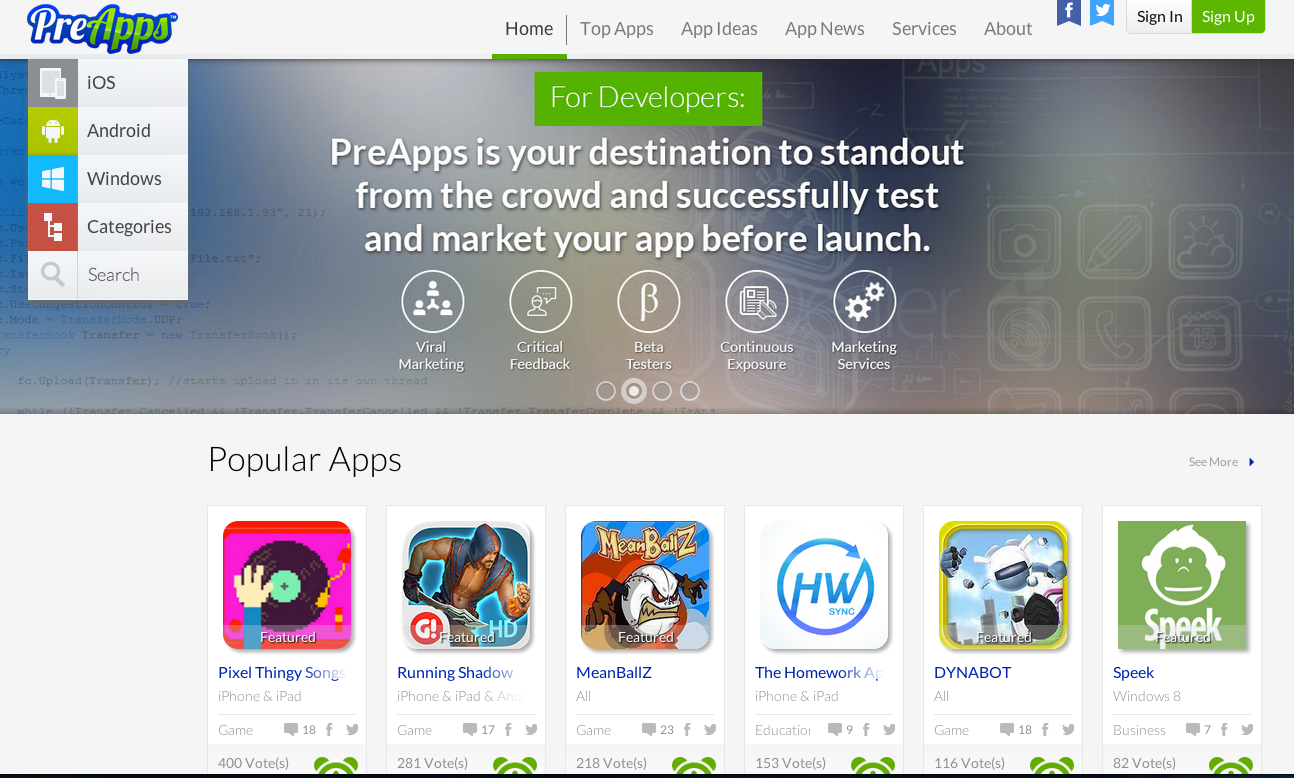
Preapps
One of the easiest things to do is list your app on Preapps.
Preapps has a community of early adopters who are looking for interesting new app ideas before they launch. Users can sign-up to be notified of when the app is released or even become a beta tester.
As a developer, you will get emails of those of who want to beta test your app. This is a great and easy way to start building your email list and get valuable feedback.
When signing up for Preapps, you will need to provide them with:
  • App name
  • App description
  • Price
  • Category
  • Device
  • Expected release date
  • App icon
  • App screenshots
You can always update the app icon and screenshots as you progress, so I’d recommend putting your app on the site as early as possible – ideally 4-6 weeks before launch.

#2: Create a Landing Page

Next you want to create a website for your app where users can learn more about the app, sign-up for your email list, download the press kit, and watch your app video.
Now the website does not have to be elaborate. You can use LaunchRock and have a website in minutes.
I bought a landing page theme from ThemeForest, modified a few images and text and I was off and running.
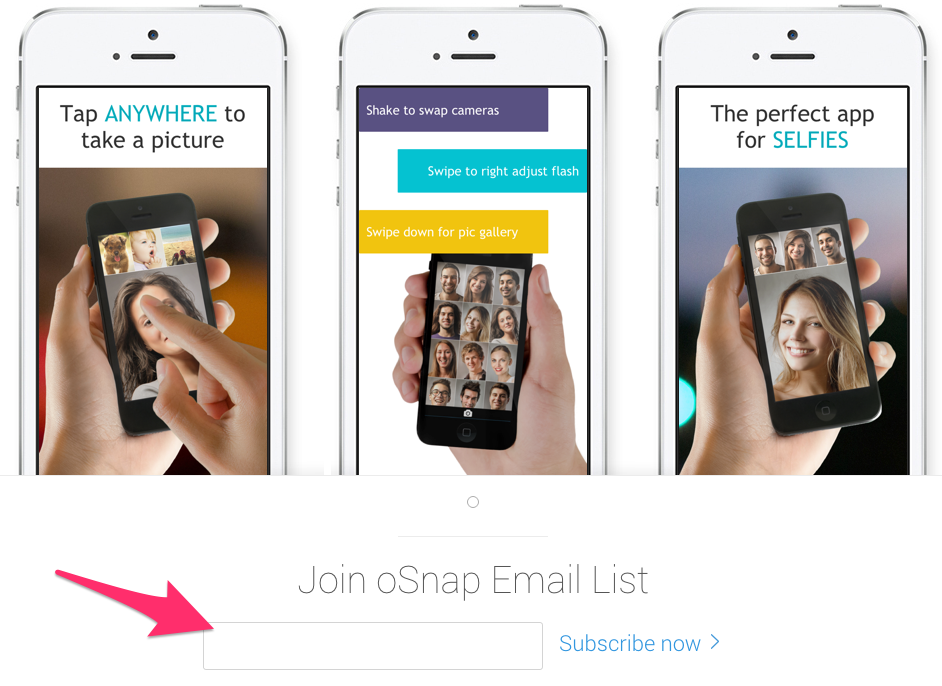
The important thing is that you allow users to easily sign-up for your email list on your website.
Email signup
You want to make it easy for users to sign-up to be notified of the app’s release and email is still the number one way to communicate to your users.
LaunchRock has built-in email capture features, but if you are purchasing a landing page template or theme, then make sure they have an email signup feature.
You can also use services such as Lander or Unbounce that make it easy to create custom landing pages. Both have customizable templates, email capture capibilities, and integration with the popular email marketing providers.

#3: Pick a Fight

As someone who has pitched the press multiple times and been hired to do PR, I find it very difficult to get bloggers to pay attention or write about my apps.
I didn’t want to rely on a third party to get noticed, so I decided to create my own content.
My Medium post entitled “Hey Apple, I Just Fixed Your Camera App” generated over 10K views and the number 2 referr was a site called LayerVault – a Reddit for designers.
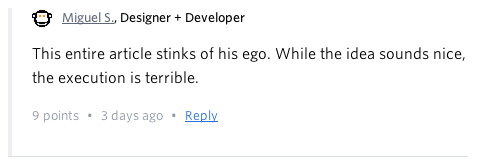
Here are just a few of the comments I received from the site:
Comment2
layervault
Now I received an equal if not greater number of those who loved my app idea, but I wanted to show you the hateful ones to make the point that you have to pick a fight.
It’s important for the reader to pick a side and either agree or disagree with you. The last thing you want to do is have them ignore you.
Write about the problems you see with current apps and attack a big player in your category. I knew that by having “Apple” in the title, that would generate the buzz I needed.
Obviously you will need to have good points, so that readers are not put off by the title and consider you as spam or link bait.

#4: Leverage Another Audience

After you create the “controversial” content, then you want to find the platform that has a built-in audience that is relevant to your app.
Now I could have written the above post on my blog, but I knew that Medium had a much bigger audience than me.
In addition, I could reach those who were passionate about design and user experience on Medium.
Pro tip: When publishing on Medium make sure you submit your story to relevant “Collections”.
I also created the Slideshare below entitled “13 Steve Jobs Quotes About Design”:

Again I knew that Slideshare had a built-in audience of entrepreneurs that I wanted to reach. The above presentation was featured on the Slideshare homepage.
Publish your content on the platform that has an built-in audience and is relevant to your app.

#5: Promote It

Lastly, you want to maximize your reach by promoting your content on the obvious social networks – LinkedIn, LinkedIn Groups, Facebook, Facebook Groups, Twitter, Reddit, Hacker News, etc.
If your content is interesting and makes valid points, you shouldn’t feel ashamed of promoting in fact you should be proud of it.
You’re not trying to sell anything, you want readers to first engage with your content and if they find it valid then they will take the necessary steps to learn more about your app.
Pro tip: Do a Google search for “forums: [target audience]” if you need to find forums to post your content.

Conclusion

Using the steps outlined above you’ll be able to use content marketing to drive awareness for your app.
In addition, you can use the buzz that you created in your press outreach emails. Press loves to write about hot topics, so use this strategy to show that you have something worth writing about.

Apple and Visa to work together? (paymentscardsandmobile.com)

In another bout of analyst fuelled prospecting, Apple and Visa are now deepening their relationship – Pacific Crest analysts issued a report in which they declare that “we think a partnership between Apple and Visa would make strategic sense and believe an announcement could happen as early as this fall.”
The report presumes the next model of the iPhone, an “iPhone 6,” will have contactless
Apple and Visa logos
Apple and Visa to accelerate payments
payments technology in it.
As the analysts see it, past efforts to use mobile devices at point of sale were cumbersome, and Visa has introduced ways to make it easier:
“Security has played a key role in the formation of mobile payment initiatives and in the past has introduced complex business models that have been unable to scale quickly. ISIS used a physical secure element and a carrier SIM rental model. Google has moved toward a host card emulation (HCE) to reduce business-model friction. PayPal has relied on distribution partnerships with terminal providers and networks [...] New security models could lower adoption hurdles for mobile payments at physical retailers and expand the Visa platform, enabling new commerce opportunities for technology giants, merchants and issuers.
The authors offer the following slide of Visa innovations (click for larger image):
Pac Crest Visa e-payment innovations August 2014
For Apple, the Visa “token service” could help it “gain scale more rapidly,” which has been a “key obstacle that has muddled previous mobile payment projects.”
“A combination of cloud-based (HCE) and physical (SE or TEE) seems like a plausible security strategy for Apple.”
The authors offer this graphic of stock implications for Apple:
Pac Crest AAPL payments payoff Aug 2014

Cross-Platform Monetization Strategies for Mobile App Developers (appia.com)

There is no doubt that apps are one of the fastest growing areas of the mobile ecosystem today. Developing cross-platform apps that function well across Android, iOS, tablets, and the web can be challenging for developers. Figuring out how to monetize those apps can be even more difficult. Here are a few strategies for monetizing a cross-platform app.
·      Consider your audience – Just because your app monetizes well on one platform, does not mean it will be just as successful on another. Users behave differently across platforms, so be thoughtful about your monetization strategy for each audience. Small adjustments may be necessary to maximize revenue.
·      Be creative – Similar to their variations in behavior, users on different platforms will respond to different ad formats. Developers can get creative with ad placements that are cohesive with the app’s UI. Testing across platforms is also critical. Optimized, engaging ad units will result in higher click through rates and conversion rates, ultimately leading to higher eCPMs.
·      Reengagement – Bringing users back into your app can add incremental value that may have been left on the table. Notifications or cross-platform ads can serve as reminders for users to return to the app.
Single platform applications can be successful, but building for multiple platforms will help maximize your monetization potential. Building a holistic cross-platform monetization strategy with nuances for specific audiences will ensure developers are generating the most revenue possible.